
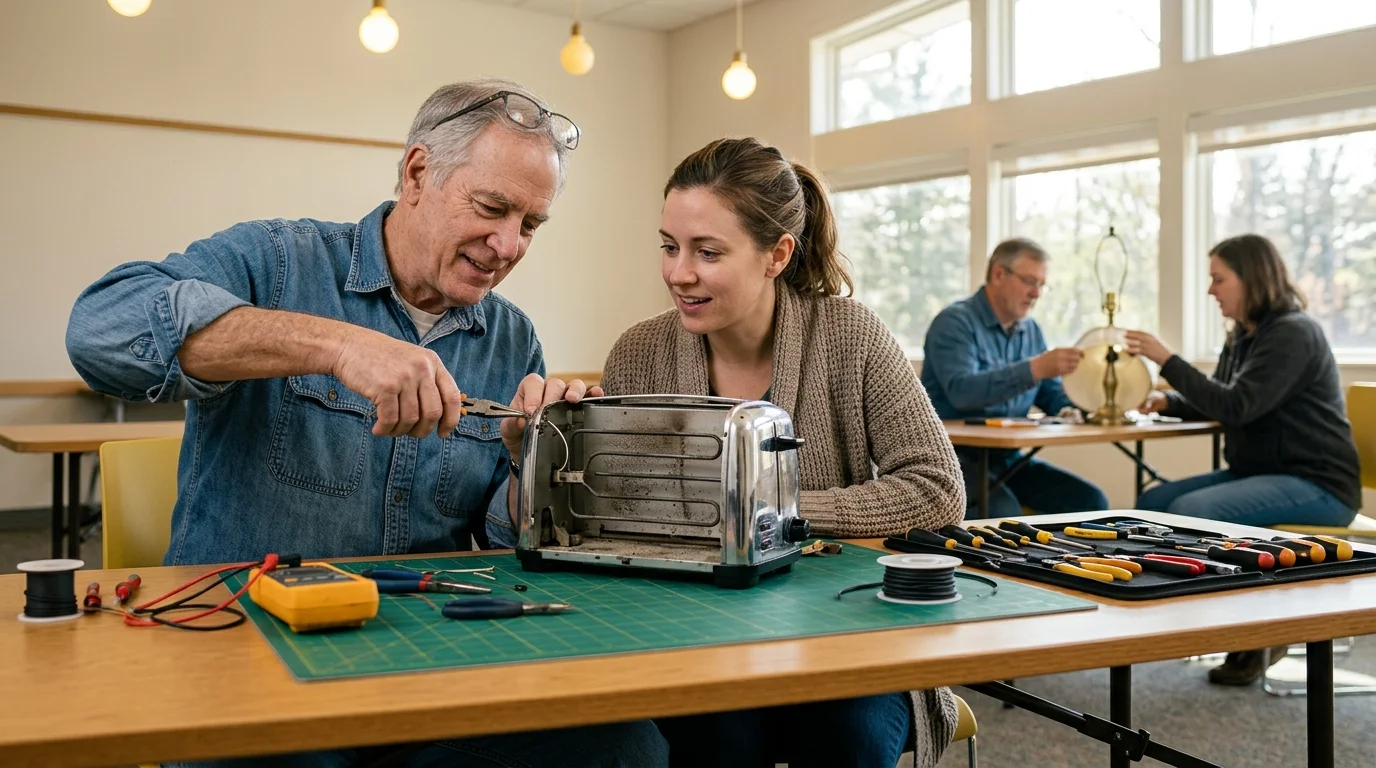
Your hard-earned mechanical troubleshooting skills remain razor-sharp long after your final corporate retirement shift. Channeling that diagnostic intuition into a neighborhood clinic keeps dozens of broken household goods out of overflowing local municipal landfills.
Transitioning your mechanical background into neighborhood troubleshooting is a wonderful way of reinventing yourself after a corporate career.
Launching a neighborhood clinic is just one of many inspiring projects for all skill levels that can bring fresh purpose to your post-career routine.
Many former technicians hesitate to launch because commercial storefront leases, confusing suburban zoning classifications, and perceived legal liabilities feel like impossible operational hurdles.
By leveraging the federal Volunteer Protection Act alongside municipal accessory civic assembly exemptions, you can safely launch a compliant community repair café using an organized $500 workbench toolkit.
Navigating Suburban Garage Zoning and Assembly Codes
Launching a neighborhood repair clinic starts with understanding municipal land-use laws. Most suburban neighborhoods carry strict R-1 or R-2 single-family residential zoning designations.
If navigating non-profit zoning feels complex, some retirees choose private advisory models instead by starting a consulting business in retirement to leverage their expertise.
Much like running a garage-based small engine repair shop, any home workshop initiative must carefully balance municipal ordinances with neighborly goodwill.
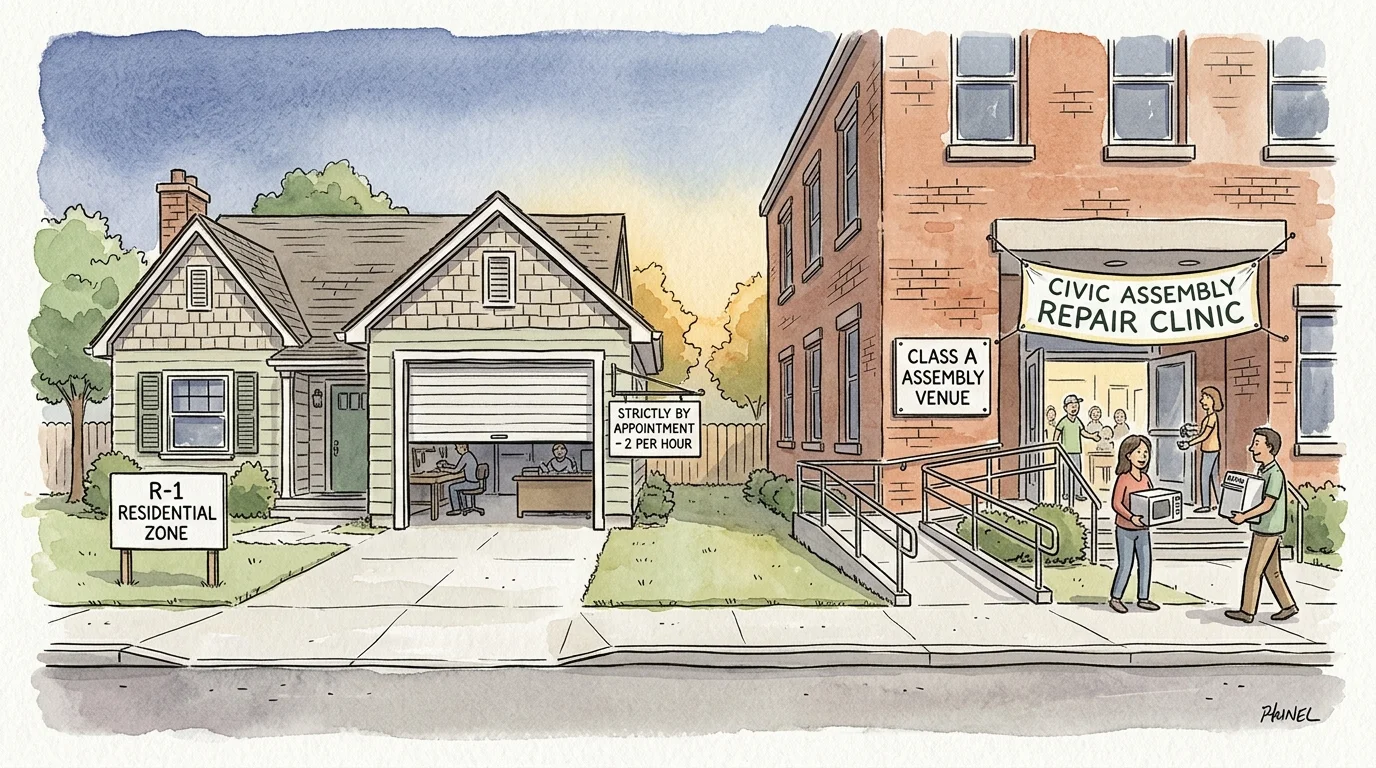
These residential municipal codes strictly prohibit walk-in retail foot traffic, curbside customer parking congestion, and commercial business signage. Running an unpermitted clinic out of an open residential garage risks swift code enforcement citations.
Mark resolved this regulatory barrier by bypassing residential storefront operations entirely. Instead of inviting uncontrolled crowds to his driveway, he structured his clinic as a mobile pop-up model.
He partnered directly with existing municipal facilities, including public library branches, community senior centers, and church fellowship halls. These non-commercial properties already maintain valid Class A public assembly permits, accessible ADA ramps, and designated parking lots.
Municipal zoning boards categorize these periodic community clinics as accessory civic assembly events rather than commercial service enterprises. This legal distinction eliminates the requirement for commercial retail occupancy licenses.
If you prefer hosting diagnostic sessions on your own residential property, you must maintain strict operational limits. You can run small-scale clinics safely by adhering to specific neighborhood guidelines:
- Operate strictly by advance appointment, booking only two neighbors per hour to prevent street congestion.
- Keep roll-up garage bay doors closed during operation to control bench noise and power tool decibels.
- Ban all commercial money transactions on the residential property, accepting only voluntary hardware donations online.
- Restrict outdoor storage completely by keeping all broken appliances and diagnostic totes inside your shop footprint.
Commercial Waivers and the Volunteer Protection Act
Technicians often worry about potential civil liability if an appliance malfunctions after leaving the workbench. Understanding legal safeguards allows you to supervise community repairs with total peace of mind.
Many volunteers first build their diagnostic confidence by mastering home repair and DIY skills for retirement before taking on community-level projects.
Retirees leading other grassroots civic efforts, such as establishing a free community foot clinic, rely on these same statutory protections to serve neighbors safely.
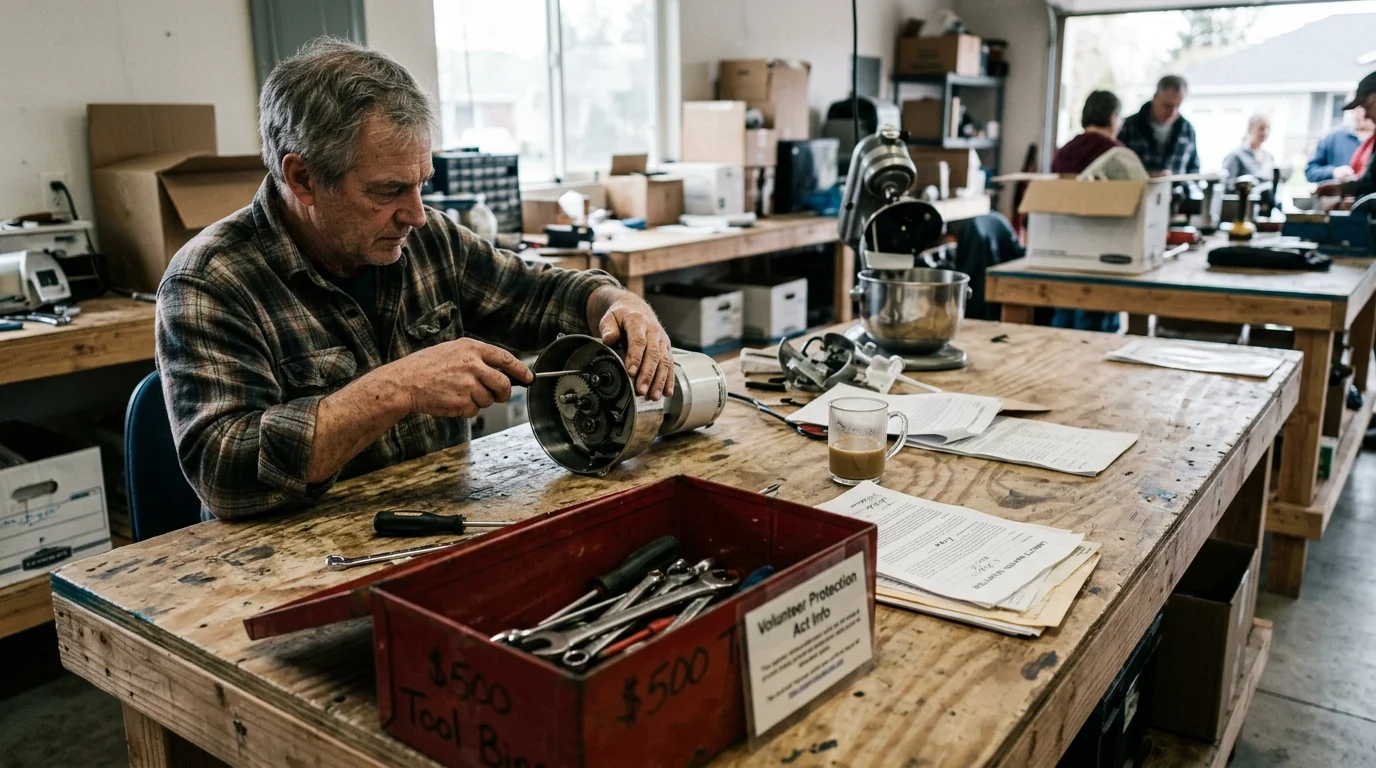
Under the federal Volunteer Protection Act of 1997 (42 U.S.C. § 14501), uncompensated volunteers working with civic non-profits receive broad immunity from civil negligence claims. This federal statute shields your personal retirement savings if an appliance encounters unexpected mechanical failure.
Statutory protection requires clear operating protocols. Your clinic must never charge labor fees, and every participant must actively acknowledge the educational nature of the event.
Mark adopted the proven operating rules established by the international repair movement, which began in Amsterdam in 2009. These house rules require visitors to register at the door and sign a binding liability waiver.
A legally sound intake waiver protects your volunteer team by establishing four core conditions:
- The repair work is performed strictly on an unpaid, best-effort volunteer basis without implied performance guarantees.
- The appliance owner must remain standing at the diagnostic bench, directly observing and assisting with the disassembly work.
- The owner explicitly releases all volunteer fixers and host venues from liability for accidental damage or subsequent losses.
- No Underwriters Laboratories (UL) safety warranties apply to the refurbished consumer hardware.
Recent legislative developments offer even greater legal support for independent mechanics. Modern state “Right to Repair” statutes, such as California SB 244 and Minnesota’s Digital Fair Repair Act, took effect on July 1, 2024.
These laws require manufacturers to provide public access to technical schematics, diagnostics, and authentic replacement parts. You can legally access official factory service documentation to guide safe appliance troubleshooting.
The $500 Diagnostic and Repair Tool Bin Blueprint
Starting a repair cafe does not require industrial machine tools or capital-intensive diagnostic racks. You can resolve the vast majority of small consumer appliance failures with a disciplined, portable $500 hardware kit.
Crafting a disciplined, compact tool collection is similarly critical for retirees restoring antique books at home where delicate preservation requires specialized equipment.
This curated collection of testing equipment mirrors the compact setups utilized by a certified manufactured home inspector when assessing electrical and mechanical integrity in the field.
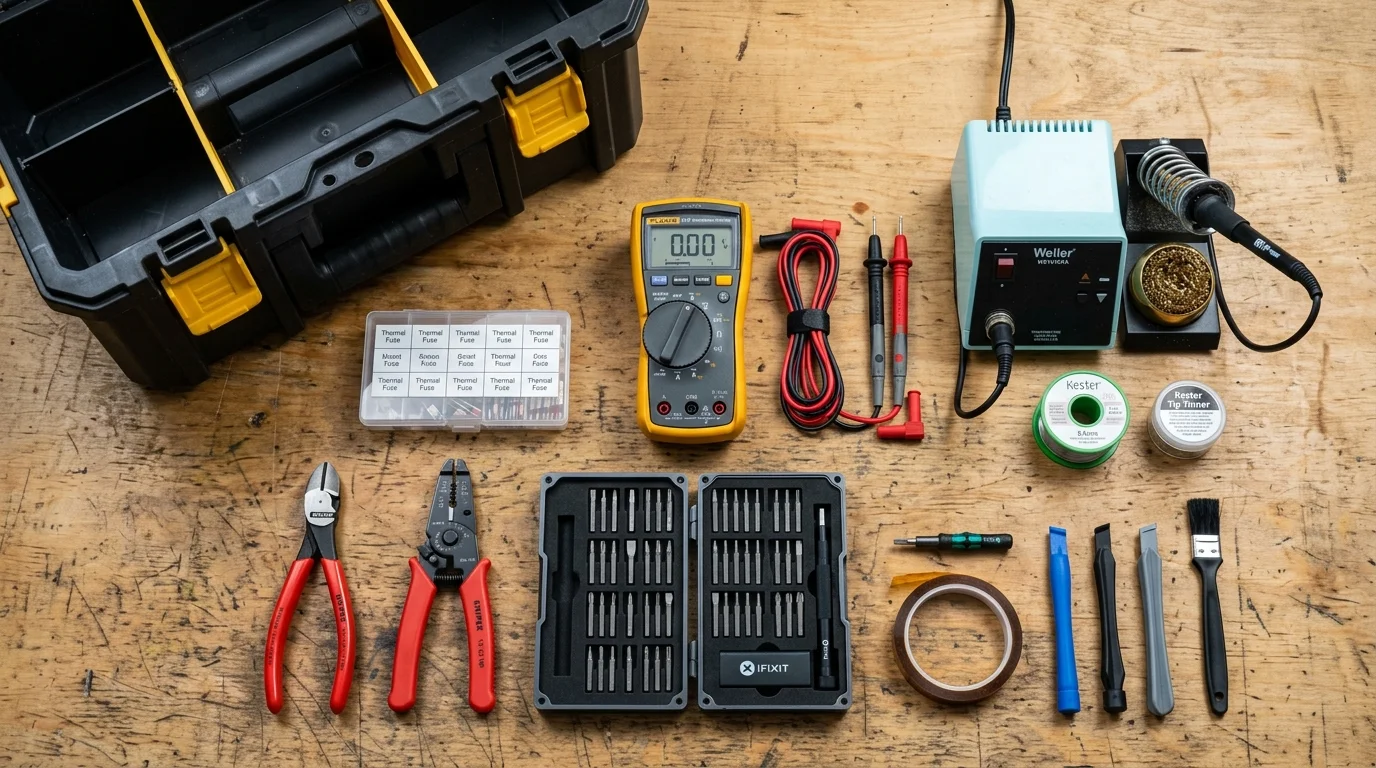
Mark packaged his entire diagnostic clinic into a single heavy-duty 20-gallon Husky storage tote. This modular setup allows fast trunk transport to libraries, community centers, and neighborhood workshops.
The foundation of consumer electronics repair is precision fastener extraction. Manufacturers frequently employ security screws to prevent consumer access to internal appliance chassis.
Mark allocated $74.99 for the iFixit Pro Tech Toolkit, which contains 64 specialized steel driver bits, spudgers, and electrostatic-discharge tweezers. This kit easily opens security Torx, pentalobe, tri-point, and spanner fasteners found on modern small appliances.
Accurate electrical testing requires a dependable digital multimeter. Mark selected the auto-ranging Klein Tools MM400 multimeter ($49.97), rated CAT III 600V for household line voltage safety.
This diagnostic instrument measures circuit continuity, operational switch resistance, and heating coil integrity without risking technician safety. It identifies open thermal cutoffs in seconds.
Soldering capabilities require clean heat and thermal recovery. Mark chose an adjustable 70-watt Weller WE1010NA digital soldering station ($119.00), paired with lead-free rosin-core solder and copper desoldering braid.
The remaining tool budget purchases essential mechanical hand tools and consumable shop supplies:
- Knipex 6-inch Cobra water-pump pliers ($34.00) for stubborn fittings and rounded hardware extraction.
- Klein Tools 11055 dual-wire strippers and wire cutters ($21.99) for rebuilding strained AC line cords.
- Genesis GHG1500A dual-temperature heat gun ($24.99) for setting industrial wire insulation shrink tubing.
- Dual-wall adhesive polyolefin heat shrink assortment pack ($12.50) for long-term electrical moisture insulation.
- CRC QD electronic cleaner ($8.98) and a 3-ounce tube of Super Lube synthetic grease ($9.25).
- Assorted high-temperature nylon spade crimp terminals and zip ties ($18.00).
- Husky 20-gallon professional organizer storage bin ($29.98) to keep tools organized and secure.
This intentional tool payload totals exactly $395.65, leaving over $100 for replacement thermal fuses and spare hardware trays.
Mobilizing Retired Technicians for Your Community Bench
You do not have to staff the diagnostic repair tables alone. Global survey data reveals that over 50% of active repair clinic volunteers are aged 60 and older.
For retirees who enjoy local civic connection but prefer conflict resolution over hardware maintenance, becoming a certified community mediator offers another rewarding way to serve.
These collaborative worktables serve as outstanding alternative social hubs for retirees who prefer problem-solving alongside peers over conventional clubhouse activities.
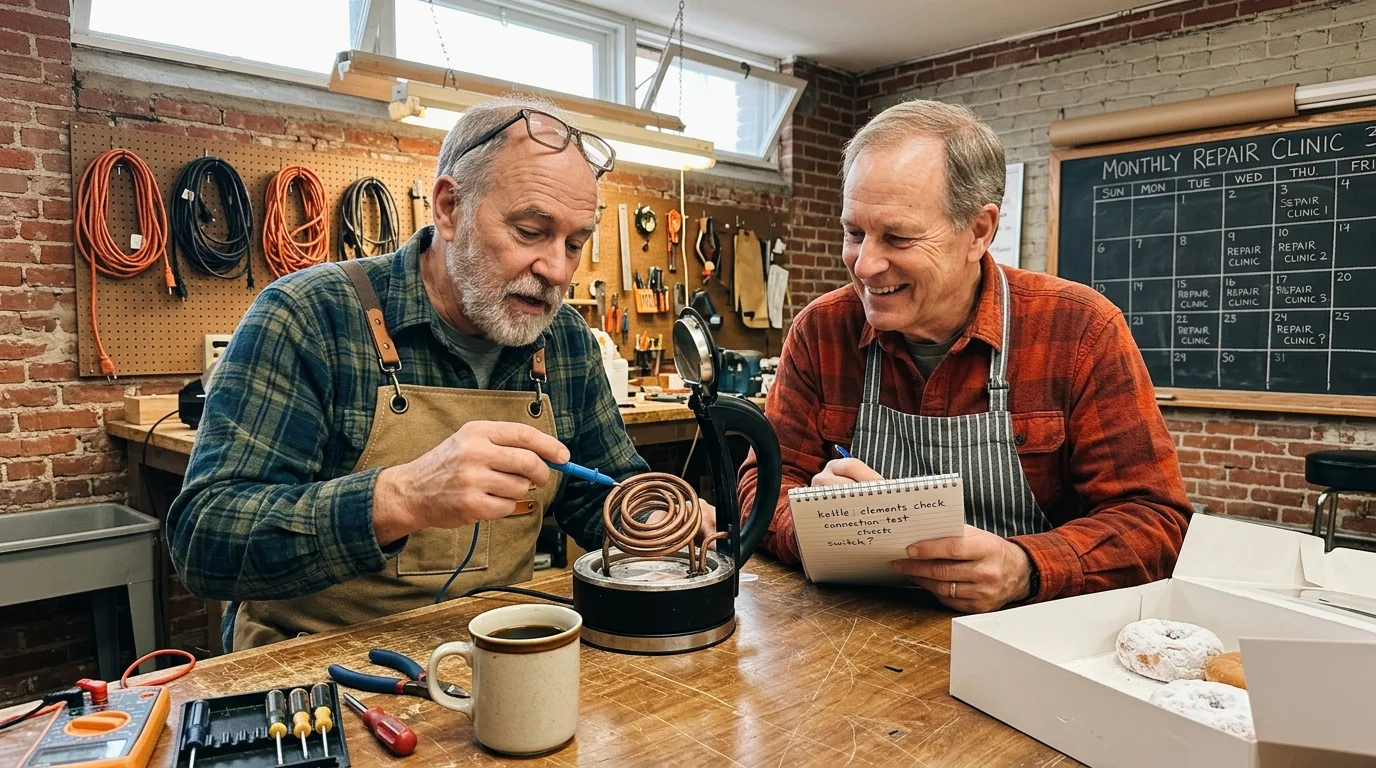
Retirement offers a profound opportunity to reconnect with skilled tradespeople who share your passion for hands-on problem-solving. A senior community repair shop thrives when you bring together diverse mechanical backgrounds.
Seek out retired commercial HVAC mechanics, automotive technicians, industrial electricians, and hobbyist woodworkers across your immediate community. Each specialist brings distinct troubleshooting instincts to the workbench.
You can locate talented local tradespeople through established civic platforms. Using resources like VolunteerMatch helps you post specific technical openings for your upcoming community clinic events.
Organizations like Encore.org champion purposeful second acts that transform lifelong occupational skills into vital community assets. Your technical background offers immense civic value to your hometown.
Organize your volunteer bench into three focused roles to ensure calm operations during busy weekend sessions:
- Intake Coordinators: Welcome neighbors, explain operating rules, and ensure every attendee signs the liability waiver.
- Lead Diagnostic Technicians: Supervise mechanical teardowns, conduct multimeter resistance testing, and guide owners through component repairs.
- Safety Bench Marshals: Verify bench cleanliness, inspect extension cords, and test all repaired items on safety isolation circuits.
The Intake Workflow: Triage, Repair, and Hand-Off
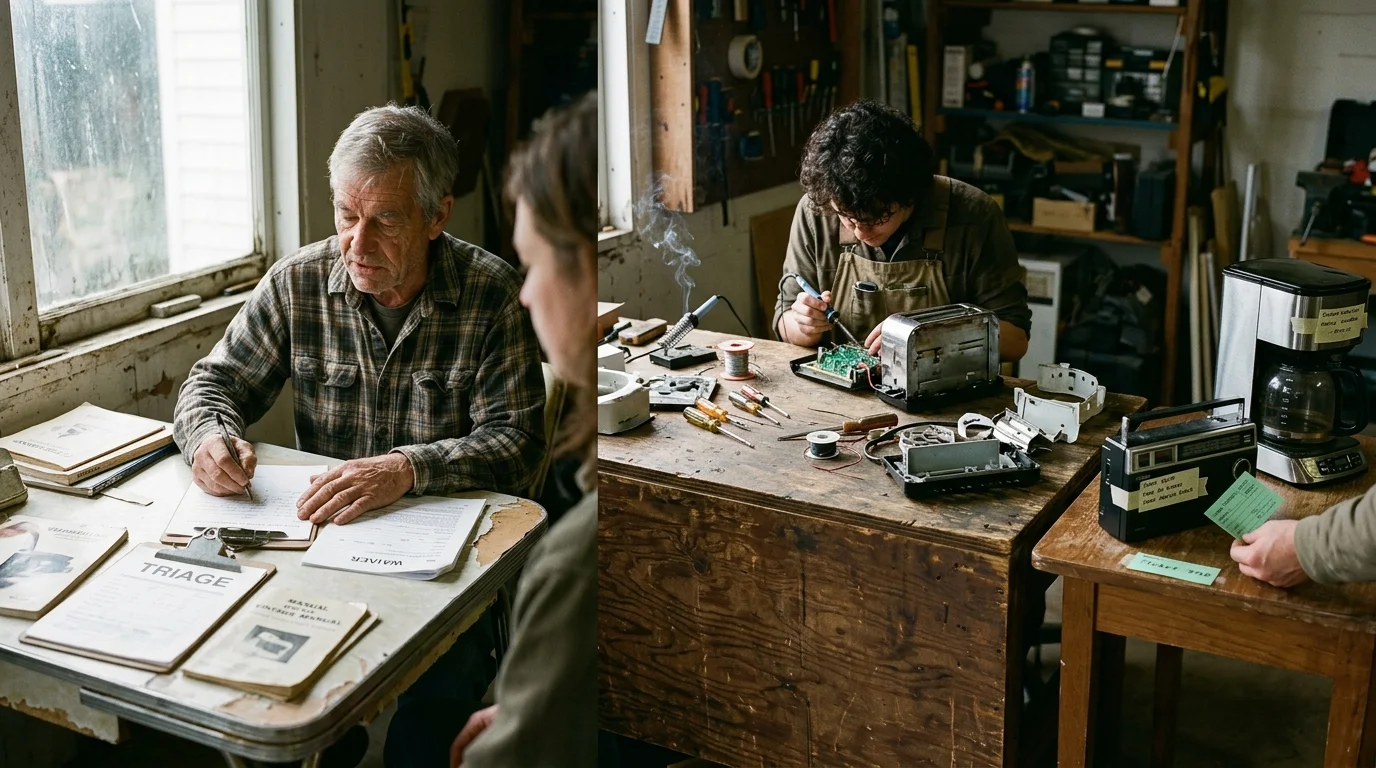
A structured workflow prevents workbench crowding and maintains electrical safety. Standardizing the diagnostic sequence keeps both volunteers and appliance owners productive and engaged.
Volunteers who develop an appreciation for compact, quiet craftsmanship often gravitate toward apartment Japanese hand-tool joinery to continue building fine woodwork in limited living spaces.
Walking neighbors through these diagnostic steps empowers them with practical knowledge, reinforcing the value of mastering home repair for routine household upkeep.
Mark established a disciplined five-step triage method for every appliance entering the clinic:
- Intake Logging: The owner signs the legal waiver and completes a card describing the exact symptom failure.
- Visual Cord Inspection: Technicians inspect the external power cord for copper exposure, cracked insulation, or damaged grounding pins.
- Cold Resistance Verification: The mechanic measures internal device resistance with a multimeter while the unit remains completely unplugged.
- Collaborative Fastener Removal: The owner removes external housing screws using proper bit drivers under technician guidance.
- GFCI Isolation Testing: The repaired device receives functional live power testing solely through an isolated, push-button GFCI receptacle strip.
The collaborative phase is the heart of the clinic model. You are not running an uncompensated drop-off repair mill.
You are teaching your neighbors how everyday consumer hardware functions. When a neighbor holds the screwdriver and sees a blown fuse directly, their relationship with technology changes forever.
Always enforce strict safety rules on live power testing. Never energize an appliance chassis while internal wiring remains exposed on the open bench.
Worked Scenario: Diagnosing 400 Small Appliances
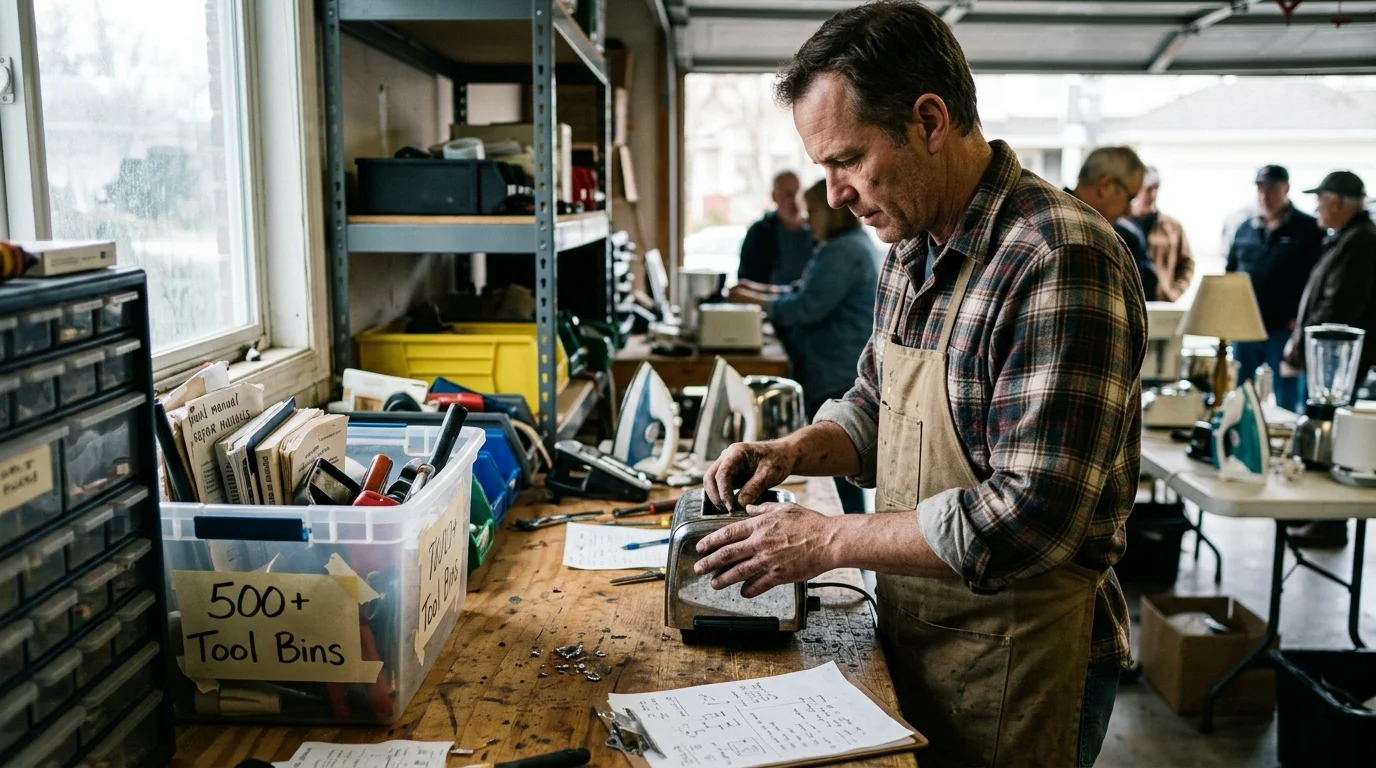
To understand the practical impact of a suburban clinic, examine Mark’s logged shop records over an 18-month operating schedule. His team hosted one four-hour repair event every month across local community venues.
Across these 18 sessions, Mark’s team logged exactly 400 small appliance intake tickets. Their diagnostic records illustrate the real-world economics of neighborhood repair work.
The volunteer bench achieved a 62% complete repair rate across all 400 items. This metric matches the international success rate recorded across thousands of global repair clinics.
A closer look at the 400 intake tickets reveals four dominant appliance categories:
- 120 Drip Coffee Makers: Technicians successfully repaired 78 units by clearing calcified internal valves and replacing open 216°C thermal cutoff fuses ($1.85 each).
- 95 Two-Slice and Four-Slice Toasters: Technicians restored 64 units by clearing breadcrumb accumulation from optical leaf sensors and adjusting mechanical carriage release springs.
- 85 Vacuum Cleaners: Volunteers returned 58 units to service by removing hair tangles from roller bearings and installing fresh 3M-201-9.5 drive belts ($4.50 each).
- 100 Desktop Fans, Lamps, and Mixers: The team repaired 48 units by cleaning gummed bronze sleeve bearings, replacing rocker switches, and resoldering broken power cord leads.
The operational metrics demonstrate remarkable community efficiency across the 18-month window:
- Total Items Fully Repaired: 248 units returned to active daily household use.
- Average Diagnostic and Repair Time: 38 minutes invested per appliance intake ticket.
- Average Out-of-Pocket Part Cost: $2.40 spent per successful repair, funded by the appliance owner.
- Landfill Diversion: 1,041 total pounds of electromechanical plastic and copper waste diverted from local county dumps.
Embracing a volunteer workbench retirement turns basic electrical theory into tangible, measurable environmental conservation.
Comparing Community Repair Workbench Setups
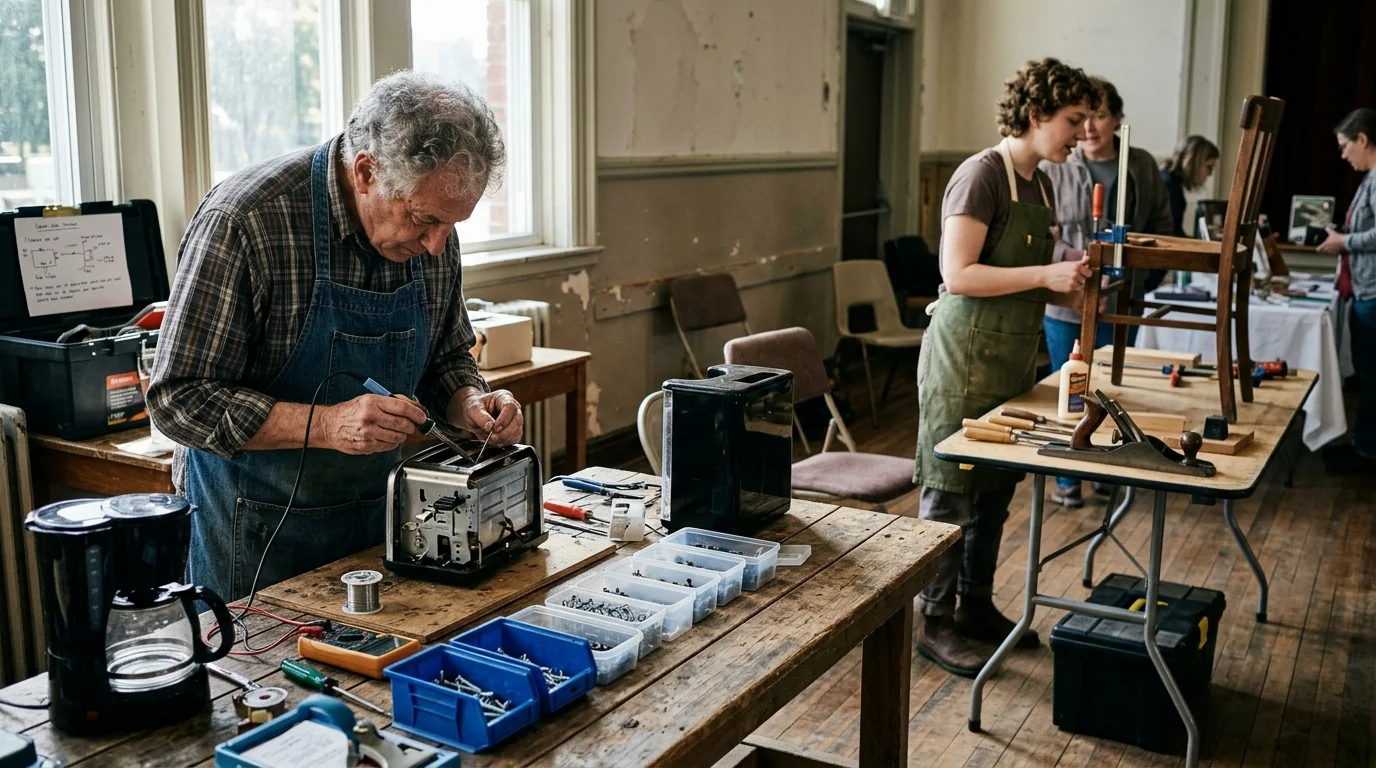
Selecting your clinic equipment depends on your venue access, transportation footprint, and technical goals. Use this comparison table to match your investment with your target diagnostic capability.
| Workbench Configuration | Total Hardware Budget | Core Diagnostic Tooling | Power & Safety Gear | Footprint & Transport |
|---|---|---|---|---|
| Lean Pop-Up Kit | $250 | iFixit 64-bit driver kit, compact manual multimeter, hand pliers, wire stripper | Single inline GFCI adapter cord, basic safety glasses | 15-inch standard tool tote bag; fits easily in any vehicle |
| Suburban Community Station | $500 | Klein MM400 auto multimeter, Weller WE1010NA station, Knipex pliers, heat gun | Heavy-duty 15A GFCI power strip, anti-static bench work mat | 20-gallon Husky rolling tote; portable trunk footprint |
| Civic Repair Lab | $1,200 | Dual soldering bench, Siglent digital oscilloscope, bench variable DC supply, security bits | Independent isolation transformer, thermal imaging camera, dual GFCI stations | Two rolling steel field carts; requires station wagon or truck |
Starting with the $500 suburban configuration gives your team the ideal balance of precision, diagnostic versatility, and easy trunk transport. You can expand hardware gradually as your team of mechanics grows.
Frequently Asked Questions
Does the Volunteer Protection Act cover accidental damage to the appliance?
The federal Volunteer Protection Act shields unpaid volunteers from personal civil liability for simple negligence during civic tasks. Requiring owners to sign an explicit intake waiver reinforces that repairs are attempted entirely at the owner’s risk.
Can we legally charge visitors for replacement parts at a community clinic?
You should never sell parts directly or charge fees, as doing so can trigger commercial retail sales tax obligations and void volunteer liability protections. Direct owners to purchase their own specific replacement parts online or bring them to the next clinic.
What should technicians do when an appliance cannot be repaired safely?
If an appliance displays cracked internal insulation, burnt motor windings, or internal short circuits, refuse the repair on safety grounds. Explain the specific hazard to the owner and direct them to an authorized local municipal electronic recycling depot.
How do we safely handle lithium-ion battery repairs in a repair clinic?
Avoid servicing swollen, punctured, or unbranded lithium-ion battery packs during community clinics due to thermal runaway fire hazards. Restrict your battery workbench strictly to standard alkaline holders, external power supplies, or direct OEM battery swaps.
Disclaimer: This article is for informational and inspirational purposes. Life decisions are deeply personal, and we encourage readers to pursue their dreams while considering their unique circumstances, health, and financial situation.





2 Comments