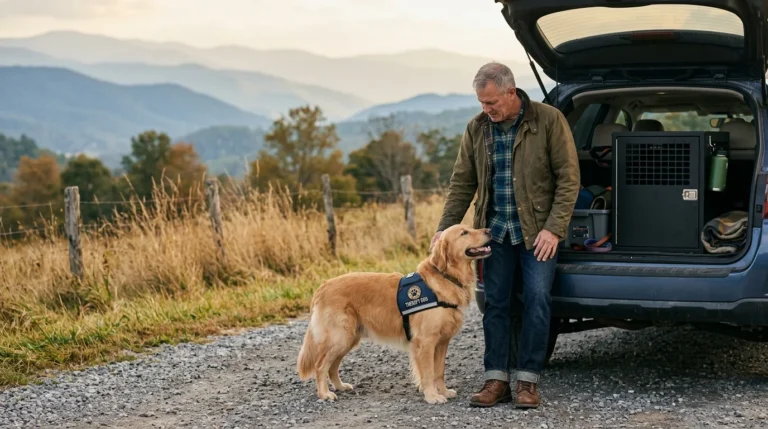
You can transform your administrative career into a life-saving sanctuary for senior canines on rural acreage. Your organizational precision provides the exact operational foundation required to rescue vulnerable older dogs facing shelter euthanasia.
For professionals focused on reinventing yourself in retirement, establishing a specialized animal hospice channels decades of executive discipline into purposeful animal welfare.
While most rescue guides emphasize emotional goodwill, a sustainable hospice sanctuary survives solely on corporate discipline, institutional pharmacy partnerships, and strict regulatory compliance. Mastering these structural systems turns your retirement acreage into a permanent haven.
By deploying proven filing strategies and clinical workflows, you will protect both your personal retirement assets and the geriatric animals in your care.
Establishing the 501(c)(3) Entity and Governance
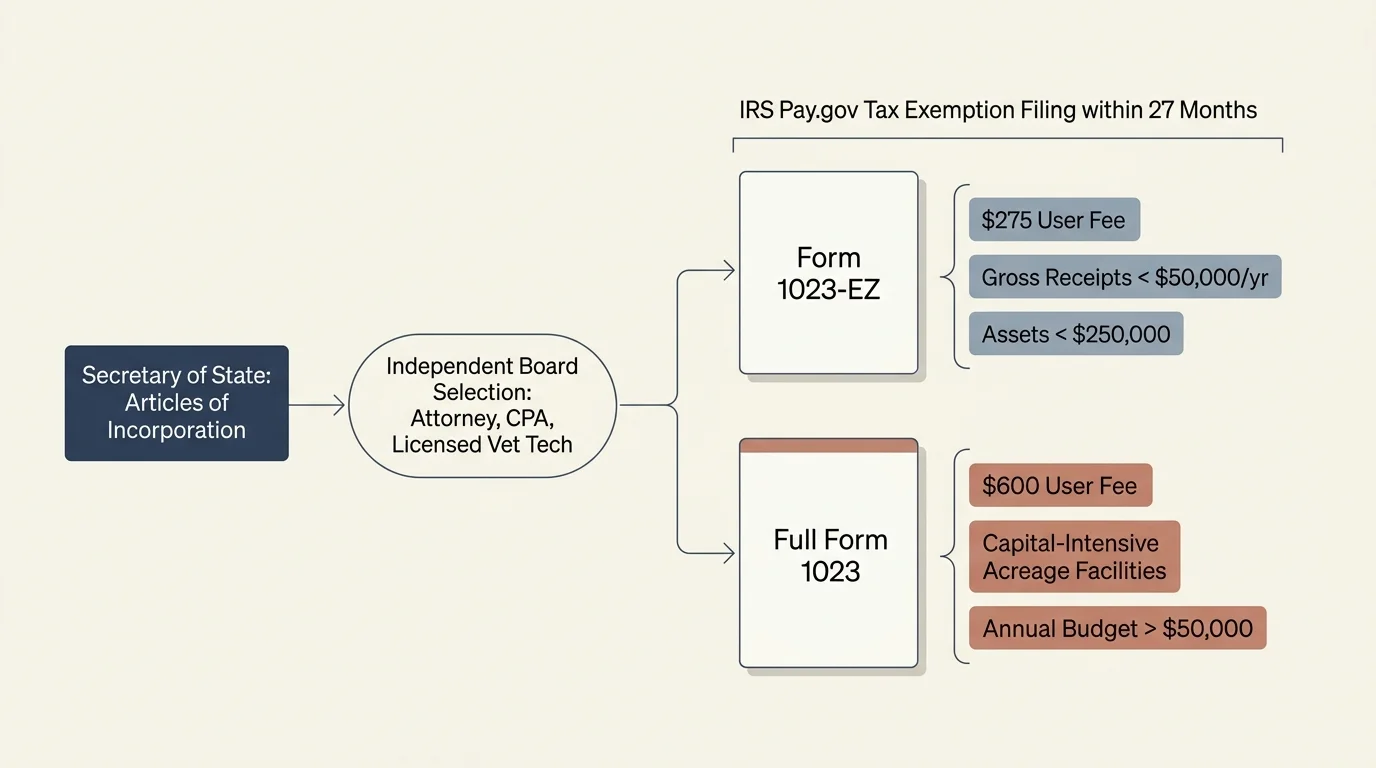
Transforming rural acreage into a licensed sanctuary begins with forming a domestic non-profit corporation. You must submit formal articles of incorporation to your Secretary of State before seeking federal tax-exempt status.
Properly structuring your entity also allows you to implement smart tax strategies for second careers to protect your household financial plan.
Much like retirees who launch a free community clinic, creating an animal sanctuary demands strict corporate boundaries to shield personal retirement assets from premises liability.
Establishing a compliant non-profit animal sanctuary in retirement shields your personal nest egg from premises liability. Your organizational administrative skills will guide the precise drafting of corporate articles and corporate bylaws.
“The best way to find yourself is to lose yourself in the service of others.” — Mahatma Gandhi
Your non-profit board of directors requires independent members whose professional expertise offsets your operational liabilities. You should recruit an attorney familiar with agricultural zoning, an experienced accountant, and a licensed veterinary technician.
Free mentoring resources like SCORE Mentoring can review your organizational bylaws to ensure strict conflict-of-interest compliance. Independent voting directors cannot receive personal salaries, which protects your ongoing non-profit standing.
Federal tax exemption requires an electronic submission through the IRS Pay.gov system. The IRS charges a $275 user fee for Form 1023-EZ or $600 for the full Form 1023.
You qualify for the streamlined Form 1023-EZ only if projected gross receipts remain below $50,000 annually for three years and assets stay under $250,000. Capital-intensive acreage sanctuaries often exceed these financial boundaries due to essential facility construction.
Submit your application within 27 months from the end of the month of your corporate formation. Filing within this statutory window grants tax exemption retroactively to your sanctuary’s founding date.
Navigating State Solicitation and Regulatory Compliance
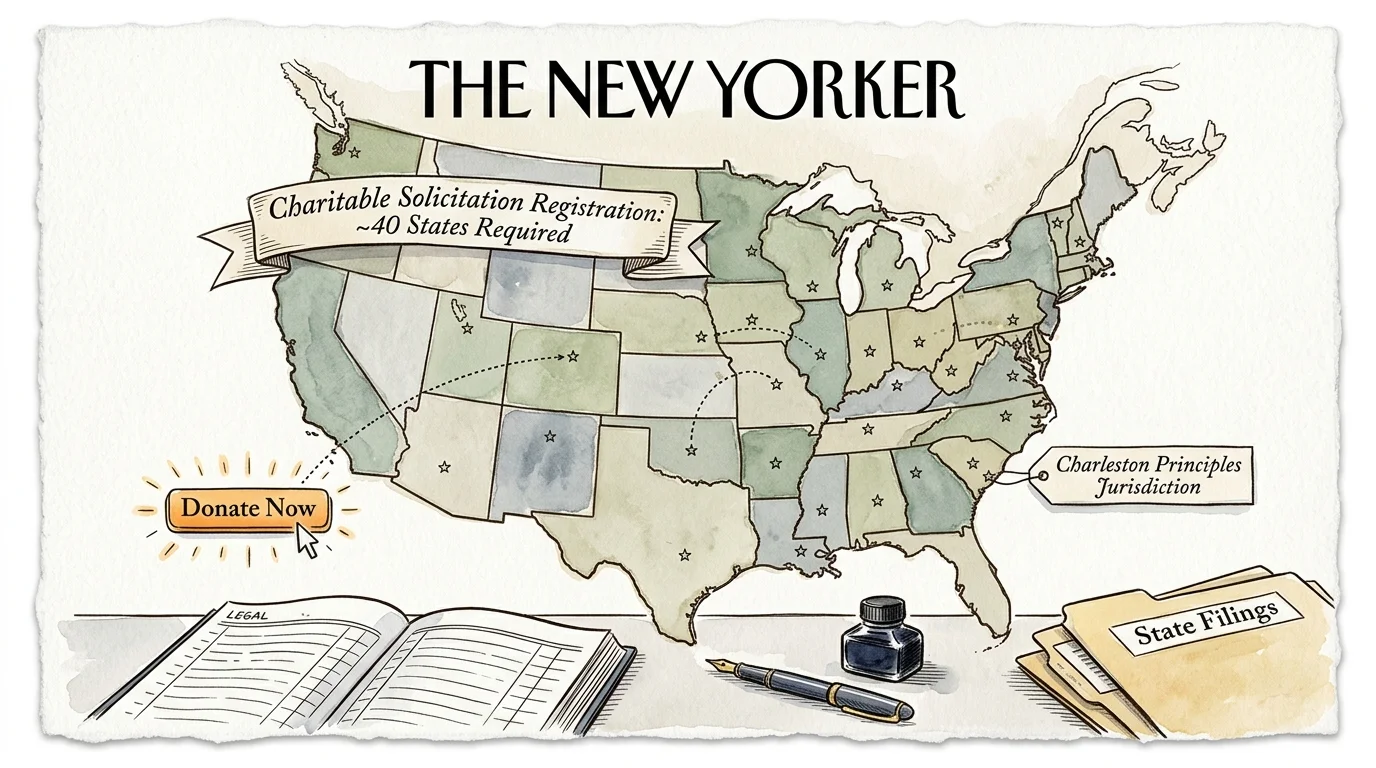
Obtaining 501(c)(3) determination does not grant universal fundraising clearance. Roughly 40 states require animal charities to complete independent charitable solicitation registration before accepting public donations.
Just like entrepreneurs managing city permits and liability insurance for public ventures, animal rescues must stay ahead of local administrative requirements.
Treating your nonprofit with the same discipline as someone building a successful small business ensures long-term operational resilience.
Similar to community initiatives requiring local zoning permits and liability waivers, securing municipal clearance early protects your organization from unexpected closures.
Accepting contributions through online donation buttons subjects your organization to out-of-state regulatory scrutiny under the national Charleston Principles. You must maintain systematic records showing the geographic origin of every financial gift.
Executing a proper hospice dog rescue setup requires clearing multiple overlapping municipal and state compliance hurdles. Follow this procedural sequence to ensure full legal authorization:
- Register domestic non-profit articles of incorporation with your state corporate filing office.
- Secure an Employer Identification Number from the IRS for corporate banking identification.
- File IRS Form 1023 or 1023-EZ via Pay.gov to obtain your federal 501(c)(3) tax status.
- Submit charitable solicitation licensing packages with your state attorney general or consumer protection division.
- Obtain municipal kennel permits and confirm agricultural zoning variances for housing multiple rescue dogs.
Never mix personal retirement funds with your sanctuary operating accounts. Open distinct corporate checking accounts, commercial merchant gateways, and dedicated utility services in the rescue’s legal name.
This strict corporate separation creates an unbreakable liability barrier between your private retirement assets and sanctuary premises. Clean bookkeeping remains your best defense against personal administrative liability.
Structuring Veterinary School Partnerships and Bulk Formularies
Municipal shelter data indicates senior dogs face an adoption rate of approximately 25%, compared to 60% for younger puppies. Older dogs remain unadopted primarily because incoming medical exams expose expensive, unmanaged chronic conditions.
Mastering clinical supplier relationships often involves upskilling for your second act to navigate wholesale medical distribution and compounding terminology.
Annual medical maintenance for an older canine ranges from $1,500 to $3,000 or more. Semi-annual geriatric blood panels cost $100 to $250 each, while restorative dental surgeries range between $300 and $1,500.
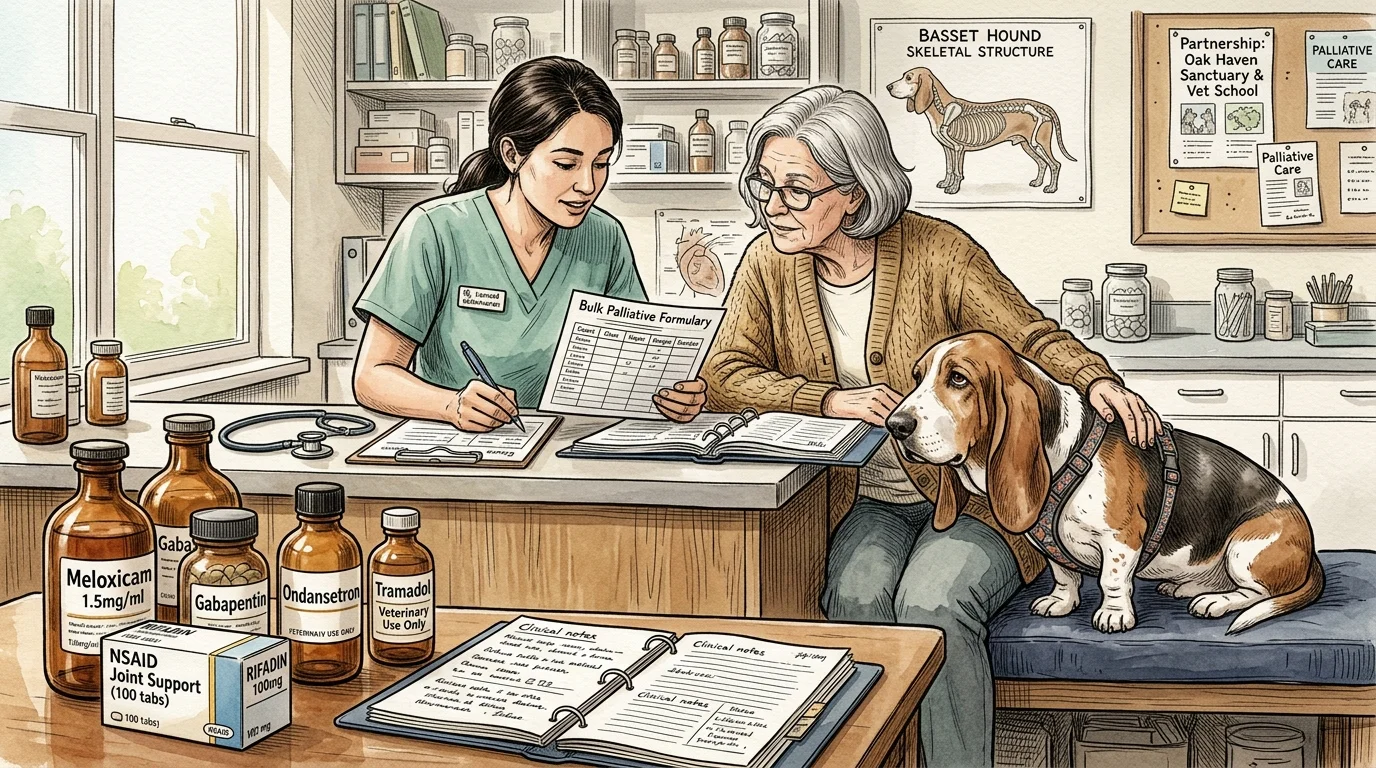
Managing multiple hospice dogs at retail veterinary rates will rapidly exhaust your sanctuary’s financial reserves. You must negotiate institutional partnerships with regional veterinary colleges or licensed compounding facilities to access wholesale drug pricing.
Veterinary teaching hospitals frequently operate shelter medicine departments willing to extend clinical discounts. You can present your 501(c)(3) determination letter to negotiate institutional purchasing arrangements for chronic palliative medications.
Second-act founders highlighted by organizations like Encore.org prove that executive administrative negotiation skills directly create sustainable community impact. Your professional communication skills make institutional pharmacy negotiations possible.
| Procurement Channel | Average Savings vs Retail | Licensing & Account Requirements | Typical Delivery Turnaround |
|---|---|---|---|
| Veterinary Teaching Hospital Clinic | 40%–60% | Active 501(c)(3) status and clinical affiliation agreement | Same-day to 48 hours |
| 503B Compounding Pharmacy | 35%–50% | Supervising veterinarian license and clinical account profile | 3–5 business days |
| Commercial Veterinary Distributor | 20%–35% | Veterinarian-of-record signature and state DEA license | 24–48 hours standard freight |
| Retail Veterinary Practice | 0%–15% | Standard client relationship with per-animal physical exams | Immediate outpatient dispensing |
Prioritize volume purchasing agreements for essential geriatric analgesics including gabapentin, carprofen, and pimobendan. Purchasing generic gabapentin in 1,000-count bottles drops the unit price from fifty cents to approximately seven cents per dose.
Establishing recurring accounts with 503B outsourcing compounding pharmacies allows you to acquire liquid suspensions and chewable flavored formulations in bulk. Customized flavoring ensures fragile canines consume critical pain medications without mealtime stress.
Designing Acreage Infrastructure for Mobility-Challenged Canines
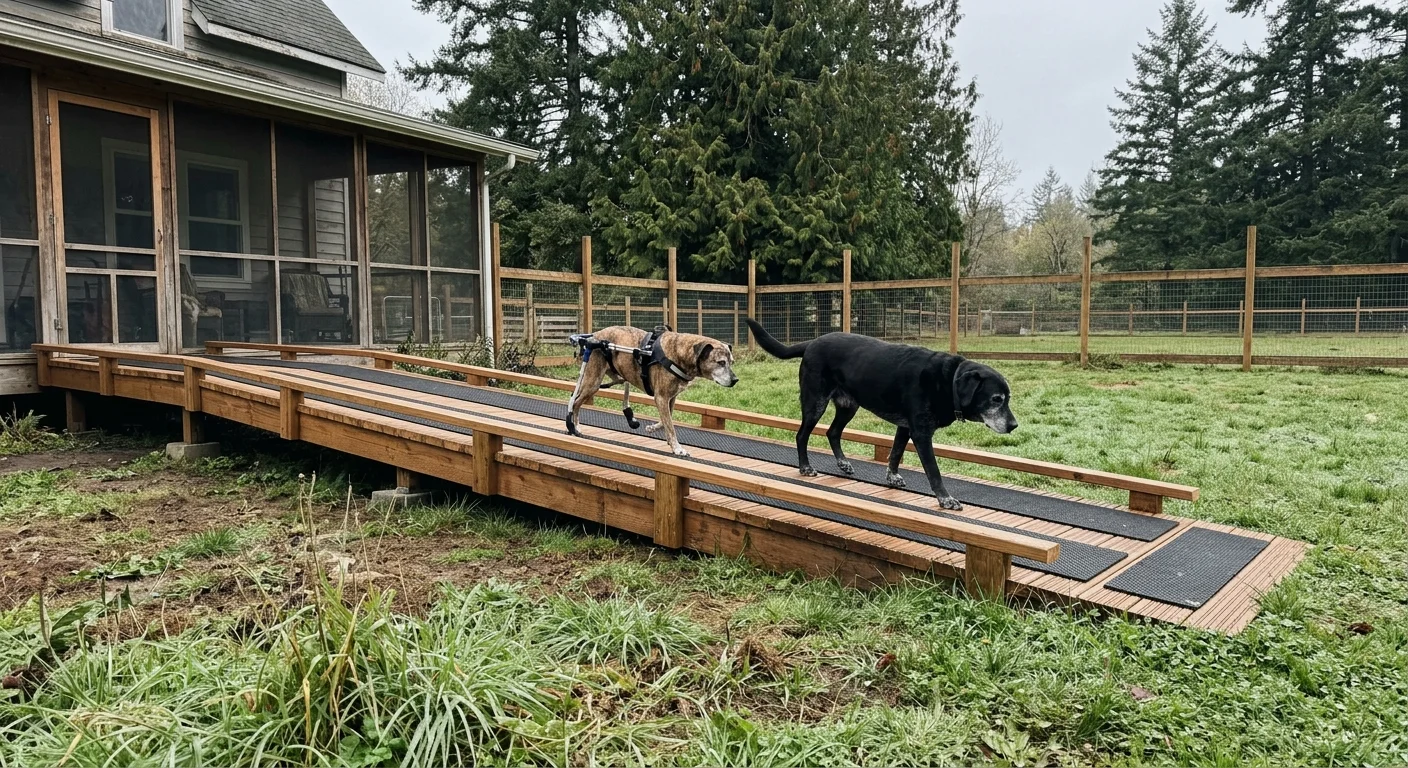
Converting rural acreage into a functional senior dog sanctuary requires structural upgrades tailored for mobility-impaired animals. Geriatric dogs suffering from osteoarthritis, lumbosacral stenosis, or degenerative myelopathy cannot navigate standard steps or slick surfaces.
Replace all exterior stairs with gradual ramps constructed at a strict 1:12 slope ratio. Every single inch of vertical threshold rise requires one horizontal foot of ramp run.
Outfitting your acreage buildings demands specific architectural materials engineered to protect compromised joints and maintain sanitary conditions:
- 3/4-inch vulcanized rubber livestock stall mats sealed with commercial polyurethane to prevent fluid penetration.
- Commercial 7-inch orthopedic memory foam dog beds with medical-grade antimicrobial waterproof inner liners.
- Raised feeding platforms elevated between 8 and 16 inches to reduce strain on arthritic cervical spines.
- Dual-zone mini-split heat pumps maintaining ambient temperatures between 68 and 72 degrees Fahrenheit year-round.
- Low-frequency, diffuse red lighting across nocturnal walkways to comfort animals experiencing canine cognitive decline.
Grade exterior exercise areas with fine-crushed pea gravel or clean sand rather than heavy clay soil. High-traction, soft footing reduces slip injuries and simplifies daily waste sanitation across multiple turnout paddocks.
Install perimeter chain-link fencing standing at least five feet high, reinforced by a 16-gauge buried wire apron extending 12 inches outward. This construction stops vulnerable blind or disoriented dogs from escaping the acreage perimeter.
Establishing Daily Clinical and Palliative Routines
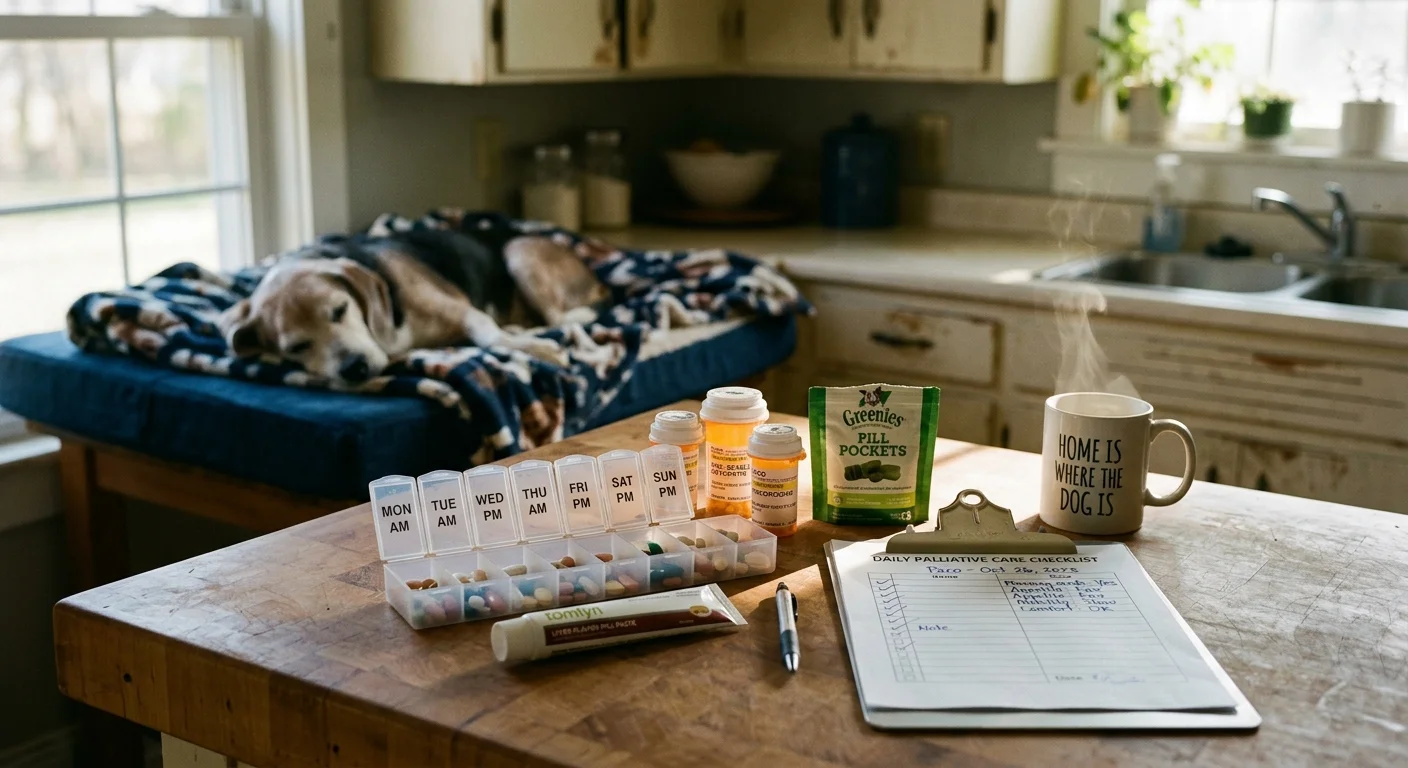
Administrative rigor dictates clinical success when running a palliative sanctuary. You must implement standardized Medication Administration Record (MAR) binders identical to systems used in professional medical environments.
Many animal welfare leaders discovered this path through hands-on shelter work, proving that volunteering as a career stepping stone builds crucial domain expertise.
Each canine requires an individual medical binder detailing surgical histories, validated dosing schedules, baseline bloodwork, and palliative care directives. Structured documentation eliminates lethal dosing mistakes when volunteer caregivers assist with feedings.
Organize daily operations using a consistent four-phase clinical care routine:
- 06:30 – Morning clinical evaluations, pain assessments, administration of morning anti-inflammatories, and supported bathroom elimination using lifting harnesses.
- 12:00 – Passive range-of-motion physical therapy, hydration monitoring, pressure-sore evaluations, and mid-day outdoor mobility exercise.
- 17:30 – Evening nutrition delivery, second-round analgesic dosing, therapeutic grooming, and sanitizing orthopedic bedding covers.
- 21:00 – Final outdoor rotation, calming sensory protocols for cognitive dysfunction, and secure bedtime positioning.
Assist mobility-compromised canines using full-body support harnesses rather than traditional neck collars. Dual-support chest and pelvic slings allow handlers to lift large recumbent dogs safely without placing pressure on arthritic spines.
Assess animal discomfort weekly using the validated HHHHHMM Quality of Life scale. Evaluating hurt, hunger, hydration, hygiene, happiness, mobility, and good days ensures compassionate, objective decisions regarding humane euthanasia.
Financial Engineering: A Worked Hospice Operating Budget
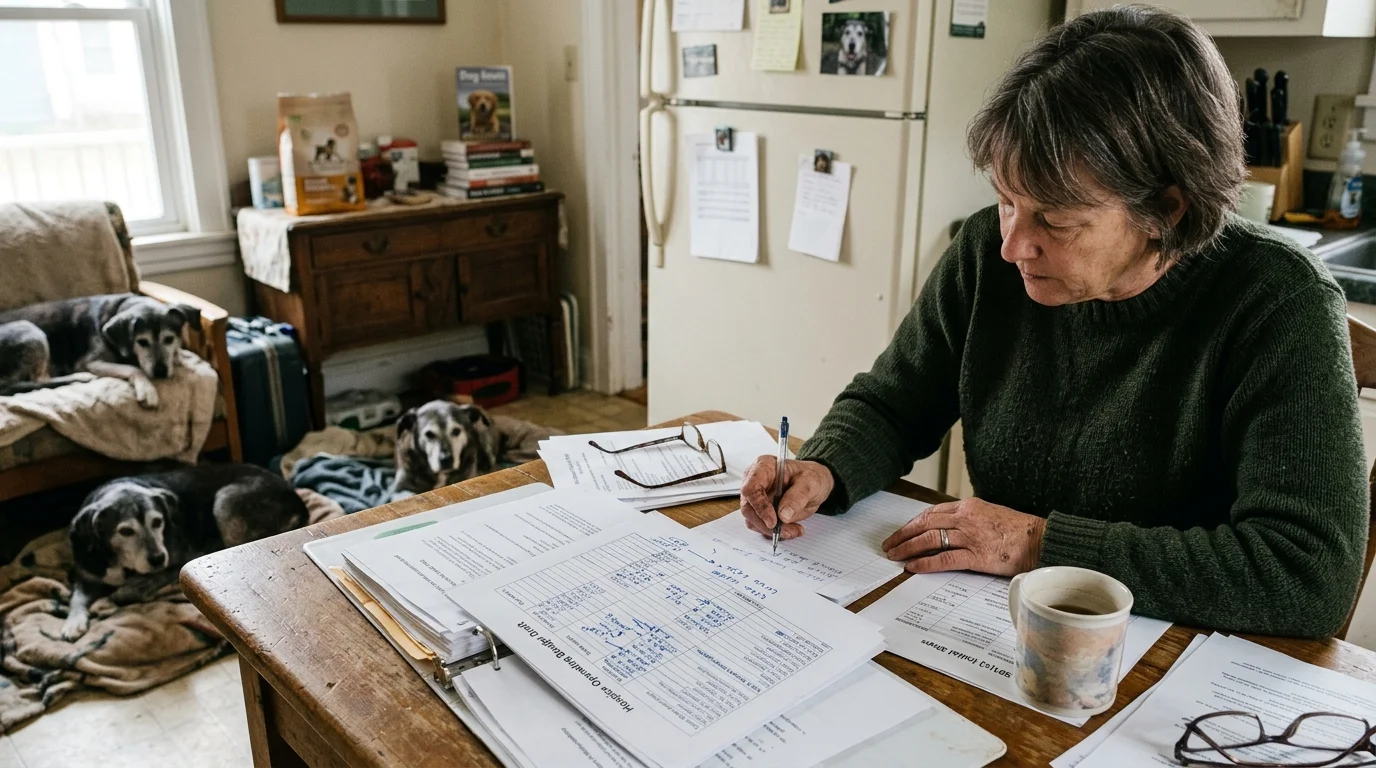
Compassion initiates a rescue, but financial discipline keeps the gates open. You must run your sanctuary using a clear operational budget structured around annual per-animal maintenance costs.
The following worked financial model illustrates the real-world annual operating budget for an eight-dog senior hospice rescue on rural acreage.
This baseline scenario assumes the property carries no external commercial lease and uses negotiated wholesale pharmaceutical accounts:
- Geriatric diagnostic bloodwork and intake assessments: $1,600 annually ($200 per dog for semi-annual panels).
- Bulk maintenance medications (gabapentin, carprofen, compounded pimobendan): $4,560 annually ($380 per month total).
- Veterinary prescription joint-support nutrition (240 pounds monthly): $6,840 annually ($570 per month).
- Sanitation chemicals, laundering supplies, and orthopedic replacement mattresses: $1,450 annually.
- Commercial non-profit liability insurance and annual state kennel licensing: $1,800 annually.
- Dedicated emergency hospitalization and humane palliative reserve: $5,000 in liquid savings.
This financial model totals $21,250 in annual operating expenses for eight senior dogs. That equates to an average operational expenditure of $2,656.25 per canine per year.
Fund this baseline budget by enrolling 15 recurring monthly kennel sponsors contributing $120 each month. Automated monthly contributions generate $21,600 annually, completely funding routine medical care and specialized clinical nutrition.
Frequently Asked Questions
How does a hospice dog sanctuary differ from a conventional rescue?
A standard dog rescue rehabilitates animals for adoption into permanent families. A hospice sanctuary provides lifelong medical palliative care and comfort for geriatric canines until natural death or humane euthanasia.
Can you operate an animal sanctuary on residential acreage without commercial rezoning?
You must verify your local county zoning ordinances and kennel licensing caps before bringing dogs onto your land. Many jurisdictions require agricultural permits or commercial kennel exemptions if you care for more than four dogs.
How much money should a senior dog rescue maintain in emergency reserves?
Maintain at least six months of routine operating costs in a liquid savings account. For an eight-dog hospice sanctuary spending $21,250 annually, maintain at least $10,625 in emergency funds.
What happens if a sanctuary founder becomes unable to run daily operations?
Non-profit corporate bylaws must identify a formal leadership succession protocol. Your governing board of directors assumes operational responsibility and appoints an interim sanctuary director to maintain uninterrupted animal care.
Disclaimer: This article is for informational and inspirational purposes. Life decisions are deeply personal, and we encourage readers to pursue their dreams while considering their unique circumstances, health, and financial situation.