

You stepped away from corporate leadership expecting immediate tranquility, yet the silence of an empty Outlook calendar feels disorienting. The sudden drop in operational tempo often triggers anxiety instead of peace.
The conventional advice telling you to treat retirement like an endless vacation fails experienced executives. Unstructured time quickly erodes the mental agency and dopamine baselines you cultivated over thirty years.
Regaining your edge requires a calibrated daily architecture. By anchoring your day around three dedicated 90-minute blocks—Cognitive, Physical, and Social—you replicate executive engagement while protecting your newfound freedom.

The Executive Decompression Shock: Why Total Freedom Backfires
For decades, your nervous system adapted to high-stakes decisions, constant pings, and demanding deadlines. When that external stimulus vanishes overnight, your neurochemistry faces an abrupt vacuum.
Proactively addressing this transition requires a balanced commitment to holistic mental and physical wellness from day one.
Executives dealing with sudden schedule disorientation can establish early momentum by utilizing a post-executive calendar reset to navigate initial morning paralysis.
Research from the Stanford Center on Longevity demonstrates that purposeful routines support sustained cognitive performance and emotional well-being as we age. Without clear daily targets, your mind invents artificial stressors to replace former operational challenges.
Many retired directors swing between two extreme traps during their transition. They either collapse into aimless media consumption or rapidly overcommit to advisory boards, recreating the exact burnout they intended to escape.
A sustainable lifestyle demands intentional scaffolding rather than passive drift. You need a reliable framework that preserves autonomy while honoring your natural drive to solve meaningful problems.

The Mechanics of Identity Loss After Leaving Executive Leadership
Navigating identity loss after retiring executive responsibilities represents one of the steepest psychological hurdles modern professionals encounter. Your title served as a universal shorthand for competence, authority, and social standing.
Many high achievers find that confronting emotional fears is the first real test of reinvention outside the C-suite.
When you surrender the corporate email address and executive assistant, your daily social reinforcement drops to zero. That sudden absence can make your past accomplishments feel distant or irrelevant.
Consider the daily operational feedback signals that suddenly disappear the morning after your corporate departure:
- Real-time validation through operational deliverables and quarterly performance milestones.
- A built-in network of cross-functional peers seeking your strategic input.
- Clear corporate metrics that define whether a specific afternoon was productive.
- An unambiguous organizational mandate providing daily direction and focus.
Recognizing this loss is not an admission of weakness. It is the necessary starting point for designing an extraordinary next chapter on your own terms.
You do not need to discard your executive toolkit. You simply need to point that strategic intellect toward personal vitality, creative mastery, and community impact.
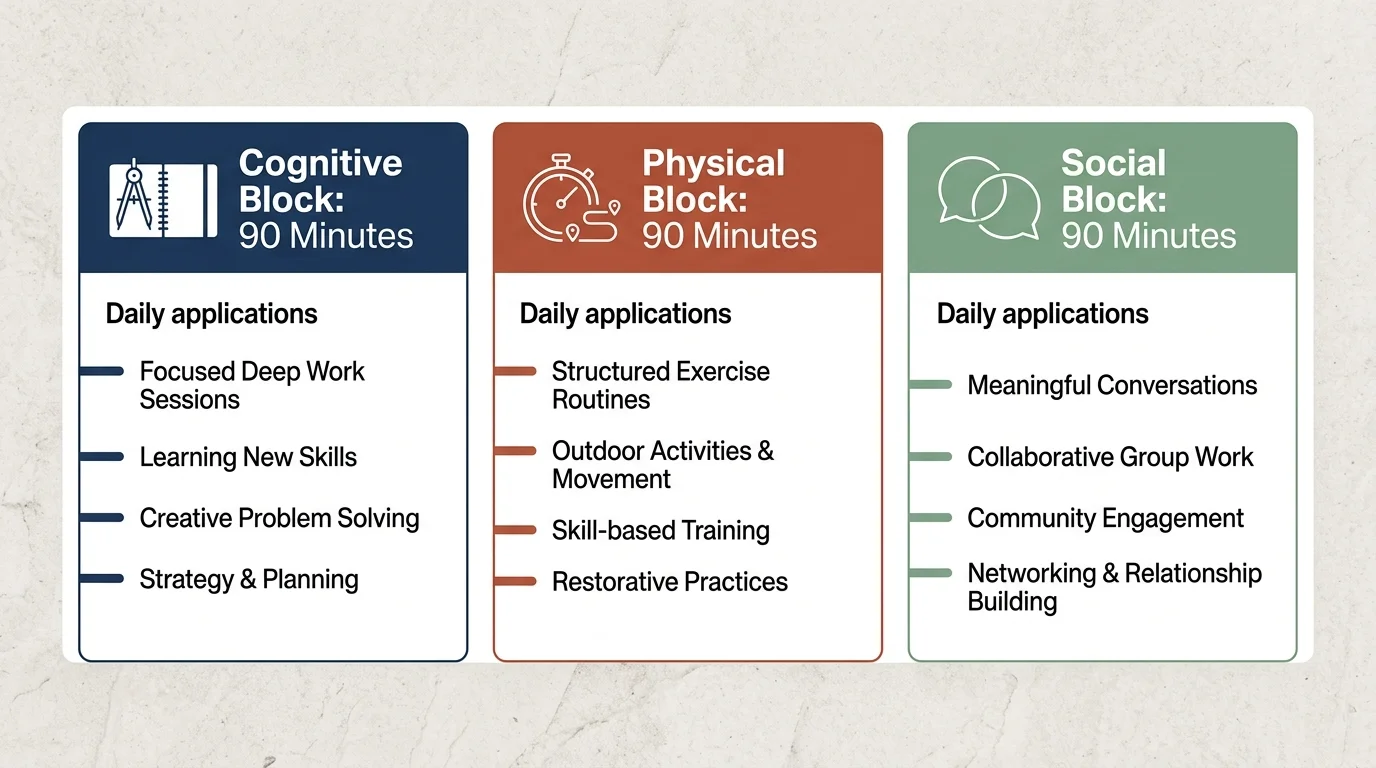
The 3-Block Daily Anchoring Architecture: Cognitive, Physical, Social
To master your first 6 months of retirement routine, replace the rigid 40-hour grind with three focused 90-minute blocks. This structure caps formal daily commitment at exactly 4.5 hours.
Limiting structured time preserves nearly eight waking hours every day for spontaneous leisure, family, and deep rest. It delivers the precise amount of friction your brain needs to stay sharp without triggering corporate fatigue.
The Cognitive Block challenges your intellectual capacity through focused, deep-work disciplines. You can dive into advanced coursework through Osher Lifelong Learning institutes, write long-form memoirs, or study complex market trends.
Use these concrete tactics during your morning Cognitive Block:
- Select one solitary intellectual domain that demands systematic learning.
- Silence your personal mobile phone and isolate your workspace from domestic distractions.
- Document tangible project milestones inside a dedicated physical field notebook.
- Stop exactly at the 90-minute mark to preserve mental hunger for tomorrow.
The Physical Block focuses on sustained metabolic and muscular health. This goes far beyond a casual stroll around the neighborhood; it requires deliberate, measurable physiological training.
Prioritize functional strength sessions, mobility routines, and targeted cardiovascular conditioning. Elevating your heart rate stimulates critical neurotrophic factors that support long-term cognitive agility and mood stability.
The Social Block shields you from the insidious isolation that often creeps into executive retirement. Building deliberate connection preserves your communicative edge and expands your community footprint.
High-performing leaders often find renewed meaning by guiding emerging entrepreneurs through SCORE Mentoring workshops and local venture incubators. Sharing your decades of management expertise provides high-leverage value to founders while feeding your collaborative instincts.

Worked Example: A Corporate Director’s Transition Schedule and Time Budget
To see how this framework functions in practice, review this worked schedule from a retired Vice President of Global Supply Chain. This scenario details an exact Monday-through-Thursday operational cadence.
Marcus retired at age 59 after managing 140 direct and indirect reports across three continents. Within forty-five days, the absence of structure left him irritable, sleepless, and overwhelmed by trivial chores.
He deployed the 3-Block Daily Anchoring system to structure retirement daily schedule commitments, establishing a precise 270-minute daily budget divided into balanced pillars.
- 07:00 to 08:30 — Morning Ramp and Stillness: Black coffee, hydration, 30 minutes of physical reading, and zero screens.
- 08:30 to 10:00 — Block 1: Cognitive Anchor: 90 minutes auditing real estate acquisitions and building an investment model in Excel.
- 10:00 to 10:30 — Decompression Buffer: Light walk outdoors and a nutritious mid-morning meal.
- 10:30 to 12:00 — Block 2: Physical Anchor: 45 minutes of Zone 2 indoor rowing at 130 bpm, followed by 45 minutes of barbell strength work.
- 12:00 to 13:30 — Open Freedom Buffer: Lunch with his spouse, unstructured reading, or personal errands.
- 13:30 to 15:00 — Block 3: Social Anchor: Advising an early-stage manufacturing startup on vendor negotiations and inventory systems.
- 15:00 onward — Complete Operational Disengagement: Gardening, culinary exploration, and unscripted evening connection.
Marcus recorded his adherence across an eight-week test period, tracking quantitative physiological and emotional indicators. The measurable results validated the power of structured containment.
His average deep sleep increased from 42 minutes to 84 minutes per night according to biometric tracking. Subjective feelings of purposelessness dropped from daily occurrences to zero within three weeks.
He maintained complete control over his calendar while producing meaningful external work. Crucially, he never exceeded 4.5 hours of daily commitments, eliminating any risk of corporate fatigue.
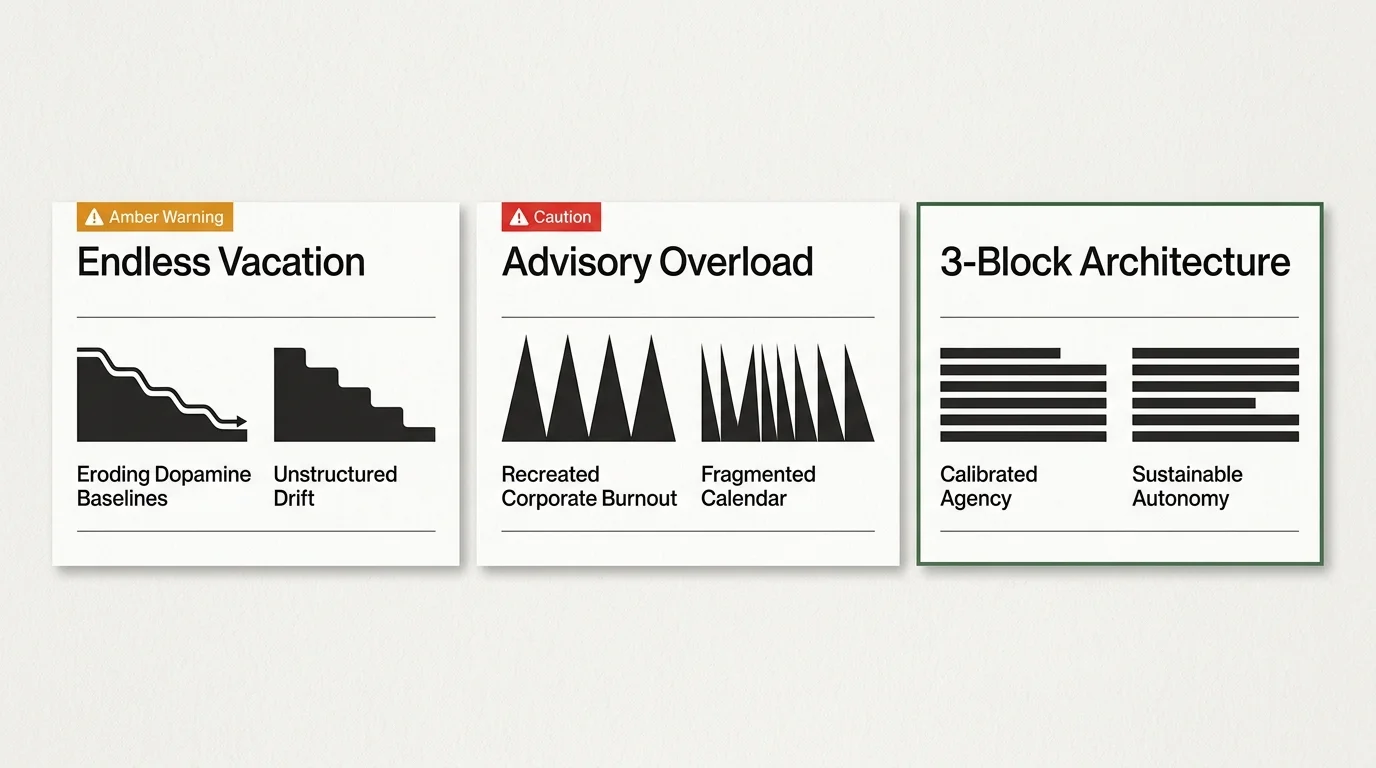
Comparing First-Year Retirement Operating Systems
Choosing the correct framework for your transition requires evaluating real trade-offs across cognitive load and calendar control. The table below analyzes three common operational models used by newly retired corporate professionals.
For executives who miss professional impact, channeling this discipline into purposeful second-career pursuits can offer lasting fulfillment without corporate stress.
| Operating Model | Daily Structured Hours | Autonomy Score (1–10) | Cortisol Crash Risk | Weekly Social Frequency | 6-Month Purpose Rating |
|---|---|---|---|---|---|
| Pure Decompression (Endless Vacation) | 0.0 to 1.0 Hours | 9.5 | Severe (Due to Void) | 1 to 2 Ad-hoc Encounters | 2.8 / 10.0 |
| Hyper-Reactive Advisory (Corporate Relapse) | 6.0 to 9.0 Hours | 2.5 | Critical (Burnout Risk) | 8 to 12 Stressful Meetings | 5.4 / 10.0 |
| The 3-Block Anchoring System | 4.5 Hours Exactly | 8.5 | Minimal (Balanced Cadence) | 4 to 5 Purposeful Sessions | 9.1 / 10.0 |
Notice that unstructured freedom scores high in theoretical autonomy but collapses in purpose and emotional stability. Total freedom quickly degenerates into decision fatigue.
The 3-Block framework provides the golden mean. It safeguards your personal sovereignty while supplying the rhythmic momentum required to thrive.
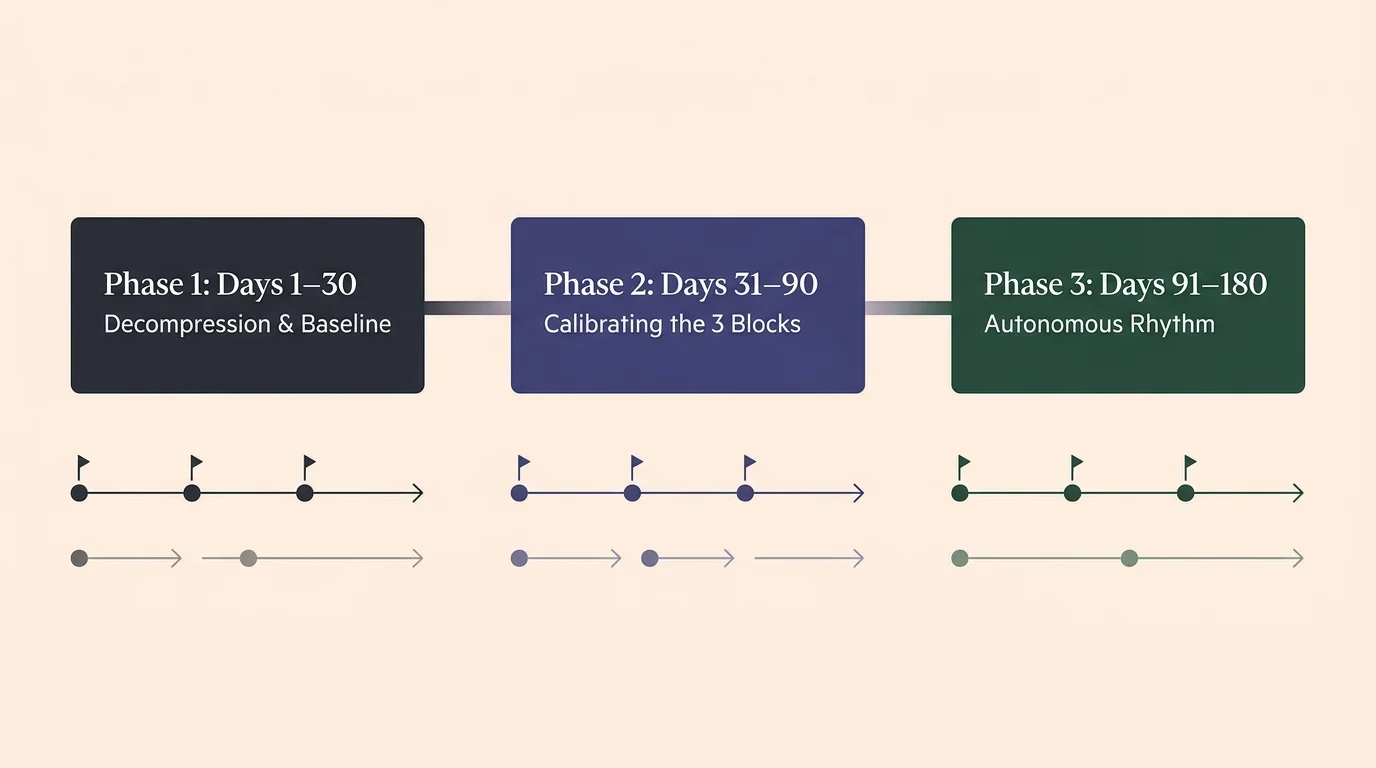
Phase-by-Phase Implementation Across Your First 180 Days
Implementing this operational system requires a sequenced rollout rather than an aggressive overnight overhaul. Divide your first 180 days into three distinct 60-day operational tranches.
Days 1 through 60 constitute your Physiological Reset and Calendar Detox. Your primary objective during this opening window is establishing deep sleep hygiene and baseline physical movement.
Execute these specific steps during your opening 60-day window:
- Remove all legacy enterprise communications software from your personal smartphone.
- Establish a permanent morning wake time that does not deviate by more than 30 minutes.
- Implement the 90-minute Physical Block as your single non-negotiable anchor each day.
- Say no to all board solicitations, commercial consulting proposals, and formal committee seats.
Days 61 through 120 mark your Intellectual Calibration. Now that your nervous system has downshifted, introduce your daily 90-minute Cognitive Block.
Treat this intellectual phase with the respect of a master craftsman. Choose a domain that fascinates you completely independent of compensation, whether that involves classical composition, coding, or economic history.
Days 121 through 180 complete the architecture through Social and Mentorship Integration. You now possess steady physical energy and deep cognitive focus.
Begin extending your influence into the broader community. Offer your battle-tested management instincts to non-profit organizations, educational initiatives, or promising early-stage founders.

Weekly Printable Framework: Auditing Your Energy and Output
As a former manager, you know that unmeasured processes inevitably decay. Maintaining alignment across your first six months requires a disciplined weekly operating review.
Reserve Friday afternoons from 14:00 to 14:30 for your personal operational audit. Grab a physical notebook and evaluate the execution of your three anchors over the preceding five days.
Answer these strategic audit prompts during your weekly review session:
- Did I complete at least four Cognitive Blocks without digital interruptions this week?
- What physical metrics did I improve across my strength, mobility, and cardiovascular sessions?
- Did my Social Blocks energize my perspective or drain my emotional reserves?
- Where did calendar creep threaten my open afternoon freedom buffers?
- What specific intellectual milestone will I target during next week’s morning blocks?
This 30-minute review closes the operational loop on your week. It provides the structured psychological conclusion that Friday status reports used to deliver in your corporate life.
When you close your journal on Friday afternoon, your weekend remains truly sacred. You step into leisure without lingering guilt because your daily baseline was executed with precision.
Frequently Asked Questions
How does the 3-block routine prevent corporate burnout in retirement?
The 3-block routine caps daily structured commitments at 4.5 hours across cognitive, physical, and social domains. This framework prevents overcommitting to volunteer boards or consulting while eliminating the paralysis of completely open calendars.
What should I do if I struggle with identity loss after leaving an executive role?
Redirect your strategic problem-solving abilities into self-directed intellectual projects and high-impact community mentorship. Tracking non-monetary metrics like mentoring hours and skill acquisition restores personal agency and purpose without corporate overhead.
Can I adjust the timing of the daily blocks to fit my natural rhythm?
Yes. Shift the blocks to match your personal chronotype by placing your cognitive block during peak mental acuity and reserving low-energy windows for restorative physical movement or social connection.
How strictly should I follow this daily schedule during the first 6 months?
Treat the framework as an operating baseline rather than a rigid corporate mandate. Aim for 80 percent consistency Monday through Friday, leaving weekends open for spontaneous travel and restorative rest.
Disclaimer: This article is for informational and inspirational purposes. Life decisions are deeply personal, and we encourage readers to pursue their dreams while considering their unique circumstances, health, and financial situation.






4 Comments