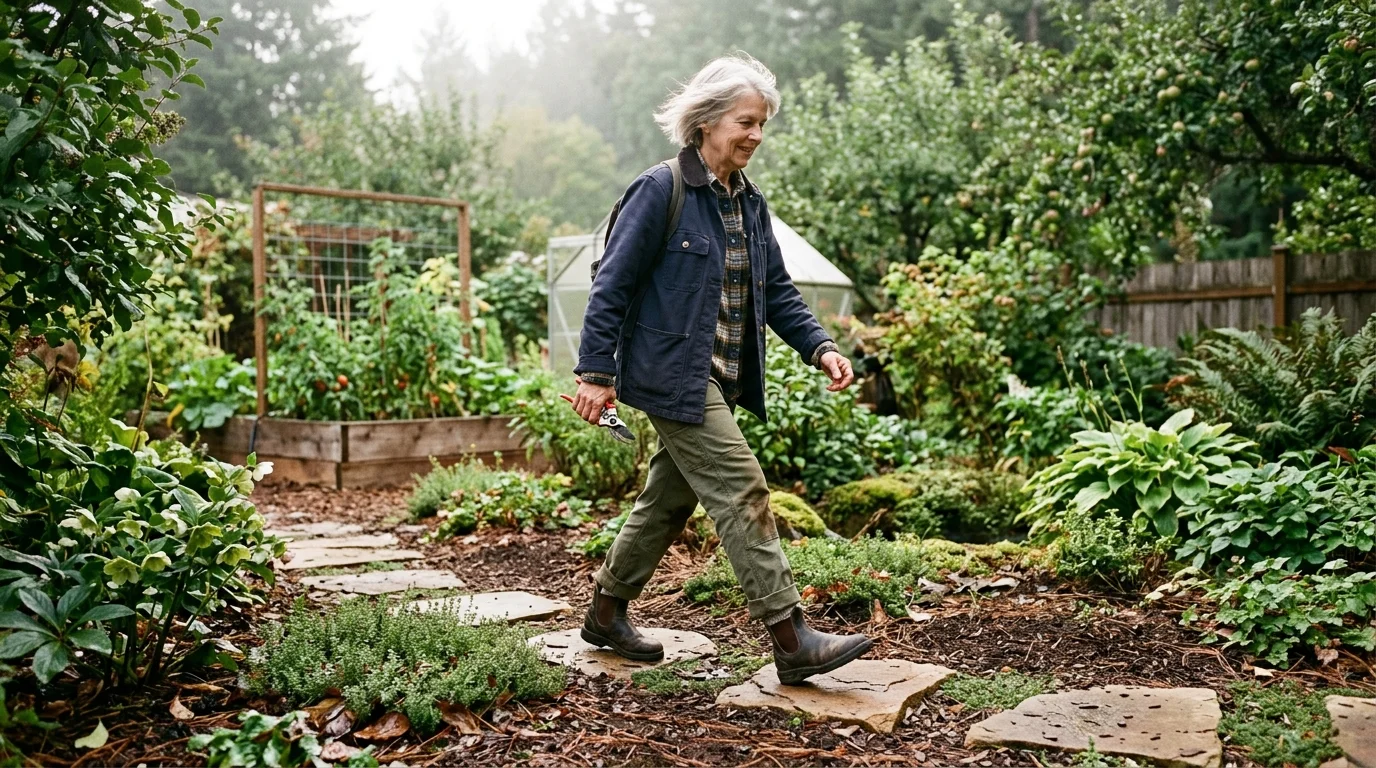
You can cultivate a thriving backyard garden without fearing unexpected trips, slips, or unstable ground beneath your boots. A vibrant retirement means digging deep beds, carrying pruning shears, and navigating root-tangled slopes with complete physical confidence.
Approaching retirement gardening as an art brings immense fulfillment, provided you maintain the physical stability to tend your landscape safely.
While conventional fitness programs focus only on basic leg strength, true yard stability requires synchronizing your inner ear with your foot mechanics. This protocol trains your vestibulo-ocular reflex and ankle proprioception together to neutralize fall risks on irregular terrain.
Dedicating just ten minutes each morning shields your independence and keeps you moving freely across every square foot of soil.
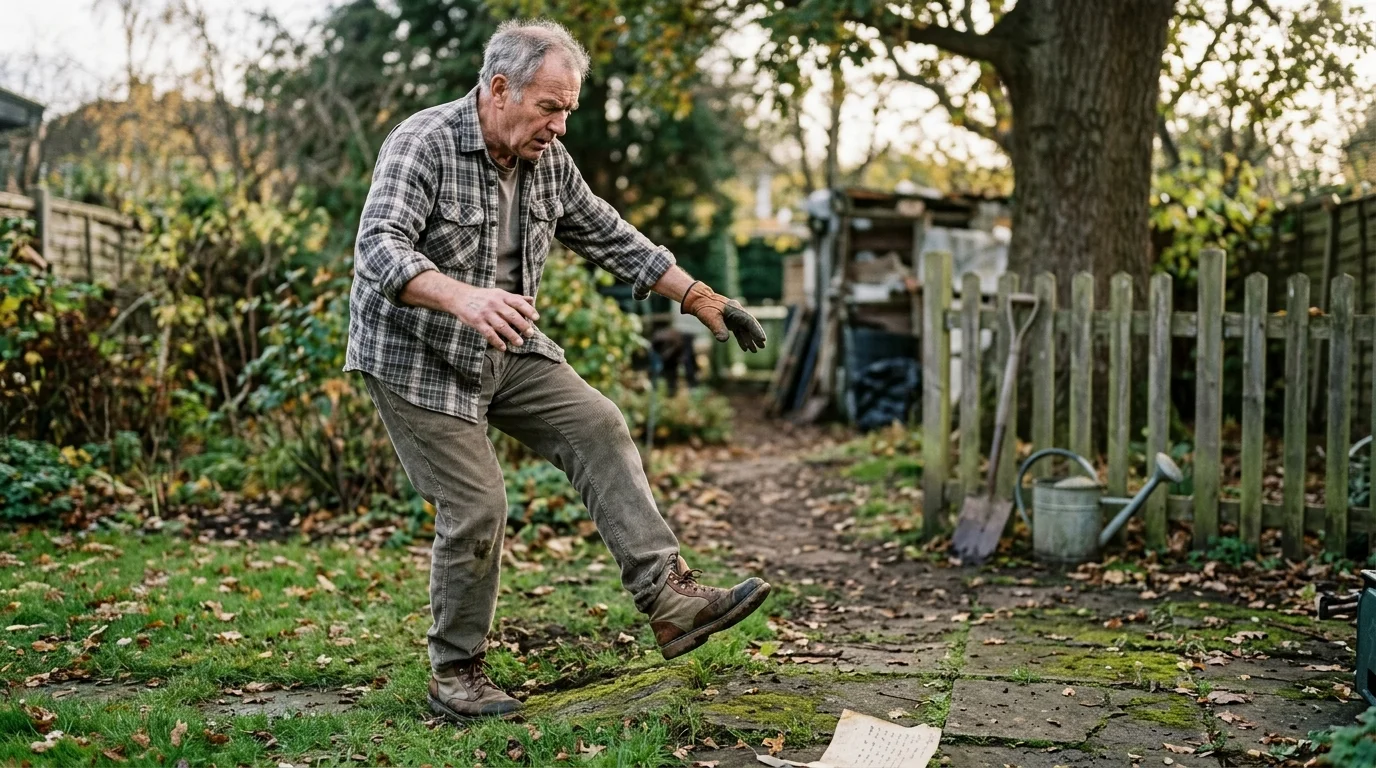
The Hidden Mechanics of Yard Falls: Uneven Terrain Meets Sensory Drift
Backyard gardens present complex biomechanical challenges that indoor living never replicates. Unlike flat indoor floors, garden turf conceals sudden divots, wet clay, exposed tree roots, and shifting mulch layers.
Rebuilding dynamic balance is essential for conquering your fears in retirement and stepping into your yard without hesitation.
Gardeners living independently can reinforce their outdoor confidence by combining balance drills with a structured solo aging safety protocol to manage unexpected accidents.
According to the MOBILIZE Boston Study, roughly 48% to 50% of falls among community-dwelling older adults occur outdoors. Furthermore, uneven surfaces contribute to nearly 75% of those outdoor fall incidents.
Yards and garden plots specifically account for approximately 14% of all outdoor fall locations. When you step onto soft loam while carrying hand tools, your base of support shifts unpredictably.
Data from the Centers for Disease Control and Prevention indicates that more than one in four adults aged 65 and older falls annually. These incidents lead to roughly 3 million emergency department visits each year.
Beyond personal well-being, direct medical costs for older adult fall injuries exceed $50 billion annually nationwide. You avoid becoming part of these statistics by preparing your sensory systems for unpredictable outdoor terrain.
A simple misstep on a lawn depression forces rapid ankle compensation. If your joint receptors fail to signal your brain instantly, your body cannot deploy corrective motor strategies.
Traditional chair squats and stationary bicycles build muscular endurance, yet they leave reflexive stabilization completely unpracticed. You need specific sensory training to prevent falls outdoor uneven ground and maintain full gardening autonomy.
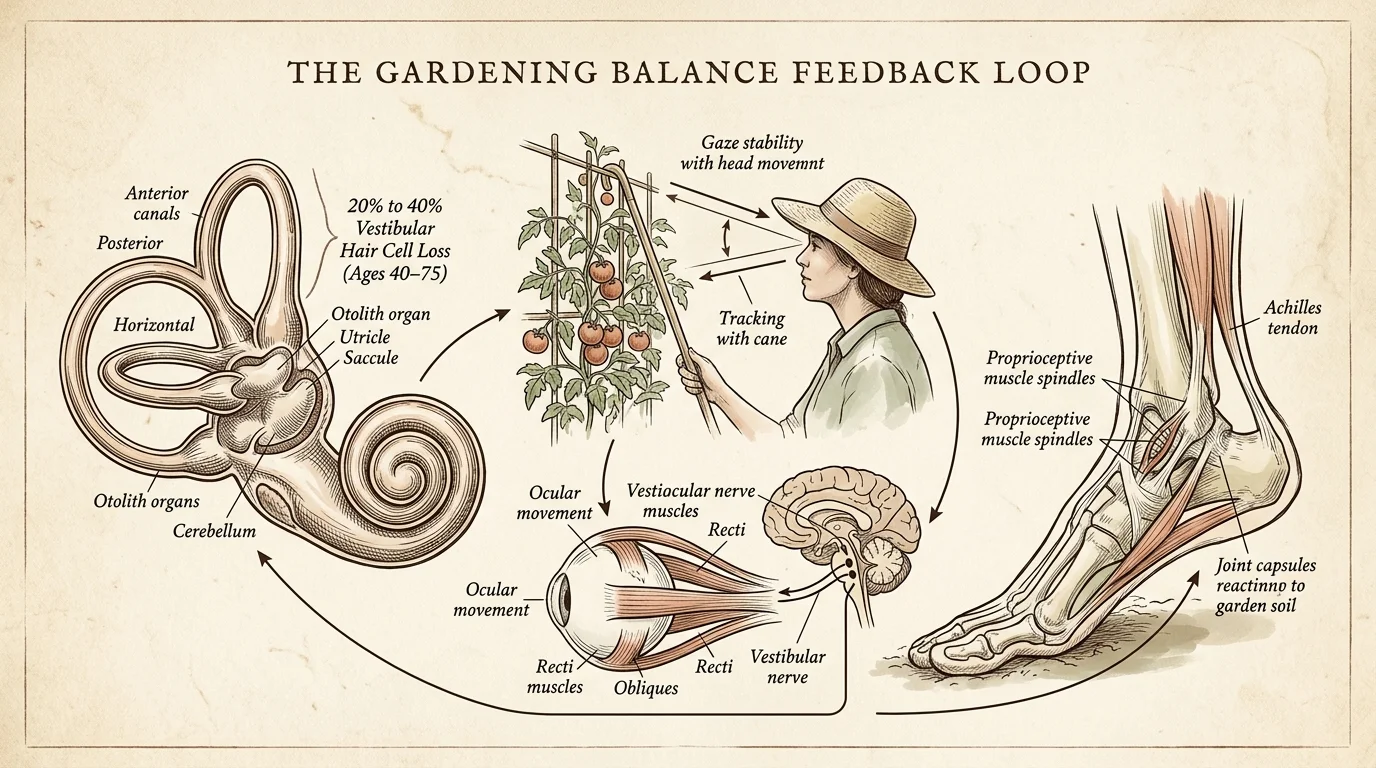
The Science of Vestibular and Proprioceptive Integration Over 65
Human balance relies on three interconnected inputs: your vision, your inner ear vestibular apparatus, and your joint proprioceptors. When you garden, these three systems face relentless simultaneous demands.
Just as endurance walkers utilize trekking pole mechanics to stabilize each stride, gardeners require fast-reacting joint mechanoreceptors to adapt to irregular outdoor surfaces.
Histological studies reveal that between ages 40 and 75, adults lose roughly 20% to 40% of their vestibular hair cells and primary vestibular neurons. This natural biological shift blunts your spatial awareness during rapid head turns.
Consider pruning high raspberry canes and then immediately looking down to secure root balls. That vertical head tilt requires an instantaneous vestibulo-ocular reflex to maintain sharp visual fixation on the ground.
Without calibrated vestibular feedback, rapid head movement causes temporary sensory disorientation. On uneven topsoil, that fractional second of gaze instability leads directly to a loss of footing.
At the same time, mechanoreceptors in your feet and subtalar ankle joints must process changing surface density. Research highlighted by the Stanford Center on Longevity demonstrates that purposeful sensory engagement preserves functional vitality across retirement.
When you walk across fresh compost or damp turf, your ankle joint must articulate across inversion and eversion planes. Proprioceptive fibers send positional data up the spinal cord to command immediate peroneal muscle contractions.
A landmark Cochrane Systematic Review led by Sherrington in 2019 evaluated 108 randomized controlled trials with 23,407 older participants. The analysis proved that targeted balance and functional exercises reduce fall rates by 23% to 24%.
By pairing vestibular gaze stabilization drills with compliant standing surfaces, you re-educate your nervous system. These proprioception drills over 65 restore the neuromuscular reflexes necessary for confident outdoor labor.
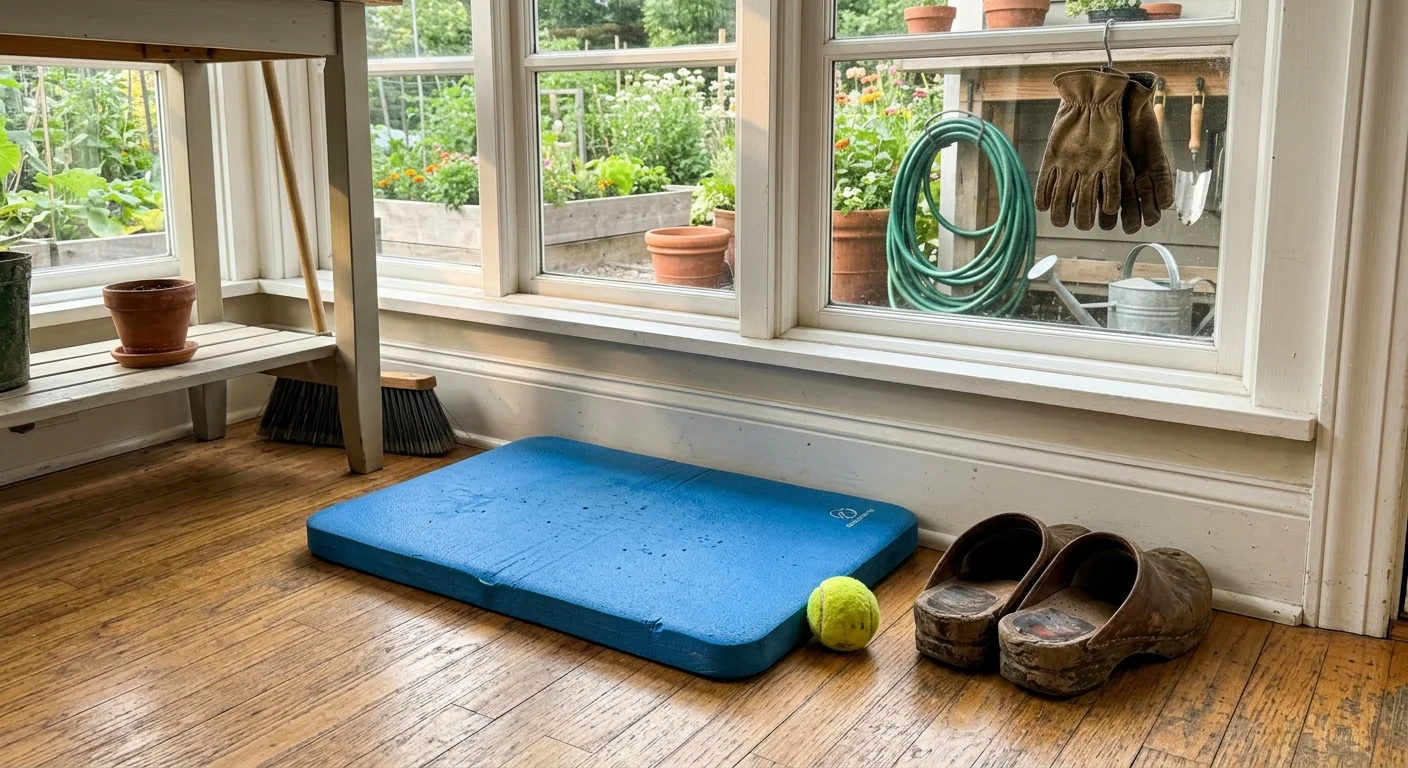
Essential Home Equipment: Closed-Cell Foam and Tennis Ball Setup
You do not need an expensive gym membership or complex machinery to build bulletproof yard balance. You can construct an elite balance station directly inside your living room or potting shed using two inexpensive items.
Setting up a dedicated home training corner is as straightforward as tackling basic DIY home repair skills around your house or garden shed.
Much like choosing specialized gear for barbell strength training, selecting the right stability tools ensures you build resilient physical adaptations without undue strain.
The primary training tool is a high-density, closed-cell balance pad measuring roughly 19.7 inches long, 16.1 inches wide, and 2.4 inches thick. The Airex Balance Pad standard model represents the clinical gold standard for stability training.
Closed-cell composite foam compresses under your body weight without bottoming out completely. This dynamic compression forces the small intrinsic muscles of your feet to work continuously to keep you upright.
Your second tool is a standard pressure-regulated tennis ball, such as a Wilson US Open Extra Duty ball measuring 2.6 inches in diameter. You will use this ball to mobilize dense plantar fascia tissue before beginning balance work.
Plantar fascia stiffness dulls sensory nerve endings on the bottom of your feet. Rolling your sole over a tennis ball restores cutaneous receptor sensitivity, allowing faster feedback from the soil.
Set up your training space adjacent to a sturdy kitchen counter, a heavy wooden workbench, or a solid deck railing. Having a firm handhold within six inches guarantees safety while you challenge your balance threshold.
Clear the immediate surrounding floor of area rugs, pet toys, garden shears, and errant footwear. Perform all drills in bare feet or non-slip grip socks to maximize tactile transmission.
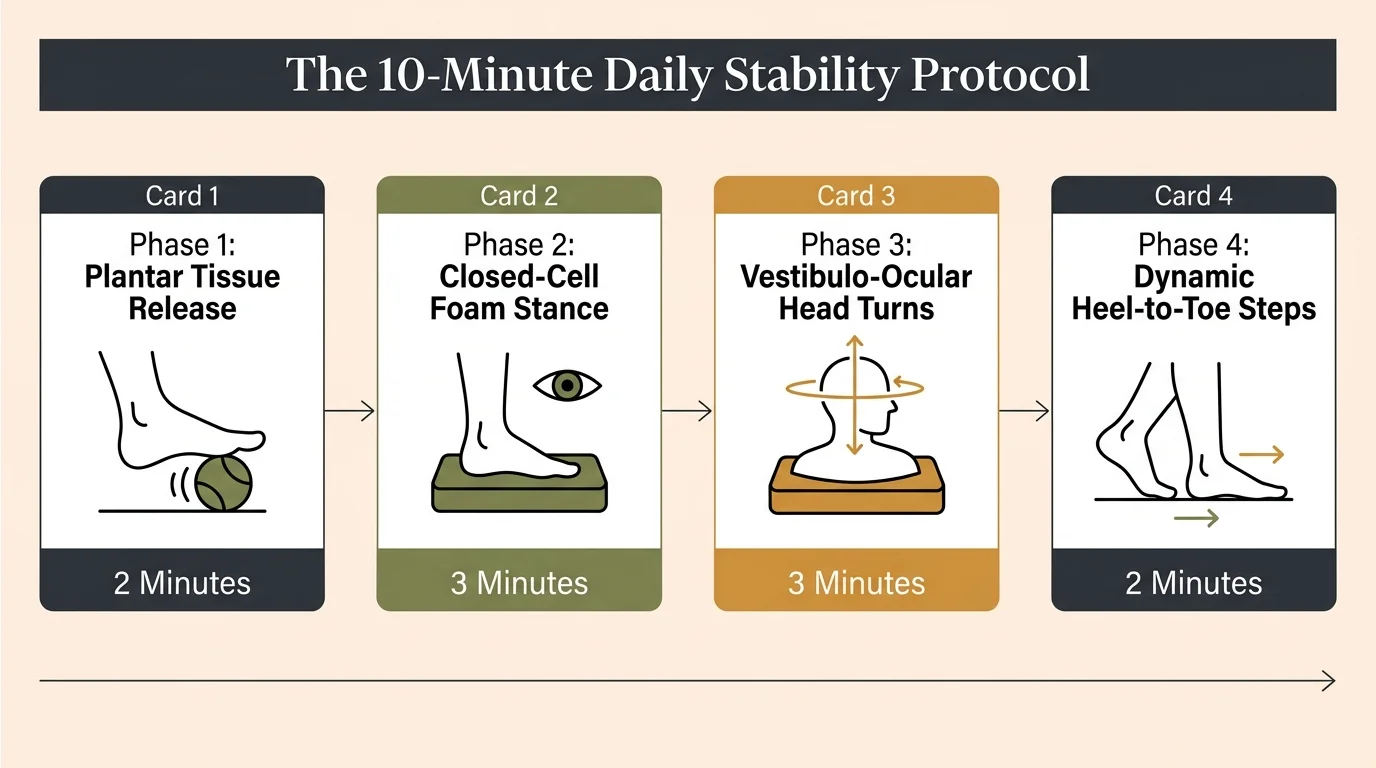
The 10-Minute Daily Stability Protocol for Gardeners
Perform this structured routine every morning before lifting watering cans, wheelbarrows, or soil amendments. This sequence pairs plantigrade myofascial release with vestibular ocular recalibration and dynamic weight shifting.
Practicing this routine near a sun-drenched window can also serve as a morning circadian light reset to reinforce steady daily energy patterns.
Integrating these daily physical micro-habits fits naturally alongside structured routines like the 3-block daily schedule that help anchor purposeful mornings.
Practicing these balance exercises for senior gardeners three to five days per week meets global physical activity guidelines established by health authorities.
-
Phase 1: Plantar Desensitization and Mobilization (Minutes 0:00–2:30)
Place your tennis ball on a firm, non-carpeted floor directly next to your balance counter.
Step your right bare foot onto the ball, applying moderate, tolerable downward body pressure.
Roll the ball slowly from the base of your heel to the metatarsal heads for 75 seconds.
Focus sustained pressure on tight longitudinal arch fibers, then switch to your left foot for 75 seconds.
-
Phase 2: Foam-Pad Tandem Stance with Vestibulo-Ocular Reflex Pitch (Minutes 2:30–5:00)
Place your closed-cell foam pad flat on the floor directly parallel to your support counter.
Step onto the foam pad placing your right foot directly in front of your left foot in heel-to-toe tandem alignment.
Hold your right thumb outward at eye level, fixing your gaze entirely on your thumbnail.
Slowly nod your head up and down in a 30-degree arc while keeping your eyes locked onto your fixed thumb.
Perform smooth nodding motions for 60 seconds, rest for 15 seconds, switch lead feet, and repeat for 60 seconds.
-
Phase 3: Foam-Pad Dynamic Reaching and Yaw Rotation (Minutes 5:00–7:30)
Stand centrally on your foam pad with your feet spaced shoulder-width apart and knees unlocked.
Turn your head smoothly from left shoulder to right shoulder in a 45-degree yaw rotation.
While maintaining continuous head rotation, reach your right arm across your body toward an imaginary low garden bed.
Return to a tall standing posture, then reach your left arm diagonally downward across your body.
Continue this deliberate diagonal reaching pattern for 2.5 minutes, keeping your core engaged and ankles stabilizing.
-
Phase 4: Perturbation Recovery Stride Drills (Minutes 7:30–10:00)
Step off the foam pad onto the solid floor, positioning the pad 18 inches directly in front of you.
Take an exaggerated forward lunge step, landing your lead foot firmly onto the unstable center of the foam pad.
Absorb the soft surface contact through your lead knee and ankle, pausing in a stable split-stance hold for three seconds.
Push dynamically off the foam pad to return to your original standing starting position.
Alternate lead legs on each repetition, executing 10 controlled deceleration strides per leg over the final 2.5 minutes.
Never rush through these movements. Quality of sensory control and steady breathing deliver far superior neurological adaptations compared to rapid repetitions.
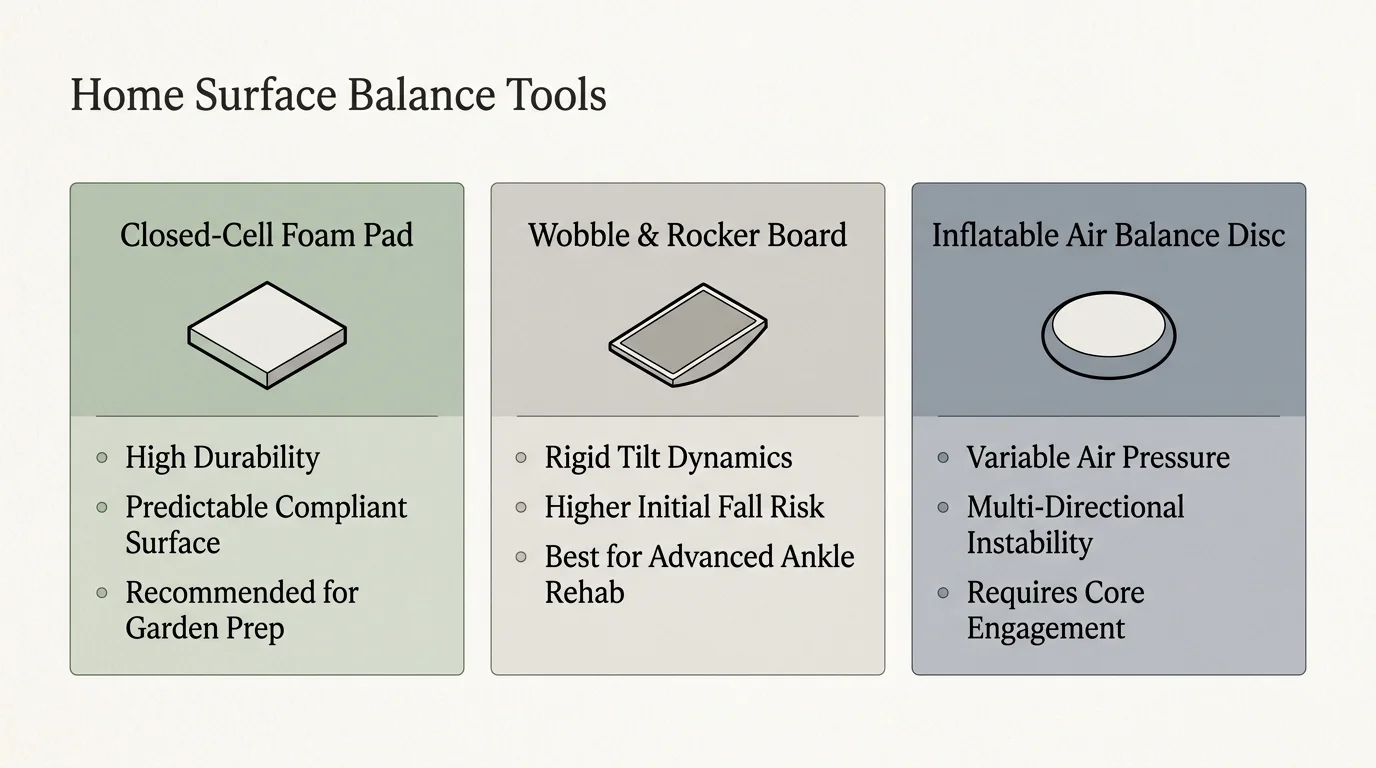
Equipment Comparison: Surface Stability Tools for Home Training
Choosing the correct training surface ensures you challenge your sensory systems without creating unnecessary injury risks. Below is an objective comparison of common balance training equipment used for functional home rehabilitation.
Investing in the right stability gear ensures you can continue gardening for the soul with peace of mind across every planting season.
Whether tending standard home beds or scaling up from lawn to flower farm, reliable footing ensures you can navigate heavy carts and shifting soil safely.
| Device Model | Dimensions (L x W x H) | Material and Density | Primary Sensory Target | Price Range (USD) |
|---|---|---|---|---|
| Airex Balance Pad Elite | 19.7″ x 16.1″ x 2.4″ | Closed-cell EVA/TPE foam; medium compliant resilience | Ankle proprioception and subtalar eversion/inversion response | $55 – $68 |
| TheraBand Stability Trainer (Green) | 14.5″ x 8.0″ x 2.0″ | Closed-cell PVC foam; firm initial resistance | Early-stage ankle stabilization and linear joint alignment | $28 – $36 |
| Bosu Balance Trainer (65cm Home) | 25.6″ diameter x 9.0″ high | Inflatable dynamic dome over rigid polypropylene base | High-amplitude knee and hip corrective motor strategies | $110 – $130 |
| Generic Yoga Foam Kneeling Block | 9.0″ x 6.0″ x 3.0″ | Open-cell dense EVA block; rigid non-compliant surface | Basic static elevation; minimal dynamic instability provided | $12 – $18 |
The standard closed-cell balance pad remains the top recommendation for gardeners. It accurately replicates the shifting, unpredictable compliance of compost piles, damp soil, and spring lawn thatch.
Inflatable domes create excessive platform height that can intimidate beginner trainees. Dense closed-cell foam keeps you close to the floor while delivering high-yield instability for your ankles.
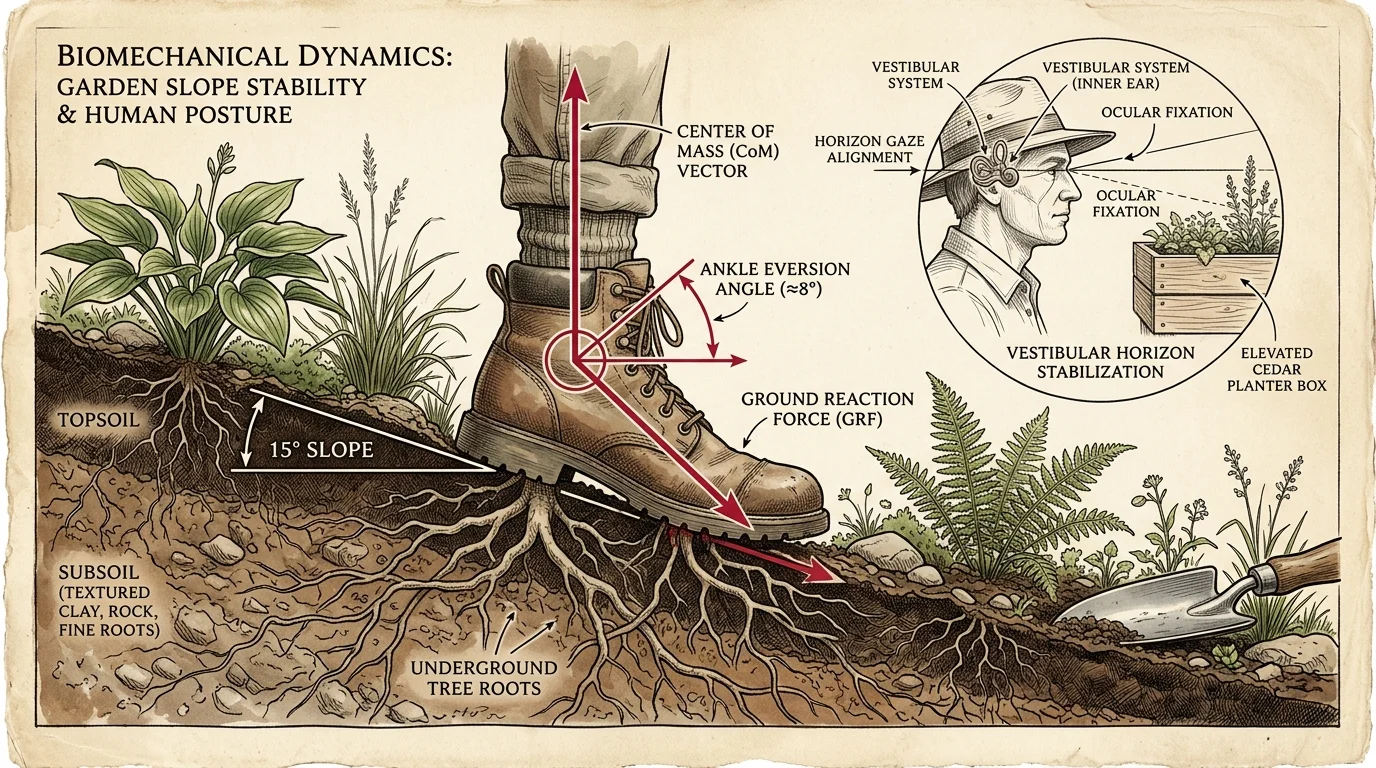
Worked Field Scenario: Navigating a 15-Degree Sloped Raised Bed
To understand how this protocol alters real-world mechanics, examine a worked scenario involving Arthur, a 68-year-old retired civil engineer. Arthur manages an active vegetable garden featuring eight raised cedar planters positioned along a 15-degree turf slope.
Arthur routinely carries a filled 2-gallon galvanized steel watering can weighing approximately 16.7 pounds. While walking across the wet 15-degree incline, his downhill right foot lands on a hidden oak root covered by grass clippings.
Prior to completing vestibular and ankle training, this sudden mechanical perturbation caused severe sensory mismatch. His right ankle inverted 14 degrees unexpectedly, while his head turned upward to verify tomato trellis ties.
Because his inner ear hair cell responses were sluggish, his gaze blurred for 400 milliseconds. That brief sensory delay prevented his peroneal longus muscle from firing in time, resulting in a stumble and dropped load.
Arthur adopted this exact 10-minute protocol every morning at 7:30 AM between March 1 and April 12. He utilized an Airex Balance Pad Elite alongside a standard tennis ball adjacent to his potting table.
Over six weeks of consistent daily drills, Arthur recorded measured balance milestones in his gardening journal:
- Single-leg foam pad stance duration increased from 7 seconds to 24 seconds without countertop hand assistance.
- Head rotation velocity during Phase 2 tandem stance doubled from 15 cycles per minute to 32 cycles without loss of gaze fixation.
- Subtalar joint stabilization latency decreased, allowing rapid ankle correction within 90 milliseconds of unexpected surface tilt.
- Across 44 subsequent backyard gardening sessions, Arthur logged zero stumbles, trips, or unassisted balance losses on the slope.
When Arthur encountered that identical root-covered slope in mid-April, his rehabilitated sensory systems fired seamlessly. His foot mechanoreceptors instantly detected the root profile, his right ankle stiffened laterally, and his visual gaze remained stable on the trellis.
He corrected his center of gravity without dropping his watering can or straining his lower lumbar spine. Consistent sensory training converted a hazardous yard scenario into a routine, effortless movement.
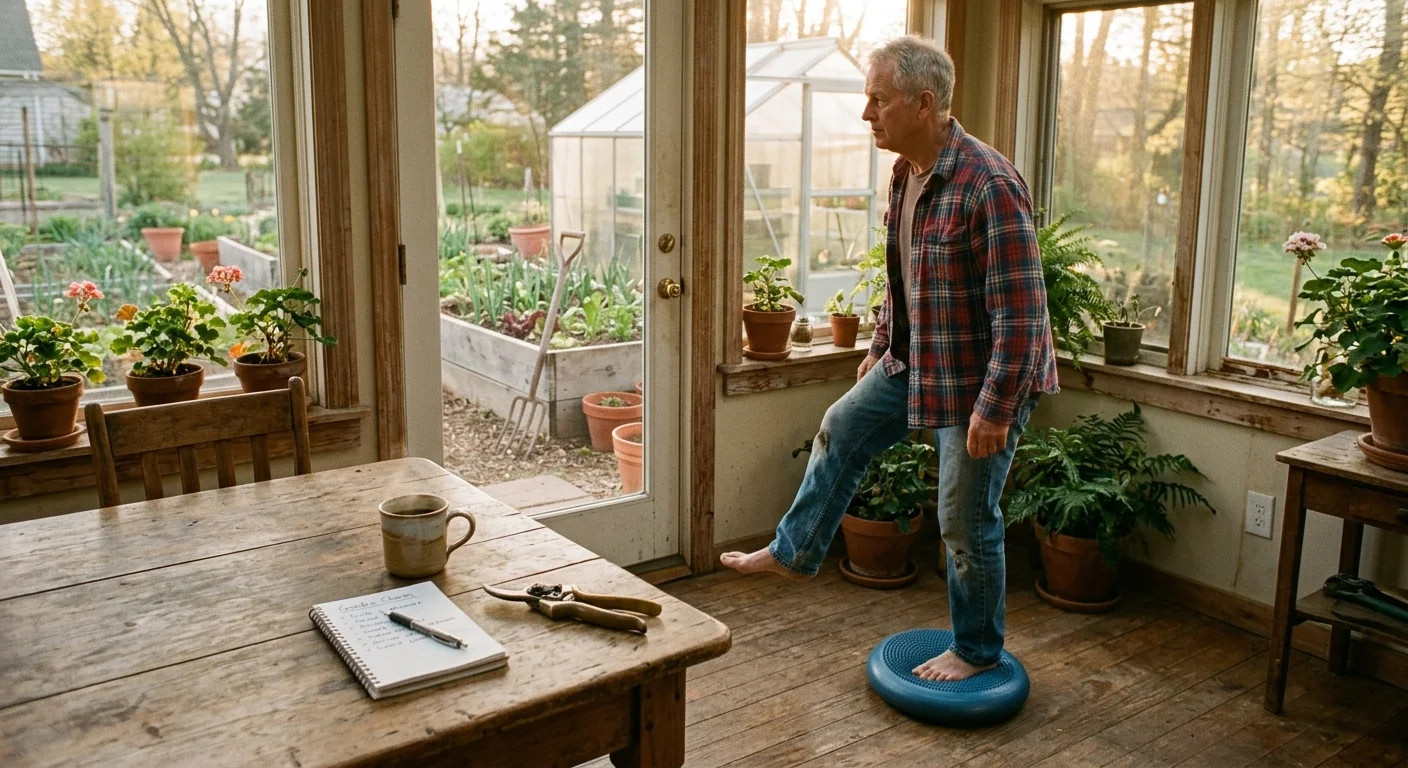
Habit Integration: Anchoring Your Routine Before Yard Work
Consistency builds neurological pathways much faster than occasional high-intensity workouts. Anchor your 10-minute balance protocol to an existing morning ritual that occurs immediately before you head outdoors.
Keep your balance pad and tennis ball visible beside the back door or near your morning coffee brewing station. Habit stacking ensures you never skip your stability work during peak planting and harvesting seasons.
Incorporate smart physical operating procedures every time you transition from your indoor preparation to actual yard work:
- Select lug-soled leather gardening boots with deep tread depth (minimum 4 millimeters) and firm ankle collar support.
- Divide heavy materials into two smaller containers rather than lugging a single unbalanced 40-pound bag of compost.
- Clear garden pathway borders of stray drip hoses, misplaced hand trowels, and protruding ground stakes every afternoon.
- Step squarely over raised garden bed frames rather than straddling timber corners while weeding or harvesting.
- Pause and look straight ahead for two seconds after standing up from a prolonged kneeling weeding position.
Retirement offers you the freedom to build a bountiful landscape with your own two hands. Protecting your physical resilience through daily balance training ensures your yard remains a sanctuary of joy and boundless vitality.
Frequently Asked Questions
How quickly will I see improvements in my outdoor gardening balance?
Most gardeners experience noticeable improvements in ankle stability and spatial confidence within three to four weeks of consistent daily training. Neurological adaptations in the vestibulo-ocular reflex occur rapidly when challenged for ten minutes each morning.
Can I perform this protocol if I already have mild knee arthritis?
Yes, because closed-cell foam pads cushion joint impact while challenging joint receptors. Maintain a sturdy chair nearby for support and limit the depth of reach if knee discomfort occurs.
Why is a tennis ball necessary for ankle balance training?
Rolling a dense tennis ball across the plantar fascia releases rigid connective tissue under your foot. This allows the mechanoreceptors in your sole to transmit faster sensory feedback when stepping on uneven backyard soil.
Should I wear my gardening boots during this indoor exercise routine?
Perform the protocol in bare feet or thin grip socks during the first four weeks to maximize sensory input. Once confident, repeat the drills while wearing your stiff gardening boots to simulate real yard mechanics.
Disclaimer: This article is for informational and inspirational purposes. Life decisions are deeply personal, and we encourage readers to pursue their dreams while considering their unique circumstances, health, and financial situation.