
Taking control of your household balance sheet after losing a partner creates profound independence. A structured 90-day administrative triage prevents cash-flow disruptions and positions you for lasting financial confidence.
Pairing your administrative roadmap with a structured daily routine can bring calm and order to your mornings during this emotional season.
Most guidance overlooks that your income drops up to 50 percent while overhead drops only 20 percent. This sequential blueprint resolves account ownership, halts tax shocks, and protects your solo wealth.

Days 1 to 30: Halting Cash Leaks and Gathering Documents
The first month requires defensive administrative maneuvers rather than permanent wealth decisions. You must preserve liquidity and secure verified legal paperwork before altering broader investments.
Beyond paperwork, establishing a reliable solo aging safety plan ensures your home environment remains secure as you adjust to living independently.
Order 10 to 15 certified death certificates from the funeral director or vital statistics office. Financial institutions, title registries, and government agencies demand original certified copies before releasing assets.
Locate the primary household accounts and lock down ongoing liabilities. Cancel recurring subscriptions, club memberships, and individual credit cards registered solely in your spouse’s name.
Notify primary banks and credit unions of your spouse’s passing without closing your joint operational checking account. Joint accounts with rights of survivorship remain accessible, ensuring uninterrupted cash flow for routine bills.
- Secure 12 physical copies of the official death certificate.
- Compile previous-year tax returns, vehicle titles, property deeds, and estate documents.
- Audit all bank statements for recurring automated debit charges.
- Cancel solo credit cards while keeping joint accounts open and active.
- Catalog every life insurance policy alongside current retirement balances.
Create a dedicated administrative notebook or digital folder to track every reference number and phone call. Documenting contact names, dates, and instructions eliminates repetitive conversations with institutional service representatives.
This organized baseline frees your mental energy for larger strategic decisions. Structured tracking transforms an overwhelming list of tasks into manageable, everyday action items.

Navigating Social Security and Structural Income Shifts
Surviving spouses face a swift, non-negotiable cash-flow adjustment at the federal level. The Social Security Administration terminates one check immediately upon reporting a death.
Navigating sudden income contraction often requires embracing the unknown with clear resolve rather than panic.
Under the single-benefit retention rule, surviving spouses aged 65 or older keep the larger of the two household benefits. You cannot combine or collect both payments simultaneously.
The agency also disburses a statutory, one-time lump-sum death payment of exactly $255. You must submit your survivor benefit application over the phone or in person at a regional field office.
If you have reached your own Full Retirement Age—age 67 for individuals born in 1960 or later—you receive 100 percent of your late partner’s monthly amount. Claiming earlier survivor benefits reduces that baseline permanently.
According to federal cash-flow research, household gross income typically falls by 30 to 50 percent after a spouse passes away. Fixed household operating costs, however, only contract by 20 to 30 percent.
The National Institute on Aging emphasizes that securing financial clarity during life transitions dramatically reduces cognitive stress and enhances resilience. Taking control of these adjustments immediately provides immense security.
- Report the death to the Social Security Administration immediately at 1-800-772-1213.
- Calculate your new monthly income based strictly on the single higher benefit.
- Claim the $255 federal lump-sum death benefit during your administrative interview.
- Request written confirmation of your updated monthly deposit date and amount.
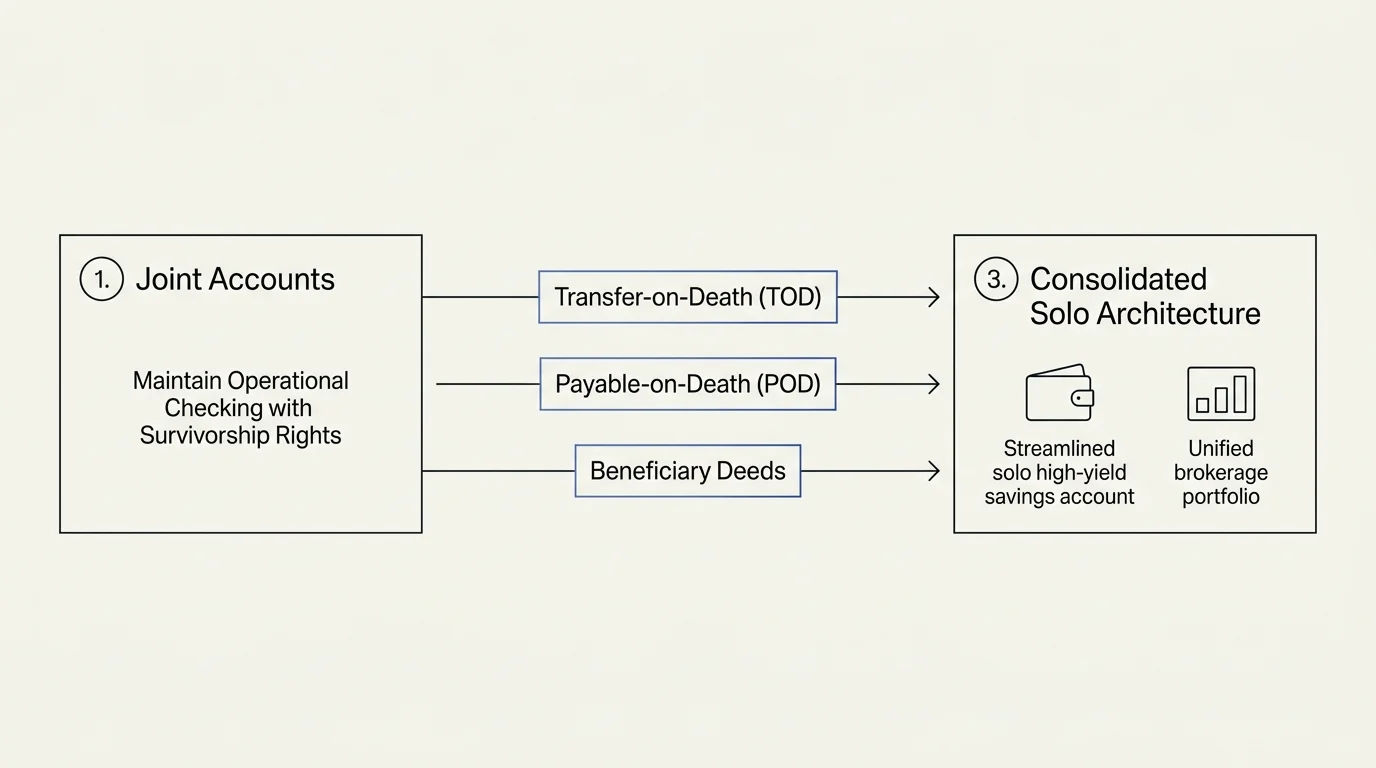
Days 31 to 60: Account Consolidation and Titling Mechanics
Month two centers on asset retitling and eliminating institutional clutter. Managing multiple accounts across different brokerage houses creates needless confusion and elevates paperwork burdens.
As you retitle property and take sole custody of your household, mastering practical home repair skills protects both your physical residence and your long-term budget.
Consolidate secondary checking accounts, old 401(k) balances, and redundant savings vehicles into one primary institution. Centralized funds give you real-time visibility over your daily liquidity.
Section 327 of the SECURE 2.0 Act provides critical tax flexibility for surviving spouses inheriting retirement assets. You can elect to be treated as your deceased spouse for Required Minimum Distribution (RMD) calculations.
This statutory election permits you to delay RMDs until your late spouse would have reached age 73, or age 75 for those born in 1960 or later. When withdrawals begin, you calculate amounts using the favorable Uniform Lifetime Table.
Avoid rushing to sell family real estate or alter long-term portfolio allocations during this window. Re-title vehicle registrations, real estate deeds, and primary taxable accounts into your name alone first.
- Roll inherited IRAs into a surviving spouse beneficiary account or your own master IRA.
- Submit certified death certificates to your county clerk to update home deeds.
- Transfer automotive titles through your state bureau of motor vehicles.
- Designate fresh primary and contingent beneficiaries across every updated financial vehicle.
Each resolved asset transfer reduces vulnerability and solidifies your independence. Taking direct ownership of these assets builds deep operational competence.
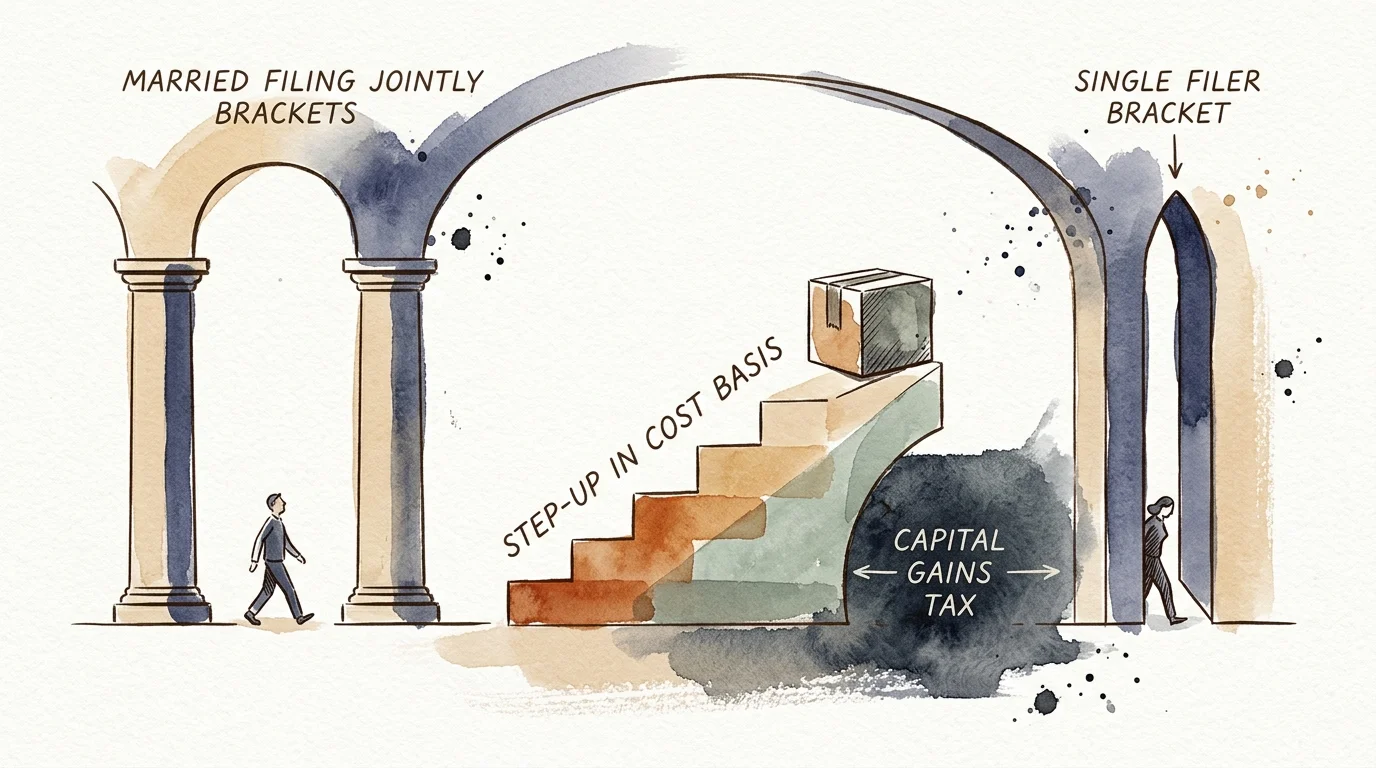
Mastering Asset Step-Up Rules and the Widow’s Tax Penalty
Surviving spouses face a steep tax transition known as the widow’s penalty. For the calendar year of death, you file your federal return using Married Filing Jointly status.
In the subsequent tax year, however, you must file as Single if you have no dependent minor children. Single tax brackets compress rapidly, subjecting identical solo income to higher marginal tax rates.
Taxpayers aged 65 or older receive an additional standard deduction alongside the standard base allowance. Strategic planning during your first year limits bracket creep before the single filing status kicks in.
Review the cost basis of taxable assets carefully under Internal Revenue Code Section 1014. Non-retirement brokerage holdings and real estate qualify for significant basis adjustments upon death.
In the 41 common law states, joint taxable assets receive a 50 percent basis step-up to the date-of-death fair market value. In contrast, the nine community property states grant a 100 percent double step-up across qualifying community assets.
| Asset Holding Structure | Basis Step-Up Scope | Statutory Reference | Administrative Action |
|---|---|---|---|
| Common Law Joint Account | 50% step-up on decedent’s half | IRC § 1014(a) | Obtain date-of-death valuation report from broker. |
| Community Property Joint Account | 100% full double step-up | IRC § 1014(b)(6) | File community property confirmation and reset ledger. |
| Spousal Rollover IRA | No step-up (tax-deferred ordinary income) | SECURE 2.0 § 327 | Elect spousal RMD status to utilize Uniform Lifetime Table. |
Consult verified AARP tax-planning resources to model your upcoming filing transition. Documenting the date-of-death valuation immediately prevents costly capital gains miscalculations later.
Resetting asset bases allows you to liquidate individual stocks or reallocate taxable funds without generating substantial tax bills. This flexibility enables cleaner, simpler investing moving forward.

Neutralizing Medicare IRMAA Surcharges with Form SSA-44
Medicare Part B and Part D premiums include an income-tested surcharge known as IRMAA. The Social Security Administration assesses these surcharges using your Modified Adjusted Gross Income (MAGI) from two tax years prior.
Because married joint brackets feature generous income caps, your joint historical tax returns might subject your new single status to heavy surcharges. The agency would incorrectly treat you as an affluent single filer.
Fortunately, you can eliminate this two-year look-back immediately. The federal government classifies the death of a spouse as a life-changing event under administrative regulations.
File Form SSA-44 (Medicare Income-Related Monthly Adjustment Amount – Life-Changing Event) directly with the Social Security Administration. Submit this form alongside your late spouse’s death certificate and an estimate of your current year solo income.
- Download Form SSA-44 from the official Social Security website.
- Select “Death of spouse” in Step 1 as your qualifying life-changing event.
- Provide an exact reduction date matching the date on the death certificate.
- Provide your projected single Modified Adjusted Gross Income for the current calendar year.
- Attach official tax schedules and deliver the packet to your local field office.
Processing Form SSA-44 saves surviving spouses hundreds of dollars in monthly Part B and Part D premiums. Correcting this metric restores hundreds of dollars to your monthly cash buffer.

Days 61 to 90: Designing Your Solo Budget Architecture
Month three transitions from emergency administrative adjustments to long-term financial architecture. You can now build a forward-looking cash flow system reflecting your personal priorities.
Establishing a stable solo budget allows you to regain control over essential living costs while eventually setting aside resources for rewarding retirement travel.
As you adjust your living expenses, consider budgeting for a comprehensive solo aging safety protocol that supports personal security and independence at home.
Divide your monthly cash flow into non-negotiable fixed overhead, discretionary personal spending, and a dynamic resilience buffer. This clear division prevents accidental balance depletion.
Review home maintenance, property taxes, auto insurance, and baseline utilities. Request updated quotes on homeowner and auto policies to ensure you carry single-driver and updated occupancy classifications.
- Maintain six to twelve months of living expenses inside a high-yield liquid savings account.
- Automate recurring utility, insurance, and medical payments from your primary checking account.
- Allocate dedicated discretionary funding for personal hobbies, travel, and creative projects.
- Audit property tax rolls to apply for senior citizen or surviving spouse exemptions.
Establishing full control over this architecture fosters genuine freedom. Directing your resources intentionally turns your budget into a tool for exploration.

Worked Example: Full 12-Month Financial Recalibration
Examining a worked scenario illustrates how these steps resolve structural deficits. Consider Eleanor, age 66, whose husband Arthur passed away on March 14, 2026.
Previously, their combined household income reached $6,500 monthly. Eleanor received $1,800 from Social Security, Arthur received $3,200 from Social Security, and Arthur received a private corporate pension of $1,500 with a 50 percent survivor annuity.
Upon Arthur’s death, Eleanor’s $1,800 Social Security check ceased, and she transitioned to Arthur’s higher $3,200 benefit. Arthur’s private pension dropped by 50 percent to $750 monthly, reducing Eleanor’s guaranteed income to $3,950.
Eleanor faced an immediate 39 percent gross income contraction. Her prior household fixed expenses averaged $4,800 monthly, leaving an unsustainable operating shortfall of $850 every month.
Eleanor executed the 90-day triage protocol to restructure her cash architecture completely. She lowered her overhead through targeted adjustments:
- Eliminated Arthur’s vehicle lease and solo insurance, saving $420 monthly.
- Discontinued unused memberships, streaming accounts, and recurring subscriptions, saving $140 monthly.
- Refiled auto and home policies with single-occupant ratings, saving $65 monthly.
- Established an automated monthly withdrawal of $700 from Arthur’s consolidated IRA under SECURE 2.0 spousal rules.
Her adjusted solo income reached $4,650 against recalibrated overhead of $4,175. She generated a sustainable monthly cash surplus of $475.
Filing Form SSA-44 prevented an erroneous $110 monthly Medicare Part B IRMAA surcharge based on their 2024 joint tax return. Eleanor restored complete cash solvency within 75 days.

Stepping into Financial Sovereignty and Future Pursuits
Mastering administrative mechanics frees you to design your next rewarding chapter. Achieving control over your personal balance sheet creates boundless opportunity for personal growth.
“You may not control all the events that happen to you, but you can decide not to be reduced by them.” — Maya Angelou
Retirement offers an incredible canvas for intellectual exploration, entrepreneurship, and creative discovery. You possess the resources, time, and autonomy to pursue interests you put aside years ago.
Enrolling in enriching programs through Road Scholar connects you with inspiring global communities and solo educational journeys. Lifelong learning sharpens cognitive vitality and expands your horizons.
Take pride in the financial system you constructed during your first 90 days. Every retitled account and balanced budget ledger represents your resilience and self-reliance.
Embrace this era as a powerful journey of personal reinvention. Your financial foundation is sound, and your future holds boundless opportunity.
Frequently Asked Questions
When must I notify the Social Security Administration about my spouse’s death?
Notify the Social Security Administration immediately to prevent improper benefit payments. Funeral homes typically report deaths electronically, but calling 1-800-772-1213 ensures direct, timely processing of your survivor application.
How does the widow’s penalty affect my federal income tax return?
You can file as Married Filing Jointly for the tax year of death. In the following calendar year, you must file as Single, which cuts standard tax bracket thresholds roughly in half and increases your effective tax liability.
Can I delay Required Minimum Distributions on an inherited IRA from my spouse?
Yes, under SECURE 2.0 Act Section 327, you can elect to be treated as your deceased spouse. This choice permits you to delay distributions until your late spouse would have reached age 73 or 75.
How long does the Social Security Administration take to adjust Medicare IRMAA surcharges?
The agency typically processes Form SSA-44 within 30 to 60 days. Once approved, the agency recalculates your Part B and Part D premiums and reimburses excess charges assessed since the qualifying date.
Disclaimer: This article is for informational and inspirational purposes. Life decisions are deeply personal, and we encourage readers to pursue their dreams while considering their unique circumstances, health, and financial situation.