
You can attend prestigious public universities tuition-free after age 60, diving into advanced history, literature, or astrophysics without pursuing a formal degree. State legislation across the country guarantees this access, yet thousands of capable retirees abandon the process each semester.
Auditing college courses can also serve as the intellectual spark for a comprehensive retirement reboot that blends education with meaningful personal projects.
Returning to the university lecture hall allows older adults to experience the joy of lifelong learning purely for the thrill of intellectual discovery.
While generic advice suggests waiting in administrative queues, securing a seat in high-demand 300-level courses actually requires securing faculty pre-clearance before the statutory drop-add window closes. This single tactical move separates frustrated applicants from engaged scholars.
Mastering state-specific registration laws, audit rules, and faculty outreach unlocks elite academic lecture halls at virtually zero cost.
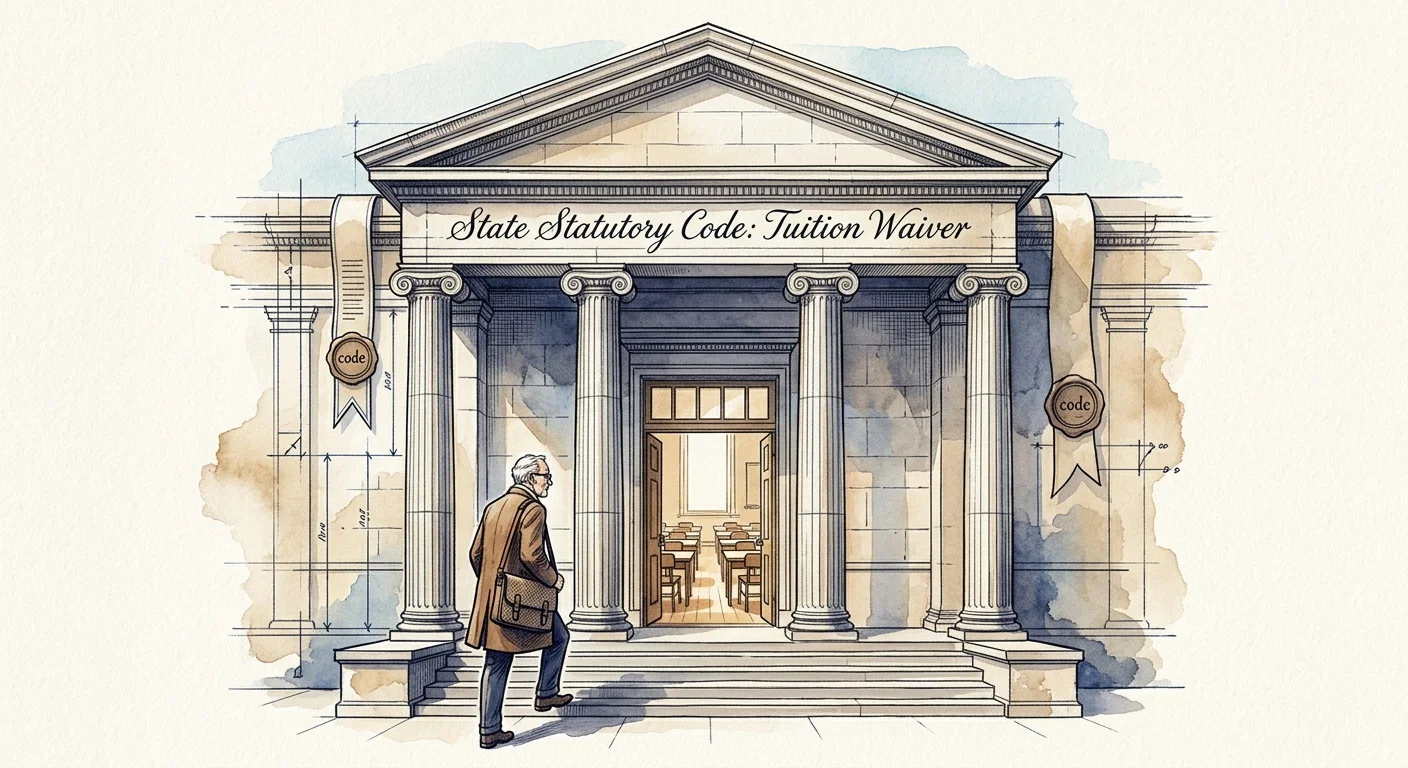
The Statutory Framework of Senior Tuition Waivers
State legislatures enact tuition-waiver laws to encourage lifelong intellectual growth and utilize unused classroom capacity. These statutes allow public colleges to open empty desks to older scholars without increasing institutional operating budgets.
Retirees who discover an affinity for dynamic academic environments might also consider substitute teaching after 60 as a structured way to stay involved in local schools.
If being in the classroom sparks an interest in sharing your own career expertise, exploring teaching after retirement offers an inspiring way to give back to the next generation.
These laws establish clear pathways to free college courses for seniors by state, but they do not guarantee automatic admission. Every state code imposes strict conditions regarding domicile, student age, and course availability.
Research published by the Stanford Center on Longevity demonstrates that intergenerational classrooms cultivate cognitive vitality and social connection. Universities welcome mature students because your life perspective enriches seminar debates.
However, administrative portals rarely explain how senior tuition waiver program rules interact with departmental enrollment caps. Institutional registrars prioritize degree-seeking undergraduates paying standard tuition rates before processing waiver paperwork.
Understanding the statutory mechanics allows you to navigate campus bureaucracies with confidence. Knowing your legal rights prevents bureaucratic hurdles from derailing your academic ambitions.

10-State Statutory Comparison: Eligibility, Windows, and Caps
State laws vary significantly regarding minimum age, credit limits, and registration windows. Some states permit degree-seeking credit study, while others restrict tuition waivers strictly to an audit status.
Earning university credits later in life provides current knowledge that can be instrumental when overcoming ageism in the workplace if you decide to re-enter the job market.
For retirees seeking credit rather than audit status, these state programs offer an affordable path for upskilling for a second act in the workforce.
The following comparison table breaks down specific statutes across ten major public university systems. Review your state’s provisions carefully before submitting institutional registration paperwork.
| State & Statute | Age Threshold | Waiver Scope | Course or Credit Cap | Registration Window | Unwaived Mandatory Fees |
|---|---|---|---|---|---|
| Virginia Va. Code § 23.1-640 |
60+ years | Audit (no income cap); Credit if income under $23,850 | 3 audit courses per term; no cap for credit | Space-available after tuition-paying students register | Course materials, laboratory fees, parking permits |
| Georgia USG Policy / Amend. 23 |
62+ years | Undergraduate and graduate credit or audit | Space-available basis across 26 USG institutions | Late registration and drop-add window only | Campus health fees, technology fees, parking |
| Florida Fla. Stat. § 1009.26(4) |
60+ years | Audit only (credit explicitly barred by law) | Space-available basis at state universities | Final day of drop-add or post-general registration | Student activity fees, lab fees, access credentials |
| California Cal. Ed. Code § 89330 |
60+ years | CSU system credit or audit enrollment | Regular degree terms (excludes extended education) | Space-available basis following regular registration | Statutory nominal fee of $1 per required student fee |
| Texas Tex. Ed. Code § 54.365 |
65+ years | Credit or audit at participating state colleges | Up to 6 credit hours per academic term | Space-available following institutional priority windows | Institutional general service fees, lab fees |
| North Carolina N.C. Gen. Stat. § 115B-2.2 |
65+ years | Audit courses at UNC campuses and colleges | Up to 6 credit hours per semester | Strict space-available basis after paying enrollment | Textbooks, consumable course materials, parking |
| Ohio Ohio Rev. Code § 3345.05 |
60+ years | Non-credit audit at all state-supported universities | Space-available basis per classroom capacity | Formal add-drop period with instructor sign-off | Digital courseware, specialized lab and studio fees |
| Illinois 110 ILCS 990/ |
65+ years | Tuition-free credit study for qualifying incomes | Public universities and community colleges | Space-available basis after paying student sign-up | Mandatory campus facility, union, and lab charges |
| Washington RCW 28B.15.540 |
60+ years | Audit courses on space-available basis | Up to 2 courses per academic quarter | Drop-add period with a nominal administrative fee | Mandatory administrative processing fee (approx. $5) |
| New York SUNY Policy 3300 |
60+ years | Audit undergraduate courses tuition-free | Space-available basis at participating campuses | First week of classes with instructor consent | Campus parking permits, physical books, lab equipment |
Every statutory waiver prioritizes paying students before opening enrollment to waiver recipients. Understanding this universal timeline prevents you from attempting to enroll during early administrative windows.
State residency remains a non-negotiable legal requirement across all listed programs. You must provide physical documentation, such as a state driver’s license or tax filing, to confirm eligibility.
Navigating Audit Rules and Course Restrictions
Auditing allows you to attend lectures, absorb reading assignments, and join seminar debates without taking graded examinations. When you audit university classes over 60, you escape the stress of grade-point averages.
Participating in classroom discussions fosters social connectivity and mental acuity similar to the proven benefits of part-time work in retirement.
Auditing coursework provides a pressure-free environment ideally suited for rekindling old passions that were put on pause during your career.
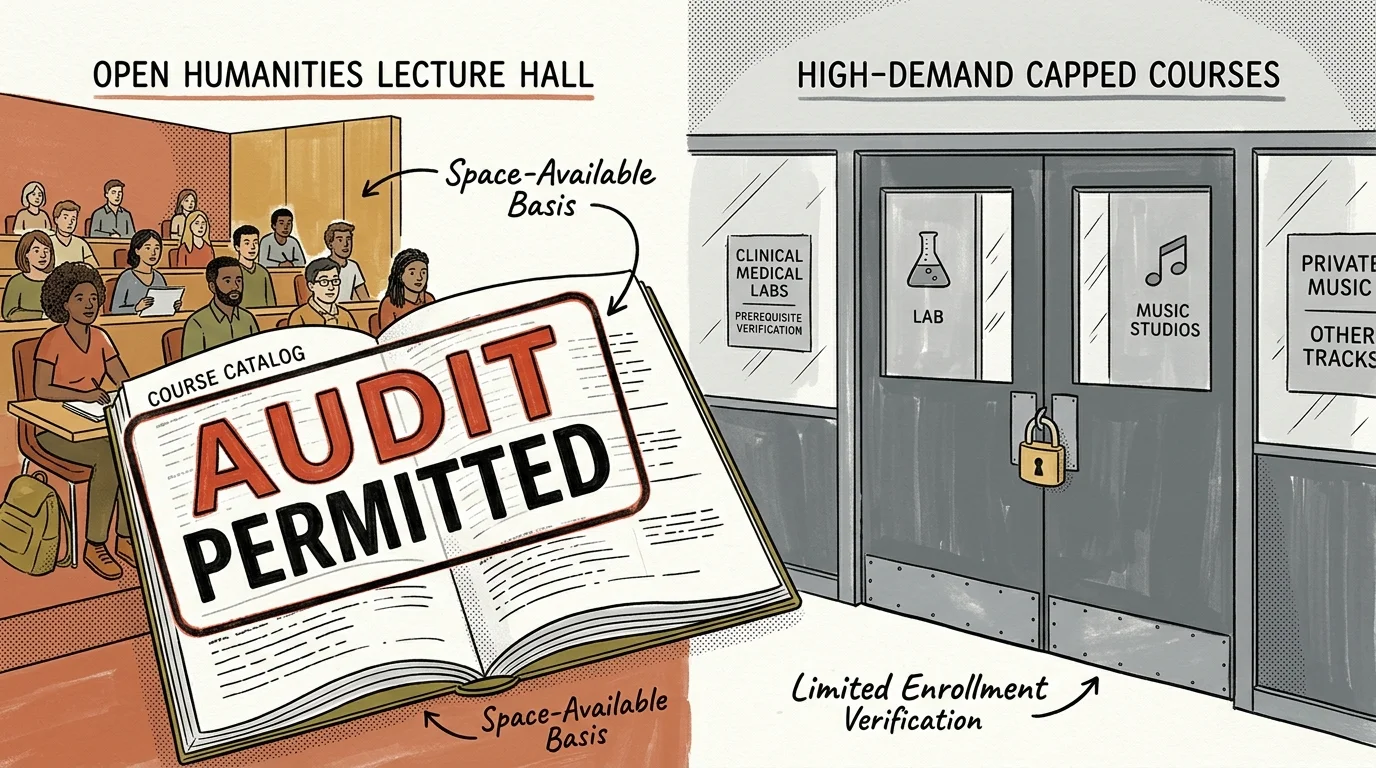
However, universities establish strict academic boundaries between general lecture classes and restricted professional tracks. Certain competitive departments remain completely off-limits to non-paying auditors under state law.
“It is never too late to be what you might have been.” — George Eliot
You can readily access upper-division courses in liberal arts, sciences, and humanities through standard audit procedures. By contrast, institutional policies routinely exclude specialized clinical and self-funded programs, including:
- Professional healthcare programs, including medicine, nursing, pharmacy, and dentistry curricula.
- Juris Doctor and specialized post-graduate legal courses at state-supported law schools.
- Self-supported, extended education, and executive MBA tracks operating outside state tax subsidies.
- Private studio music instruction and highly technical computational laboratory sections.
When auditing, your transcript records an administrative mark of “AU” rather than a letter grade. This designation verifies your formal attendance without impacting your academic record or establishing degree credit.
Professors retain complete discretion regarding auditor classroom engagement. Some instructors invite robust verbal participation, while others prefer auditors to observe quietly from the seminar perimeter.

Uncovering Hidden Out-of-Pocket Expenses
Legislative statutes waive base tuition, which eliminates the primary expense of university coursework. However, “tuition-free” does not mean your semester costs zero dollars.
Some retirees offset incidental academic costs by exploring the gig economy for seniors to fund textbooks and campus parking passes with flexible earnings.
Navigating modern digital learning portals and campus library networks also serves as practical training to sharpen your everyday retirement tech skills.
Universities maintain operational revenue through ancillary fees that are not covered under state tuition statutes. You must prepare a modest budget to cover essential campus services and digital access codes.
Anticipate these common incidental out-of-pocket expenses before your first day of class:
- Campus Parking Decals: University parking permits range from $90 to $350 per semester depending on the campus zone.
- Digital Courseware Platforms: Proprietary homework and reading portals (such as Pearson MyLab or McGraw-Hill Connect) cost $65 to $140.
- Campus Health and Transit Fees: Unwaived institutional auxiliary fees often total $40 to $120 each term.
- Consumable Art and Lab Supplies: Science goggles, art boards, and laboratory manuals require personal purchase.
Fortunately, you can minimize many incidental costs through careful planning. Public transit discounts and digital library lending programs eliminate hundreds of dollars in optional campus charges.
Review the university bursar’s billing itemization immediately after registration. Requesting an administrative fee audit ensures that automated systems do not bill you for waived base tuition.
Worked Example: Auditing an Upper-Division Course in Virginia
To understand the timeline and real-world costs, examine this scenario involving a 62-year-old resident auditing an upper-division course in Virginia. The student chooses “ARTH 342: Renaissance Iconography,” a three-credit lecture at George Mason University.
Developing deep familiarity with specialized subjects like art history can open creative pathways toward consulting in retirement or leading community cultural programs.
In Virginia, the Senior Citizens Higher Education Act allows residents aged 60 and older to audit three courses per term without income restrictions. The university schedules Fall classes to begin on Monday, August 24.
Because statutory senior registration operates strictly on a space-available basis, the senior registration portal does not open until Thursday, August 27, at 9:00 AM. The final add-drop deadline arrives on Tuesday, September 1, at 11:59 PM.
On August 10, the auditor monitors the university schedule portal and notes that ARTH 342 has seven open seats remaining out of thirty. Rather than waiting for the portal opening, the student emails the instructor on August 12 to request audit consent.
The professor responds on August 14 granting conditional permission. When the registration window opens on August 27, the student submits the completed Senior Citizen Tuition Waiver form along with the instructor’s written consent.
Examine the final mathematical ledger for this upper-division enrollment:
- Standard In-State Undergraduate Tuition ($420.50 per credit × 3 credits): $1,261.50 (Waived)
- Senior Citizen Application Processing Fee: $15.00
- Digital Course Access Fee (e-Textbook Platform): $65.00
- Single-Semester General Campus Parking Permit: $185.00
- Total Actual Out-of-Pocket Expense: $265.00
The auditor saves $1,261.50 in instructional costs while gaining complete access to academic research libraries and university lectures. A small investment of $265.00 provides an entire semester of elite intellectual engagement.

Step-by-Step Enrollment Protocol for Upper-Division Courses
Enrolling in an advanced course requires precision, clear timing, and organized paperwork. Following a structured procedure eliminates administrative delays during late registration week.
Research published by the National Institute on Aging emphasizes that intellectually demanding activities support neuroplasticity and overall well-being. Approaching course registration like a professional project yields the best results.
- Submit Non-Degree Application: Apply online as a non-degree guest or lifelong auditor at least thirty days before the semester begins to establish student identification credentials.
- Submit Proof of Domicile: Deliver your state driver’s license, voter registration card, or state tax return to the registrar’s office to lock in your statutory waiver eligibility.
- Monitor Course Seat Counts: Check the public course schedule daily starting two weeks before classes begin to confirm open capacity in your target 300-level lecture.
- Contact the Course Instructor: Send a polite, focused permission request to the professor ten days before the drop-add period begins to secure preliminary approval.
- Execute Drop-Add Registration: Log into the student portal or hand-deliver your waiver documentation during the designated senior registration window.
- Confirm Fee Adjustments: Verify with the student accounts office that base tuition charges show a zero balance before the institutional payment deadline.
Maintaining active communication with department administrative assistants frequently expedites your paperwork. These staff members understand internal add-drop overrides better than anyone on campus.
Keep physical copies of every email confirmation and signed waiver form in a dedicated folder. Having documentation ready resolves unexpected software registration holds instantly.

High-Impact Professor Email Scripts
Faculty members receive hundreds of administrative messages prior to the start of each semester. Your outreach must be respectful, concise, and focused on learning rather than logistics.
Using clear communication establishes immediate rapport and reassures the professor that you will be a positive presence in class. Copy and adapt the following templates for your specific situation.
Script 1: Pre-Registration Outreach (Send 10–14 Days Before Term)
Use this script to introduce yourself, request audit permission, and confirm syllabus requirements before the registration portal opens.
Subject: Senior Audit Inquiry: [Course Prefix and Number] – [Your Full Name]
Dear Professor [Professor’s Last Name],
I hope you are having an enjoyable week. I am an incoming community auditor participating in the state senior citizen tuition waiver program this term.
I am writing to inquire about auditing your upcoming course, [Course Title, e.g., HIST 310: The American Frontier], during the [Fall/Spring 202X] semester. I have tracked the course catalog and see that several open seats remain available.
My professional background is in [briefly mention field, e.g., environmental planning], and I have long hoped to study your published research on [mention specific topic from syllabus or bio]. As an auditor, my goal is to complete all readings, attend lectures faithfully, and contribute thoughtfully without burdening you with paper grading or exam evaluation.
Because state waiver registration occurs during drop-add week, may I have your preliminary permission to enroll if an open seat remains? I would also welcome the opportunity to review the syllabus in advance.
Thank you very much for your time, scholarship, and consideration.
Warm regards,
[Your Full Name]
[Your Phone Number]
[Your University ID Number, if assigned]
Script 2: Late Add / Near-Capacity Request (Send During Drop-Add Week)
Use this targeted message when a course has only one or two seats left and you need immediate departmental signature clearance.
Subject: Auditor Add/Drop Permission: [Course Prefix and Number] – [Your Full Name]
Dear Professor [Professor’s Last Name],
I am registered through the university’s senior waiver program and am writing regarding [Course Prefix and Number, e.g., PHIL 301]. I notice that general registration has concluded and the course retains open capacity.
I would be deeply grateful for your electronic signature or email consent to allow the registrar to finalize my audit registration. I understand that matriculated degree-seeking students hold priority, and I will happily step aside should an undergraduate require this seat before the deadline.
If you approve, could you kindly reply with your written consent or electronic override code? I am ready to submit the registration paperwork immediately.
Thank you for supporting community scholars in your classroom.
Sincerely,
[Your Full Name]
[Your Student ID Number]
Script 3: Course Expectations Alignment (Send After Enrollment)
Send this short note after registration to clarify discussion boundaries and ensure you respect classroom dynamics.
Subject: Audit Expectations: [Course Prefix and Number] – [Your Full Name]
Dear Professor [Professor’s Last Name],
Thank you for welcoming me into [Course Prefix and Number] this term. My audit registration is officially complete.
I want to confirm your classroom preferences regarding auditor participation during seminar discussions. I am delighted to listen quietly or participate actively, entirely at your direction, to ensure undergraduate students have primary access to discussion time.
I look forward to an exceptional semester in your lecture hall.
Best regards,
[Your Full Name]
Clear communication builds trust before the first lecture starts. Faculty members appreciate students who respect institutional procedures and seminar dynamics.
Frequently Asked Questions
Can you earn an undergraduate or graduate degree using senior tuition waivers?
Some states allow degree credit under specific conditions, while others restrict waivers strictly to auditing. Virginia and Georgia permit credit study on a space-available basis, whereas Florida law prohibits awarding degree credit under statutory senior waivers.
What happens if a class fills up before the senior registration window opens?
Senior tuition waivers operate on a space-available basis after paying students enroll. If every seat is filled when the late registration window arrives, you cannot use the statutory waiver for that term.
Do senior tuition waivers cover digital access codes and laboratory fees?
No, statutory waivers cover only base instructional tuition. You remain responsible for textbooks, digital homework platforms, art supplies, laboratory access fees, and campus parking permits.
Are professors required to accept senior auditors into their classes?
State statutes grant tuition assistance, but academic departments retain ultimate authority over upper-division prerequisites and course caps. Securing instructor permission beforehand ensures departmental approval during drop-add week.
Disclaimer: This article is for informational and inspirational purposes. Life decisions are deeply personal, and we encourage readers to pursue their dreams while considering their unique circumstances, health, and financial situation.