
You can transform your grandchild’s part-time summer paycheck into a multimillion-dollar retirement fund while teaching them hands-on financial sovereignty today. Seeding a custodial Roth IRA through a dollar-for-dollar match provides young adults aged 16 to 22 with an unbeatable financial head start.
Many grandparents reinventing their careers through part-time work find great fulfillment in dedicating a portion of their earnings toward launching the next generation’s financial freedom.
Most guides offer generic lectures on compound growth or tell you to write a passive check. This blueprint delivers an actionable matching contract and gamified index tracking system that turns modest earned wages into tax-free wealth without triggering federal gift taxes.
The Mechanics of the Grandparent Roth IRA Match
Gen-Z grandchildren often view retirement planning as an abstract concept reserved for decades down the road. Offering a structured matching program connects their immediate summer work to tangible, exponential future wealth.
Much like entrepreneurs building a successful retirement business, acting as an account sponsor introduces young adults to essential principles of capital matching and ownership.
Engaging your family around practical wealth habits aligns with grandparenting with purpose, turning routine financial guidance into enduring relational bonds.
Collaborating on long-term investments is one of the most effective ways of building intergenerational bridges while passing down hard-earned practical wisdom.
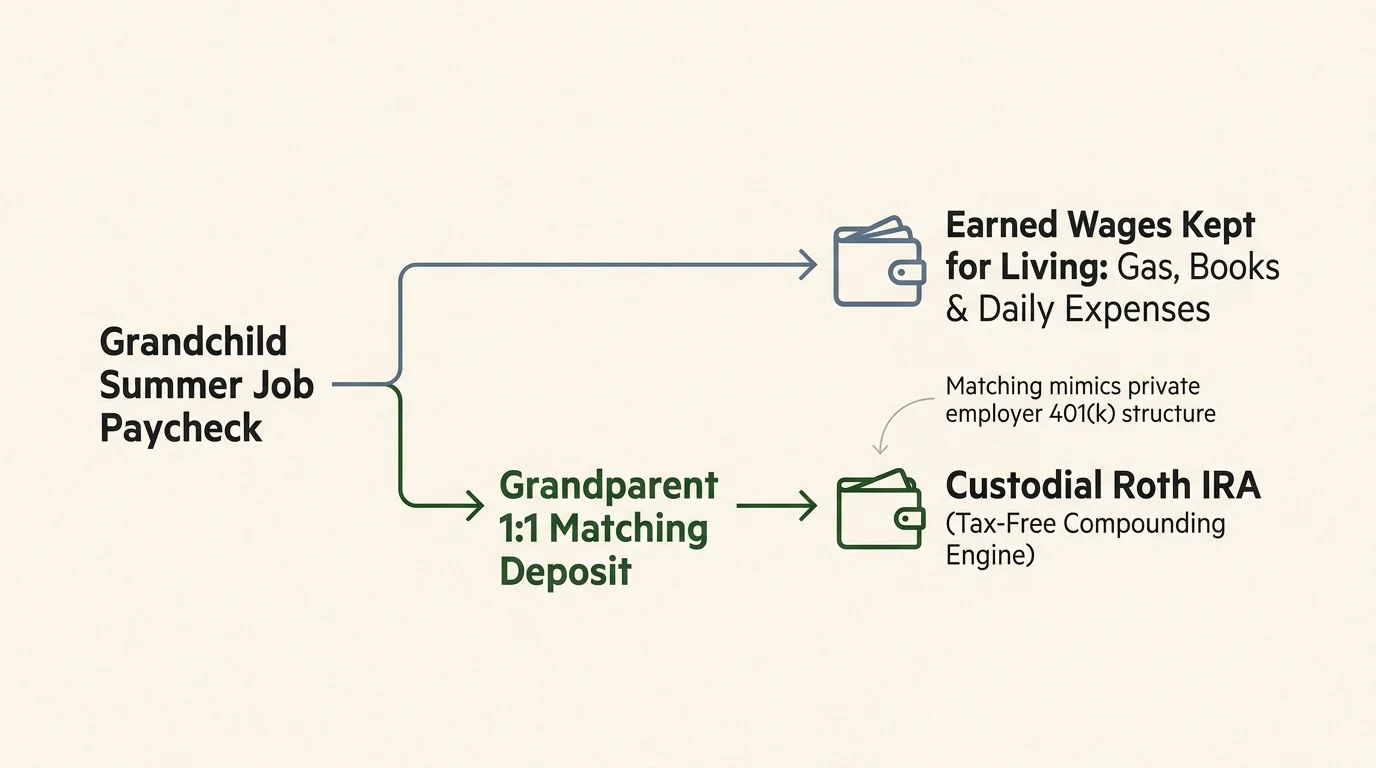
You act like an employer sponsoring a private retirement plan. When your grandchild earns money from a summer job, you match their contributions into a custodial Roth IRA.
This structure leaves their actual wages in their pocket for gas, books, or social outings. Meanwhile, your matching dollars flow into the account to begin compounding immediately.
Research from the Stanford Center on Longevity shows that engaging young adults early builds financial self-efficacy that lasts throughout their lives. Your mentorship transforms a distant concept into an exciting, collaborative game.
IRS Earned Income Rules and Gift Tax Guardrails
You cannot fund a Roth IRA for a grandchild simply out of generosity. The Internal Revenue Service mandates that the account beneficiary must possess documented earned income during that tax year.
Seniors exploring flexible gig economy roles often direct side income straight into these matching deposits without tapping their core retirement nest egg.
Just as retirees explore smart tax strategies to protect earnings, understanding IRS boundaries ensures your gift remains completely shielded from tax liabilities.
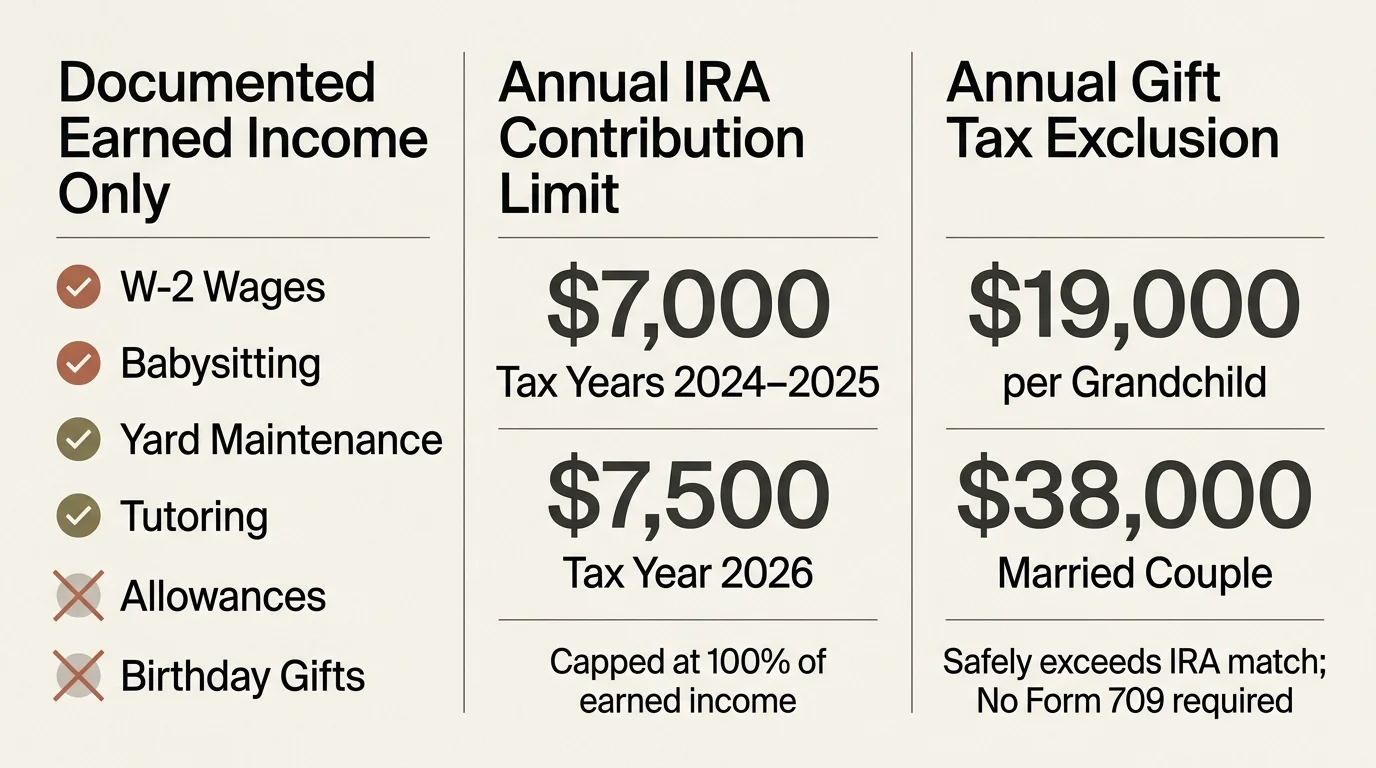
Qualifying income includes W-2 wages from retail or restaurant jobs alongside documented self-employment earnings like babysitting, yard maintenance, or tutoring. Allowances, birthday cash, and investment dividends do not count.
For tax years 2024 and 2025, the annual IRA contribution limit sits at $7,000 or 100% of the minor’s earned income, whichever is lower. The limit increases to $7,500 in 2026.
Crucially, the IRS does not track which specific dollars enter the account. Your grandchild can spend their actual wages, while you supply the cash deposit up to their total earnings.
The annual gift tax exclusion provides generous breathing room for this strategy. In 2025 and 2026, you can gift up to $19,000 per grandchild without filing IRS Form 709; married couples can combine this to $38,000.
Because your annual IRA match cannot exceed $7,000 to $7,500, your funding stays safely below federal reporting thresholds. You preserve your lifetime estate exemption while transferring wealth completely tax-free.
If your grandchild earns self-employment income, maintain meticulous contemporary records to satisfy IRS scrutiny:
- Log the exact date and hours of each service rendered.
- Document the nature of the work performed, such as pet sitting or lawn mowing.
- Record the fair market rate charged and received for each job.
- Note the client name, address, and payment method for every transaction.
Structuring Your Matching Contract: A Plug-and-Play Agreement
Treat this arrangement like a formal family partnership rather than an awkward lecture. A written agreement sets transparent expectations and gives your grandchild clear agency over their financial milestones.
Retirees who are starting a retirement consulting business can easily adapt standard client engagement letters into clear family matching frameworks.
Frameworks endorsed by SCORE Mentoring show that documented agreements build professional accountability and mutual trust. Putting terms on paper clarifies the rules and eliminates ambiguous expectations.
Select a matching formula that matches your financial capacity and motivates your grandchild without feeling restrictive:
- Dollar-for-Dollar Match (1:1): You deposit $1 for every $1 they earn, doubling their gross summer income up to annual limits.
- Two-to-One Match (2:1): You deposit $2 for every $1 they contribute from their paycheck, ideal for students working part-time hours.
- Milestone Performance Match: You match their base earnings dollar-for-dollar, adding a $250 bonus for completing semester academic goals or financial literacy books.
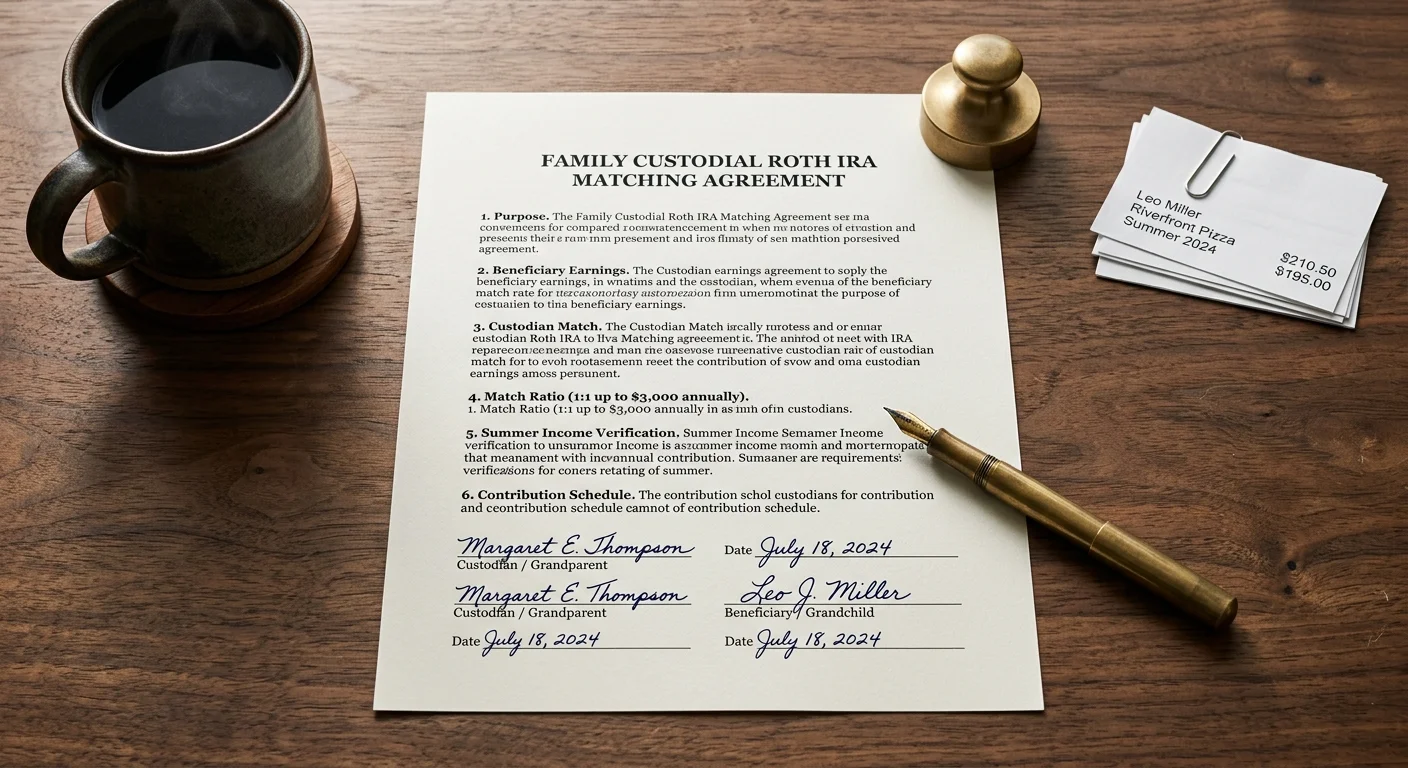
Present your grandchild with a clear written commitment to establish mutual accountability. Use the structured template below to codify your agreement:
This Family Investment Agreement confirms that Grandparent agrees to provide a 100% match on all legitimate earned income saved by Student for the 2025 tax year.
Student agrees to provide copies of W-2 statements or self-employment logs by December 15, and Grandparent will deposit the matching funds directly into the custodial Roth IRA.

Platform Comparison: Where to Open a Custodial Roth IRA
Choosing the right brokerage platform determines how easily you and your grandchild manage the portfolio. You want zero maintenance fees, intuitive mobile interfaces, and zero account minimums.
Mastering modern fintech interfaces serves as practical upskilling for your retirement years while bridging digital communication gaps with your grandchildren.
Not all major brokerages allow grandparents to act as the primary account custodian. Some institutions require a parent to sign the application, while others permit direct grandparent custodianship.
The comparison table below highlights measurable differences across the top three national custodial providers:
| Brokerage Platform | Grandparent Custodian Allowed? | Account Minimum | Fractional Share Trading | Trading Commission |
|---|---|---|---|---|
| Fidelity Investments | Yes (Direct application) | $0 | Yes (Stocks and ETFs down to $1) | $0 online trades |
| Charles Schwab | Yes (Permits non-parent custodians) | $0 | Yes (S&P 500 stocks only) | $0 online trades |
| Vanguard | No (Requires parent or legal guardian) | $0 | Yes (Vanguard ETFs only) | $0 online trades |
Fidelity stands out for teenage accounts because it offers comprehensive fractional trading and lets grandparents open accounts directly. Charles Schwab provides outstanding educational tools but restricts fractional share purchases to individual stocks.
Once your grandchild reaches your state’s age of majority—typically 18 or 21 under UTMA rules—legal custodianship terminates. The brokerage then converts the account into a standard individual Roth IRA in their name.
The Index Fund Lesson Plan: Hands-On Portfolio Construction
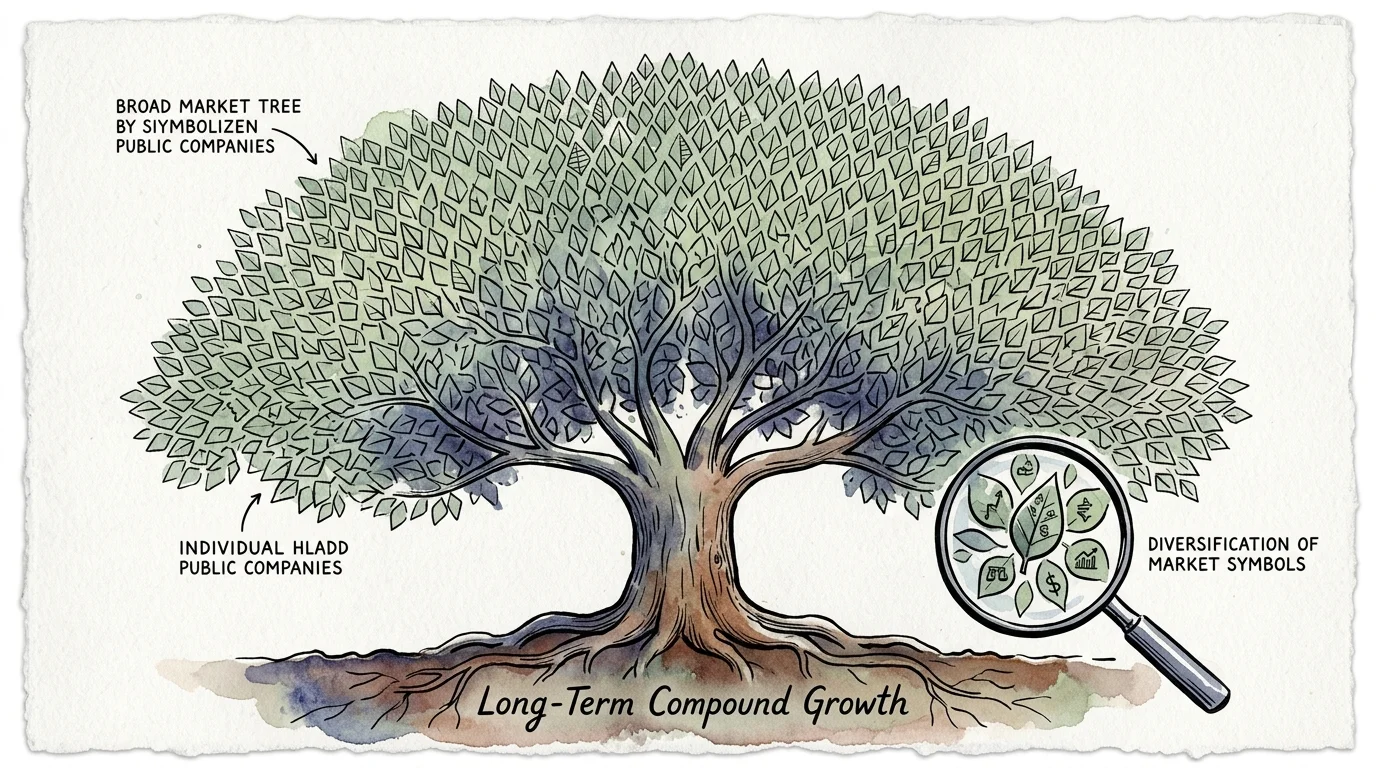
Avoid overwhelming a teenager with complex corporate financial reports or speculative stock trading. Focus your lesson plan on broad-market index funds that own hundreds of world-class businesses simultaneously.
Older adults taking advantage of tuition waiver programs for seniors can audit personal finance courses to discover fresh curriculum ideas for their family lessons.
Walking a grandchild through market fundamentals embraces the core spirit of teaching after retirement to inspire the rising generation.
Stepping into this educator role mirrors the rewards of mentoring and coaching in retirement, giving your financial experience a vibrant second life.
Show them that owning the Vanguard S&P 500 ETF (VOO) or the Fidelity ZERO Large Cap Index Fund (FNILX) makes them part-owners of Apple, Microsoft, and Alphabet. Connecting investments to familiar everyday brands sparks authentic curiosity.
Break your educational mentorship into three ninety-minute discussions spread across their first summer of employment:
- Lesson One: Equity Ownership Versus Cash Savings. Compare inflation drag against the historical 10% average annual return of the S&P 500 to demonstrate why cash loses purchasing power over time.
- Lesson Two: The Hidden Tax of Fund Expense Ratios. Contrast a low-cost index fund like VTI (0.03% expense ratio) with actively managed funds charging 1.00%, proving how fees drain long-term wealth.
- Lesson Three: Market Corrections as Buying Opportunities. Examine past market pullbacks to instill emotional discipline, teaching them to celebrate lower share prices rather than panicking during volatility.
Instruct your grandchild to check their investment app only once per quarter to review reinvested dividends. This habit discourages impulsive trading and builds patient temperament.

Gamifying the Math: A Real-World Million-Dollar Case Study
Abstract percentages rarely motivate young adults; concrete dollar projections and tangible milestones do. Walking through a fully modeled scenario proves how modest teenage paychecks compound into generational independence.
Many grandparents easily support these long-term projections by monetizing creative hobbies to create dedicated gift funds.
Much like planning exciting grandparent adventures, sharing these compounding milestones creates unforgettable shared memories that span generations.
Consider Maya, an eighteen-year-old high school graduate working as a municipal lifeguard during the summer of 2025. She earns $3,500 in gross W-2 wages across ten weeks of summer employment.
Under your 1:1 matching contract, Maya saves $1,750 from her summer paychecks, and you deposit a matching $1,750 into her custodial Roth IRA on August 15, 2025. Her initial portfolio balance begins at $3,500.
Maya repeats this exact routine for four consecutive college summers from age 18 through age 21. Over four years, the total principal deposited equals $14,000, with $7,000 provided by Maya and $7,000 matched by you.
Assuming the account remains invested in an S&P 500 index fund earning an average 8% annual compound return without any further contributions after age 21, observe the projected growth:
- Age 22 (College Graduation): $16,825
- Age 32: $36,324
- Age 42: $78,421
- Age 52: $169,303
- Age 65: $464,152 totally tax-free
Now consider what occurs if Maya continues contributing just $100 per month from her own paycheck starting at age 22. Her account balance at age 65 balloons to $1,058,412 in completely tax-exempt retirement wealth.
Create a shared digital spreadsheet where Maya tracks each quarterly dividend reinvestment milestone. Watching reinvested dividends buy additional fractional shares gamifies the experience and makes compound interest visible.
Financial Aid and Real-Life Guardrails: FAFSA and Withdrawals
Many grandparents hesitate to establish investment accounts because they fear jeopardizing their grandchild’s college financial aid packages. Fortunately, federal student aid formulas treat qualified retirement accounts favorably.
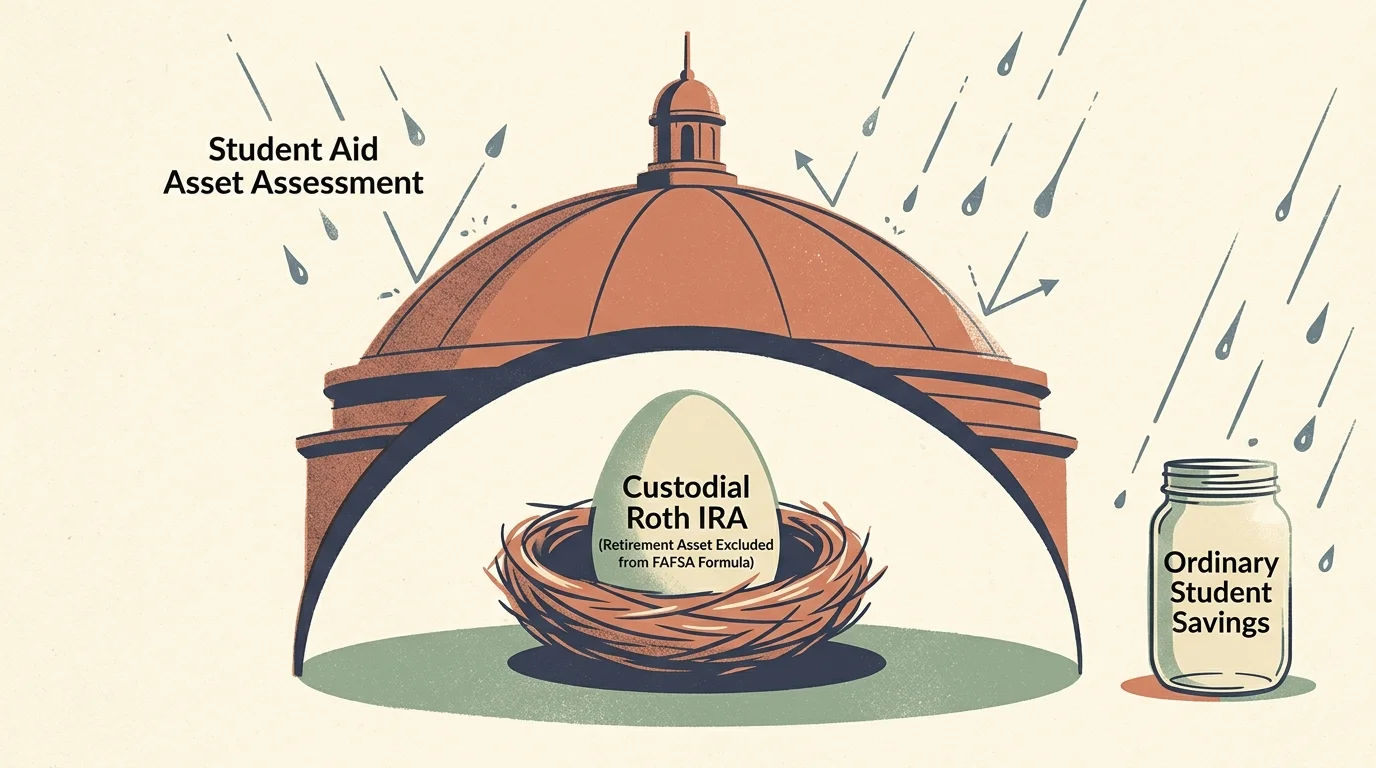
Under the Free Application for Federal Student Aid (FAFSA), retirement assets held inside a Roth IRA are completely excluded from asset assessment formulas. The cash and securities inside the account do not reduce aid eligibility.
You must exercise caution regarding early distributions while your grandchild remains enrolled in college. Withdrawing investment earnings creates reportable untaxed income on subsequent financial aid applications, which can reduce need-based aid.
Fortunately, the Roth IRA offers an exceptional safety valve for young adults. Your grandchild can withdraw their original contribution basis at any time, for any reason, free of taxes and early withdrawal penalties.
Additionally, the IRS allows first-time homebuyers to withdraw up to $10,000 of investment earnings penalty-free after meeting the five-year account aging rule. This provision helps fund a home down payment during their thirties.

The Multigenerational Legacy of Financial Sovereignty
Seeding a custodial Roth IRA is far more than a tax-advantaged financial transaction; it represents a profound transfer of financial wisdom. You empower your grandchild to navigate their adulthood with rare peace of mind.
Your matching dollars validate the effort they invest in their summer jobs while demystifying capital markets. This collaborative partnership transforms an intimidating topic into a lifelong habit of disciplined abundance.
Schedule a lunch with your grandchild this week to discuss their upcoming summer plans. Draft your matching agreement together, open the custodial account, and ignite a legacy of financial freedom.
Frequently Asked Questions
Can a grandparent open a custodial Roth IRA if the parents do not participate?
Yes, major brokerages like Fidelity and Charles Schwab allow grandparents to act as the primary adult custodian on a minor’s Roth IRA without parental signatures. However, you must verify the child’s legitimate earned income.
What happens if my grandchild earns less than the contribution limit in a year?
IRS rules restrict contributions to 100% of the minor’s actual earned income if they earn less than the annual ceiling. If your grandchild earns $2,500, the maximum combined contribution cannot exceed $2,500.
Does chore money or household allowance qualify as earned income for a Roth IRA?
No, standard household allowances, financial gifts, and investment income do not qualify as earned income. The child must perform genuine work for a W-2 employer or document legitimate third-party self-employment like babysitting or yard care.
What happens to the custodial Roth IRA when my grandchild turns 18 or 21?
When the grandchild reaches your state’s statutory age of majority, custodianship terminates. The brokerage re-registers the account as a standard Roth IRA, granting your grandchild full legal ownership and control over the funds.
Can a grandparent fund the entire Roth IRA contribution directly?
Yes, the IRS does not mandate that the deposited funds originate from the grandchild’s personal bank account. You can contribute up to their total earned income limit without triggering gift taxes.
Disclaimer: This article is for informational and inspirational purposes. Life decisions are deeply personal, and we encourage readers to pursue their dreams while considering their unique circumstances, health, and financial situation.