
You can master acoustic fingerstyle guitar in retirement without enduring debilitating fingertip pain or joint stiffness. Your musical journey never requires punishing string tension or thick, painful calluses.
By swapping heavy tension for responsive acoustic mechanics, sensitive hands can play comfortably without sacrificing tonal warmth or expressive dynamics.
This guide delivers the exact string tensions, crossover geometries, and millimeter-precise action measurements that eliminate physical fretting barriers. Discover how targeted setup specifications unlock effortless fingerstyle playing at seventy-two and beyond.
Understanding Fretting Fatigue and Hand Mechanics
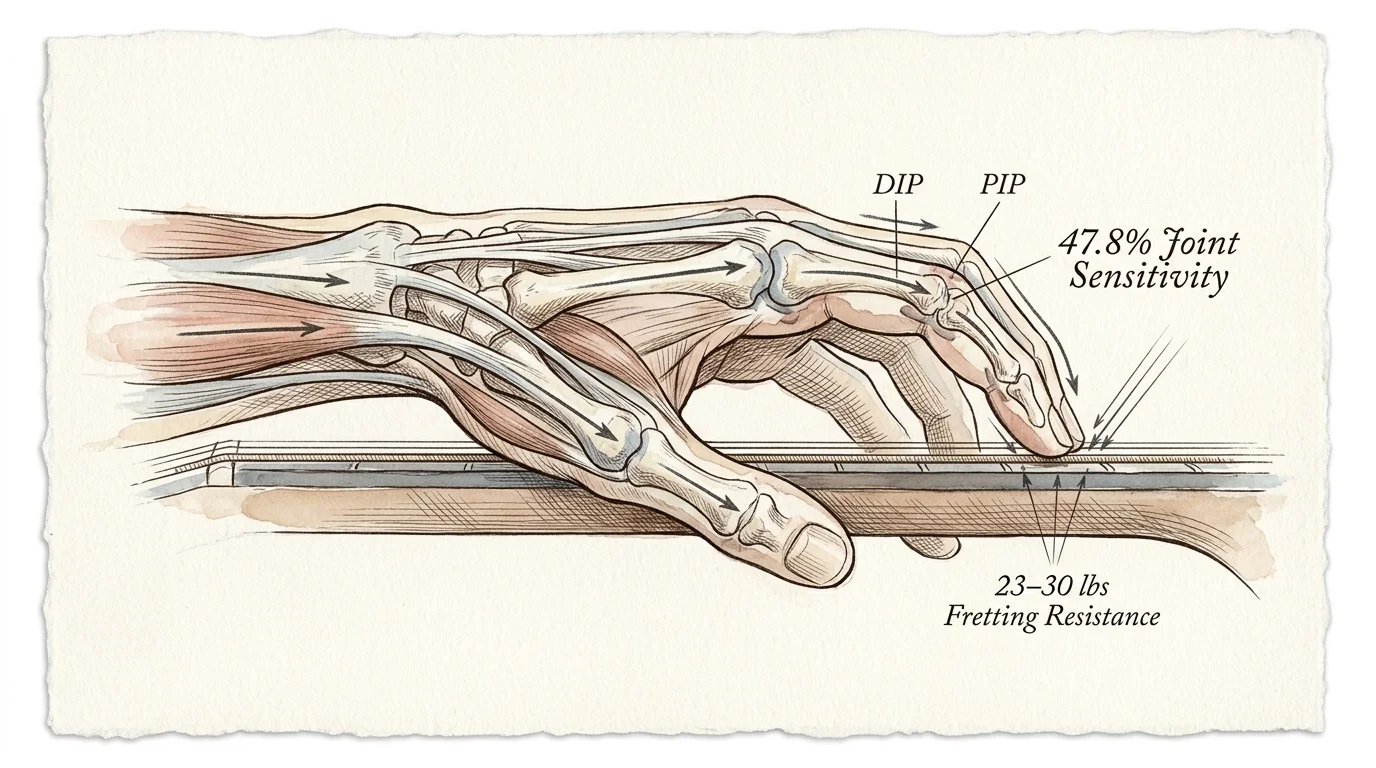
Fretting an acoustic guitar places concentrated pressure directly on your fingertip nerve endings. The force transfers across your distal interphalangeal and proximal interphalangeal joints.
Similar to how crafters adapt through ceramic hand-building with carpal tunnel, musicians can modify their physical mechanics to protect delicate hand nerves.
If discomfort is concentrated around the base of your fretting hand, transitioning to an open-tuning parlor guitar setup offers another gentle way to bypass difficult chord shapes.
According to the Centers for Disease Control and Prevention National Health Interview Survey, 47.8% of American adults aged sixty-five and older live with doctor-diagnosed arthritis.
Traditional acoustic guitars require between twenty-three and thirty pounds of downward force per string to sound clear notes. That constant resistance rapidly inflames sensitive joint tissues.
Fingerstyle technique compounds this physical demand because your fretting fingers must hold complex chord shapes while individual melody lines move above the bass notes.
When high string tension forces you to squeeze the fretboard tightly, your hand muscles fatigue within ten to fifteen minutes.
Joint-friendly playing requires lowering the physical resistance of the instrument to match your current hand strength.
Health specialists at the National Institute on Aging emphasize that engaging in creative physical activities like music supports motor function when you protect your joints from repetitive strain.
You do not need to fight stiff acoustic strings to enjoy the deep satisfaction of playing your favorite melodies.
Modifying string physics and neck dimensions removes the barrier of hand pain entirely.

Acoustic String Tension Ratings by the Numbers
String tension represents the cumulative physical pull exerted by a tuned set of strings across the guitar bridge, soundboard, and neck.
Understanding these numbers allows you to make informed decisions that protect your fretting hand from unnecessary trauma.
Standard light phosphor bronze acoustic strings, gauged 12 to 53, generate massive structural tension.
A standard set of D’Addario EJ16 phosphor bronze strings exerts 163.2 pounds of total downward and horizontal pull at standard concert pitch.
On an EJ16 set, the low E string pulls 26.0 pounds, the G string pulls 30.2 pounds, and the D string pulls 30.5 pounds.
Pressing strings under thirty pounds of individual tension against hard nickel frets rapidly irritates sensitive finger pads.
Silk and steel acoustic string sets cushion that impact by inserting micro-fiber silk winding between the steel core and the outer wrap wire.
A set of Martin Authentic Acoustic SP MA130 silk and steel strings, gauged 11.5 to 47, pulls just 122.2 pounds of total tension.
Choosing D’Addario EJ40 silk and steel strings drops total string tension down to 127.0 pounds.
These specialized hybrid sets reduce overall fretting resistance by 22% to 25% compared to standard acoustic light strings.
Normal-tension nylon classical strings offer an even more dramatic physical reduction.
A standard set of D’Addario Pro-Arté EJ45 normal-tension nylon strings pulls only 83.5 pounds across the entire neck.
Switching from standard phosphor bronze strings to normal-tension nylon removes nearly eighty pounds of continuous mechanical tension from your fretting hand.
Silk and Steel Guitar Strings for Arthritis Relief and Tone
If you love your current steel-string guitar, you do not need to replace the entire instrument to find physical relief.
Exploring gentler equipment setups is a great way to enjoy inspiring projects for all skill levels without placing undue strain on your hands.
Adopting softer strings allows you to focus on rekindling old passions rather than nursing sore fingers after practice.
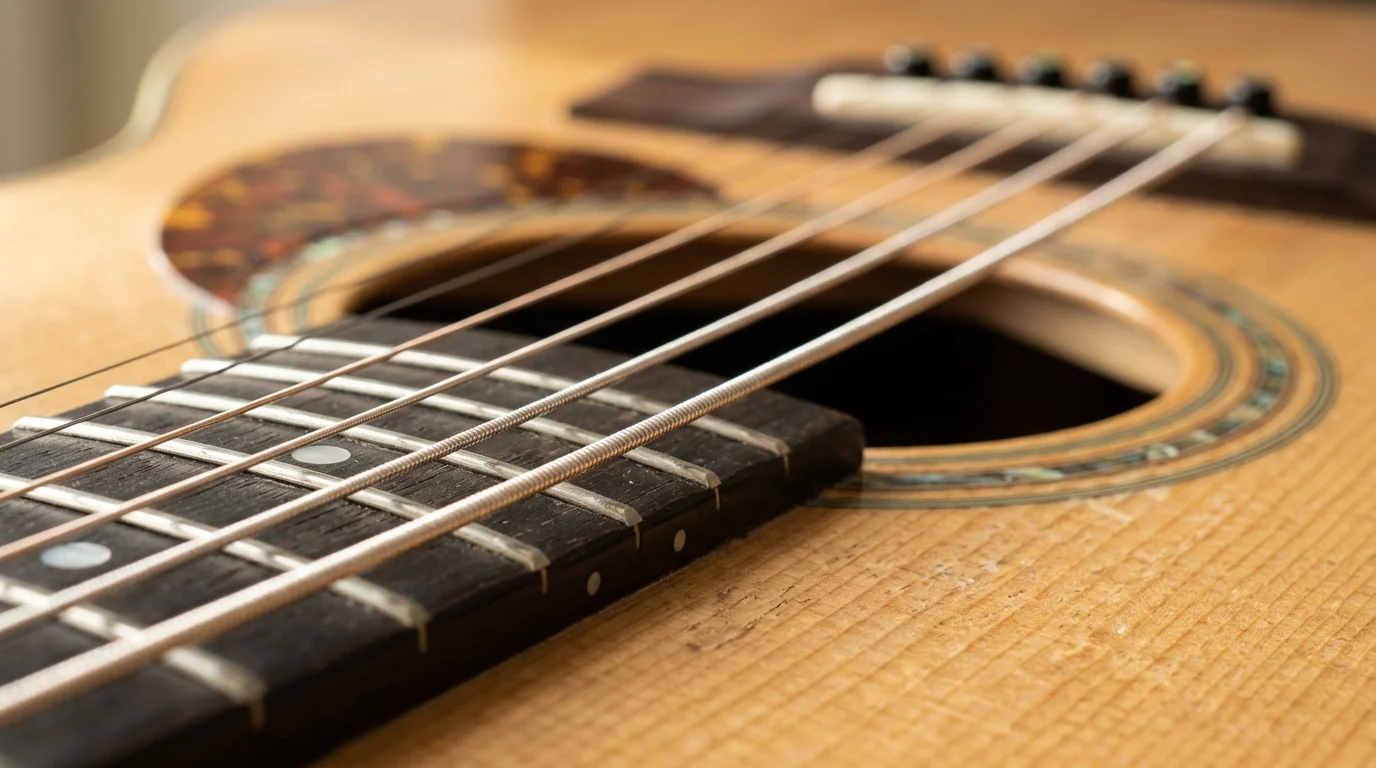
Restringing your existing guitar with silk and steel guitar strings arthritis players rely on provides immediate tactile cushioning.
Manufacturers wind silver-plated copper wire over a composite core of steel wire and soft silk filaments.
The silk layer absorbs vibration energy, softens string stiffness, and makes the outer surface feel noticeably more pliant under your fingertips.
Silk and steel strings deliver distinct acoustic and mechanical advantages for players managing sensitive joints:
- The lower tensile pull reduces the downward finger pressure required to achieve clear, buzz-free tone.
- The silver-plated outer winding produces a silky, gentle texture that eliminates the abrasive rasp of traditional bronze wrap wire.
- The composite core creates a warm, sweet, parlor-like voice that complements traditional fingerpicking patterns.
- The lower overall string pull reduces forward neck relief, which naturally brings the strings closer to the fretwire.
You must also anticipate how silk and steel strings alter your acoustic tone and projection.
Because they carry lower tension, silk and steel strings drive acoustic soundboards with less percussive kinetic energy.
They generate slightly less acoustic volume and have a shorter sustain envelope than bright phosphor bronze alloys.
For intimate home playing and fingerstyle melodies, this delicate, balanced tone sounds sweet and remarkably refined.
Crossover Classical Guitars: Ergonomic Geometry for Sensitive Hands
Many older guitarists consider classical nylon-string guitars for their soft touch but quickly abandon them due to awkward neck geometry.
Making these tactile accommodations opens a smooth pathway when reinventing yourself in retirement through art and music.
Just as weavers benefit from an ergonomic tabletop weaving setup, guitarists can choose instruments engineered to minimize upper-body and joint tension.
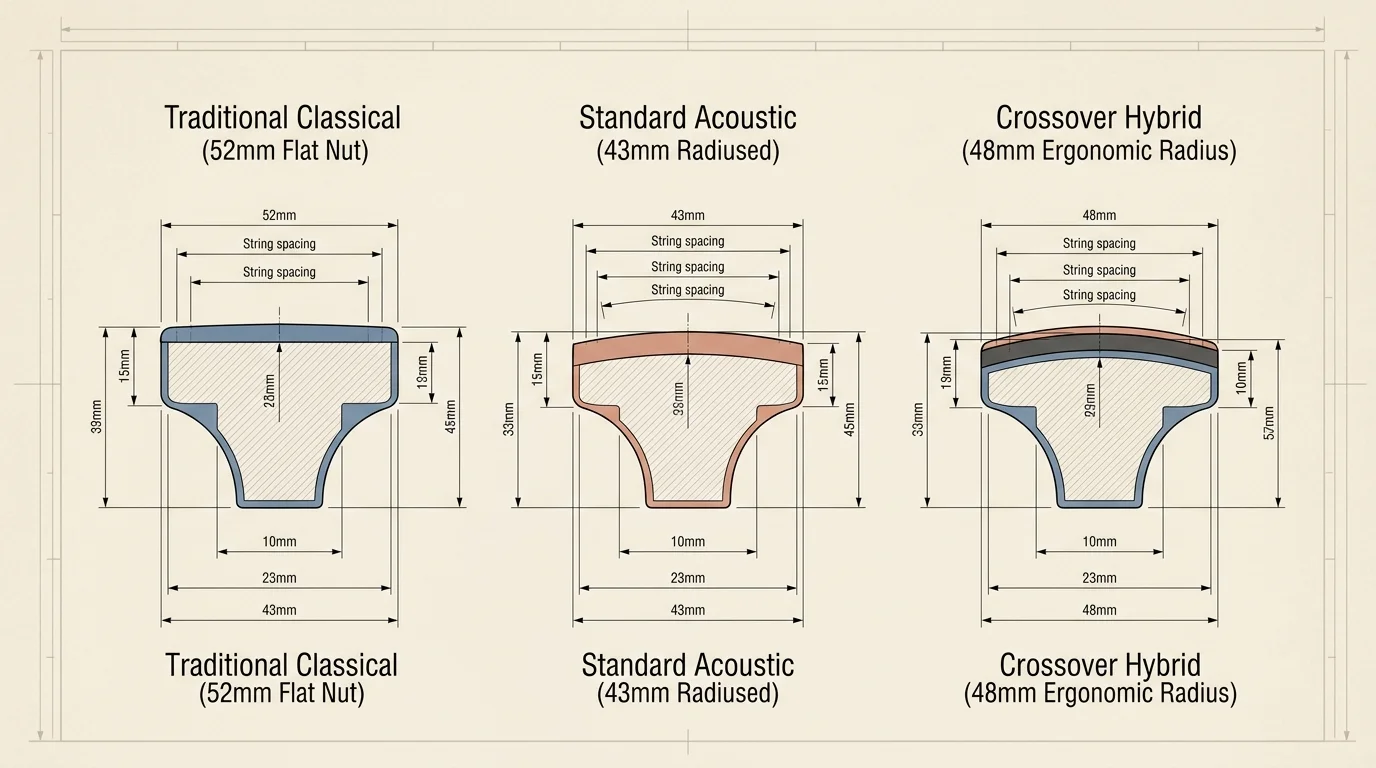
Traditional classical instruments feature an ultra-wide 52-millimeter nut width and a completely flat fingerboard.
Reaching across a flat, two-inch fretboard forces your fretting wrist into extreme flexion, which strains stiff joints and aggravates carpal tunnel tissues.
A modern crossover classical guitar for seniors solves this exact anatomical issue.
Crossover guitars blend low-tension nylon strings with the slim, comfortable neck profiles of modern steel-string acoustics.
They narrow the nut width down to 48 millimeters (1 7/8 inches) and introduce a gentle sixteen-inch fretboard radius.
This curved radius aligns naturally with the relaxed anatomical arc of your human fingers, reducing required finger reach.
Leading luthiers engineer several exceptional crossover instruments that cater specifically to sensitive hands:
- Córdoba Fusion 5 ($449–$499 USD): Features a fast 48-millimeter nut width, a 16-inch fretboard radius, cutaway access, and an onboard Fishman pickup.
- Yamaha NTX1 ($480–$549 USD): Offers a 48-millimeter nut width, slim modern neck carve, and shallow body depth that reduces shoulder elevation.
- Taylor Academy 12e-N ($799 USD): Provides a 47.6-millimeter nut width and an integrated armrest bevel that prevents forearm circulation cutoff.
The built-in armrest bevel on the Taylor Academy series represents a profound ergonomic leap forward for older players.
By softening the hard wooden edge where your strumming arm rests, the bevel protects your radial nerve and preserves blood flow.
Researchers at the Stanford Center on Longevity highlight that adopting supportive tools and adaptable environments empowers older adults to thrive in complex creative pursuits.
Selecting an ergonomically tailored crossover guitar allows you to express your musical creativity without physical strain.

Benchmarking Instrument Specifications and Tension Loads
Comparing physical guitar specifications side by side clarifies why certain setups cause chronic finger fatigue while others feel effortless.
Combining instrument modifications with broader routines for staying active and healthy after 65 ensures long-term physical freedom.
Much like adjusting bench heights when downsizing to Japanese hand woodworking, fine-tuning your guitar setup preserves physical endurance.
Making sensible mechanical adjustments to keep your favorite pastimes comfortable is an essential component of overall retirement wellness.
Evaluating nut width, fingerboard radius, string tension, and standard action reveals the exact mechanical loads your hands must manage.
The comparative data below outlines structural dimensions across standard steel acoustics, hybrid string configurations, and leading crossover models.
| Guitar Setup & Model | String Type & Core | Total Tension (lbs) | Nut Width (mm) | Fretboard Radius | Street Price (USD) |
|---|---|---|---|---|---|
| Standard Acoustic (000-12 Fret) | D’Addario EJ16 Phosphor Bronze | 163.2 lbs | 44.5 mm (1 3/4″) | 16″ Curved | $800–$1,500 |
| Cushioned Acoustic (000-12 Fret) | Martin MA130 Silk and Steel | 122.2 lbs | 44.5 mm (1 3/4″) | 16″ Curved | $800–$1,500 |
| Traditional Classical | D’Addario EJ45 Normal Nylon | 83.5 lbs | 52.0 mm (2.05″) | Flat (Infinite) | $400–$1,200 |
| Córdoba Fusion 5 Crossover | Savarez Corum High/Normal Nylon | 85.0 lbs | 48.0 mm (1 7/8″) | 16″ Radiused | $449–$499 |
| Yamaha NTX1 Crossover | Yamaha S10 Normal Nylon | 83.0 lbs | 48.0 mm (1 7/8″) | 16″ Radiused | $480–$549 |
| Taylor Academy 12e-N Crossover | D’Addario Pro-Arté Carbon/Nylon | 86.4 lbs | 47.6 mm (1 7/8″) | 15″ Radiused | $799 |
Notice the massive mechanical difference between the standard acoustic baseline and the crossover options.
Switching to a crossover instrument reduces your hand’s physical workload by roughly seventy-eight pounds of resistance while preserving familiar neck spacing.
Low Action Acoustic Guitar Fingerstyle: Luthier Bench Specs
String tension represents only one half of the physical playability equation; the height of those strings above the frets dictates fretting effort.
Standard factory acoustic guitars ship with conservative, high action designed to prevent fret buzz under heavy flatpick strumming.
A typical factory setup measures 6/64 inch (2.38 mm) at the twelfth fret on the low E string and 5/64 inch (2.0 mm) on the high E string.
Pushing stiff strings down across that wide gap strains aging joints and pulls individual notes sharp.
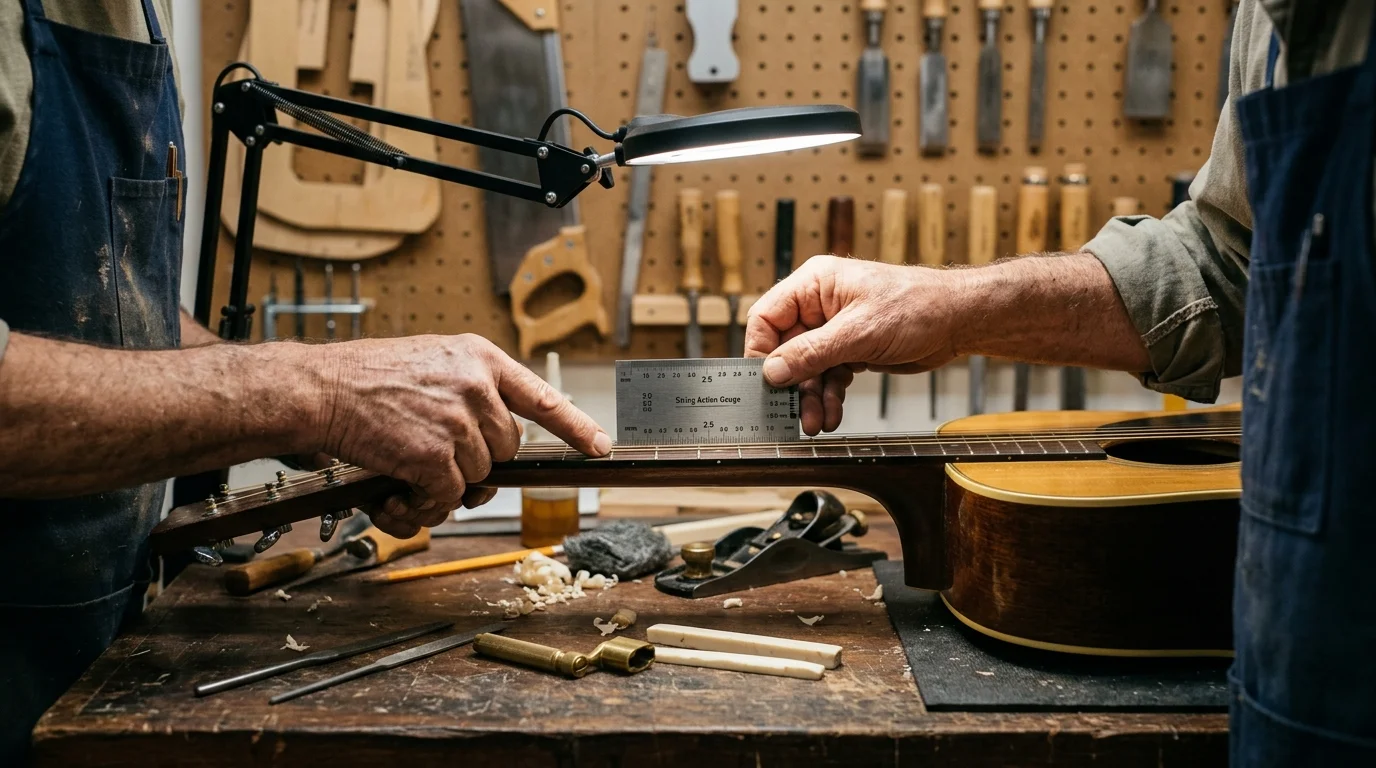
Achieving a true low action acoustic guitar fingerstyle setup requires professional bench calibration across three specific mechanical parameters.
Take your instrument to a skilled guitar repair technician and request these exact bench specifications:
- Neck Relief: Adjust the internal truss rod to achieve between 0.006 and 0.008 inches (0.15 to 0.20 mm) of clearance at the 7th fret.
- Nut Slot Depths: File the individual nut slots so open strings clear the 1st fret crown by just 0.012 to 0.014 inches on trebles and 0.018 inches on basses.
- 12th Fret Low E Height: Lower the bridge saddle to set the 12th fret low E string clearance to 4/64 inch (1.6 mm).
- 12th Fret High E Height: Shape the treble side of the saddle to set the 12th fret high E string clearance to 3/64 inch (1.2 mm).
Lowering the nut slots makes an astonishing difference in open-position chord comfort.
When the nut slots sit at proper bench heights, fretting an F-major barre chord or a C-major chord requires minimal hand clamping pressure.
Because low tension strings vibrate with a wider physical ellipse, setting the action to 1.6 millimeters requires level fret crowns.
Ask your luthier to inspect the fretboard with a precision fret rocker to level any high spots before finalizing your low action.

Worked Example: A 72-Year-Old Retiree’s Setup Transformation
Consider the real-world scenario of Robert, a seventy-two-year-old retired school administrator who dreamed of playing acoustic fingerstyle.
Robert owned a heritage spruce-top dreadnought strung with standard 12-53 phosphor bronze strings pulling 163 pounds of tension.
His guitar featured factory-stock 12th fret action measuring 2.6 millimeters on the low E string and 2.1 millimeters on the high E string.
Within twelve minutes of fingerpicking, sharp joint pain flared across the base of his fretting thumb and index finger.
His tender fingertips developed deep grooves that burned for hours, forcing him to take three days off between practice sessions.
Robert refused to abandon his musical passion and executed a structured, affordable instrument transformation.
First, Robert purchased a Córdoba Fusion 5 crossover guitar for $469 USD, reducing his neck string pull down to 85 pounds.
Next, he invested $85 USD with a local master luthier for a comprehensive bench setup tailored specifically to fingerstyle touch.
The luthier leveled frets four through nine, dialed neck relief to 0.007 inches, and lowered the bone bridge saddle.
The finished setup measured exactly 1.7 millimeters on the low E string and 1.2 millimeters on the high E string at the 12th fret.
Robert also introduced an ergonomic foam thigh cushion costing $38 USD, raising the guitar neck to a forty-five-degree angle.
This elevated neck angle straightened his fretting wrist, completely eliminating the joint pinching he had endured for years.
His total investment across the new crossover guitar, professional bench setup, and ergonomic cushion came to $592 USD.
Robert now practices forty-five minutes every morning without pain, comfortably learning the classic fingerstyle repertoire he loves.
Adaptive Practice Protocols and Joint Preservation
Optimizing your guitar hardware is the mechanical foundation, but adapting how you practice ensures long-term physical longevity.
Retirement gives you the invaluable gift of schedule flexibility; use that luxury to your musical advantage.
Rather than grinding through an exhausting single sixty-minute practice block, divide your playing into two twenty-minute sessions.
Spacing your sessions across morning and afternoon allows joint synovial fluid to recover and prevents tissue inflammation.
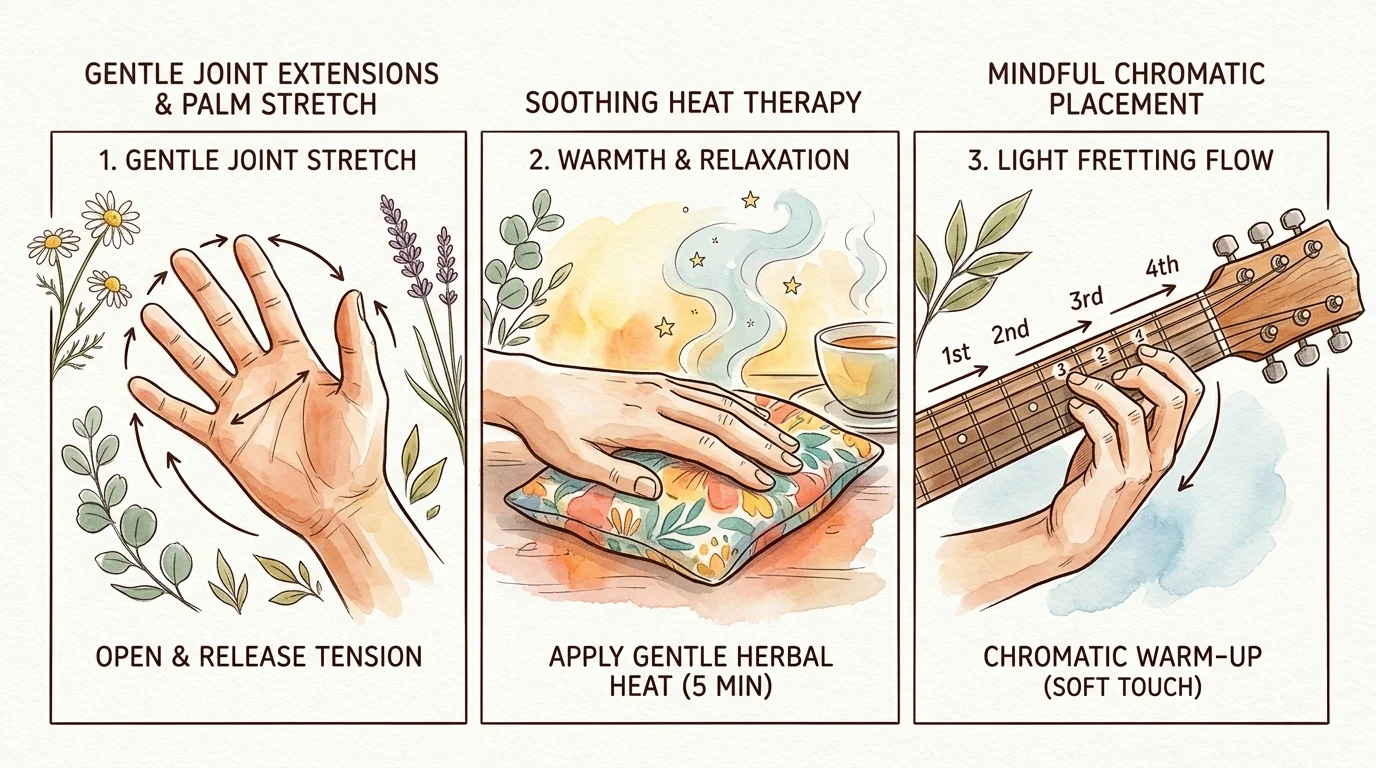
Implement these joint-preserving practice habits every time you pick up your instrument:
- Immerse your hands in warm water for three minutes prior to playing to increase connective tissue elasticity.
- Perform slow, gentle finger extensions and wrist circles away from the fretboard before touching the strings.
- Anchor your fretting thumb squarely behind the guitar neck rather than wrapping it tightly over the top edge.
- Apply only the minimum finger pressure required to sound a clean note, consciously releasing excess tension between chord changes.
- Conclude each practice session with gentle forearm stretches to keep flexor tendons gliding smoothly.
Retirement represents the ultimate chapter for creative reinvention, curiosity, and artistic growth.
Social organizations like Encore.org champion older adults who channel their time and passion into meaningful encore pursuits.
Learning acoustic fingerstyle guitar allows you to create beauty, sharpen your cognitive reflexes, and share timeless music with those you love.
By pairing low-tension strings and refined crossover ergonomics with mindful practice routines, you can play comfortably for decades to come.
Frequently Asked Questions
Can I install nylon strings directly onto my standard steel-string acoustic guitar?
No, you should never put standard tie-end nylon strings on a steel-string guitar without specialized ball-end nylon sets, and even then results are poor. Steel-string soundboards are braced heavily for 160 pounds of tension, meaning lightweight 85-pound nylon strings cannot vibrate the top efficiently.
Do silk and steel strings require a new nut or saddle setup?
Silk and steel strings fit into standard acoustic nut slots without modification because their outer gauges closely match standard ultra-light strings. However, because they pull approximately forty fewer pounds of tension, your luthier may need to loosen the truss rod slightly to maintain proper neck relief.
What is the difference between a classical guitar and a crossover guitar?
Traditional classical guitars feature wide 52-millimeter nut widths, flat fingerboards, and no onboard electronics. Crossover guitars narrow the nut width to 48 millimeters, add a comfortable curved 16-inch fingerboard radius, and often include cutaway body profiles for effortless access to higher frets.
Will lowering acoustic guitar action to 1.6 mm cause fret buzz?
A 1.6-millimeter low E action will not buzz during fingerstyle playing provided your frets are level and you play with a controlled touch. If you strike strings aggressively with a heavy flatpick, low action will buzz; fingerstyle touch relies on clean, upward string release.
Disclaimer: This article is for informational and inspirational purposes. Life decisions are deeply personal, and we encourage readers to pursue their dreams while considering their unique circumstances, health, and financial situation.