If your retirement landscape washes collapse into dull sludge, fluid dynamics is the real culprit rather than your creative potential. You can master how to stop muddy watercolors by treating paint viscosity and particulate mass as an engineering challenge.
Developing technical confidence with watercolors is just one of many inspiring retirement crafting projects designed to stimulate mental focus and fine motor precision.
If you are setting up your studio kit from scratch, curating a dedicated split-palette watercolor setup will make pigment behavior far more predictable.
Watercolor behaves according to fluid mechanics and mineral particulate density, meaning clean washes require matching surface tension and viscosity rather than relying on artistic intuition. Learning beginner watercolor wash techniques over 60 begins with understanding that heavy mineral particles sink while light synthetic dyes float.
By applying a systematic watercolor water to pigment ratio, you will build luminous atmospheric depth across your paper without over-working a single wash.
The Physics of Mud: Why Intuition Fails the Analytical Mind
Watercolor painting often intimidates analytical professionals because traditional instruction relies on vague descriptions like feeling the wash. If you spent decades evaluating grades, structural loads, and material specs, intuitive advice offers little actionable guidance.
Retirees seeking another structured visual craft with tangible technical rules may also appreciate kitchen-table linocut printmaking for bold graphic contrast.
Many retirees find success pairing wash studies with beginner retirement sketching habits to map tonal values before laying down paint.
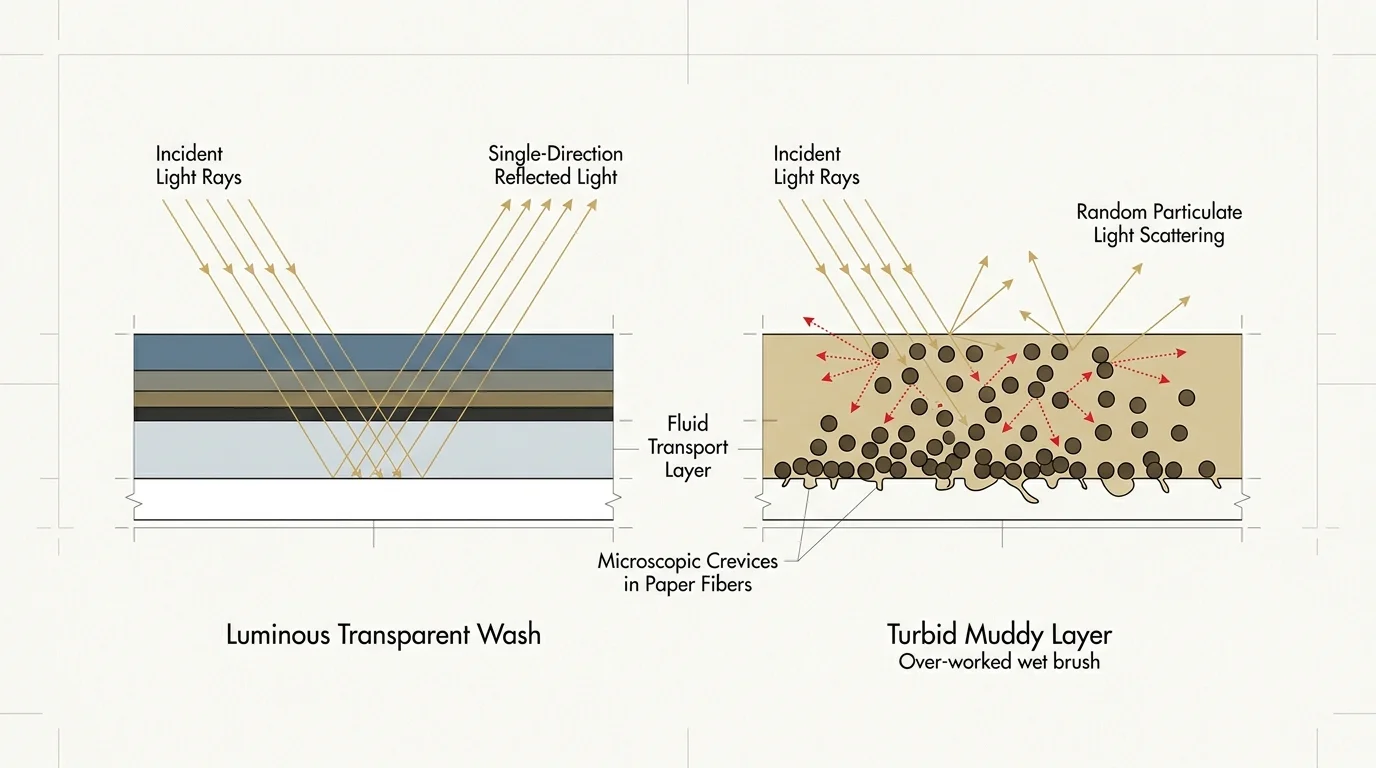
Mud is not an aesthetic failing; it is an optical and mechanical phenomenon. It occurs when light waves cannot penetrate your paint layers to reflect off the white cellulose fibers beneath.
When you brush pigment over paper, water acts as a fluid transport mechanism. The cotton fibers of watercolor paper absorb fluid through capillary draw, pulling suspended pigment particles downward into microscopic crevices.
Different pigments feature radically different specific gravities and particle diameters. Heavy mineral particulates drop into paper indentations almost immediately, while micro-milled synthetic dyes remain suspended in the surface water film.
Trouble begins when you apply a wet brush to an area that has already begun to evaporate. The mechanical abrasion of the hairs pulls heavy settled particles back up into the fluid suspension.
Once lifted, those mineral particles collide randomly with your newer paint layer. This erratic particulate suspension scatters light in every direction, which destroys clarity and creates an opaque brown film.
To avoid this collapse, you must respect the drying timeline of your paper. Understanding fluid movement allows you to step back and let hydraulic forces do the work.
The Four Viscosity Ratios: From Tea to Butter
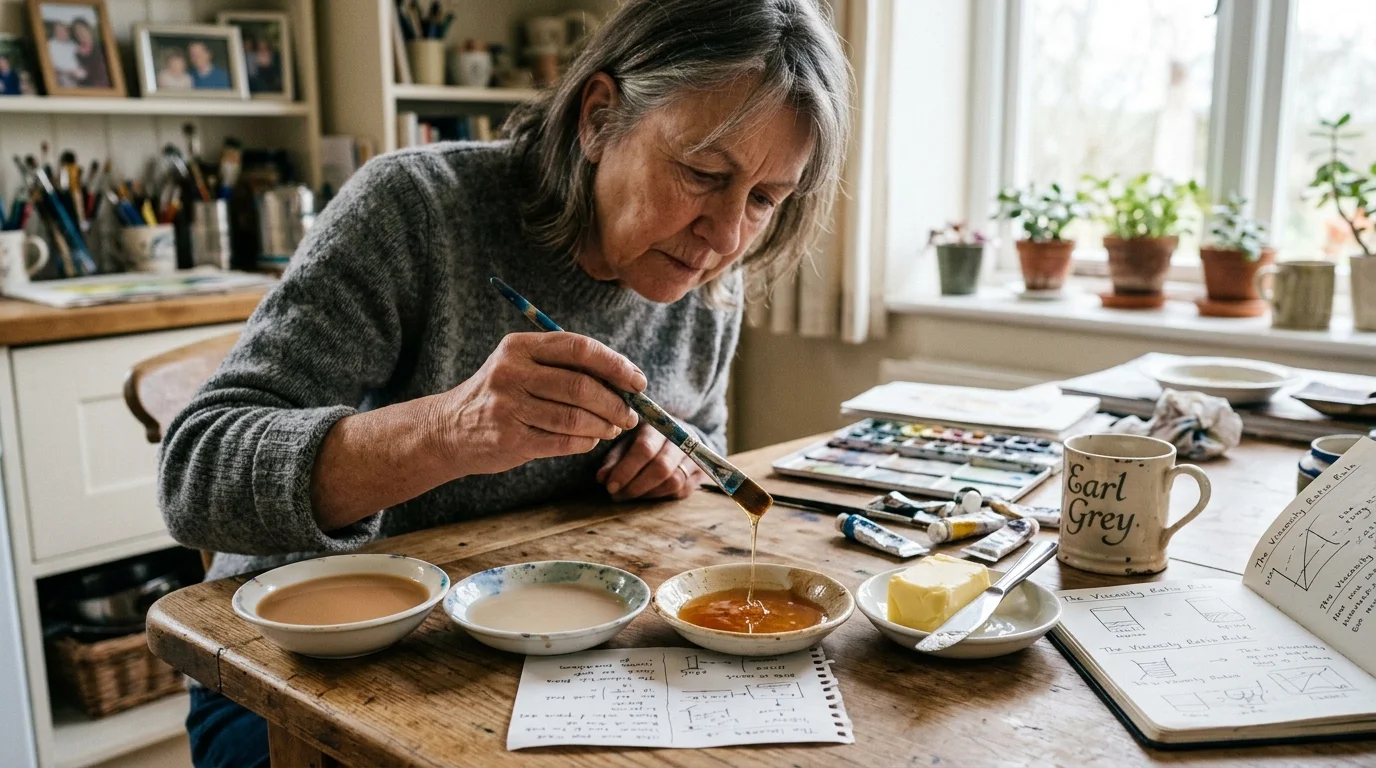
Controlling your watercolor water to pigment ratio requires quantifiable benchmarks rather than guesswork. Professional painters categorize paint dilution into four mechanical viscosity states: tea, milk, cream, and butter.
This measured control of fluid dynamics and tool pressure shares much in common with mastering retirement calligraphy stroke techniques on textured paper.
Each viscosity stage serves a precise functional role in building landscape depth. The foundational rule of clean watercolor layering requires working from the lowest viscosity to the highest viscosity.
- Tea Viscosity (90% water, 10% pigment): Pale, fully fluid suspension designed for sky underwashes, background hazes, and preliminary structural maps.
- Milk Viscosity (75% water, 25% pigment): Flowing wash with moderate tinting strength, used for distant mountain ranges, soft foliage masses, and broad shadows.
- Cream Viscosity (50% water, 50% pigment): Saturated paint that holds brush shape briefly before settling, ideal for midground tree trunks, architectural structures, and deep water reflections.
- Butter Viscosity (20% water, 80% pigment): Dense paste directly from the tube, designed for crisp dry-brush texture, foreground rocks, and sharp silhouette details.
Applying a low-viscosity wash over a high-viscosity layer causes an instant hydraulic blowout called a backrun or cauliflower. The excess water in the new layer dilutes the drying paint and drives pigment outward into a ragged, muddy ridge.
You can prevent wash destruction by testing your mixture on a scrap strip of 140-pound paper before touching your painting. The paint should flow from the brush belly smoothly without flooding the paper fibers in an uncontrolled puddle.
By standardizing your paint mixtures into these four distinct categories, you eliminate the primary cause of muddy watercolors. Every brush stroke receives an intentional job and an exact water volume.

Pigment Mineralogy: The Inorganic vs Organic Spec Chart
A civil engineer would never mix concrete without reviewing aggregate specifications, and you should treat watercolor pigments with the same rigor. Art supplies fall into two chemical categories: inorganic mineral compounds and modern organic synthetics.
Working with heavy natural minerals often sparks a curiosity for three-dimensional mediums, much like exploring retirement sculpting to build tactile form.
If managing water drying times feels restrictive outdoors, exploring a lightweight plein air oil rig provides an alternative medium with longer working times.
Inorganic pigments, such as natural ochres and synthetic iron oxides, consist of crushed stone, calcined minerals, and heavy metals. Their dense particles settle rapidly and form grainy, granulating textures on cold-press paper.
Modern organic pigments, such as quinacridones and phthalocyanines, are carbon-chain compounds engineered in chemical laboratories. Their microscopic particles stain paper fibers directly and permit light to pass straight through without scattering.
When you combine dense inorganic minerals with modern synthetic dyes on damp paper, the heavy particles collide with the staining dyes. The result is rapid optical contamination and sludge.
| Pigment Name & Color Index | Chemical Classification | Specific Gravity & Particle Size | Light Transmission Rating | Behavior in Mixed Washes |
|---|---|---|---|---|
| Burnt Sienna (PR101) | Synthetic Iron Oxide | Heavy / Coarse (4.8–5.2 g/cm³) | Semi-Transparent to Opaque | Flocculates quickly; settles into valleys and muddies if re-brushed. |
| Phthalo Blue (PB15:3) | Copper Phthalocyanine | Light / Ultra-Fine (1.6 g/cm³) | Completely Transparent | Stains fibers permanently; glazes cleanly over completely dry underlayers. |
| Raw Umber (PBr7) | Natural Iron Oxide / Manganese | Dense / Coarse (3.4–3.9 g/cm³) | Semi-Opaque | Rapid sedimentation; creates opaque sludge if mixed with warm yellow dyes. |
| Quinacridone Rose (PV19) | Quinacridone Organic Dye | Low / Colloidal (1.4 g/cm³) | Completely Transparent | Produces luminous secondary glazes without blocking paper reflection. |
| Ultramarine Blue (PB29) | Complex Silicate with Sulfur | Medium / Irregular (2.4 g/cm³) | Transparent Granulating | Separates mechanically in washes; creates distinct optical granulation patterns. |
| Cadmium Yellow (PY35) | Cadmium Zinc Sulfide | Very Heavy / Dense (4.8 g/cm³) | Opaque | Blocks light completely; clouds any mixture when layered over dark washes. |
Understanding this chart enables you to select paint combinations that maintain chromatic purity. If your sky demands clean transparency, choose Phthalo Blue over a dense, semi-opaque Cerulean.
When you require rugged rock textures, select granulating Ultramarine Blue and Burnt Sienna. Those heavy minerals settle apart harmoniously because their particle weights complement each other.
Worked Engineering Example: Painting an 11×15 Mountain Wash
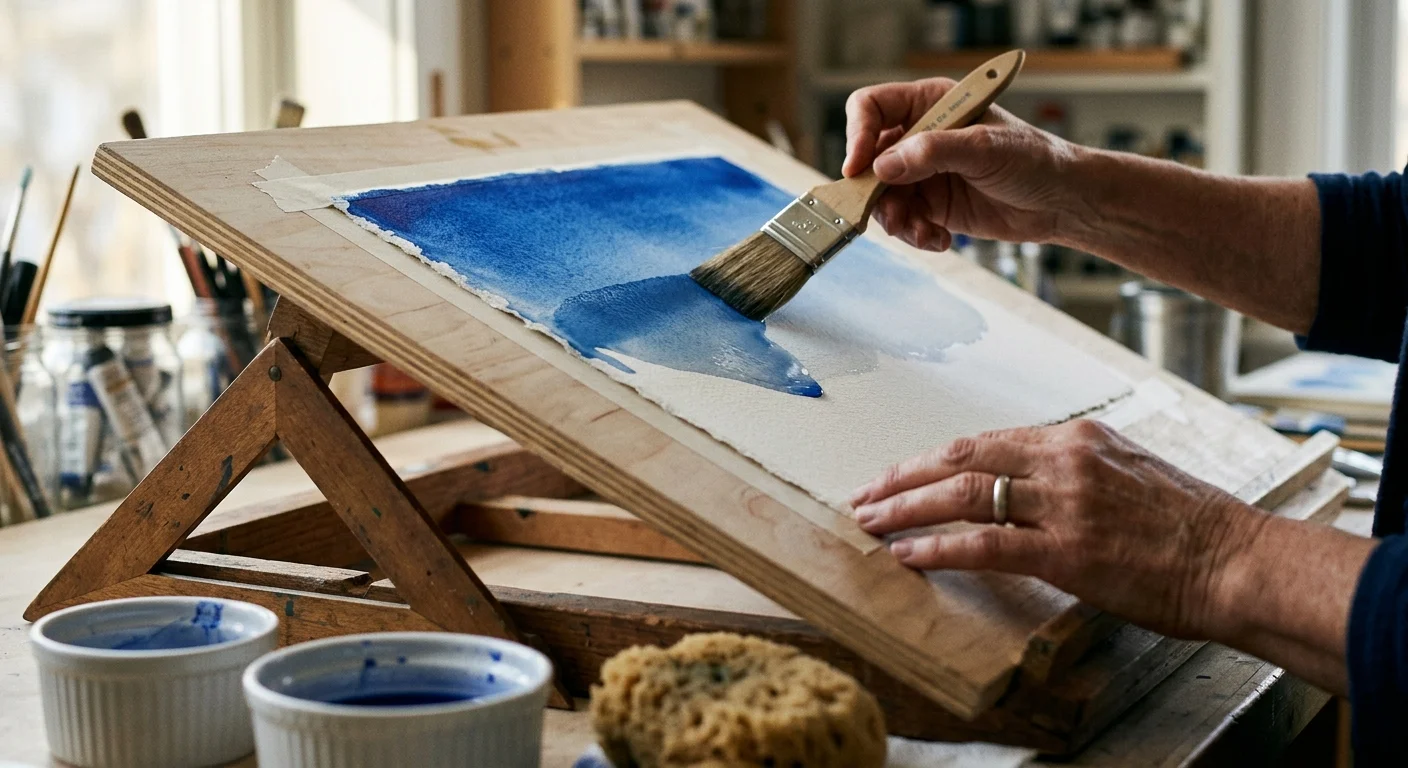
Let us execute a concrete landscape scenario on an 11-by-15-inch sheet of Arches 140-pound cold-press watercolor paper. This quarter-sheet project demonstrates how to stop muddy watercolors using measurable water volumes and scheduled drying intervals.
Tackling hands-on artistic challenges can serve as an invigorating doorway to rekindling creative passions you set aside during your busy working years.
Like engineers and accountants who trade corporate spreadsheets for tactile art forms, mastering technical paint ratios transforms analytical rigor into creative expression.
Set your drafting board to a 15-degree working angle to establish a steady gravitational pull on your fluid washes. Keep a clean cellulose sponge, a balance-tipped Da Vinci Casaneo No. 8 round brush, and a 1-inch flat wash brush on hand.
- Prepare Paper and Fluid Mix: Tape your sheet to a waterproof gatorboard support using 1-inch masking tape. Measure 4.0 milliliters of distilled water into your ceramic palette well, then mix in 0.4 milliliters of Ultramarine Blue (PB29) to create a tea viscosity.
- Lay the Sky Wash: Charge your 1-inch flat brush with 1.5 milliliters of your tea solution. Sweep across the top edge from left to right, allowing gravity to create a fluid bead along the bottom edge of the stroke.
- Step Down the Gradient: Dip the brush tip in clean water to lower pigment concentration, then overlap the bead by two millimeters. Repeat down to the horizon line, then pause for exactly 14 minutes at 68 degrees Fahrenheit to allow complete evaporation.
- Formulate Distant Ridges: Mix 2.5 milliliters of water with 0.8 milliliters of Cobalt Turquoise (PG50) and 0.2 milliliters of Burnt Umber (PBr7) to produce a flowing milk viscosity. Ensure the paper surface has transitioned from wet gloss to completely bone dry before continuing.
- Apply Ridge Silhouettes: Using your No. 8 round brush, draw the angular profile of the mountain ridge across the dry sky boundary. The milk-viscosity wash will adhere sharply to the dry paper fibers without blooming upward into the sky.
- Introduce Midground Foliage: Prepare a cream-viscosity mixture using 1.0 milliliter of water and 1.0 milliliter of Sap Green (blended from PG7 and PY110). Brush this saturated value over the bottom third of your dry mountain wash to anchor the landform.
- Establish Crisp Foreground Elements: Pick up pure Butter-viscosity Burnt Sienna (PR101) directly from your palette well using a lightly dampened brush tip. Scrape the brush belly across the dry tooth of the paper to generate broken, textured fence posts and rock outcroppings.
Following this precise step-by-step sequence guarantees crisp value separation across your composition. You avoid mud entirely because each wash layer dries thoroughly before higher-viscosity paint touches the surface.
Notice that the paint volume and pigment density increase systematically with every progressive layer. This disciplined approach eliminates the chaotic pooling that ruins traditional beginner landscape studies.
Capillary Action and Brush Mechanics: Controlling Surface Tension
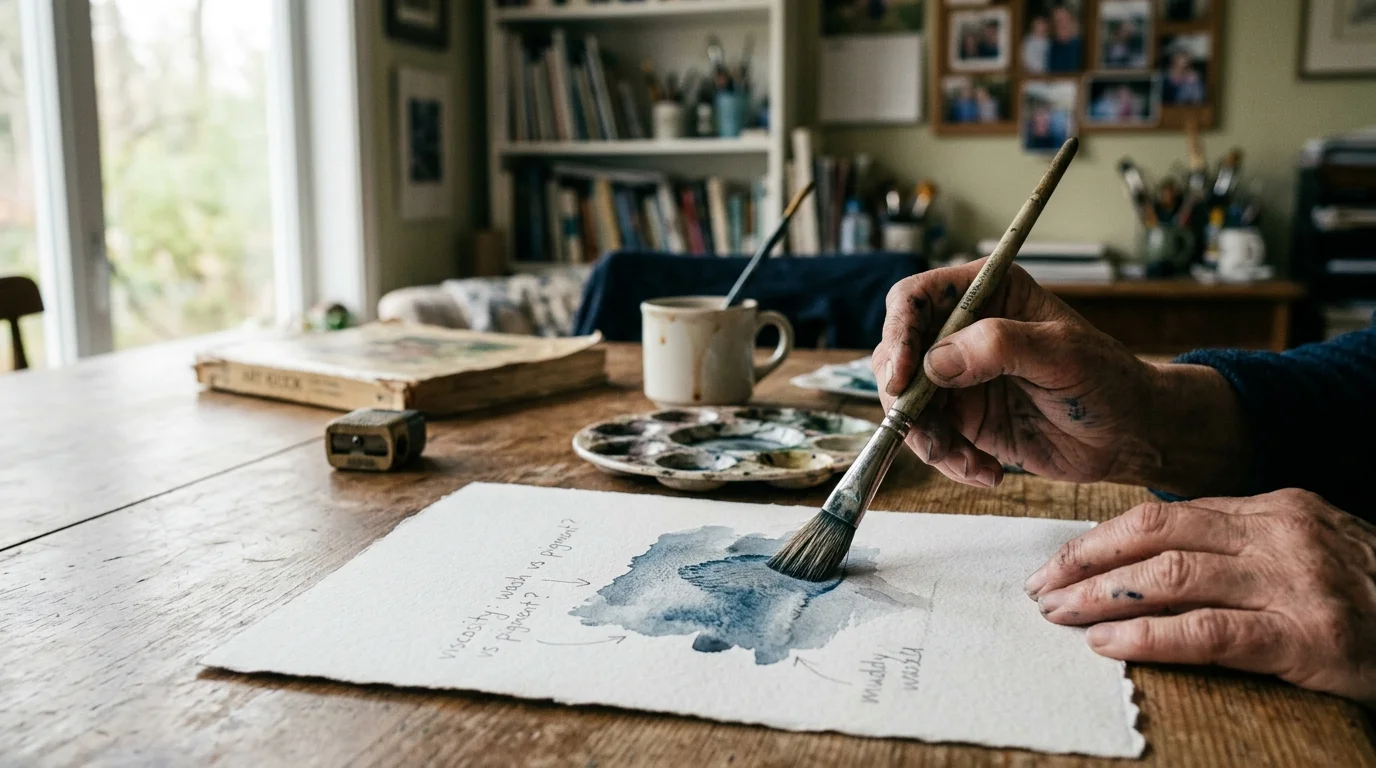
Your watercolor brush is not merely a styling tool; it operates as an adjustable fluid reservoir. Professional mop and round brushes utilize natural hairs or micro-etched synthetics to hold fluid through capillary action.
When you fully immerse a dry brush into a water basin, the belly swells with fluid. If you touch that overloaded brush straight to your paper, capillary tension snaps, dumping an uncontrollable puddle across your painting.
You can regulate fluid discharge by touching the belly of your charged brush against a damp cellulose sponge before making contact with the paper. This simple action drains excess surface water from the brush ferrule while keeping pigment locked in the tip.
Controlling beginner watercolor wash techniques over 60 requires tracking the four distinct drying stages of wet cotton paper.
- Stage 1: Mirror Gloss: The paper carries an active surface sheen of standing water; safe for wet-in-wet blending using equal or thicker paint.
- Stage 2: Satin Sheen: The standing water has absorbed into the cotton fibers, leaving a soft sheen; highly sensitive to backruns if wet paint touches it.
- Stage 3: Matte Damp: The sheen disappears, but the sheet remains cool to the touch; touching this stage with a brush causes immediate wash failure.
- Stage 4: Bone Dry: The paper reaches ambient room temperature and feels flat; completely stable for subsequent glazes of higher viscosity.
Most muddy washes occur during Stage 3 when an artist notices an irregular edge and tries to smooth it with a wet brush. That brush injects fresh water into unstable fibers, triggering instant granulation collapse.
Keep your hands away from any wash that has entered the matte damp phase. Accept whatever drying marks occur, and wait for complete evaporation before evaluating the result.
“Every artist was first an amateur.” — Ralph Waldo Emerson
Diagnostic Troubleshooting for Over-Worked Paper
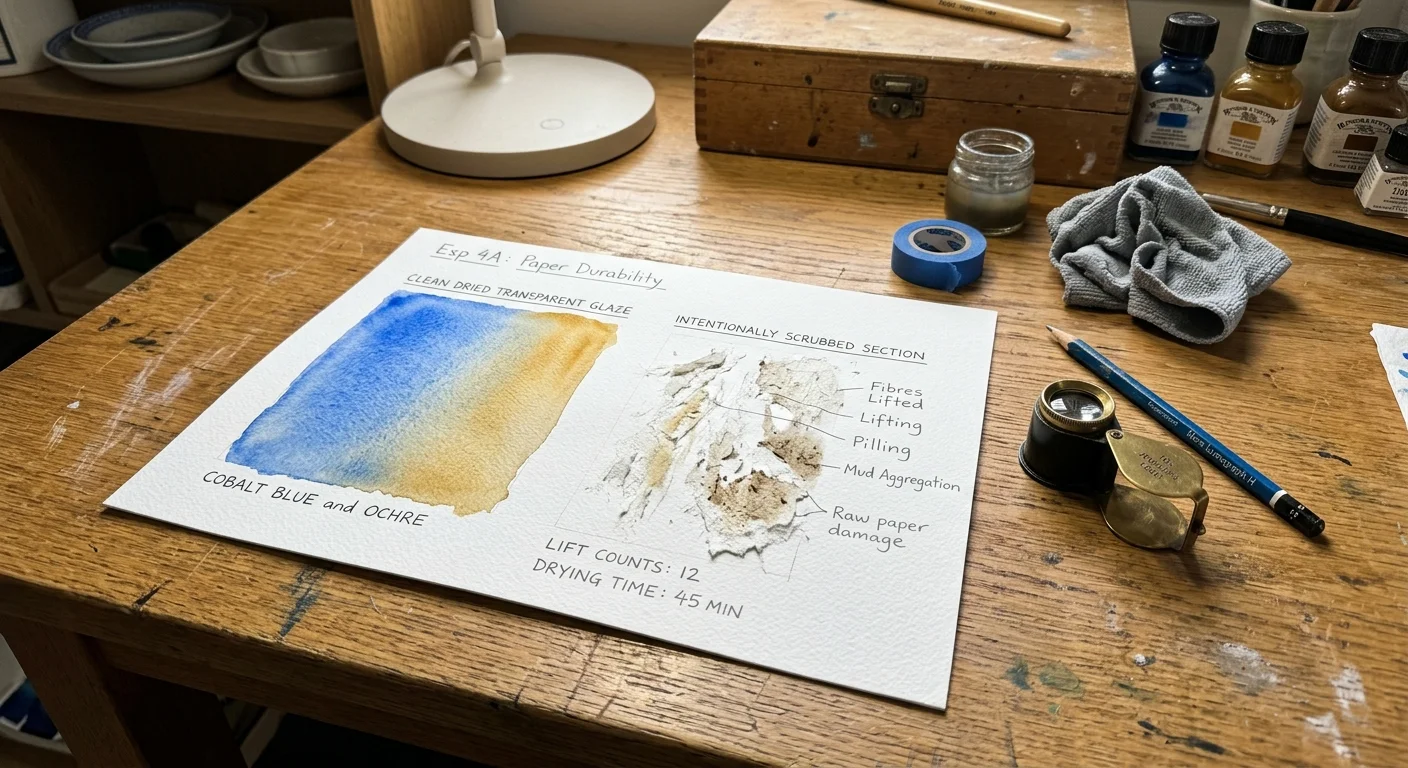
Even seasoned painters encounter occasional wash defects when changing paper brands or shifting ambient humidity. Identifying the mechanical cause of a paint failure lets you correct the problem analytically rather than scrapping the whole sheet.
When a wash forms an uneven cauliflower edge, a dilution differential is responsible. The incoming stroke carried more free water than the receiving paper surface could absorb.
To repair an unwanted cauliflower after it dries, use a synthetic flat shader brush moistened with clean water. Gently stroke the raised ridge of pigment using short, horizontal motions, then blot immediately with a dry tissue.
If your skies look chalky and dull, you likely used an opaque inorganic pigment in your tea-viscosity base layer. Cadmium yellows and synthetic iron oxides scatter overhead light instead of transmitting it.
Restore depth to chalky passages by letting the sheet dry completely, then glazing a transparent organic dye over the surface. A thin wash of Quinacridone Gold or Phthalo Blue will lock down loose surface particles and restore rich luminosity.
- Symptom: Flaking or Cracking Paint: Caused by applying pure Butter viscosity over cold-press paper without enough gum arabic binder; mist lightly with water to stabilize the surface.
- Symptom: Fiber Pilling: Caused by scrub brush friction during Stage 3 drying; switch to 100% rag cotton paper with heavy gelatin sizing.
- Symptom: Streaky Flat Washes: Caused by painting flat on a level desk; elevate your drafting board to at least 15 degrees to let gravity pull down an even bead.
Document these mechanical solutions inside a small studio logbook beside your easel. Tracking your water ratios and pigment combinations builds dependable technical confidence far faster than trial and error.

Precision and Creative Reinvention in Your Next Chapter
Retirement represents the premier opportunity to repurpose decades of professional analytical skills into expressive studio work. Your background in spatial reasoning, project scheduling, and structured problem solving provides a major advantage at the easel.
Mastering watercolor mechanics engages fine motor coordination, spatial analysis, and working memory. Scientific studies from the Stanford Center on Longevity demonstrate that acquiring complex new skills maintains cognitive vitality and builds neural reserves throughout later adulthood.
Do not let conventional art classes convince you that precision conflicts with artistic expression. The most evocative landscape masters in history achieved emotional depth through meticulous control of pigment weight and water chemistry.
If you enjoy collaborative study, consider enrolling in specialized creative courses through Osher Lifelong Learning Institute courses across the country. Working alongside other motivated adults provides supportive community feedback as you refine your technique.
Treat your palette like an experimental laboratory where every failed wash delivers clear diagnostic data. With the viscosity rule and pigment transparency chart as your framework, pristine landscape washes are entirely within your grasp.
Frequently Asked Questions
Why do my watercolor landscape washes always turn into gray mud?
Washes turn muddy when you disturb semi-dry paint or mix dense mineral pigments with fine synthetic dyes without balancing their viscosity. Working back into damp paper with a wet brush lifts settled particles and creates dull, opaque sediment.
What is the tea-to-butter viscosity rule in watercolor painting?
The tea-to-butter rule defines four specific paint-to-water ratios: tea (fluid and pale), milk (flowing and luminous), cream (rich and saturated), and butter (thick and structural). You must always apply thicker paint over thinner paint to avoid lifting underlying washes.
Can you fix a muddy watercolor wash after it dries on the paper?
Once a muddy wash dries completely, you cannot restore transparent luminosity beneath it. However, you can lift sedimentary surface pigments using a damp synthetic flat brush and clean water, or apply a dark, opaque cream-viscosity layer to reclaim lost contrast.
Which pigments cause the most mud for beginner painters?
Inorganic earth pigments and synthetic iron oxides, such as Burnt Umber (PBr7) and Venetian Red (PR101), create heavy particulate sediment. When mixed mechanically on damp paper with semi-opaque yellows like Cadmium Yellow (PY35), they scatter light and produce instant sludge.
Disclaimer: This article is for informational and inspirational purposes. Life decisions are deeply personal, and we encourage readers to pursue their dreams while considering their unique circumstances, health, and financial situation.