

Stepping away from a corporate desk does not mean benching your leadership skills. Suburban school districts face unprecedented staffing shortages and actively recruit second-career professionals to guide their classrooms.
You can step directly into these roles through streamlined emergency substitute credentials without holding an education degree. Daily substitute teaching offers complete control over your working calendar.
The secret lies in calibrating your daily shifts against state pension clawbacks and federal earnings tests to maximize revenue without forfeiting retirement benefits. Here is your roadmap to teaching on your own terms.

The Modern Suburban Classroom Needs Your Executive Experience
Suburban school districts regularly struggle to staff middle and high school classrooms. School administrators increasingly seek mature professionals whose career discipline commands immediate respect.
Decades spent managing corporate teams, orchestrating project deadlines, and resolving personnel conflicts translate directly into effective classroom management. Students respond positively to adults who possess authentic poise and composure.
Organizations like Encore.org highlight how second-career pursuits channel hard-won corporate knowledge into vital community institutions. Your presence bridges the gap between academic theory and real-world application.
You do not need to deliver complex subject lectures from scratch. Full-time classroom teachers leave structured lesson plans, digital slide decks, and student assignments for you to supervise.
Your primary objective is maintaining a focused, productive learning environment. That role requires leadership, situational awareness, and clear communication rather than pedagogical theory.
- Executive presence prevents disruptive student behavior before it begins.
- Crisis mediation and conflict de-escalation keep secondary classrooms calm and on task.
- Time management ensures students complete designated assignments within forty-five-minute class blocks.
- Real-world career stories ignite student curiosity about professional career pathways.
Fast-Track Licensing: Navigating State Emergency Credentials
State education departments have overhauled substitute licensing over recent years. They eliminated obsolete bureaucratic obstacles to attract capable degreed professionals into public schools.
Stepping back into school culture also offers retirees an inspiring opportunity for embracing lifelong learning in retirement while staying mentally engaged.
Most states issue short-term or emergency credentials specifically designed for individuals who hold a bachelor’s degree in any field. You do not need an undergraduate major in education.
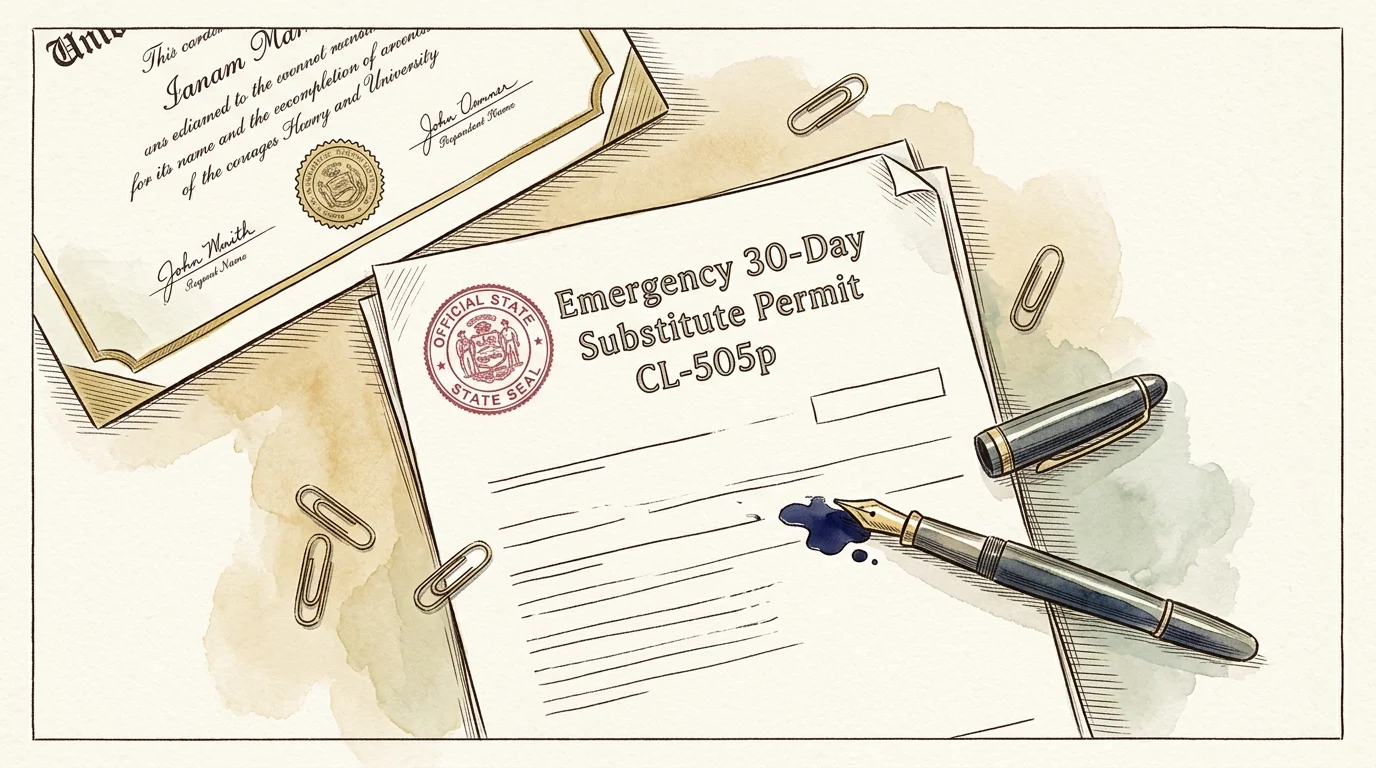
In California, the Emergency 30-Day Substitute Teaching Permit (CL-505p) allows degreed candidates to lead classrooms immediately. A bachelor’s degree satisfies both the subject knowledge and basic skills requirements without extra standardized tests.
Other states have lowered entry barriers even further. Missouri authorizes emergency substitute certificates for candidates who complete a state-approved twenty-hour online training course, bypassing formal teacher preparatory programs.
Illinois and Nevada offer short-term emergency authorizations for applicants with at least sixty semester hours of college credit. These permits provide rapid entry for retirees seeking flexible local employment.
- Request official college transcripts confirming your bachelor’s or associate degree.
- Complete state-mandated criminal history background checks via live-scan fingerprinting services.
- Register on your state department of education credentialing portal and select the emergency substitute permit.
- Complete mandatory online safety modules covering child abuse reporting and student data privacy.
- Submit your approved state credential directly to suburban human resources departments or regional offices of education.

State-by-State Emergency Credential Comparison
Licensing guidelines, daily placement limits, and credential validity periods differ significantly across state jurisdictions. Researching your specific state rules prevents administrative surprises during district hiring.
The following matrix compares primary emergency pathways across five representative states actively recruiting substitute teachers.
| State & Credential Name | Minimum Education Requirement | Classroom Day Limits | Credential Validity | Suburban Daily Pay Range |
|---|---|---|---|---|
| California (CL-505p 30-Day Permit) | Bachelor’s Degree (Any Major) | 30 days per classroom teacher per year | 1 Calendar Year | $160 – $240 / day |
| Illinois (Short-Term Sub License) | 60 College Credit Hours or Associate Degree | 5 consecutive days per teacher | Valid through June 2028 | $125 – $190 / day |
| Missouri (Content Substitute Certificate) | High School Diploma + 20-Hour Online Training | Subject to local district needs | 1 Calendar Year | $110 – $145 / day |
| Pennsylvania (Type 06 Emergency Permit) | Bachelor’s Degree (Any Major) | Full school year within sponsoring district | 1 School Year | $120 – $175 / day |
| Texas (District-Discretion Local Permit) | High School Diploma (BA preferred for top suburban rates) | Varies by individual independent school district | Annual District Renewal | $115 – $165 / day |
Most emergency substitute credentials remain valid for a single academic year. Districts routinely process quick renewals each summer for active substitutes in good standing.
Substitute Teacher Daily Pay Matrices: Suburban Economics
Substitute teacher compensation has shifted away from stagnant hourly rates toward competitive per diem pay scales. Suburban districts compete vigorously for reliable substitutes who accept assignments consistently.
National wage data from the U.S. Bureau of Labor Statistics (BLS OEWS, Short-Term Substitute Teachers, SOC 25-3031) establishes a mean hourly wage of $20.95. Suburban districts typically structure compensation as full-day or half-day flat stipends.
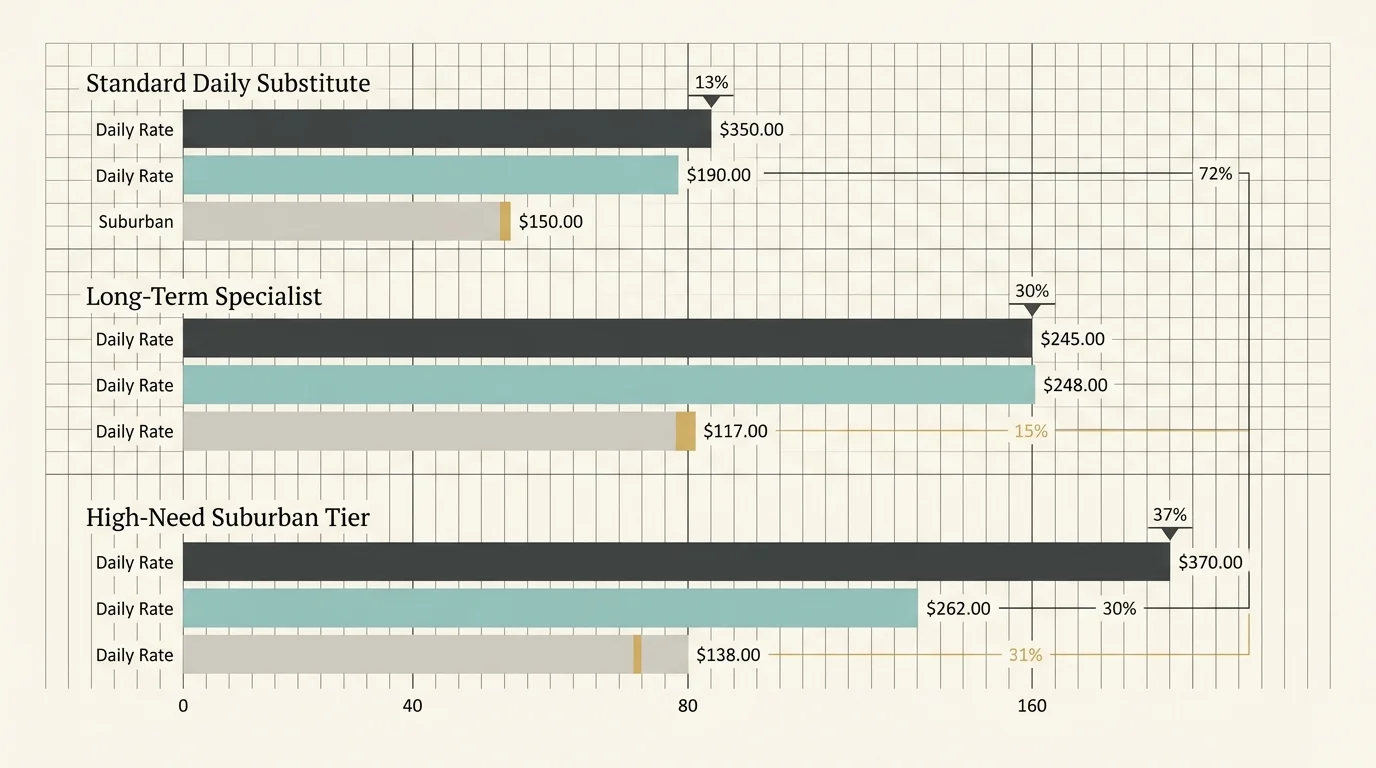
Entry daily wages in suburban districts generally start between $120 and $150 per day. Wealthier districts and high-cost suburban corridors regularly offer daily rates between $180 and $220.
School districts also create tiered compensation matrices to encourage recurring coverage. You can systematically increase your per diem income by leveraging several structured district premiums.
- Consecutive-day bonuses provide an extra $20 to $40 per day once an assignment extends past ten days.
- High-need day incentives offer bonus stipends for accepting Friday or Monday assignments.
- Subject premiums provide higher daily pay for supervising specialized classes like high school chemistry or computer science.
- Building substitute contracts guarantee pay for every school day regardless of cancellations.
A corporate retiree working two days per week at $185 per day earns $1,480 monthly. That supplemental cash flow funds travel or hobbies without drawing down retirement investments.
Financial Safeguards: Managing Social Security and Public Pension Limits
Earning extra income after sixty requires careful coordination with public retirement programs. Unmonitored earnings can trigger unexpected tax consequences or reduce monthly annuity checks.
If you collect Social Security before your Full Retirement Age (FRA), your earnings are subject to the Retirement Earnings Test (RET). The Social Security Administration withholds $1 of benefits for every $2 earned above the annual cap.
The annual earnings cap stands at $23,400 for 2025 and rises to $24,480 for 2026. Once you reach the month of your Full Retirement Age, the Social Security earnings cap disappears entirely.
Research published by the Stanford Center on Longevity shows that structured part-time work supports financial longevity. Staying within statutory income caps lets you preserve benefits while staying active.
Corporate professionals holding public pensions from past government service must also monitor post-retirement employment rules. Public educator systems enforce strict post-retirement employment rules.
Under California Senate Bill 765, CalSTRS retirees returning to school service face an annual earnings cap set at $74,733 for the 2024–2025 fiscal year. Exceeding state caps causes dollar-for-dollar benefit deductions from monthly pension checks.
Many state systems also require mandatory waiting periods. For example, CalSTRS enforces a 180-calendar-day separation-of-service requirement before retirees can accept paid school district assignments.

The Exact Math: A Worked Schedule Scenario for Maximum Earnings
Let us examine a concrete scenario for managing work hours and statutory thresholds. Meet Arthur, a 63-year-old retired corporate operations manager living in suburban Chicago.
Arthur claims early Social Security, receiving $2,100 per month. His Full Retirement Age is 67, meaning he is subject to the 2025 Social Security earnings limit of $23,400.
A premier suburban school district hires Arthur at a daily rate of $165 for general high school coverage. Arthur must calculate his maximum teaching days to avoid triggering Social Security withholdings.
Dividing the $23,400 limit by his $165 daily rate reveals an absolute ceiling of 141 working days per calendar year. Exceeding 141 days would trigger benefit clawbacks.
Arthur builds a sustainable, stress-free schedule based on working exactly two days per week. He selects Tuesdays and Thursdays across a thirty-six-week academic calendar, totaling 72 teaching days.
Arthur earns a gross annual substitute income of $11,880 (72 days multiplied by $165). This leaves an $11,520 safety buffer beneath the Social Security threshold.
His schedule leaves Mondays, Wednesdays, and Fridays free for personal pursuits, and leaves his entire summer open. He secures $11,880 in extra cash while protecting his retirement benefits from administrative deductions.

District Onboarding and Classroom Management Tactics for Professionals
Suburban districts manage substitute rosters through automated dispatch software platforms. Programs such as Frontline Education, SmartFind Express, and SubDirect automate assignment scheduling.
These applications notify you of available openings via smartphone alerts. You retain complete authority to accept or decline assignments with a single tap, with no minimum shift quotas.
When you arrive at the school, report to the administrative office fifteen minutes before the morning bell. Secure the teacher’s lesson plan folder, student attendance rosters, and building emergency keys.
Classroom success hinges on establishing authority immediately. Stand at the classroom door to greet students personally as they arrive, setting a professional tone from the opening minute.
- Introduce yourself clearly with your formal surname and outline expectations for the class period.
- Follow the primary teacher’s printed lesson plan precisely rather than introducing personal assignments.
- Direct students to submit all completed work before the dismissal bell rings.
- Leave detailed, objective notes documenting student cooperation and any unresolved behavioral issues.
Experienced substitutes carry an executive emergency kit containing dry-erase markers, a digital timer, and extra pens. Being thoroughly prepared turns daily substitute assignments into rewarding community leadership opportunities.
Frequently Asked Questions
Do I need an education degree to become a substitute teacher after 60?
No. Most suburban school districts only require a bachelor’s degree in any field alongside a state emergency or short-term substitute permit. Several states accept an associate degree or sixty college credit hours.
Will substitute teaching reduce my Social Security benefits?
Your benefits remain unaffected if you have reached Full Retirement Age. If you are under your Full Retirement Age, your annual earnings must stay below the statutory threshold ($23,400 in 2025; $24,480 in 2026) to avoid benefit withholdings.
Can I choose which suburban schools and grade levels I teach?
Yes. Automated scheduling systems let you configure precise preferences for specific schools, academic subjects, and grade levels. You can accept high school assignments exclusively while declining elementary requests.
What should corporate retirees pack in their daily substitute bag?
Bring whiteboard dry-erase markers, student hall passes, a simple digital timer, and a clipboard. Keep an organized notebook for leaving structured progress summaries for the regular teacher.
Disclaimer: This article is for informational and inspirational purposes. Life decisions are deeply personal, and we encourage readers to pursue their dreams while considering their unique circumstances, health, and financial situation.






1 Comment