
You can turn your numerical precision into a rewarding four-month winter engagement without signing away your retirement freedom. Winter tax jobs for retirees allow you to earn substantial income from January through April while keeping your summers completely free.
If you are currently finding your niche for post-retirement income, seasonal tax preparation offers an optimal balance of strong compensation and defined scheduling.
While many professionals assume you need a multi-year Enrolled Agent credential, the 18-hour IRS Annual Filing Season Program provides immediate qualification for top-tier agency roles.
This roadmap delivers the exact certification steps, real hourly compensation figures across retail and remote agencies, and a proven blueprint for your seasonal encore career.
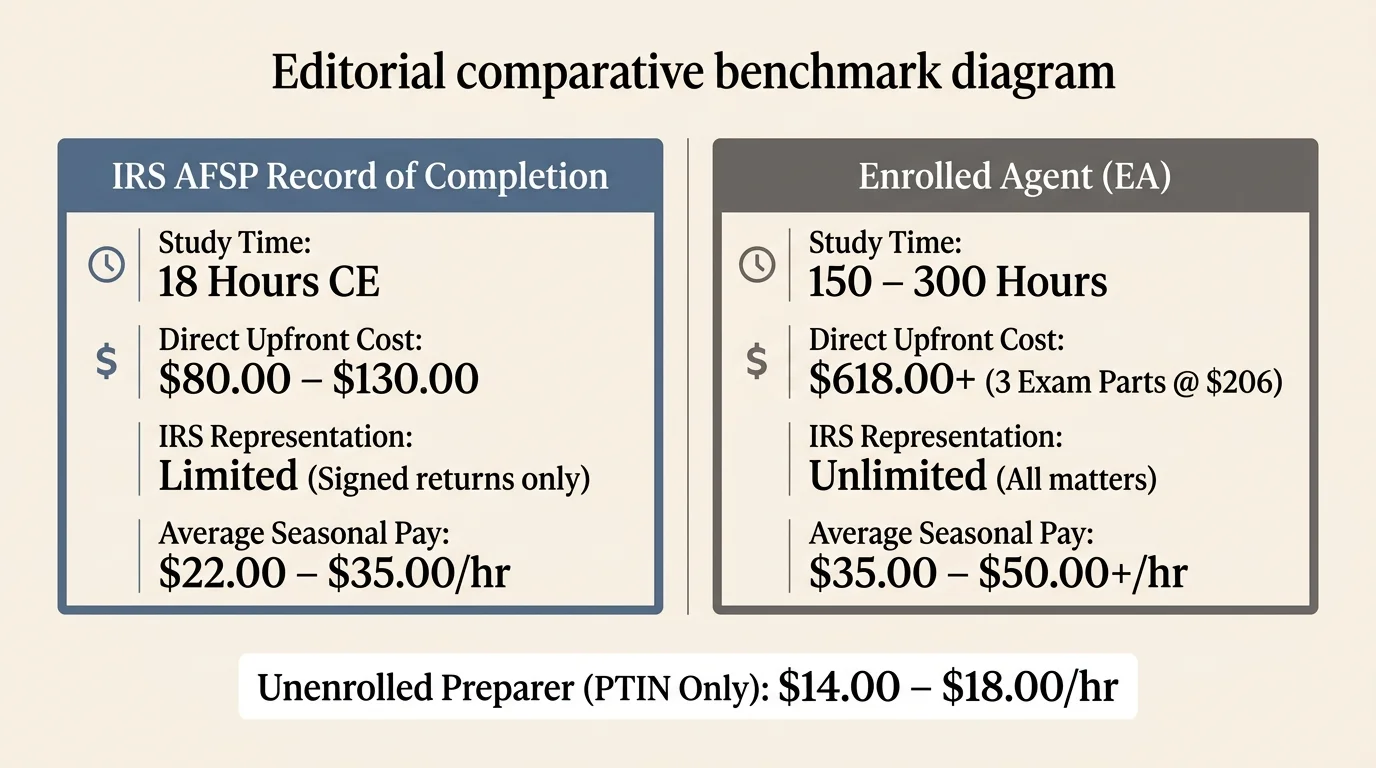
IRS AFSP vs. Enrolled Agent: Choosing Your Seasonal Credential
Entering the seasonal tax industry requires choosing the right professional designation. Many retirees waste months preparing for unnecessary licenses when entering the market.
Many professionals discover that reinventing your career with part-time roles offers a revitalizing path to stay engaged while enjoying personal freedom.
Stepping into this specialized field showcases the benefits of part-time work in retirement, keeping your analytical skills sharp without committing you to a year-round grind.
The Enrolled Agent (EA) credential requires passing the three-part Special Enrollment Examination administered by Prometric. Candidates study hundreds of hours across individual taxation, business entities, and representation procedures.
Each exam part costs $206, and passing all three sections creates a significant time commitment. That depth makes sense for year-round representation, but seasonal workers rarely need it.
The IRS Annual Filing Season Program (AFSP) offers an efficient alternative. Non-credentialed preparers complete 18 continuing education hours annually to earn an official Record of Completion.
This credential grants limited representation rights under Treasury Department Circular 230 regulations. You can represent clients before IRS revenue agents and customer service representatives for returns you prepared and signed.
As documented by organizations like Encore.org, transitioning into seasonal specialized work provides intellectual stimulation while safeguarding your personal time.
You avoid year-round compliance burdens while establishing immediate credibility with employers. The table below details how the primary seasonal tax credentials compare across essential benchmarks.
| Credential Level | Study Time Required | Direct Upfront Cost | IRS Representation Rights | Average Seasonal Pay |
|---|---|---|---|---|
| Unenrolled Preparer (PTIN Only) | 0 Hours | $18.75 | None (Cannot represent clients) | $14.00 – $18.00/hr |
| IRS AFSP Record of Completion | 18 Hours CE | $80.00 – $130.00 | Limited (Signed returns only) | $22.00 – $35.00/hr |
| State Registered (CTEC / Oregon) | 15 – 60 Hours | $100.00 – $250.00 | State-specific authority | $20.00 – $32.00/hr |
| Enrolled Agent (EA) | 150 – 300 Hours | $618.00+ (Exams only) | Unlimited (All IRS matters) | $35.00 – $50.00+/hr |
For most retirees, the AFSP credential hits the exact sweet spot. It delivers optimal hourly returns without sacrificing months of retirement leisure.
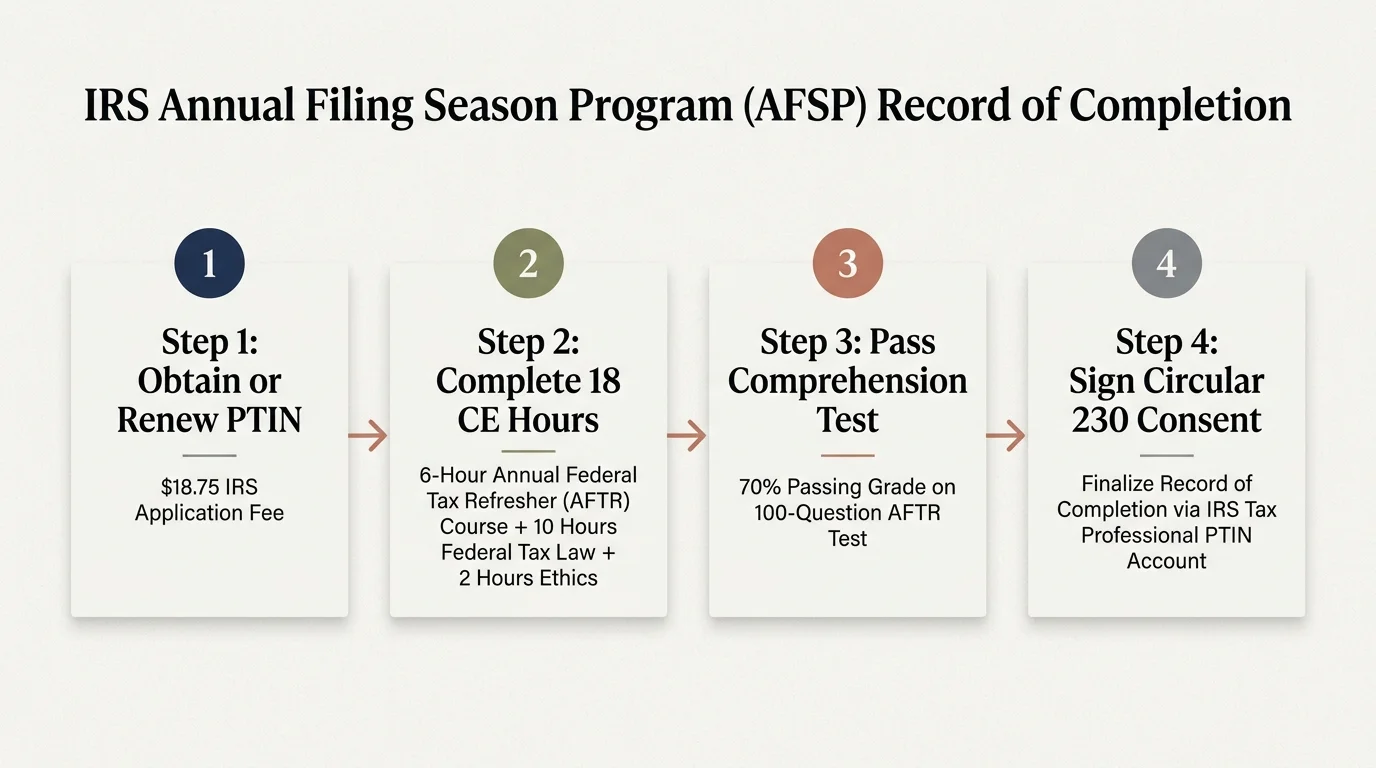
Step-by-Step IRS AFSP Certification Roadmap for Seniors
Earning your AFSP certificate is a straightforward, self-paced process. You can complete the entire curriculum online from your home office.
Much like building a mobile loan signing encore career, seasonal tax preparation turns precise administrative expertise into reliable, flexible income.
Completing this annual certification program is an efficient method of upskilling for your second act without needing to invest in long-term academic degrees.
The IRS mandates an 18-hour continuing education package for non-exempt preparers each year. This curriculum ensures your knowledge reflects the most recent tax code adjustments.
- Obtain or Renew Your PTIN: Secure your active Preparer Tax Identification Number through the IRS online portal before enrolling in coursework.
- Enroll in an IRS-Approved CE Provider: Purchase an AFSP package through an accredited education vendor like WebCE, Surgent, or Fast Forward Academy.
- Complete the 6-Hour AFTR Course: Study the Annual Federal Tax Refresher curriculum covering individual tax changes and key filing thresholds.
- Pass the AFTR Comprehension Exam: Complete the 100-question multiple-choice exam online with a score of 70% or better within the 3-hour limit.
- Finish the Remaining 12 CE Hours: Complete 10 hours of federal tax law topics and 2 hours of professional ethics.
- Sign Circular 230 Consent: Log into your IRS PTIN account and formally accept Circular 230 conduct obligations.
Certain experienced preparers qualify for exempt status. Passing recognized state programs like California CTEC or serving with VITA exempts you from the AFTR exam.
Exempt preparers only need 15 hours of continuing education annually. Their curriculum includes 3 hours of tax updates, 10 hours of tax topics, and 2 hours of ethics.
Select your education vendor based on usability and presentation style. The following IRS-approved providers offer comprehensive AFSP self-study bundles:
- WebCE: Offers mobile-friendly modules, instant reporting to the IRS, and practice exams for $79.95 to $99.00.
- Fast Forward Academy: Provides interactive digital textbooks, bank exam simulations, and responsive support for $89.00.
- Surgent Income Tax School: Delivers detailed case studies and practical software walkthroughs for $119.00.
- National Association of Tax Professionals (NATP): Features extensive research libraries and member discounts for seasonal workers.
All approved providers report your passing scores directly to the IRS. You do not need to submit paper certificates or manual transcripts.
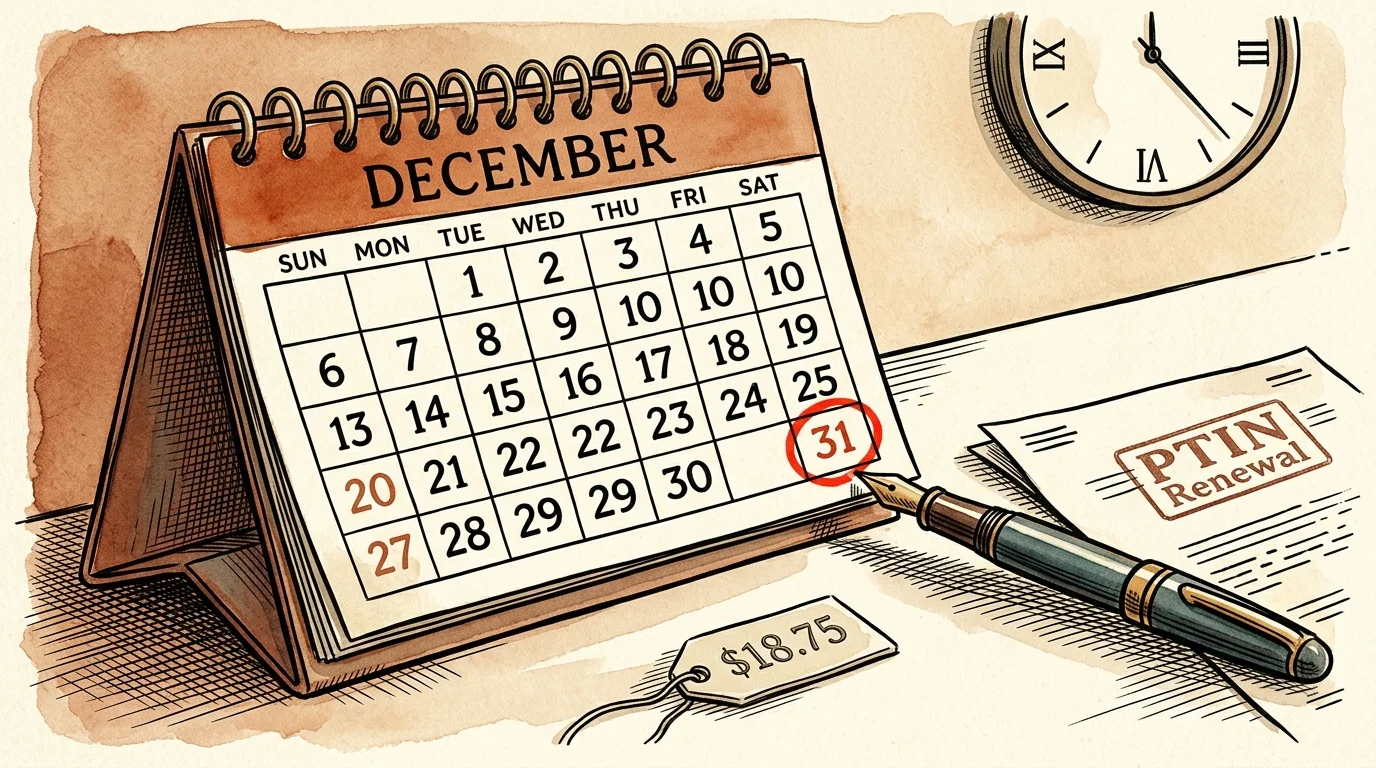
PTIN Renewal Protocols and Non-Negotiable Year-End Deadlines
Timing your certification correctly determines whether you can legally prepare returns. The IRS enforces strict annual deadlines that cannot be extended.
Highlighting up-to-date certifications like the AFSP is also one of the most effective approaches for overcoming ageism during the job search.
Every paid preparer must hold an active Preparer Tax Identification Number. Applying for or renewing a PTIN costs a non-refundable fee of $18.75.
This charge includes a $10.00 IRS user fee and an $8.75 contractor processing fee. Annual PTIN renewals open in mid-October for the upcoming tax filing season.
The Annual Federal Tax Refresher course opens on June 1 each year. Coursework, exam completion, and credit transmission must occur before December 31 at midnight local time.
If you miss the December 31 deadline by a single minute, the IRS will not issue an AFSP Record of Completion. You must wait until the following June to restart.
After your provider reports your credits, log into your PTIN account. You must navigate to the AFSP consent screen to complete the process.
You must formally sign consent to Subpart B and Section 10.51 of Treasury Department Circular 230. This final confirmation activates your limited representation rights.
Once confirmed, the IRS adds your profile to the public Directory of Federal Tax Return Preparers. National agencies use this database to verify credentials during hiring.

Retail vs. Remote Agency Pay Scales: Where Retirees Earn the Most
Seasonal tax preparation pays reliable hourly wages across several distinct operational models. Your earnings depend on experience, agency structure, and regional cost of living.
Both national storefront chains and virtual tax software companies rank among well-known age-friendly employers that value the precision and patience mature professionals bring to the table.
The U.S. Bureau of Labor Statistics reports a national median wage of $23.56 per hour for tax preparers. The mean hourly wage reaches $27.96, while the top 25 percent earn $36.55 or more.
Data highlighted by AARP reveals that older workers increasingly gravitate toward flexible seasonal engagements that honor their professional experience.
Retail storefront franchises represent the largest employer category for seasonal staff. Chains like H&R Block, Jackson Hewitt, and Liberty Tax operate thousands of temporary offices.
First-year preparers at retail franchises typically earn $13.00 to $18.00 per hour. Returning preparers with two or more seasons of experience earn $18.00 to $28.00 per hour.
Many retail agencies provide production incentives based on completed returns. These bonuses can add $3.00 to $7.00 per hour to your base pay during peak weeks.
Virtual tax preparation platforms provide an attractive alternative for retirees seeking remote work. Platforms like Intuit TurboTax Live and TaxSlayer hire thousands of winter workers.
General remote customer support roles pay between $17.00 and $24.00 per hour. Dedicated TurboTax Live Tax Experts holding an AFSP certificate earn $22.00 to $35.00 per hour.
Remote positions eliminate commuting and office friction entirely. However, remote platforms usually require a commitment of at least 20 hours per week during peak season.
Independent regional CPA and accounting firms offer another lucrative path. These firms frequently hire seasonal preparers to handle individual Form 1040 volume.
Local accounting firms typically pay $25.00 to $40.00 per hour for experienced part-time support. These positions rarely involve direct sales and focus entirely on accurate data entry.

Worked Financial Scenario: A 15-Week Tax Season Earnings Breakdown
Examining a realistic working scenario illustrates the financial returns of a seasonal tax engagement. Consider Arthur, a 63-year-old retired corporate accountant living in Ohio.
Before taking on seasonal work, it is important to review Social Security earnings rules to understand how additional winter wages might affect your benefits.
When earning substantial seasonal income over a single quarter, reviewing proactive tax strategies for second careers can help protect your earnings from pushing you into an unintended tax bracket.
Arthur wants an active role that leaves four days open every week for personal pursuits. He obtains his AFSP certificate in November and accepts a remote seasonal position.
Arthur tracks his initial launch expenses carefully before starting client work. His startup outlays include the following concrete expenditures:
- IRS PTIN registration fee: $18.75
- WebCE 18-hour AFSP continuing education bundle: $79.95
- USB noise-canceling headset for client calls: $38.50
- Dual-monitor desk riser: $44.99
- Total upfront capital investment: $182.19
Arthur works 24 hours per week across 15 weeks, beginning January 12 and concluding April 26. He schedules three eight-hour shifts on Tuesday, Wednesday, and Thursday.
His contract establishes a base wage of $26.00 per hour for standard operations. The employer adds a $4.00 per hour surge rate during the final three peak filing weeks.
During the first 12 weeks, Arthur completes 288 standard working hours. At $26.00 per hour, his regular seasonal compensation equals $7,488.00.
During the final three weeks, Arthur works 72 surge hours at $30.00 per hour. This peak period produces $2,160.00 in additional wages.
His gross earnings across the 15-week tax season total $9,648.00. Subtracting his startup costs of $182.19 leaves a net seasonal profit of $9,465.81.
Arthur generated substantial cash flow while maintaining four-day weekends throughout the winter. He finishes his seasonal commitment on April 26 with zero ongoing obligations.

How to Land Flexible January-to-April Seasonal Positions
Hiring for the winter tax season begins long before holidays arrive. Securing the best hours and hourly rates requires early action.
Major tax agencies launch their recruiting pipelines between August and November. Applying by October ensures priority scheduling before candidate pools fill.
You can leverage small business networks like SCORE Mentoring to connect with independent CPAs who need seasonal overflow capacity.
Position your career history as an asset when building your application. Agencies value maturity, calm customer communication, and professional dependability above pure speed.
Highlight familiar accounting software and tax platforms on your resume. Employers look for candidates who understand industry-standard applications:
- Drake Tax: Popular among independent practitioners and small regional accounting firms.
- Intuit ProConnect and Lacerte: Standard tools for mid-tier firms and virtual tax environments.
- CCH ProSystem fx: Common in high-volume, complex individual preparation offices.
- TaxWise and TaxSlayer: Widely utilized across retail storefronts and high-volume operations.
Tailor your interview responses around reliability and client rapport. Emphasize your ability to explain complex financial concepts in plain, reassuring language.
Small independent accounting practices often offer better hourly wages than national retail chains. Reach out to local practitioners in November offering part-time support for 15 to 20 weekly hours.

Maintaining Your Freedom: Setting Contract Boundaries and Post-April Retirement
A seasonal encore career should enhance your retirement lifestyle rather than consume it. Setting firm contractual boundaries prevents seasonal work from overwhelming your personal life.
Agree on weekly working limits in writing before accepting any seasonal position. Request a contract cap between 15 and 25 hours per week.
Tax agencies often pressure staff for overtime as the April 15 deadline nears. Protect your well-being by maintaining fixed working days and refusing unscheduled shifts.
Establish a hard completion date in your hiring agreement. State clearly that your availability terminates on April 15 or April 30.
“It is never too late to be what you might have been.” — George Eliot
Celebrate your finish line when tax season concludes. Close your laptop, step away from spreadsheets, and dive into your spring and summer plans.
You can use your seasonal earnings to fund travel, support hobbies, or build savings. When autumn arrives, renew your PTIN and decide whether to return.
Frequently Asked Questions
Do I need a background in accounting to earn the IRS AFSP credential?
No formal degree or accounting background is required. Any individual with basic numerical aptitude can complete the 18 hours of continuing education and pass the open-book comprehension exam.
What happens if I fail the 100-question AFTR comprehension exam?
IRS-approved providers allow multiple retakes at no extra charge. You receive different question pools on subsequent attempts, but you must pass with at least 70% before December 31.
Does seasonal tax income affect Social Security retirement benefits?
If you are under full retirement age, earnings above the annual limit ($22,320 in 2024) reduce your benefit temporarily by $1 for every $2 earned. Reaching full retirement age eliminates all earnings caps.
Are PTIN renewal fees and AFSP course costs tax-deductible?
Yes, if you operate as an independent contractor or sole proprietor, these qualify as ordinary and necessary business expenses on Schedule C. W-2 statutory employees cannot deduct unreimbursed employee expenses under current federal rules.
Disclaimer: This article is for informational and inspirational purposes. Life decisions are deeply personal, and we encourage readers to pursue their dreams while considering their unique circumstances, health, and financial situation.