
You can transform decades of legal paperwork familiarity into a predictable $1,900 monthly income by executing three mobile loan signings weekly before lunchtime. This focused morning routine replaces 40% of a legal clerk’s past salary.
Exploring a thoughtful retirement reboot with a fulfilling second career allows former professionals to stay mentally engaged without sacrificing personal freedom.
Operating as an independent mobile notary signing agent retirement business gives you complete autonomy while keeping gross receipts comfortably below Social Security clawback limits.
Unlike general notary work, targeting title direct appointments and signing platforms converts your document diligence into reliable $150 payouts for sixty minutes of work.

The Morning Route Advantage for Legal Clerks
You already know how to examine complex legal agreements without hesitation. Decades spent reviewing settlement sheets, deeds, and court filings give you an immediate advantage in real estate finance.
For those with formal background in conflict resolution or contract disputes, exploring work as a certified community mediator offers another compelling way to use court experience on your own schedule.
Title officers face constant stress caused by inexperienced mobile notaries who miss critical initials or misplace notarization stamps. Your background guarantees the exact opposite: flawless accuracy and absolute composure.
A morning route offers the ideal structure for an active lifestyle. Most home purchase closings and refinances require execution early in the day so title agencies can fund transactions before afternoon wire cutoffs.
By scheduling two to three appointments between 8:30 AM and 11:30 AM, you complete your paid tasks before lunch. Your afternoons remain open for family, personal projects, or travel.
Organizations like Encore.org highlight how purposeful encore careers leverage established skills into flexible, independent work. You avoid the office politics and daily commute while retaining professional stimulation.
This senior legal second act turns your professional precision into a self-directed, lucrative morning rhythm. You set your service radius, accept only convenient assignments, and dictate your daily routine.
Rather than sitting at a desk all day, you drive across scenic local neighborhoods to meet signers at their kitchen tables. Every appointment presents a brief, positive interaction where people celebrate buying a home.

Social Security Safe Harbors and the $1,900 Monthly Math
Retirees who collect Social Security before reaching full retirement age must monitor their earned income carefully. Exceeding federal income limits triggers automatic benefit reductions that erode your financial peace of mind.
The Social Security Administration establishes an annual earnings threshold of $23,400 ($1,950 monthly) for 2025. That threshold rises to $24,480 ($2,040 monthly) for 2026.
If you earn more than these annual caps before reaching full retirement age, the agency withholds $1 of benefits for every $2 earned above the limit. Keeping gross revenue at $1,900 per month keeps you safe.
This $1,900 monthly revenue target produces $22,800 annually. That volume allows you to collect your full Social Security entitlement while adding substantial supplemental cash flow.
Generating this part time notary income requires remarkably little time in the field. You can build this revenue stream through two primary dispatch methods with distinct fee structures:
- Signing Services (Platforms): Intermediary platforms dispatch assignments paying between $75 and $125 per completed signing file.
- Direct Title Appointments: Escrow and title agencies dispatch orders directly to preferred agents, paying between $150 and $225 per closing.
- Blended Volume Model: Completing three signing service appointments and one direct title appointment weekly generates roughly $475 weekly, or $1,900 monthly.
- Direct-Only Model: Handling just ten direct title closings each month at $190 per appointment yields your exact $1,900 monthly target.
Because each closing requires approximately 45 to 60 minutes of table time, you generate your entire monthly target in twelve to fifteen field hours. Few part-time opportunities provide comparable hourly returns for legal professionals.

Startup Capital: Certification, Insurance, and Commissioning
Launching a mobile loan signing route requires minimal startup capital compared to conventional small businesses. You can establish a compliant, professional mobile enterprise for less than $1,000 in total upfront expenses.
Your first step involves securing or renewing your traditional state notary public commission. Secretary of State application fees, mandatory surety bonds, and state filing costs typically range from $50 to $200.
Mortgage lenders require specialized credentials before permitting agents to handle closing documents. The National Notary Association (NNA) offers an industry-standard certification package that costs $199.
This package includes your background screening, certification examination, and an active listing on SigningAgent.com. Title officers routinely require this credential before adding you to approved vendor lists.
You must renew your NNA background screening annually to remain eligible for dispatched orders. The standalone annual screening fee is currently $89.
Comprehensive insurance protects your personal assets against clerical errors. While signing platforms accept $25,000 in Errors and Omissions (E&O) coverage, serious title officers demand a $100,000 policy.
A $100,000 E&O policy through commercial underwriters costs between $45 and $120 per year. That modest cost provides substantial peace of mind when notarizing six-figure mortgage instruments.
- Submit your state notary public application and purchase your statutory surety bond ($50 to $200).
- Complete the NNA certification course, exam, and background screening verification ($199).
- Purchase a $100,000 Errors and Omissions insurance policy through a reputable surety provider ($45 to $120).
- Acquire your official notary embosser or self-inking stamp, plus an all-inclusive journal ($40 to $70).
- Order professional business cards and dual-color closing pens ($30 to $50).

Direct Outreach Strategies for Title and Escrow Officers
While signing platforms offer quick order volume, direct title agency relationships provide higher pay and geographic convenience. Direct orders pay twice as much per appointment because no dispatch broker takes a percentage.
Much like launching a retirement consulting practice, marketing yourself directly to local decision-makers yields far better margins than relying solely on third-party broker platforms.
Escrow officers manage intense deadlines and dread document errors. When an agent misses a signature on a deed of trust, the loan cannot fund, creating severe friction for lenders and buyers.
Your legal background serves as your most persuasive marketing asset. Escrow officers immediately recognize that an experienced former legal clerk understands statutory requirements and document precision.
You can connect with local business mentors through SCORE Mentoring to refine your local title company outreach scripts. Structured networking turns cold agency visits into enduring professional partnerships.
- Compile a targeted roster of ten independent escrow and title agencies situated within a twelve-mile radius of your residence.
- Assemble clean presentation folders containing your resume, NNA verification certificate, $100,000 E&O insurance declaration, and state commission copy.
- Visit title branch offices in person on Tuesday or Wednesday mornings between 9:30 AM and 11:00 AM, avoiding busy month-end settlement dates.
- Introduce yourself directly to the escrow receptionist or branch manager, highlighting your background in legal document execution.
- Emphasize your exclusive availability for early morning appointments that staff closers cannot accommodate due to office duties.
- Send a personalized follow-up note within twenty-four hours thanking the escrow officer for their consideration.
Dropping by offices with neat presentation packets creates genuine rapport that digital directories cannot replicate. Escrow teams prefer working with dependable local professionals whom they can reach directly by phone.
Once you complete two consecutive closings without error, title officers routinely assign you their regular morning purchase transactions. This direct pipeline secures higher fees and predictable appointment schedules.
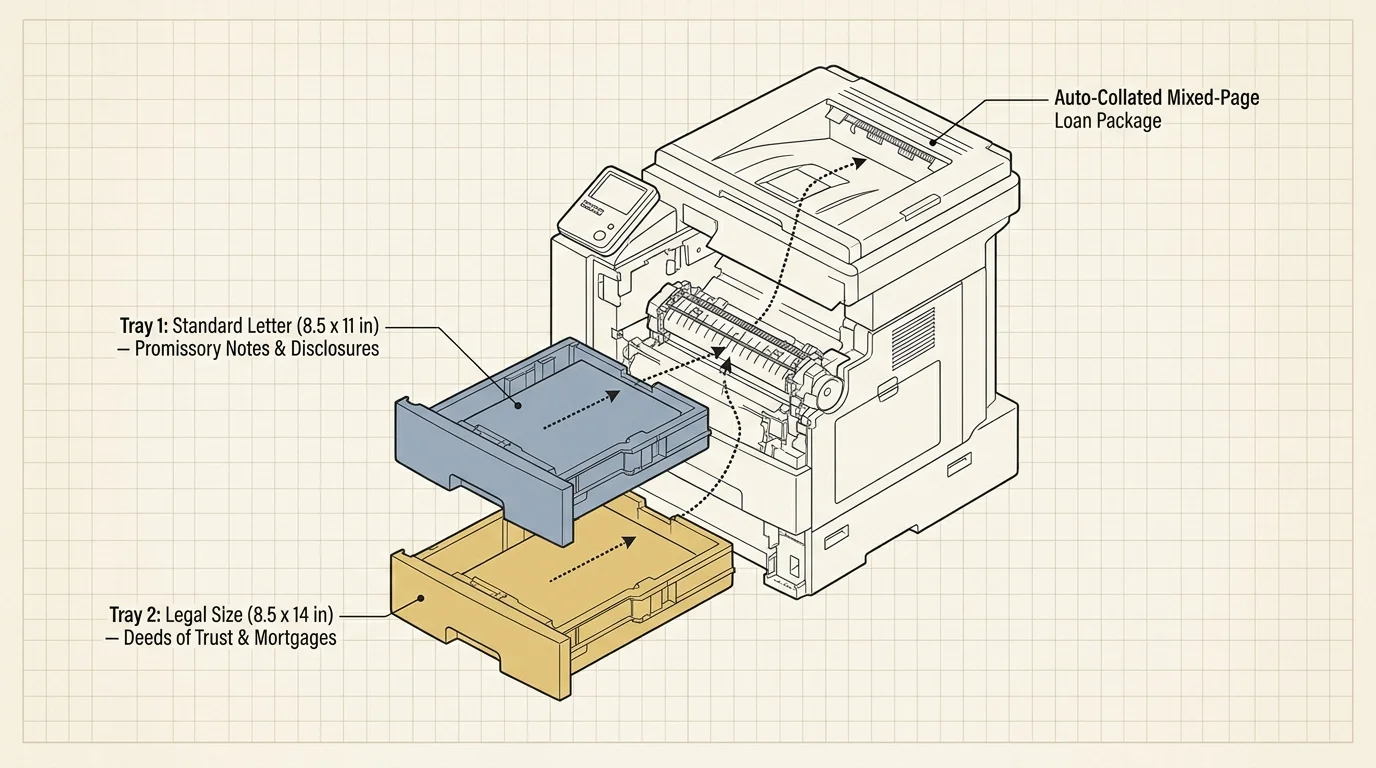
Dual-Tray Laser Printer Hardware Specifications
Mortgage packages present unique printing challenges that standard consumer hardware cannot accommodate. Mortgage documents routinely mix 8.5″x11″ letter sheets and 8.5″x14″ legal pages within the exact same electronic PDF file.
Properly writing off high-volume printing supplies and business equipment is a core element of minimizing taxes on second career earnings.
Lenders and county recorders strictly prohibit inkjet printers. Inkjet ink smudges under moisture and degrades over time, violating archival document standards required for recorded property deeds.
A commercial dual-tray monochrome laser printer is mandatory for a professional route. The machine reads page dimensions automatically, pulling letter pages from Tray 1 and legal pages from Tray 2 without manual sorting.
A standard closing package contains 120 to 200 pages, and you must print two complete sets: one for signing and one for borrower records. Fast print speeds prevent morning workflow bottlenecks.
| Printer Model | Hardware & Tray Package Cost | Print Speed (PPM) | Legal Tray Capacity | Toner Yield / Cost per Page |
|---|---|---|---|---|
| Brother HL-L5200DW + LT-5500 | $380 to $420 | 42 PPM | 250 Sheets | 8,000 Pages / 1.8¢ |
| Brother HL-L6200DW + LT-6500 | $430 to $480 | 48 PPM | 520 Sheets | 12,000 Pages / 1.4¢ |
| HP LaserJet Pro M404dn + Tray 3 | $420 to $460 | 40 PPM | 550 Sheets | 10,000 Pages / 2.1¢ |
The Brother HL-L6200DW paired with the LT-6500 secondary paper tray represents the gold standard for mobile loan signing agents. Its heavy duty cycle and ultra-high-yield toner cartridges keep operating costs exceptionally low.
Reliable hardware ensures you can print two complete 160-page loan document sets in under seven minutes. That speed prevents delays and maintains a relaxed morning routine.
First-Year Tax Deductions, Mileage Tracking, and UPL Boundaries
Operating an independent mobile loan signing service establishes you as a sole proprietor. This business structure unlocks significant tax deductions that shelter a substantial portion of your gross revenue.
Applying sound tax strategies for second careers helps you maximize deductions for vehicle travel and equipment while keeping your net earnings compliant.
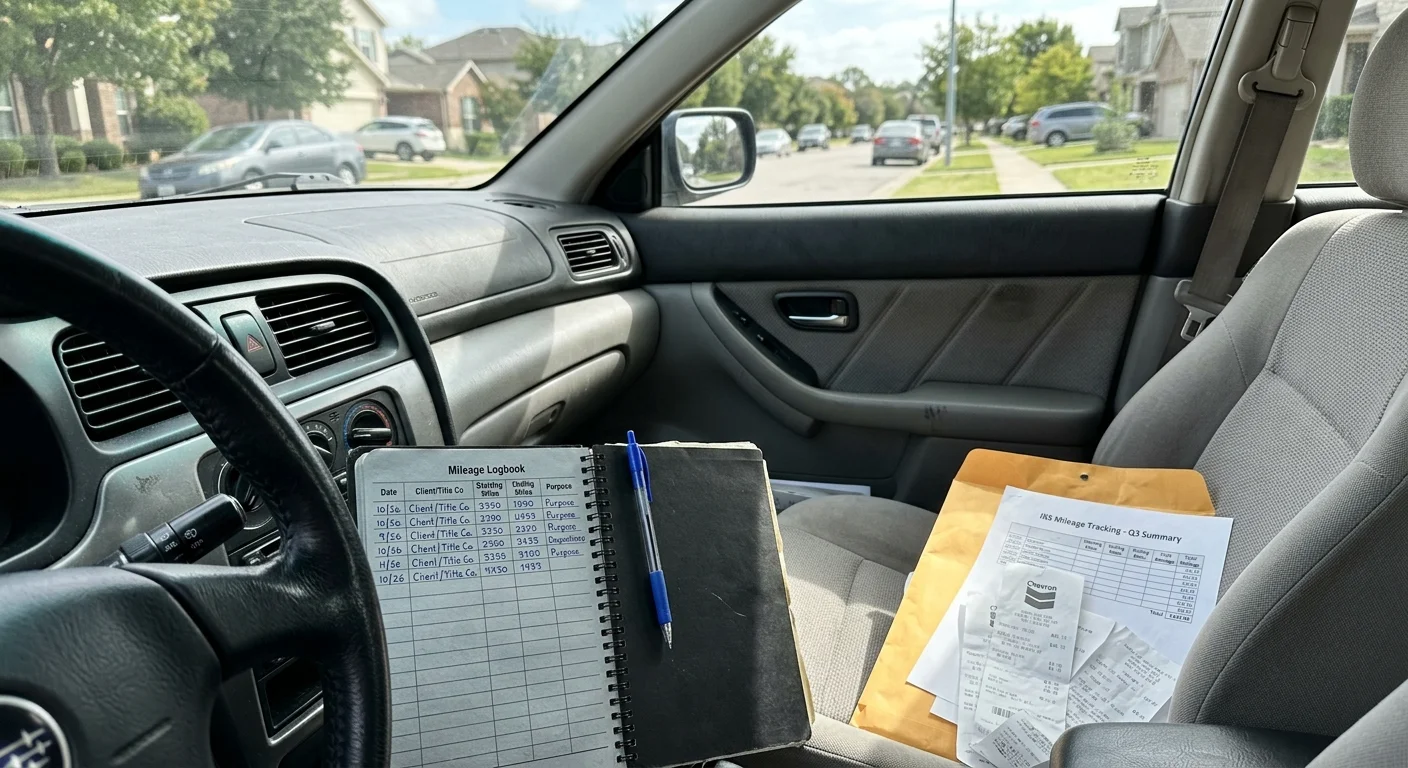
Your primary tax shelter comes from business vehicle mileage. Every mile driven from your home office to borrower appointments and shipping receptacles counts as an allowable expense.
The IRS standard business mileage rate is 70 cents per mile for 2025 and 72.5 cents per mile for 2026. Maintaining a detailed vehicle log turns routine driving into large deductions.
Smartphone mileage tracking applications record driving logs automatically using internal sensors. These digital records satisfy IRS documentation requirements without manual paperwork.
Despite your deep familiarity with legal instruments, you must strictly respect boundaries prohibiting the Unauthorized Practice of Law (UPL). Non-attorney signing agents serve strictly as impartial ministerial witnesses.
Even with decades of legal clerk experience, you may never interpret contract language, evaluate loan terms, or advise borrowers regarding property vesting choices. Violating UPL rules risks your notary commission.
Furthermore, several states enforce strict attorney-closing mandates. Georgia, Massachusetts, South Carolina, Connecticut, Delaware, Vermont, and West Virginia require licensed attorneys to supervise or conduct real estate closings.
If you reside outside these specific states, you can operate an independent mobile route freely. Adhering to clear procedural boundaries protects your business reputation and legal standing.
- Always direct specific questions regarding interest rates, payments, or escrows directly to the lender’s loan officer.
- Guide borrowers by reading the exact document titles and instructional captions printed at the top of each page.
- Never advise signers on whether they should hold title as joint tenants or tenants in common.
- Log every single trip detail immediately, recording departure locations, total mileage, and appointment reference numbers.
- Deduct equipment depreciation, paper reams, toner cartridges, and home internet costs on your annual federal Schedule C.

A Worked Week: The Step-by-Step Morning Signing Scenario
To understand how this route functions, examine a practical weekly schedule for a former paralegal managing a $1,900 monthly revenue target. She operates four mornings weekly within a tight ten-mile geographic radius.
Her weekly schedule includes one direct title closing paying $175 and three platform-dispatched appointments paying $100 each. This workflow generates $475 in gross earnings each week.
Over a four-week operational month, she earns exactly $1,900 across sixteen completed signings. Her field time averages under eight total hours per week.
- 7:45 AM: Receive electronic document package via encrypted title portal; verify borrower names and notary certificate wording (10 minutes).
- 7:55 AM: Send the 150-page package to the dual-tray laser printer, producing lender and borrower sets (6 minutes).
- 8:05 AM: Review document stacks, place adhesive signature flags on execution lines, and prep the official journal (15 minutes).
- 8:35 AM: Drive seven miles to the borrower’s home address (15 minutes).
- 8:50 AM: Verify government identifications, administer statutory oaths, and witness document executions (50 minutes).
- 9:40 AM: Conduct a comprehensive table audit, verifying that zero initial fields or notary acknowledgments were overlooked (10 minutes).
- 9:55 AM: Drive five miles to the nearest FedEx or UPS priority drop box for overnight delivery to escrow (12 minutes).
- 10:15 AM: Return home, record mileage in log, upload shipping receipts to the title portal, and close the file (15 minutes).
She drives twenty-four total miles per assignment day, covering ninety-six miles weekly and 384 miles each month. At 70 cents per mile, she captures $268.80 in monthly mileage deductions.
Paper and high-yield toner consume approximately $48 monthly for 4,800 total printed pages. Her net operational expenses remain exceptionally low, preserving over 80% of gross revenues as net profit.
By 10:30 AM each morning, her paid responsibilities conclude entirely. She enjoys a purposeful professional routine while retaining full freedom for the rest of her day.
Frequently Asked Questions
How many hours per week does a $1,900 monthly route require?
Completing three to four morning appointments takes roughly six to eight hours of field and printing time weekly. You control your schedule completely and take every afternoon off.
Does an ex-paralegal need a law degree to work as a loan signing agent?
No law degree is required. You only need an active state notary commission, industry certification, and background screening to execute real estate closing packages.
Will earning $1,900 per month reduce my Social Security retirement benefit?
No, earning $1,900 monthly totals $22,800 annually, which remains below the $23,400 early retirement earnings limit for 2025. You collect your complete monthly benefit check.
Why are inkjet printers prohibited for mortgage loan packages?
Lenders and county recorders require laser printing because inkjet ink smears easily when exposed to moisture. Laser toner bonds heat directly into paper fibers, ensuring permanent legal records.
Disclaimer: This article is for informational and inspirational purposes. Life decisions are deeply personal, and we encourage readers to pursue their dreams while considering their unique circumstances, health, and financial situation.