Trading a high-intensity software architecture career in San Jose for an off-grid sanctuary in Michigan’s Upper Peninsula delivers complete personal autonomy. You do not need to sacrifice modern comfort, high-speed data, or clean heat to thrive in sub-zero winter conditions.
Stepping away from the tech industry proves that reinventing yourself in retirement can take the form of self-reliant homesteading rather than passive leisure.
Generic retirement guides suggest northern off-grid living requires grueling rustic deprivation. In reality, treating your homestead as a precision energy microgrid proves that smart solar engineering and fuel budgeting maintain reliable warmth for under $2,200 monthly.
At 67, your systems-thinking background provides the ideal toolkit for designing a self-reliant winter paradise. This operational guide breaks down every watt, cord, and tax exemption for your Upper Peninsula second act.
Architecting the Winter Microgrid: Sizing Panels for Lake-Effect Skies
Designing an off-grid power system in the Northwoods requires abandoning California solar assumptions. Annual sunshine averages deceive newcomers because winter weather patterns change the equation entirely.
Living independently in remote northern winters also requires establishing a proactive solo aging safety protocol for check-ins and emergency fall protection.
While lower Michigan enjoys over four peak sun hours per day during summer, Upper Peninsula winters average only 1.5 to 2.0 peak sun hours daily. Heavy lake-effect cloud cover from Lake Superior blankets the landscape from late November through January.
Snowfall totals ranging from 150 to over 280 inches will bury standard residential roof-mounted arrays. Clearing snow from a second-story roof pitch at age 67 poses unacceptable physical risk.
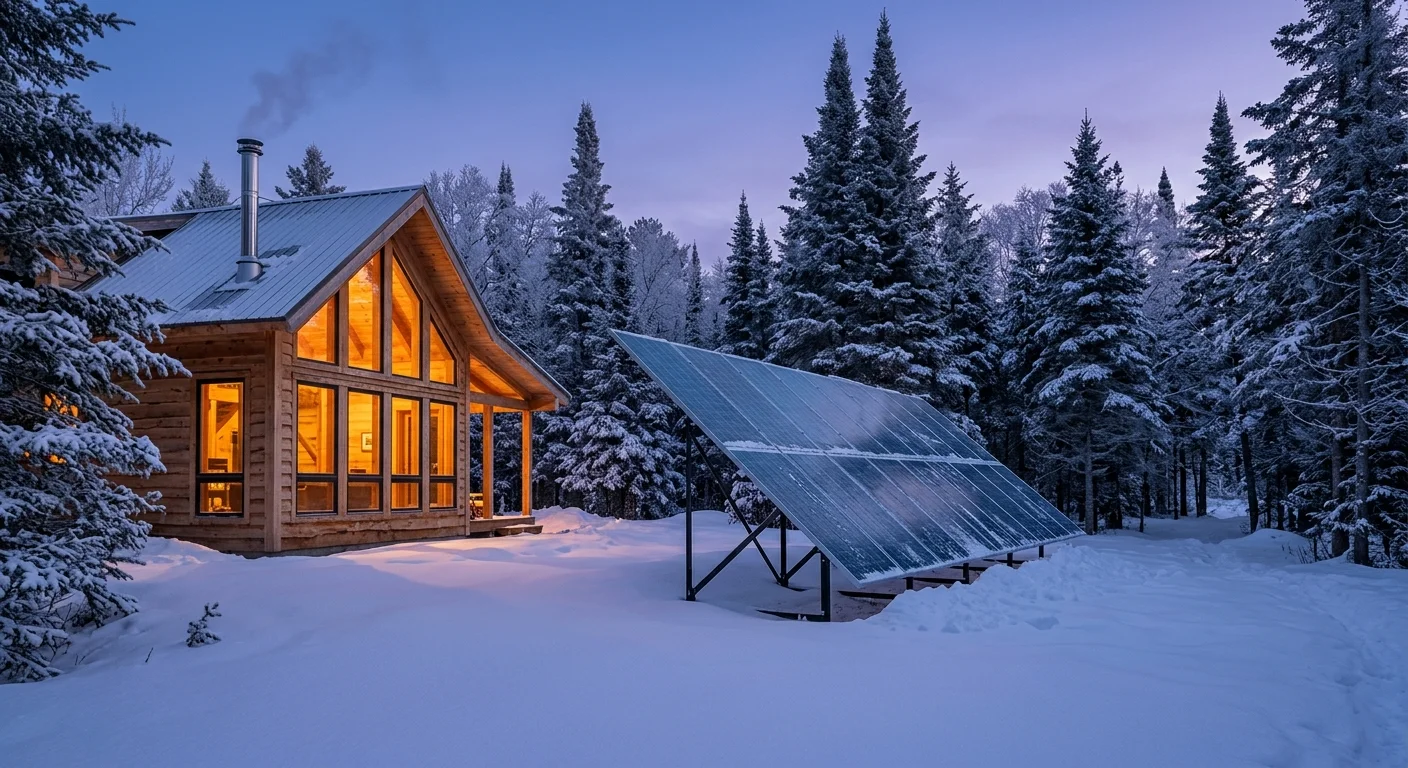
Ground-mount arrays solve this challenge by allowing immediate maintenance from the ground. Setting your ground array to a steep 55-degree or 60-degree tilt angle sheds heavy snowfall automatically while aligning perpendicularly with the low winter sun.
To secure energy independence when retiring off grid Michigan Upper Peninsula woodlands demand substantial generation capacity. You must oversize your photovoltaic array to harvest usable current even during dull, gray overcast days.
- Array architecture: Twenty-four 410-watt bifacial monocrystalline panels providing 9.84 kW nameplate capacity
- Racking infrastructure: Ground-mounted steel framing with dual-position seasonal tilt adjustment pins
- Inverter platform: Sol-Ark 15K or dual Schneider Conext XW Pro 6.8 kW hybrid split-phase inverters
- Snow clearance design: 48-inch lower-lip ground clearance preventing ground snow accumulation from blocking panels
Bifacial panels capture light from both sides, generating up to 15 percent additional power from ground albedo when snow covers the field. This snow bounce effect often offsets the production drop caused by high cloud haze.
Lithium Battery Math: Cold-Weather Storage and Amp-Hour Reserves
Lead-acid batteries belong to the past century of off-grid living. Modern energy independence relies on Lithium Iron Phosphate (LiFePO4) chemistry due to its 6,000-cycle lifespan and exceptional round-trip efficiency.
Maintaining critical power infrastructure becomes much simpler when mastering basic DIY home repair skills before configuring off-grid components.
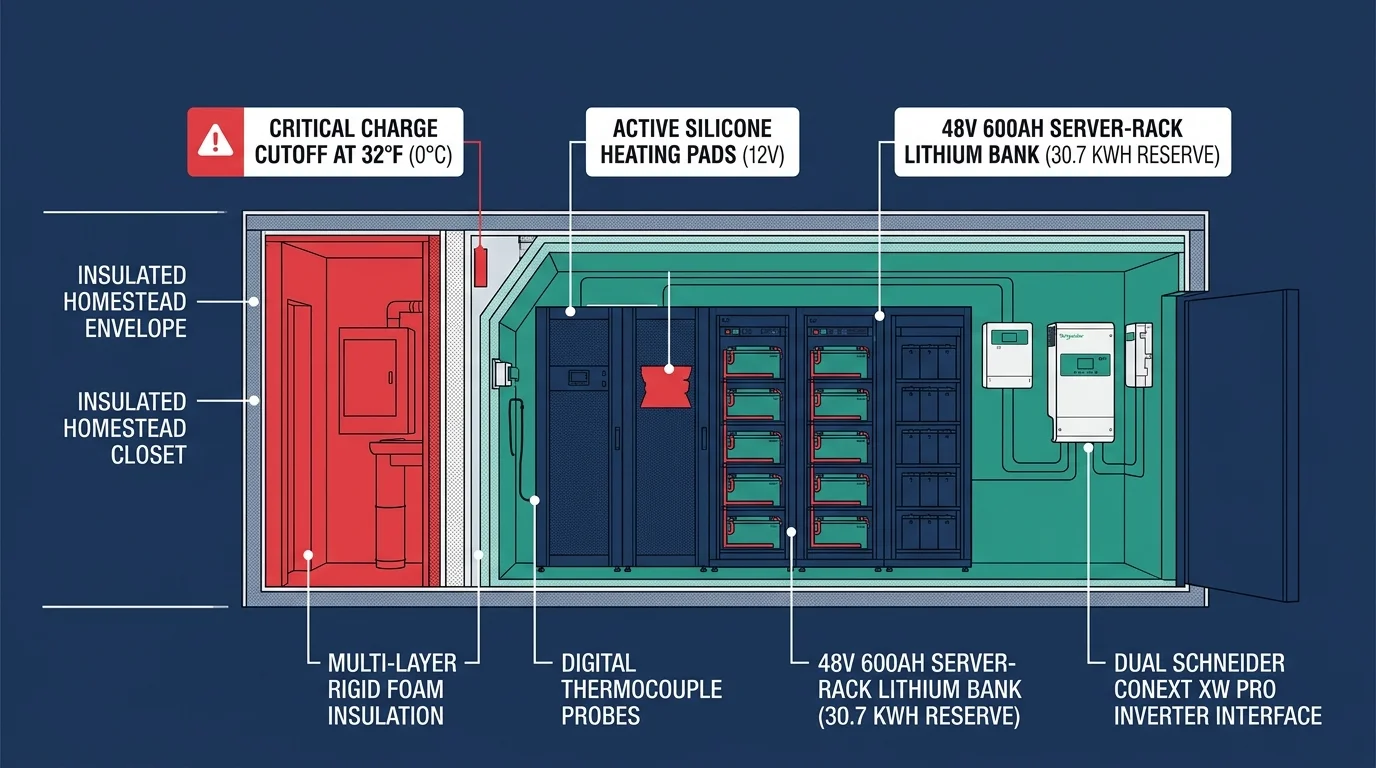
However, LiFePO4 cells exhibit one critical vulnerability: you cannot charge them below 32 degrees Fahrenheit without causing permanent lithium plating and catastrophic cell destruction. You must engineer your battery housing inside your conditioned thermal envelope.
A solar battery system senior off grid builders construct should always occupy an insulated mechanical room. Keeping this interior space between 50 and 65 degrees Fahrenheit ensures maximum battery efficiency and safety.
A resilient winter system requires 30 kWh of gross storage to endure three consecutive zero-production days without running a generator. At a standard 48-volt configuration, six 5.12 kWh server rack batteries connected in parallel provide 600 amp-hours of reserve capacity.
- Install an enclosed steel rack housing six 48V 100Ah LiFePO4 server-rack batteries inside an insulated utility room.
- Establish closed-loop communications between battery internal management systems and the hybrid inverter via CAN-bus protocol.
- Program strict depth-of-discharge cutoffs at 20 percent state-of-charge to guarantee emergency reserves.
- Integrate 12-volt silicone heating pads beneath individual battery modules configured to activate via thermostat if ambient room temperature drops below 42 degrees.
Under the federal Inflation Reduction Act, residential battery storage installations of 3 kWh or greater qualify for the Section 25D 30 percent tax credit. This incentive applies directly against your federal tax liabilities through 2032, significantly reducing upfront capital expenses.
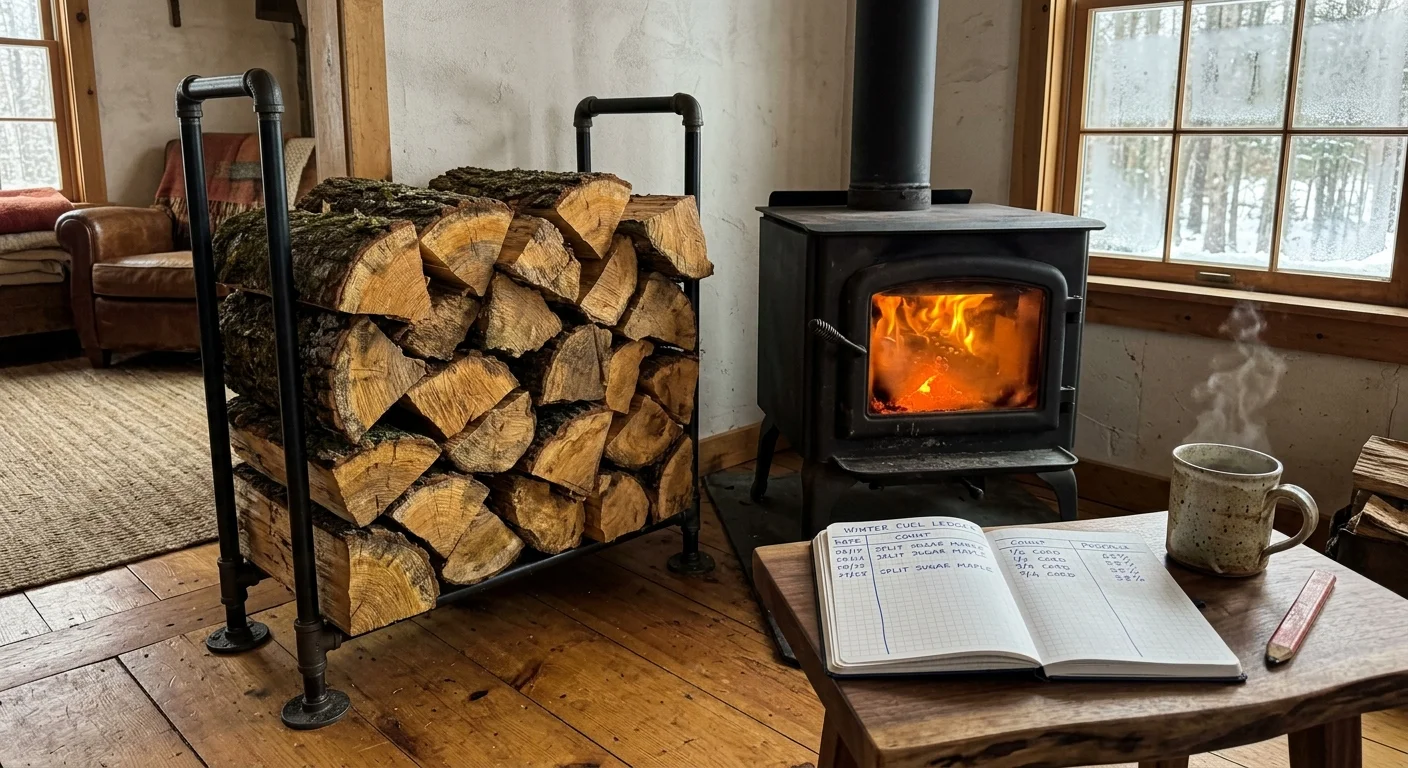
Thermal Dynamics: The Real Propane and Cordwood Heating Ledger
Heating an off-grid home in USDA Plant Hardiness Zone 5a or 4b demands deliberate thermal redundancy. Relying exclusively on electricity for winter heat will rapidly deplete your battery bank within hours.
A hybrid heating strategy combining seasoned hardwood with sealed-combustion direct-vent propane heating creates reliable thermal security. This dual-source approach keeps your cabin cozy regardless of external blizzards.
According to the U.S. Energy Information Administration, residential propane in Michigan averages between $2.20 and $2.40 per gallon during heating months. Heating a tight, 1,200-square-foot cabin solely on propane requires roughly 500 to 800 gallons across the six-month cold season.
Seasoned dense hardwoods such as sugar maple and yellow birch provide outstanding local heating value across the Upper Peninsula. Locally purchased seasoned cordwood currently costs between $200 and $300 per full cord delivered.
A modern catalytic wood stove achieves an efficiency rating above 78 percent, extending a single wood load into a clean 12-hour burn. You burn wood while awake and active, allowing the automated propane wall heaters to maintain baseline temperatures overnight.
- Primary heat: High-efficiency catalytic wood stove consuming 4 to 5 full cords of mixed hardwood per winter
- Secondary heat: Two Rinnai EX38CT direct-vent wall furnaces running on propane with digital wall thermostats set to 62 degrees
- Propane storage: 1,000-gallon underground or leased aboveground tank filled in August during low off-season pricing
- Emergency backup: Passive Empire gravity-vent floor heaters that operate without any household electrical power
This balanced system reduces annual propane consumption to under 350 gallons while giving you the healthy physical routine of managing a wood stove. The combination provides total comfort during minus-twenty-degree deep freezes.
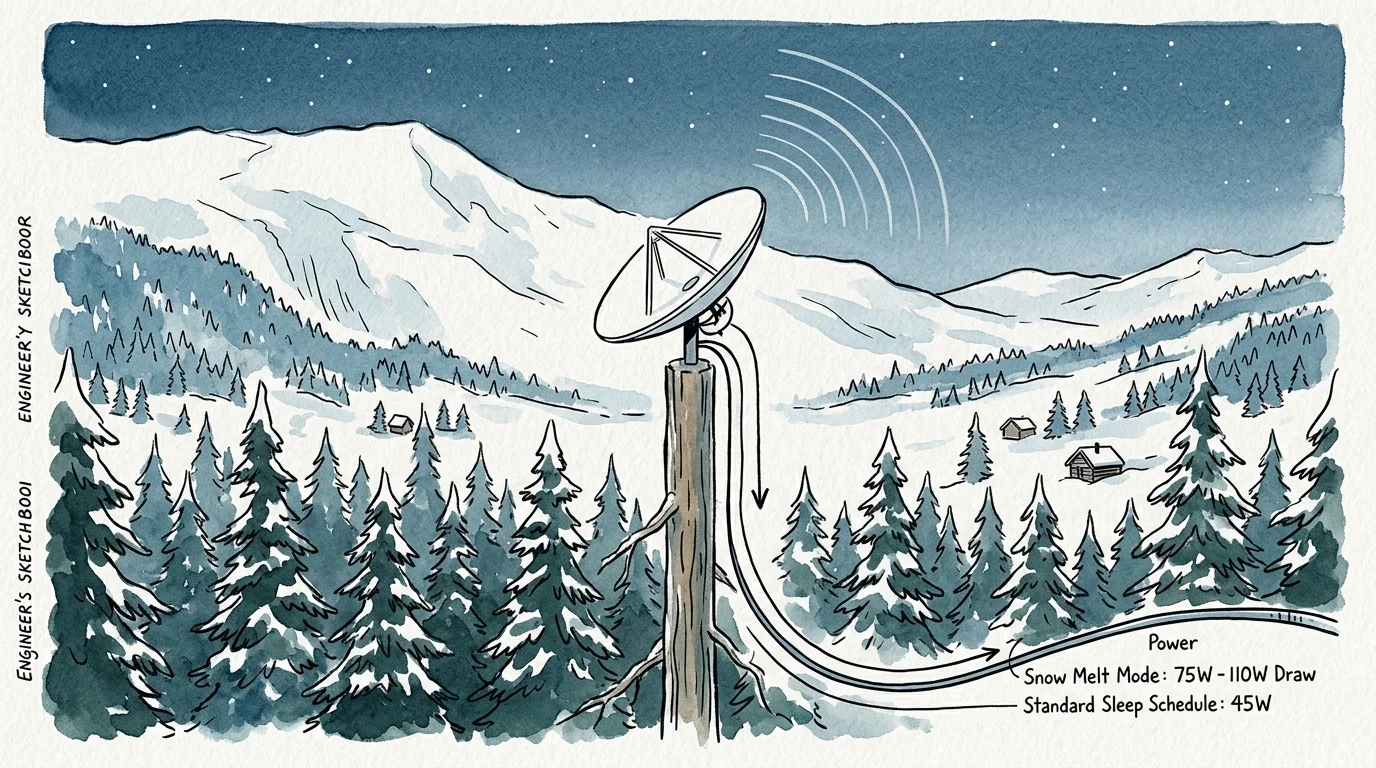
Connectivity in the Conifers: Starlink Power Loads and Remote Reliability
A successful transition from Silicon Valley architecture meetings to northern solitude requires reliable high-bandwidth connectivity. Modern satellite internet enables seamless consulting, family video calls, and remote system telemetry.
Starlink standard residential hardware costs approximately $349 upfront, with monthly service tiers running between $85 and $130. Speeds in rural Michigan consistently reach 120 to 220 Mbps download, exceeding typical suburban DSL lines.
However, the operational challenge lies in hardware energy management during snowy months. The dish requires an internal heater to prevent ice accumulation, creating an unexpected drain on off-grid battery systems.
In standard running mode, the terminal draws 50 to 75 watts, consuming roughly 1.5 kWh every 24 hours. When snowfall triggers automatic melt cycles, power consumption climbs by an extra 40 to 100 watts continuously.
Running the heater non-stop through a dark snowstorm consumes over 3.5 kWh daily, representing nearly 15 percent of your total battery storage. You must manage this load actively using system software.
Setting the snow-melt toggle from “Automatic” to “Off” or “Pre-heat Only” inside the mobile interface prevents unnecessary power drain. Using a manual extended broom to dust ground-accessible dish mounts preserves critical winter watt-hours.
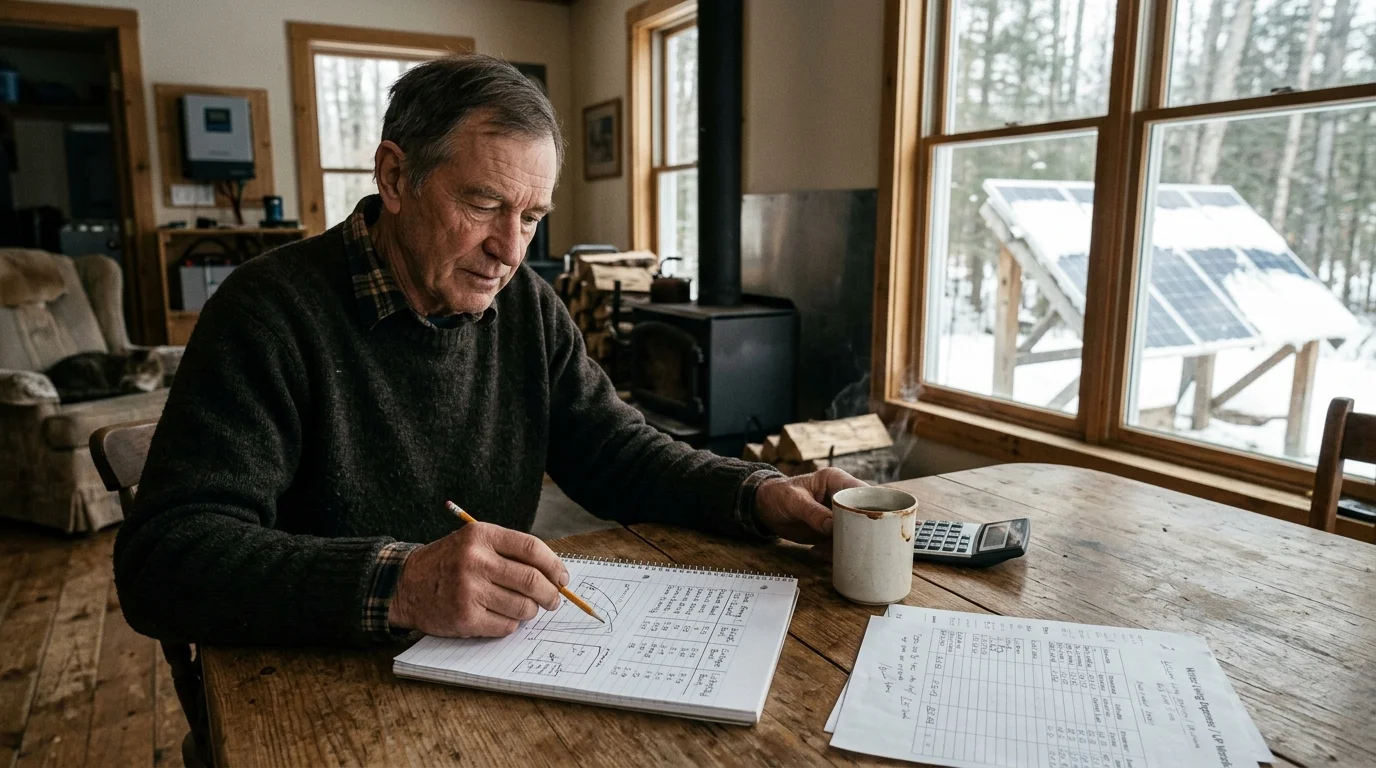
Off-Grid Winter Microgrid Configurations Compared
Selecting the right microgrid balance requires aligning equipment scale with your personal comfort needs and budget. Below is an engineering comparison of three distinct winter system architectures for off-grid living.
Selecting a smaller microgrid profile aligns naturally with embracing minimalism and downsizing to eliminate unnecessary appliances and energy waste.
| System Profile | Array & Storage Specs | Winter Daily Yield | Generator Run-Time | Net Upfront Hardware Cost |
|---|---|---|---|---|
| Essential Cabin (Minimalist) | 4.5 kW Array, 15 kWh LiFePO4, 5 kW Inverter | 5 to 8 kWh/day | 45 to 60 hours/month | $13,500 (After 30% Tax Credit) |
| Balanced Modern Homestead | 9.8 kW Array, 30 kWh LiFePO4, 12 kW Inverter | 12 to 18 kWh/day | 12 to 18 hours/month | $23,800 (After 30% Tax Credit) |
| Full Redundancy Microgrid | 14.5 kW Array, 45 kWh LiFePO4, 15 kW Inverter | 20 to 28 kWh/day | 3 to 6 hours/month | $36,200 (After 30% Tax Credit) |
For most retirees, the Balanced Modern Homestead delivers optimal comfort without requiring daily generator operation. It easily powers an induction cooktop, modern refrigeration, well pumps, and continuous high-speed internet.

Comprehensive Winter Budget: Real Expenses for an Off-Grid Homestead
Moving off the grid reduces utility bills, but it introduces capital maintenance and fuel replenishment expenses. Tracking your true off grid retirement living expenses provides financial clarity and peace of mind.
Operating a debt-free woodland property in northern Michigan costs substantially less than maintaining property in metropolitan California. However, you must budget accurately for consumables, mechanical maintenance, and equipment replacement reserves.
- Propane fuel supply: $115 per month ($690 seasonal total for 300 gallons at $2.30 per gallon)
- Seasoned hardwood: $125 per month ($1,000 seasonal total for 4 cords delivered and stacked)
- High-speed satellite internet: $120 per month (Starlink standard residential plan)
- Generator maintenance and gasoline/oil: $45 per month (synthetic oil, spark plugs, filters, backup fuel)
- Equipment depreciation reserve: $175 per month (battery bank and inverter replacement fund)
- Homestead property taxes: $165 per month ($1,980 annual bill on 40 wooded acres with homestead exemptions)
- Plowing and snow trail clearing: $80 per month (fuel and maintenance for tractor or snowblower)
Your total monthly operational overhead averages approximately $825 per month during deep winter. Even when adding groceries, comprehensive health coverage, and vehicle insurance, monthly living expenses rarely exceed $2,200.
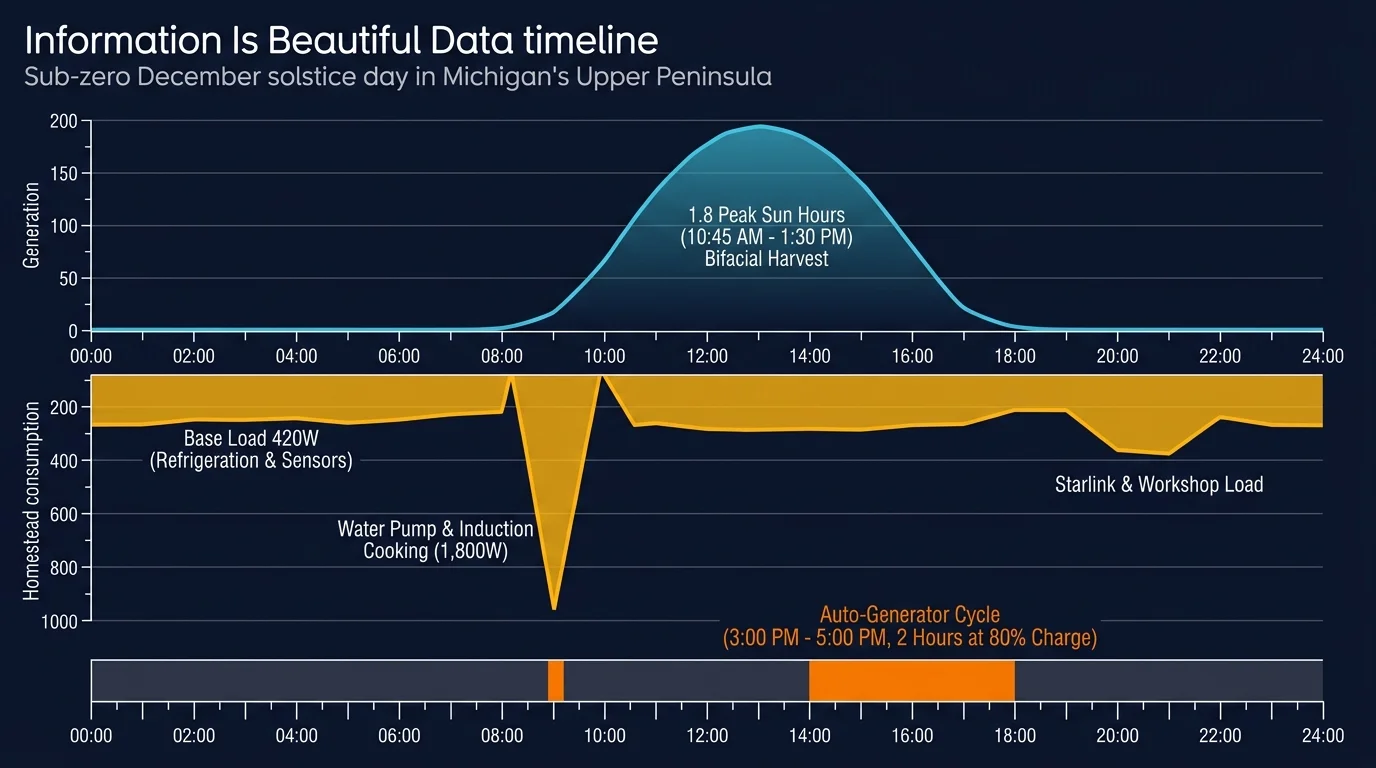
Worked Scenario: A Complete 24-Hour December Energy and Fuel Audit
Consider an actual winter solstice scenario on December 21 at an off-grid cabin outside Marquette, Michigan. Outdoor ambient temperatures sit at -4 degrees Fahrenheit with overcast, lake-effect cloud cover.
The 9.8 kW ground-mount array produces an effective 0.75 sun-hour equivalent due to heavy cloud cover, delivering 7.35 kWh of DC generation. The cabin’s total electrical consumption over 24 hours equals 8.4 kWh across all domestic circuits.
Baseload electrical draw consists of 1.6 kWh for Starlink internet, 1.4 kWh for refrigeration, 0.8 kWh for the well pump, 1.8 kWh for LED lighting and laptops, and 2.8 kWh for furnace draft blowers and wood stove circulation fans.
The daily energy deficit is exactly 1.05 kWh, drawn cleanly from the 30 kWh battery bank without dropping system capacity below 85 percent state-of-charge. No generator intervention is required on this day.
On the thermal side, the cabin burns 38 pounds of seasoned sugar maple across two stove loadings. The secondary direct-vent propane furnace cycles three times during early morning hours, burning 0.85 gallons of propane at an operating cost of $1.96.
Total real cash operating cost for 24 hours of total warmth, power, and connection equals $1.96 in propane plus $8.33 in cordwood value. That yields a remarkably comfortable day in sub-zero woods for just $10.29.
Maximizing Michigan Senior Tax Protections and Homestead Credits
Michigan tax statutes offer valuable financial shields for retirees investing in rural primary residences. Understanding state-specific property tax exemptions protects your retirement capital from unexpected reassessments.
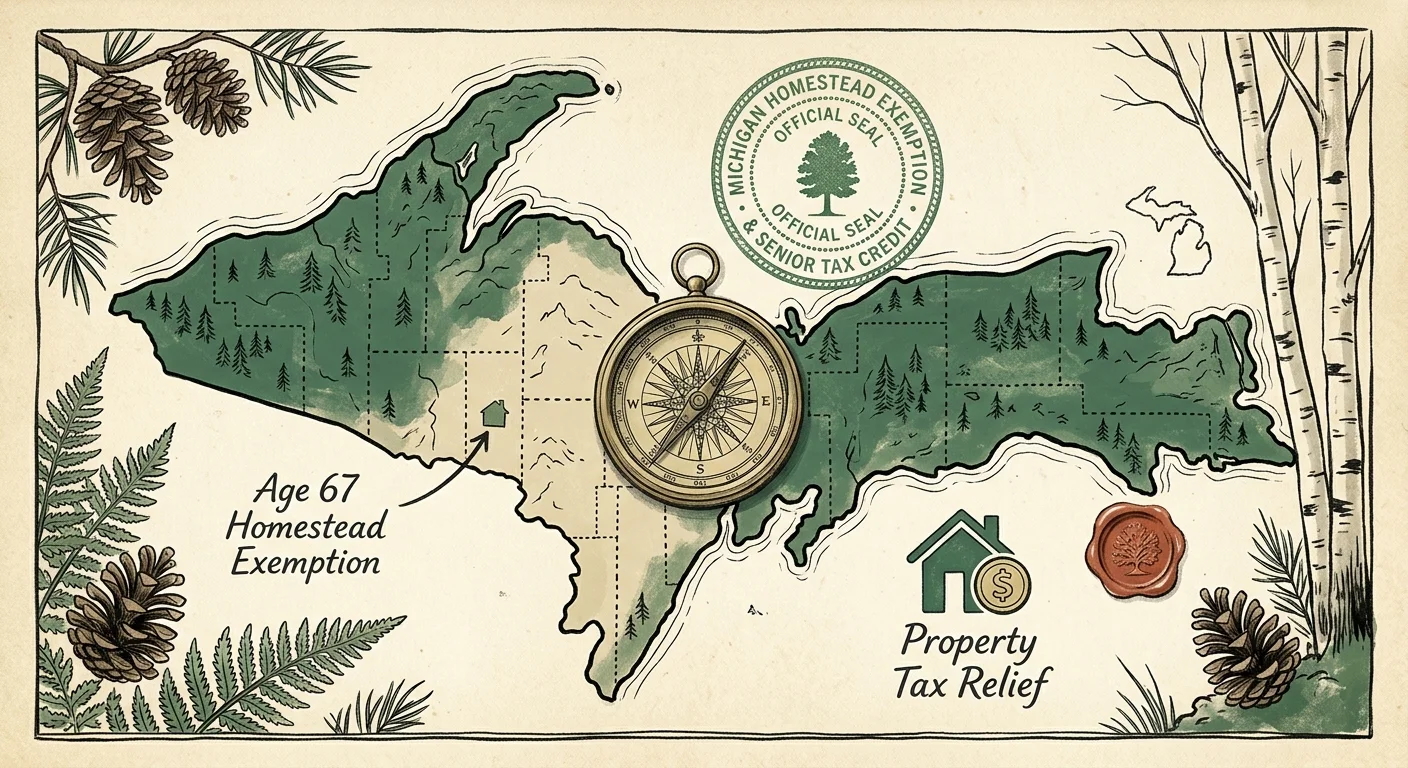
The Michigan Principal Residence Exemption (PRE) exempts your primary owner-occupied homestead from up to 18 mills of local school operating taxes. You claim this exemption by filing Form 2368 with your local township assessor upon closing.
For a homestead valued at $250,000 with a taxable value of $125,000, the PRE saves you up to $2,250 annually. This single filing drastically lowers holding costs on off-grid woodland acreage.
Furthermore, Michigan seniors aged 65 and older qualify for the Homestead Property Tax Credit via Form MI-1040CR. If your total household resources remain under $71,500, the state provides a refundable credit covering up to 100 percent of property taxes exceeding 3.5 percent of income.
Even if you owe zero Michigan state income tax due to pension deductions or Roth IRA distributions, the state issues this credit as a direct refund check. These statutory tax shields make Michigan exceptionally friendly for conservative retirement cash flow.
Curating Purpose and Physical Vitality Beyond the Screen
Stepping away from an enterprise tech career often leaves a psychological vacuum where complex architecture challenges once lived. Managing a northern homestead fills that void by demanding practical systems engineering and continuous learning.
Off-grid living transforms daily chores into meaningful rituals. Tuning an inverter charge profile, tracking battery state-of-charge curves, and processing cordwood create immediate, tangible achievements.
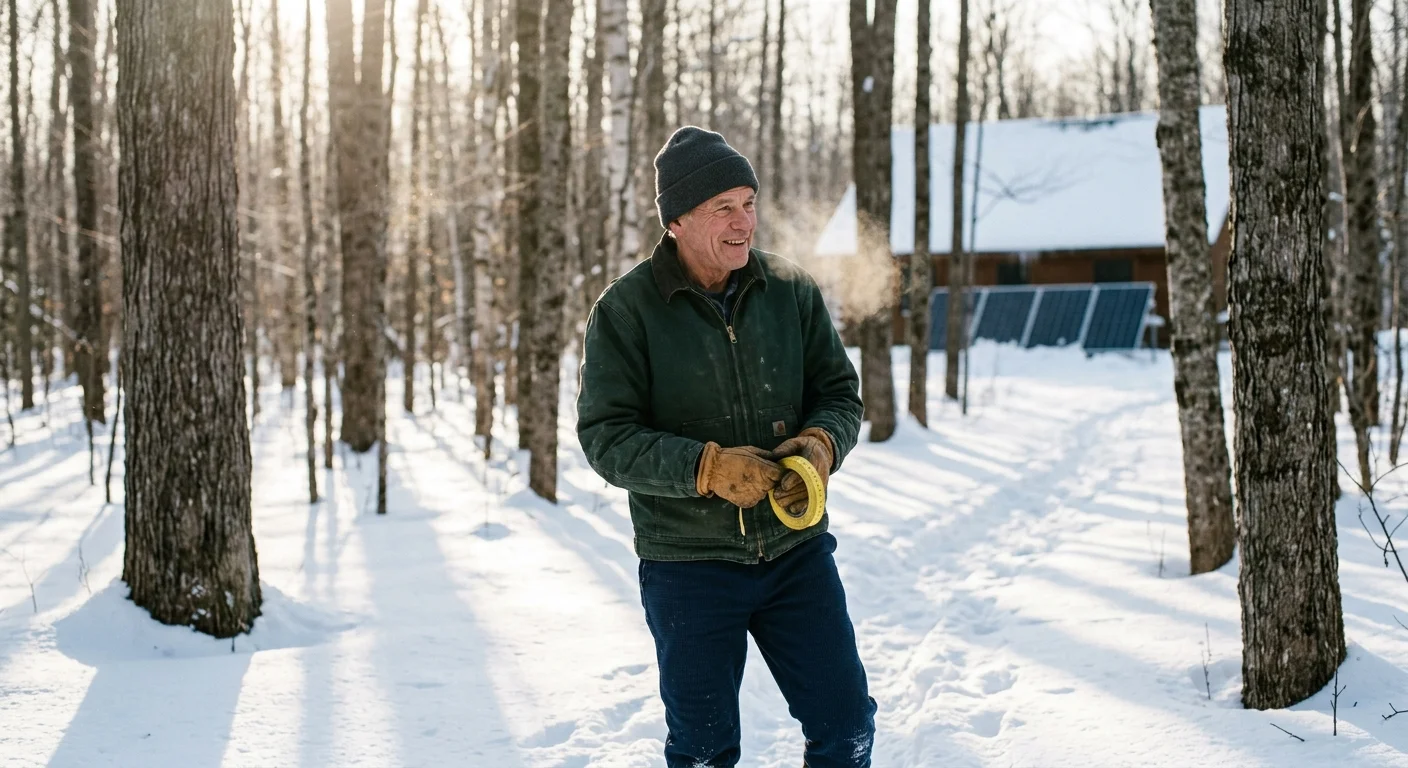
Physical labor in the crisp winter air provides natural resistance training that supports cardiovascular health and joint mobility. Stacking wood and managing trail snow replaces artificial gym workouts with productive physical agency.
Studies published by the Stanford Center on Longevity show that remaining physically active through daily lifestyle tasks dramatically extends cognitive vitality in your late sixties and seventies. Your physical environment becomes your longevity partner.
Moreover, transitioning technical expertise into community mentorship offers profound purpose. Organizations like Encore.org highlight how retired professionals find fulfillment by combining professional skills with regional conservation initiatives.
Your technical career was merely the warmup for this chapter. Designing and inhabiting your self-reliant homestead stands as the ultimate capstone project of an empowered life.
Frequently Asked Questions
Can solar panels produce enough electricity during an Upper Peninsula winter?
Yes, provided you mount panels at a 55-degree to 60-degree tilt on ground racks and size the array between 8 kW and 10 kW. While regional winter insolation drops to 1.5 peak sun hours daily, bifacial panels capture direct and reflected light while shedding heavy snow loads.
How do you keep lithium batteries from freezing in sub-zero off-grid cabins?
You must install Lithium Iron Phosphate (LiFePO4) batteries within a climate-controlled building envelope maintained above 40 degrees Fahrenheit. Modern server rack batteries also feature internal low-draw heating pads that prevent charging cycles from initiating when internal cell temperatures drop below 32 degrees Fahrenheit.
How much propane does an off-grid cabin consume during a northern Michigan winter?
A well-insulated 1,200-square-foot cabin utilizing a hybrid heating approach consumes 500 to 800 gallons of propane between November and April. At average Michigan residential rates of $2.20 to $2.40 per gallon, seasonal heating and generator fuel costs range from $1,100 to $1,920.
Does Starlink satellite internet draw too much power for an off-grid solar system?
Standard residential Starlink hardware draws 50 to 75 watts during normal operation, totaling roughly 1.5 kWh daily. When active snow-melt mode engages during blizzards, consumption spikes by 40 to 100 watts, requiring homesteaders to manually manage heater settings during prolonged low-solar periods.
Disclaimer: This article is for informational and inspirational purposes. Life decisions are deeply personal, and we encourage readers to pursue their dreams while considering their unique circumstances, health, and financial situation.