
You traded thirty years of back-to-back corporate meetings for an empty calendar, and by 7:15 AM, the silence feels paralyzing. You can end this disorientation immediately by reclaiming your executive command structure rather than forcing artificial relaxation.
True psychological freedom after the C-suite requires an intentional operating architecture, not an open-ended vacation. This guide introduces the 168-hour time reset to convert your leadership discipline into self-directed creative output, civic impact, and athletic vitality.
By replacing corporate urgency with structured high-leverage personal blocks, you eliminate unstructured time anxiety in retirement starting tomorrow morning.

The Neurobiology of the Empty Corporate Calendar
For decades, enterprise priorities dictated your circadian rhythm. Your neurobiology adapted to high dopamine cycles driven by operational crises, strategic board decisions, and continuous inbox demands.
Stepping into this vast void often feels intimidating, making stepping outside your comfort zone in retirement an essential mental hurdle to clear right away.
When you step away from the executive suite, those external stimuli evaporate overnight. Your brain expects immediate direction at 6:30 AM, but finds an empty screen instead.
This stark vacuum triggers an acute neurological response known as unstructured time anxiety in retirement. Without external demands, your central nervous system misinterprets open space as stagnation rather than opportunity.
The human brain dislikes unmapped territory, particularly when conditioned by decades of intense problem-solving. When you lack clear morning parameters, executive inertia sets in.
This dynamic manifests in distinct behavioral friction points during your first thirty days out of office:
- Compulsively checking commercial news sites or stock tickers to manufacture artificial urgency.
- Lingering over coffee for hours while experiencing low-grade guilt about unexpressed capability.
- Experiencing decision fatigue before 9:00 AM because every minor morning action requires deliberate choice.
- Feeling an unsettling loss of operational rhythm that mimics grief or professional irrelevance.
Overcoming this hurdle does not mean scheduling yourself into frantic busywork. Instead, you must deploy deliberate structure to release your creative agency.

Dismantling Corporate Identity Without Losing High-Performance Drive
Many retiring leaders fall into one of two damaging traps during month one. They either surrender entirely to passive leisure, or they immediately take low-value consulting gigs out of sheer panic.
Many former executives channel this drive into an intentional retirement reboot with fulfilling second careers rather than walking away from leadership altogether.
If strategic advisory work remains part of your vision, starting a consulting business in retirement allows you to monetize your hard-won expertise strictly on your own schedule.
Neither approach serves your long-term potential. Slumping into passive leisure blunts your cognitive edge, while reactive consulting merely binds you back to someone else’s agenda.
Your goal is not to suppress your ambitious drive, but to change its beneficiary. You are no longer generating equity for shareholders; you are directing your intellectual capital into personal mastery.
Research from the Stanford Center on Longevity shows that purposeful cognitive engagement is a primary determinant of health and vigor in our second half of life. Intellectual rigor protects vitality.
“The best way to predict the future is to create it.” — Peter Drucker
Drucker’s maxim applies directly to your calendar architecture. You built enterprises by defining organizational clarity, and your personal life warrants that same strategic focus.
A successful post executive retirement transition requires recognizing that ambition never dies. It simply demands higher-quality objectives that you design yourself.
When you view your calendar as an instrument of self-actualization, morning hesitation dissolves. You wake with a precise mandate that honors your lifelong capabilities.

The 168-Hour Executive Time-Allocation Architecture
Conventional retirement advice encourages people to take life day by day. For a former corporate executive, that unstructured approach creates confusion and aimlessness.
A rigorous retirement schedule template operates across an entire 168-hour weekly container. When you evaluate time through a weekly lens, zero-sum pressure disappears.
The 168-hour model divides your weekly capacity into four non-negotiable operational quadrants. Each quadrant protects a vital dimension of your health, impact, and curiosity:
- Foundational Vitality (70 Hours): Non-negotiable sleep, nutritional preparation, Zone 2 cardiovascular training, and restorative physical therapy.
- High-Agency Deep Work (20 Hours): Rigorous intellectual output, creative authorship, complex skill acquisition, or commercial venture design.
- Civic Leadership and Mentorship (15 Hours): Pro bono advising, community governance, nonprofit steering, and emerging leader sponsorship.
- Spontaneous White Space and Connection (63 Hours): Unstructured family engagement, exploratory reading, social travel, and serendipitous leisure.
This allocation preserves substantial flexibility while maintaining the structural scaffolding your nervous system requires. It ensures that 85 hours each week remain entirely free of obligation.
Crucially, this framework eliminates the dreaded morning void. You always know the primary objective of your 8:00 AM to 11:00 AM block before your head hits the pillow.
Structure does not restrict your freedom; it defends it. By anchoring your mornings in high-agency focus, you enjoy your unstructured afternoons without residual anxiety.
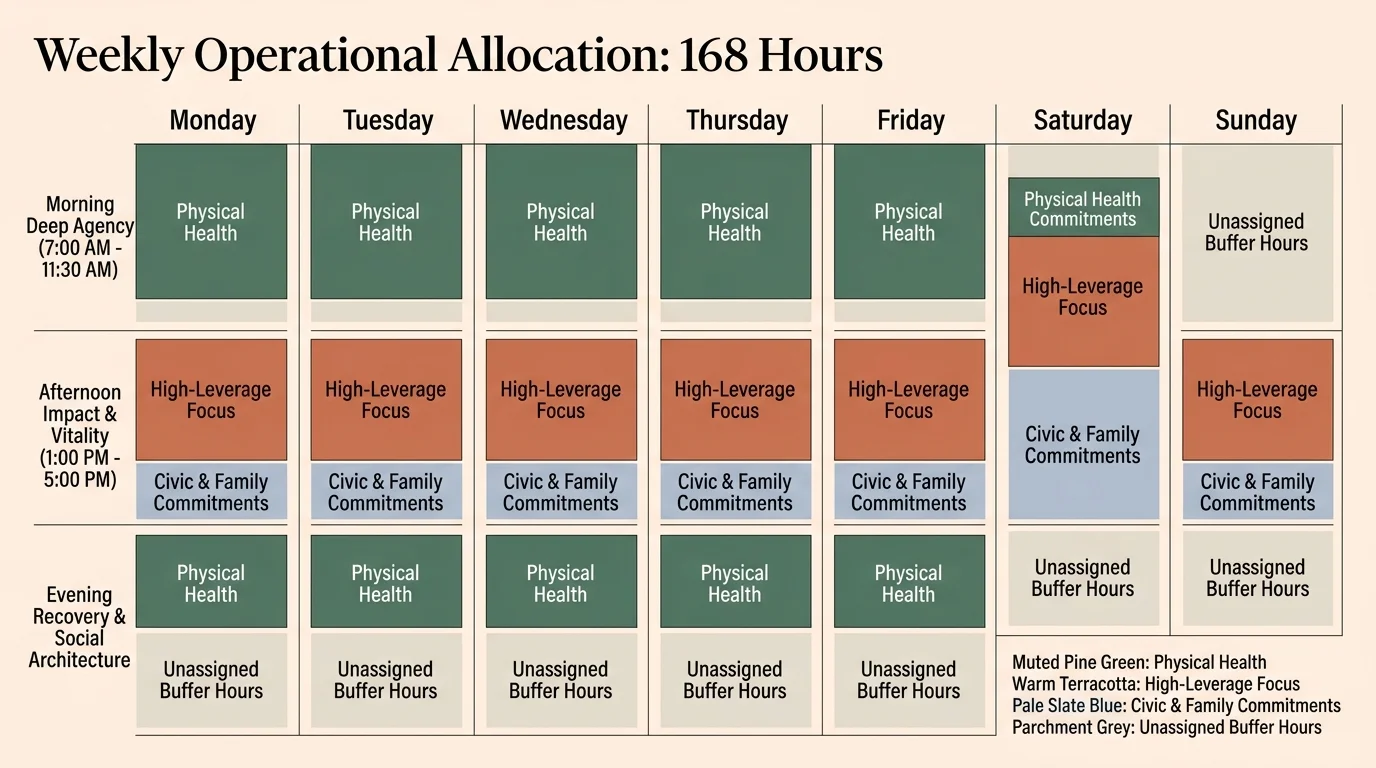
A Worked Example: Allocating 168 Hours for Peak Vitality
Consider a practical scenario featuring Mark, a 59-year-old former Executive Vice President of Operations who retired four weeks ago. In week two, Mark found himself pacing his kitchen at 7:30 AM with no agenda.
Allocating protected white space also grants you permission to pursue an ambitious retirement bucket list beyond the obvious choices.
Mark implemented the 168-hour architecture by treating his retirement schedule template with executive precision. He mathematically mapped his weekly baseline down to the exact hour.
He designated 56 hours per week for sleep, enforcing an eight-hour nightly recovery window between 10:30 PM and 6:30 AM. This established a predictable biological anchor.
Mark then scheduled 10.5 hours for athletic conditioning. Every morning from 6:45 AM to 8:15 AM, he cycles through Zone 2 endurance work and heavy resistance training.
From 9:00 AM to 12:00 PM, Monday through Thursday, Mark runs a three-hour Deep Work block dedicated to writing an operational manual for clean-tech startups. That claims 12 hours weekly.
He reserved Tuesdays and Thursdays from 1:30 PM to 4:30 PM for civic advisory work, dedicating 6 hours weekly to local governance boards. He assigned 14 hours across the week for meal preparation and deliberate dining.
The remaining 69.5 hours are protected as open white space for his marriage, recreational sailing, and spontaneous community connections. His total adds up perfectly:
56 + 10.5 + 12 + 6 + 14 + 69.5 = 168.0 hours allocated with zero corporate interference.
Mark transformed his morning routine into an empowering sequence that drives energy throughout the day:
- 6:30 AM: Rise immediately without checking digital notifications, followed by 500 milliliters of electrolyte hydration.
- 6:45 AM to 8:15 AM: Complete prescribed physical conditioning and cold-water recovery.
- 8:15 AM to 9:00 AM: High-protein breakfast and focused review of the morning deep-work charter.
- 9:00 AM to 12:00 PM: Deep intellectual execution with all email, phone calls, and interruptions blacked out.
- 12:00 PM: Complete transition into an open, unstructured afternoon.
By 12:05 PM, Mark has trained like an athlete and produced significant intellectual value. He spends his afternoon with absolute psychological calm.

Channeling Leadership Muscle into Civic and High-Leverage Impact
Corporate executives possess immense operational capabilities that civic organizations, community foundations, and early-stage entrepreneurs desperately need. The key is deploying these skills strategically.
Do not allow yourself to be recruited into low-impact administrative volunteer work that drains your time. You should serve at the strategic and fiduciary level where your operational experience produces outsized results.
Through SCORE Mentoring, former executives can counsel ambitious founders on cash-flow modeling, supply-chain resilience, and organizational growth. This work transforms business experience into community development.
Similarly, initiatives championed by Encore.org prove that combining decades of corporate problem-solving with social causes builds powerful second acts. Your career was simply training for this civic chapter.
To avoid overcommitting your calendar, establish rigid operational boundaries for all civic and advisory engagements:
- Cap total outside advisory roles at two active organizations simultaneously.
- Restrict advisory meetings to designated afternoon windows, leaving mornings completely protected.
- Demand clear terms of reference with quantifiable project milestones rather than open-ended commitments.
- Step down immediately if the organization treats your strategic guidance as passive clerical labor.
When you direct your corporate skills into purposeful community projects, your authority remains active. You maintain professional relevance entirely on your own terms.
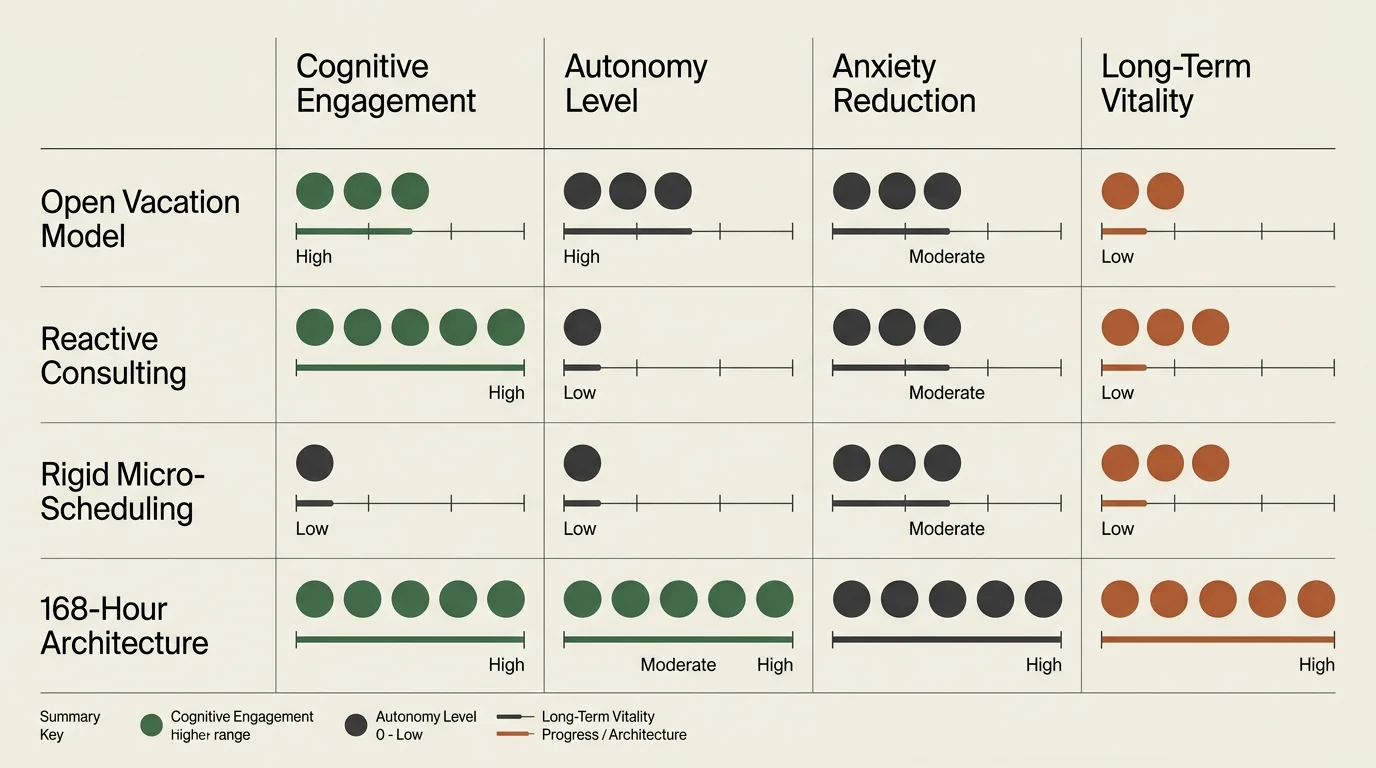
Time Management Frameworks for Retired Executives: A Quantitative Comparison
Selecting the wrong scheduling approach can prolong unstructured time anxiety in retirement. Executives require frameworks that balance agency with meaningful challenge.
Below is a comparative breakdown of common retirement calendar models evaluated across objective operational metrics.
| Operating Framework | Structured Weekly Hours | Morning Decision Latency | Cognitive Drift Index (1-10) | Primary Operational Failure Point |
|---|---|---|---|---|
| Tabula Rasa (Total Decompression) | 0 to 10 Hours | 45 to 90 Minutes | 8.7 | Apathy, loss of momentum, and morning depressive inertia. |
| Corporate Mimicry (Fragmented Consulting) | 45 to 60 Hours | 5 to 10 Minutes | 2.1 | Burnout, resentment, and repeating previous corporate stress patterns. |
| Micro-Scheduled Hobbyism | 35 to 45 Hours | 15 to 25 Minutes | 5.4 | Trivial busywork that fails to stimulate executive-level intellect. |
| The 168-Hour Autonomous Grid | 25 to 35 Hours | 0 Minutes | 1.8 | Requires self-discipline to protect deep-work and fitness boundaries. |
The comparative metrics reveal why the Tabula Rasa model fails former executives so consistently. A morning decision latency of 45 to 90 minutes guarantees paralysis.
Conversely, corporate mimicry simply recreates the operational cage you worked for decades to escape. It solves the schedule problem by resurrecting corporate stress.
The 168-Hour Autonomous Grid eliminates morning decision latency entirely through strategic pre-commitment. You step into each day with purpose, yet retain dozens of open hours for true personal freedom.
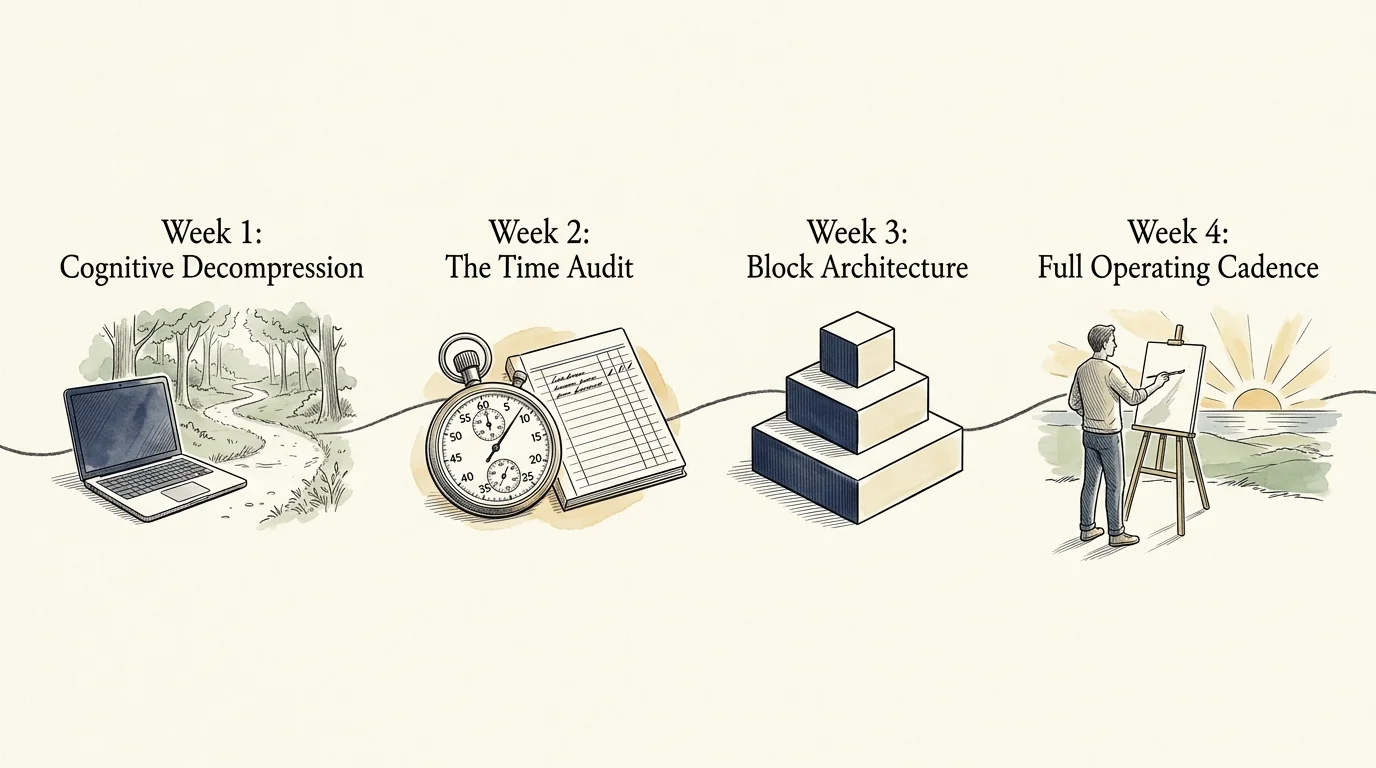
The Four-Week Calendar Reset Protocol
Transitioning from an enterprise command post to a self-directed life requires a deliberate onboarding process. You cannot overhaul your neurological habits in a single afternoon.
Deploy this four-week implementation protocol to progressively construct your calendar scaffolding during month one:
- Week One: Baseline Vitality and Sleep Locking. Establish a strict 6:30 AM wake-up time regardless of when you sleep. Dedicate your first 90 minutes entirely to hydration, light exposure, and athletic conditioning.
- Week Two: Deep Work Block Activation. Introduce a single two-hour focused block between 9:00 AM and 11:00 AM, Monday through Thursday. Dedicate this window to a challenging creative or intellectual project without internet browsing.
- Week Three: Civic Engagement Screening. Conduct preliminary interviews with two organizations where your enterprise skills solve specific operational problems. Commit to no more than six hours weekly.
- Week Four: The 168-Hour Audit and Calibration. Review your time expenditures against your target allocation. Rebalance your white space to ensure you are not slipping back into corporate overcommitment.
By approaching your transition in stages, you avoid the jarring shock of an unstructured lifestyle. You build sustainable daily momentum that carries you through month one and beyond.
Treat this protocol as your most important executive assignment. You are designing the framework for the most productive and rewarding decade of your life.
Frequently Asked Questions
How do I overcome guilt when taking unstructured time off during the workday?
Guilt stems from old corporate conditioning that equated open time with unproductivity. Reframe white space as an essential operational asset that enables strategic creativity, recovery, and lifelong intellectual stamina.
What if my spouse prefers a completely unstructured daily schedule?
Communicate your need for morning focus clearly, while maintaining shared afternoons and evenings. Your 168-hour grid allows you to pursue deep focus independently while preserving ample time for joint activities.
How do I stop reflexively checking corporate email and market tickers every morning?
Remove financial and news applications from your home screen and institute a strict device blackout until your morning workout concludes. Replace the reflexive dopamine loop with the physical stimulation of rigorous exercise.
Is morning anxiety in month one of retirement normal for senior leaders?
Yes, morning anxiety is a natural neurobiological reaction to the sudden removal of high-stakes responsibility. Implementing a structured morning framework quickly restores your sense of purpose and psychological equilibrium.
Disclaimer: This article is for informational and inspirational purposes. Life decisions are deeply personal, and we encourage readers to pursue their dreams while considering their unique circumstances, health, and financial situation.