
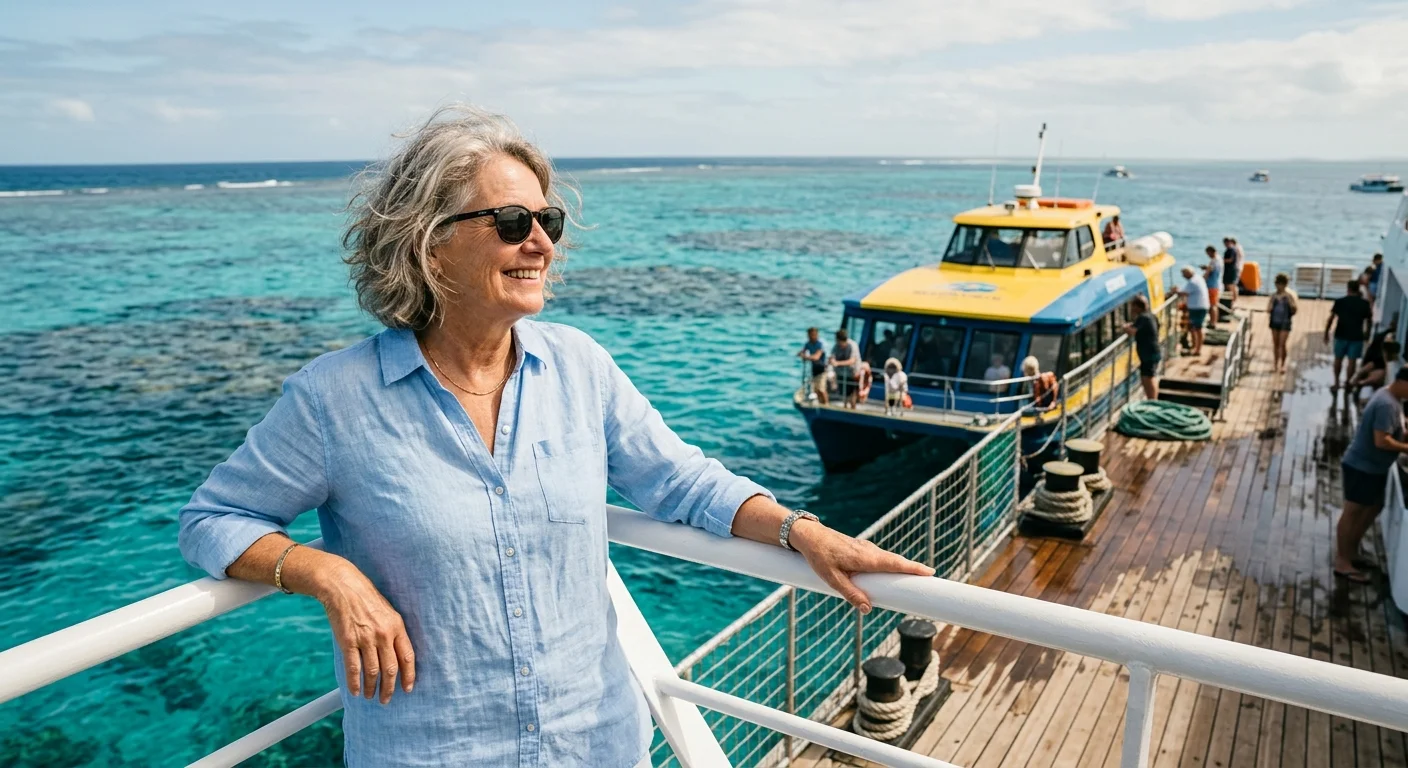
You can experience the vibrant biodiversity of the Great Barrier Reef without ever kicking a flipper or putting your face in the water. At age 66, you do not need swimming lessons or scuba certification to gaze directly into the coral gardens of the outer shelf.
From viewing underwater marine wonders to witnessing the night sky during budget Fairbanks aurora hunting, modern travel allows older adults to witness global wonders on their own terms.
Many tour reviews assume visitors will snorkel, yet modern Cairns mega-pontoons deliver deep-water marine immersion through submersibles, observatories, and helmet treks while keeping you entirely dry. This comprehensive guide compares platforms, medical requirements, and real costs so you can tour fearlessly.
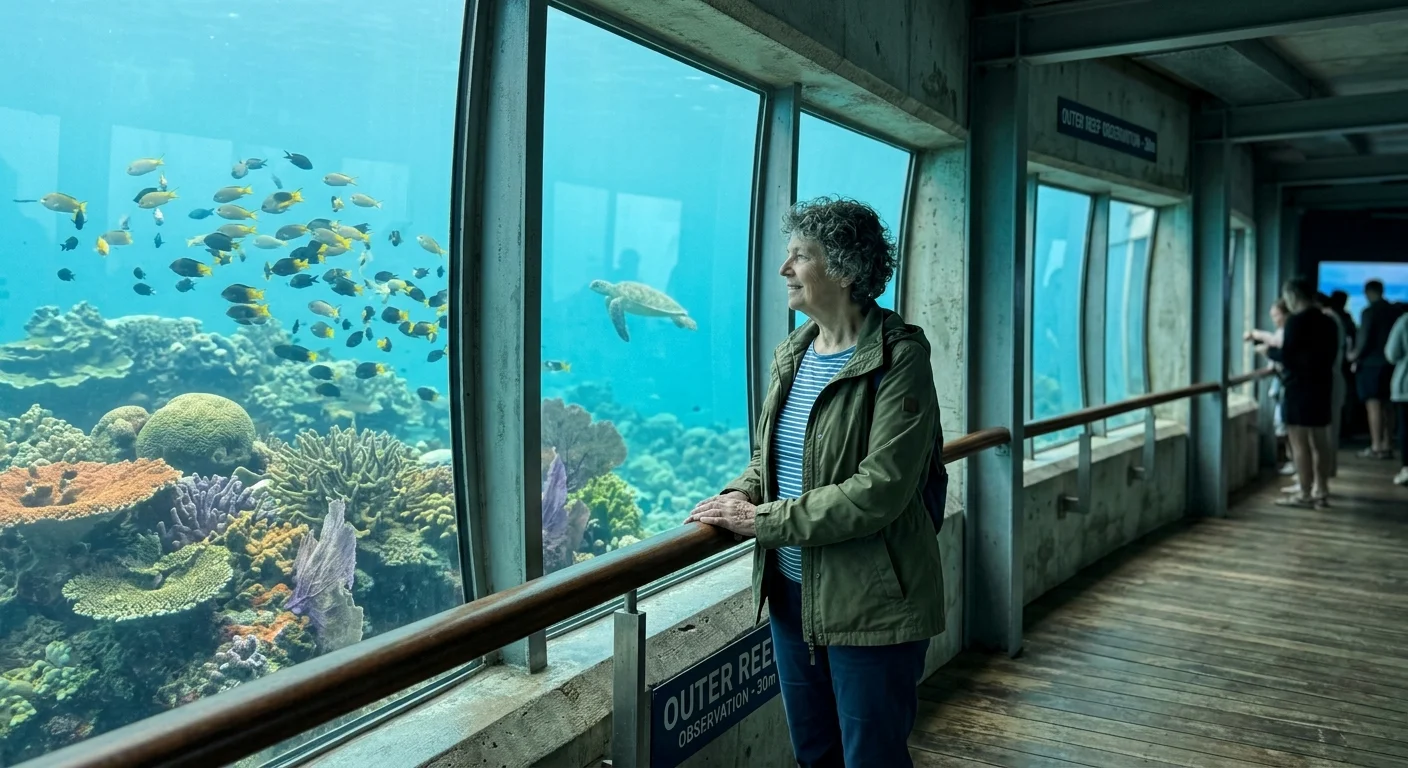
The 66-Year-Old Non-Swimmer Blueprint for Outer Reef Exploration
Retirement opens the doorway to global wonders you may have postponed for decades. Standing on the deck of a catamaran offshore from Cairns proves your sense of adventure remains boundless.
Whether you are learning to navigate new waters on pontoons or consider returning to the helm on a flotilla, ocean adventures remain well within reach during your retirement years.
Exploring offshore reefs without swimming is a prime example of designing a retirement bucket list that moves beyond conventional tourist itineraries.
Many travelers assume the Great Barrier Reef demands athletic swimming endurance or heavy scuba apparatus. That assumption prevents thousands of vibrant older adults from witnessing one of the world’s great natural ecosystems.
The outer continental shelf features massive, permanently anchored marine activity pontoons engineered specifically for multi-generational access. These stable platforms act as floating island bases anchored directly alongside thriving coral walls.
You step off the vessel onto a wide, flat deck where ocean swells do not pitch the floor beneath your feet. From there, you descend into air-conditioned viewing chambers or board specialized watercraft without getting wet.
Organizations like Road Scholar champion educational, immersive travel for older adventurers precisely because lifelong curiosity never requires athletic perfection. You possess the wisdom to choose tours that prioritize safety, accessibility, and high visual reward.
“The biggest adventure you can take is to live the life of your dreams.” — Oprah Winfrey
By choosing an outer reef platform, you bypass the coastal murk of nearshore islands and head straight to pristine oceanic waters. You will encounter wild sea turtles, schools of giant trevally, and vibrant coral heads without touching the sea.
Cairns Pontoon Operators: Platform Specs, Run Times, and Base Costs
Four major operators run daily excursions from Cairns and Port Douglas to dedicated outer reef platforms. Each operator offers different platform sizes, onboard facilities, and lengths of stay on the reef.
Much like balancing drive times and scenic stops on a retirement cross-country road trip, matching platform hours to your physical comfort ensures an unforgettable excursion.
Carefully comparing platform amenities and excursion run times is an essential part of thorough retirement travel planning when booking overseas adventures.
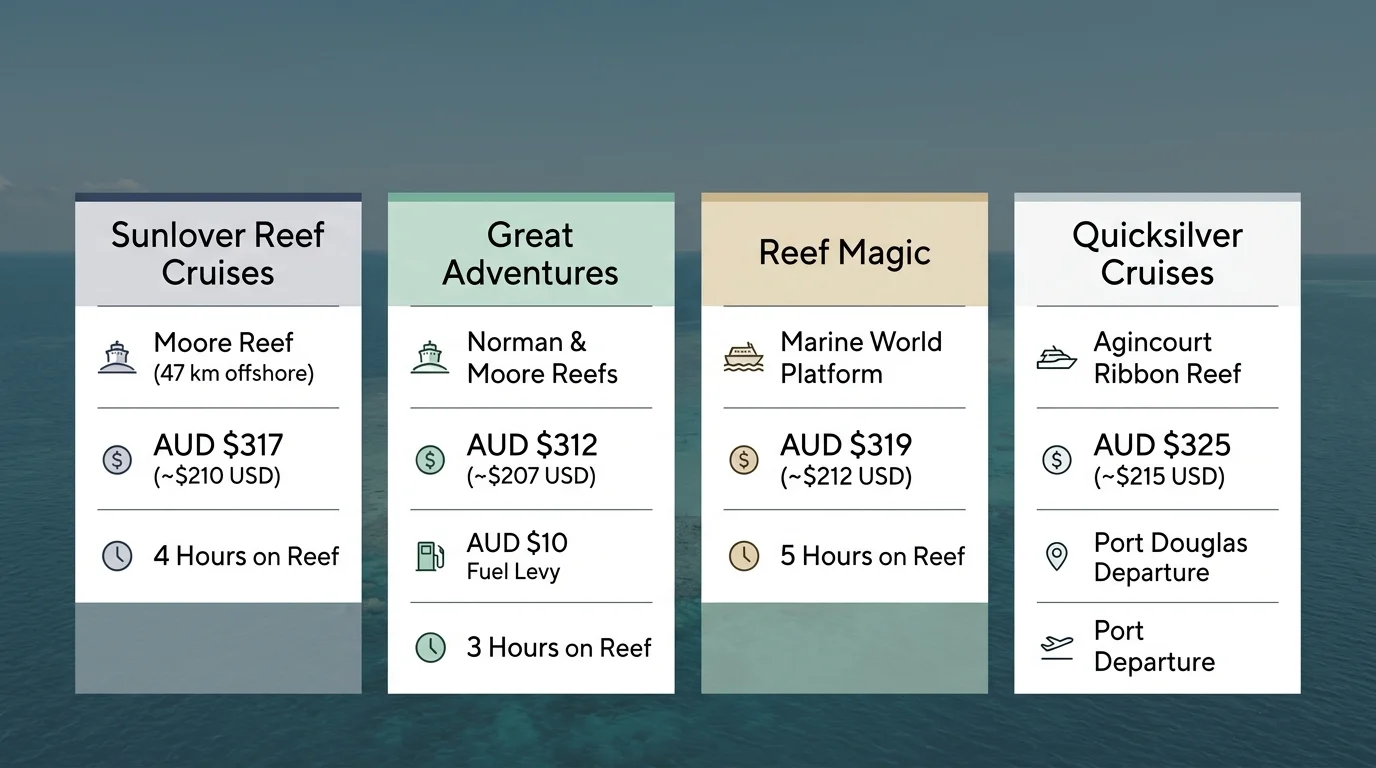
Sunlover Reef Cruises moors its primary platform at Moore Reef, roughly 47 kilometers offshore from Cairns. Their adult day ticket costs AUD $317 (~$210 USD) and provides four hours of pontoon exploration.
Great Adventures operates on Norman Reef and Moore Reef with fares starting at AUD $312 (~$207 USD) plus an AUD $10 fuel levy. Their platform grants three hours of reef time and hosts the exclusive Scuba-Doo underwater scooter program.
Reef Magic launched a brand-new, eco-conscious pontoon at Moore Reef in 2022 that spans 1,003 square meters (~10,800 square feet). Fares range from AUD $325 to $360 (~$215–$240 USD) for a generous five hours on site.
Quicksilver Cruises departs Port Douglas for the Agincourt Ribbon Reefs on the very edge of the continental shelf. Base adult fares run AUD $338 to $348 (~$225–$230 USD) plus an AUD $10 fuel levy, offering 3.5 hours at the reef.
All statutory fares include the Great Barrier Reef Marine Park Authority Environmental Management Charge of AUD $8.50 per person. This statutory environmental levy increases to AUD $9.00 on April 1, 2027.
| Operator | Reef Moorings | Platform Specs | Time on Reef | Base Adult Fare (AUD) |
|---|---|---|---|---|
| Sunlover Reef Cruises | Moore Reef | Multi-level platform with shaded seating and sun deck | 4.0 Hours | $317 (Levies included) |
| Great Adventures | Norman & Moore Reefs | Activity platform with underwater scooter staging area | 3.0 Hours | $312 + $10 Fuel Levy |
| Reef Magic | Moore Reef | 1,003 m² platform built in 2022 with scientific lab | 5.0 Hours | $325 to $360 |
| Quicksilver Cruises | Agincourt Ribbon Reef | Deep-shelf pontoon with dual semi-submersible docks | 3.5 Hours | $338 to $348 + $10 Fuel Levy |
Selecting the right pontoon depends on your stamina and desire for quiet space. Reef Magic provides the largest deck surface per passenger, while Quicksilver accesses the dramatic drop-offs of the continental shelf.
Submersible Craft and Underwater Observatories: Staying Dry at Depth
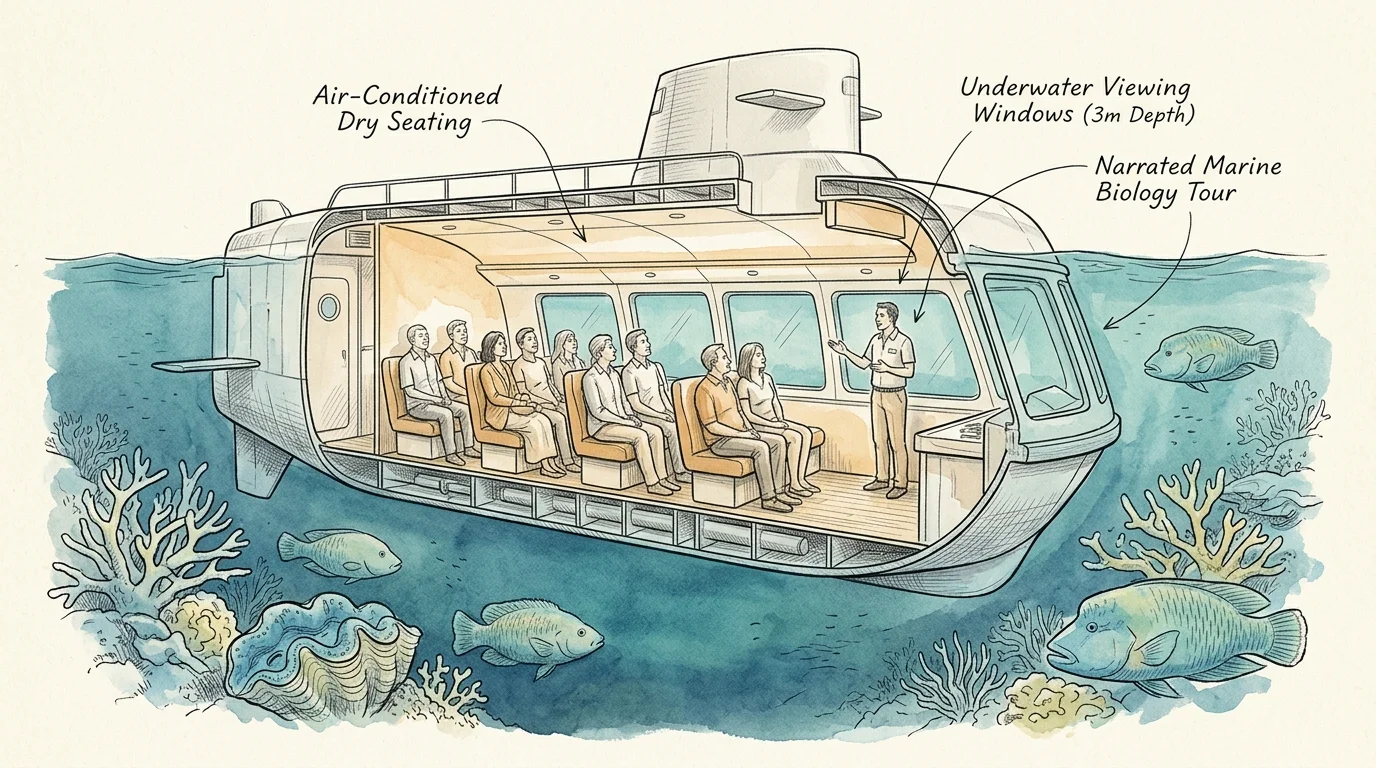
If you prefer to stay completely dry, semi-submersible vessels provide the ultimate viewing experience. These vessels sit lower in the water column than standard boats, featuring submerged hulls with large glass windows.
For travelers sensitive to open ocean motion, reviewing seasickness protocols before boarding helps ensure the 90-minute transit to the outer reef remains completely relaxing.
You walk down a brief interior stairway into an air-conditioned cabin positioned approximately one meter (3.3 feet) beneath the surface. As the vessel cruises along the reef wall, marine biologists provide continuous live commentary.
Because you sit at eye level with the reef, you observe schooling parrotfish, sea anemones, and massive coral bommies in natural sunlight. Every major pontoon operator includes unlimited semi-submersible tours in their base ticket price.
- Hard coral structures including massive Porites bommies, delicate staghorn thickets, and plate corals.
- Diverse marine species such as clownfish, giant clams, green sea turtles, and white-tip reef sharks.
- Interactive reef behaviors like cleaner wrasse stations and schools of grazing blue-green chromis.
Underwater observatories offer a static, self-paced viewing option located directly beneath the main pontoon structure. You can descend into the observatory whenever you wish to sit quietly and watch pelagic marine life drift past.
These observatories feature wide acrylic windows that look straight out into the coral garden below the hull. Scheduled fish-feeding presentations take place right outside the glass, drawing giant trevally, yellowfin batfish, and resident Maori wrasse.
Glass-bottom boats operate in shallower lagoons where sunlight illuminates intricate coral formations. These open-air vessels run parallel to semi-submersibles on platforms like Sunlover and Reef Magic, giving you multiple angles without dipping a toe.

Helmet Diving vs. Scuba-Doo: Active Viewing Without Snorkel Skills
Non-swimmers who crave direct water contact without holding their breath can choose guided underwater helmet diving. Systems like Ocean Walker, available on Reef Magic and Quicksilver, require zero swimming or regulator clearing skills.
Similar to how hikers adapt their pace when walking the Camino after a joint replacement, helmet walking allows you to enjoy unique physical milestones comfortably within your personal limits.
A heavy helmet rests comfortably on your shoulders while an umbilical hose pumps continuous fresh air from surface compressors. The positive air pressure prevents seawater from rising into the helmet, keeping your head and hair completely dry.
You can wear your standard prescription glasses inside the helmet throughout the entire walk. You descend an underwater staircase to a submerged platform roughly three to four meters deep, where certified divers guide your path.
Ocean Walker helmet dives cost between AUD $170 and $190 (~$113–$126 USD) as an optional pontoon upgrade. The experience lasts approximately 20 minutes beneath the surface under continuous one-on-one professional dive staff supervision.
Great Adventures offers an alternative called Scuba-Doo, which functions as an underwater motorized scooter. You sit upright on an electric scooter seat with your head enclosed in a clear, air-fed dome.
A small electric motor propels you through the reef lagoon at a gentle two knots while you steer with handlebars. Scuba-Doo costs AUD $190 (~$126 USD) per rider and allows you to cruise alongside schools of butterflyfish effortlessly.
Both technologies eliminate the need to bite down on a rubber regulator or balance with dive fins. They grant you the sensory thrill of underwater exploration while preserving your natural breathing rhythm.
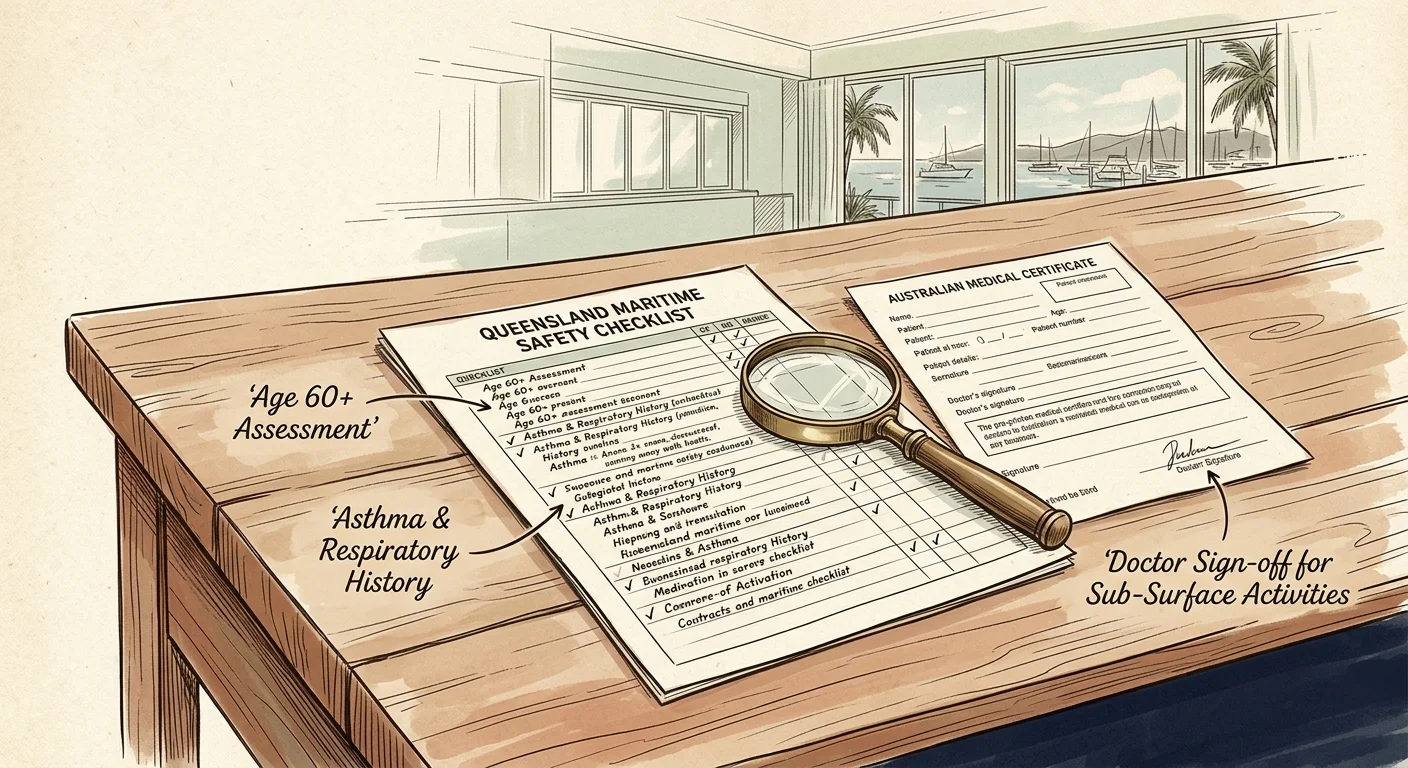
Queensland Maritime Medical Rules: Health Clearances Over Age 60
Queensland enforces some of the strictest marine safety standards on earth under the Recreational Diving, Recreational Technical Diving and Snorkelling Code of Practice. These legal standards apply directly to helmet diving and Scuba-Doo scooters.
If long-distance international travel or water-based medical paperwork feels daunting, an accessible domestic journey like the Amtrak Empire Builder route offers scenic wonder with minimal physical strain.
Much like preparing to visit Machu Picchu with osteoarthritis, clearing health requirements in advance guarantees your bucket-list trip remains safe and enjoyable.
Before boarding or purchasing add-on dive activities, operators require every participant to complete an official medical questionnaire. When you are over age 60, answering “yes” to any medical condition triggers mandatory clearance protocols.
Conditions requiring physician sign-off include asthma, cardiovascular disease, angina, previous heart attacks, fainting spells, and prescription medication for high blood pressure. Ear surgeries, chronic sinus congestion, and insulin-dependent diabetes also mandate pre-trip evaluation.
The National Institute on Aging emphasizes that managing cardiovascular health and communicating openly with physicians allows seniors to engage in dynamic adventures safely. Obtaining your clearance in advance prevents travel disappointment.
Standard doctor notes often get rejected at the harbor if they lack specific wording. The Australian standard requires a dive medical certificate aligned with AS 4005.1 or SPUMS guidelines completed within 90 days before your excursion.
Semi-submersibles, glass-bottom boats, and underwater observatories do not require any medical questionnaires or physical clearances. If you take cardiovascular medications and prefer to skip medical exams, passive pontoon activities keep your day seamless and stress-free.

Worked Budget and Itinerary Scenario for a Solo Non-Swimmer
To see how an outer reef adventure fits into your retirement spending, examine this realistic day budget. This scenario follows a 66-year-old traveler departing from Cairns on Reef Magic Pontoon.
Independent travel is surging among older adults, whether embarking on a solo senior Amtrak route across the country or flying across the Pacific to Australia.
You purchase the Reef Magic adult day fare for AUD $340, which includes your return catamaran transit and buffet. You also choose to add the Ocean Walker helmet dive for AUD $180.
Before departure, you visit a Cairns general practitioner specializing in marine medicine to secure your AS 4005.1 certificate. A travel medical consultation in town costs approximately AUD $120 out-of-pocket for international visitors.
To minimize travel fatigue, you book a hotel within walking distance of the Cairns Reef Fleet Terminal on Spence Street. You budget AUD $25 for morning motion-sickness medication, bottled water, and an afternoon espresso on deck.
Here is how the single-day investment totals in Australian and US currency:
- Reef Magic full-day pontoon pass (inclusive of EMC levy): AUD $340 (~$226 USD)
- Ocean Walker guided helmet dive add-on: AUD $180 (~$120 USD)
- Pre-tour dive medical examination in Cairns: AUD $120 (~$80 USD)
- Motion-sickness remedies and deck refreshments: AUD $25 (~$17 USD)
- Total full-day investment: AUD $665 (~$443 USD)
This single-day expenditure delivers five continuous hours on the outer reef with zero athletic stress. You witness one of the planet’s seven natural wonders from both an air-conditioned submarine and a submerged walking platform.
If you prefer to bypass helmet diving and medical clearance fees, your total outlay drops to AUD $365 (~$243 USD). That lower total still includes the semi-submersible, observatory, marine biologist presentations, and a full hot-and-cold buffet.
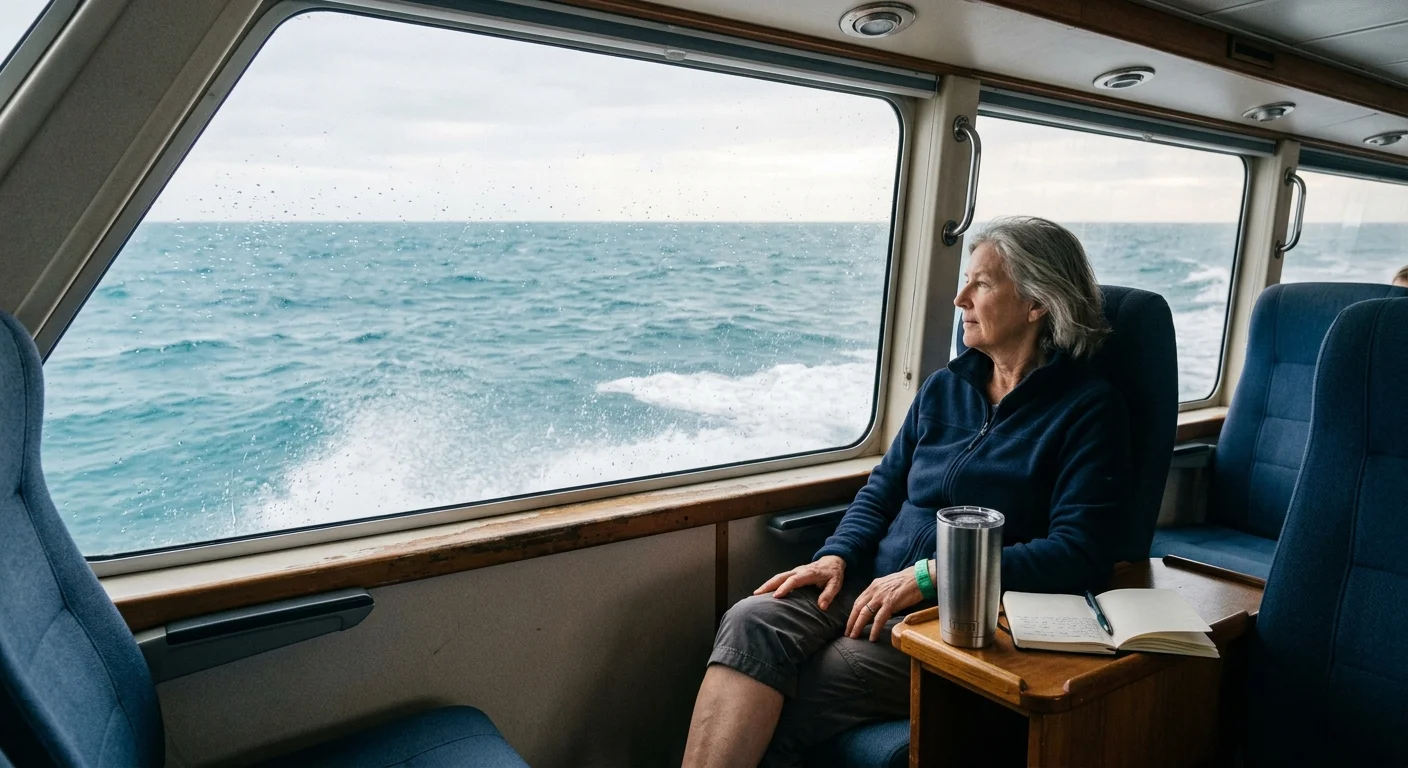
Managing Open-Water Transit: 90 Minutes Across the Coral Sea
Reaching the outer continental shelf requires traveling roughly 45 to 65 kilometers off the Queensland coast. High-speed catamarans power across open water for approximately 90 minutes each way from Cairns or Port Douglas.
The Coral Sea often produces rolling swells, especially when regional trade winds blow between May and October. Catamarans feature computerized wave-piercing hulls that reduce pitching, but motion sensitivity can still affect older passengers.
Take proven motion-sickness medication, such as dimenhydrinate or hyoscine hydrobromide, at least 45 minutes before the boat leaves the terminal. Waiting until you feel queasy inside the vessel renders oral tablets far less effective.
Choose seating on the lower deck near the center of the vessel where hull motion remains lowest. Avoid staring at phone screens or reading books; instead, keep your eyes fixed on the distant ocean horizon.
For those who experience severe motion sickness, operators offer scenic helicopter fly-cruise packages starting at AUD $515 (~$342 USD). Flying one way by helicopter cuts transit time to 25 minutes and delivers breathtaking aerial reef views.
Once the vessel docks alongside the permanently moored pontoon, wave motion drops dramatically. The immense weight and stability of the platform allow you to walk, dine, and explore with complete confidence.
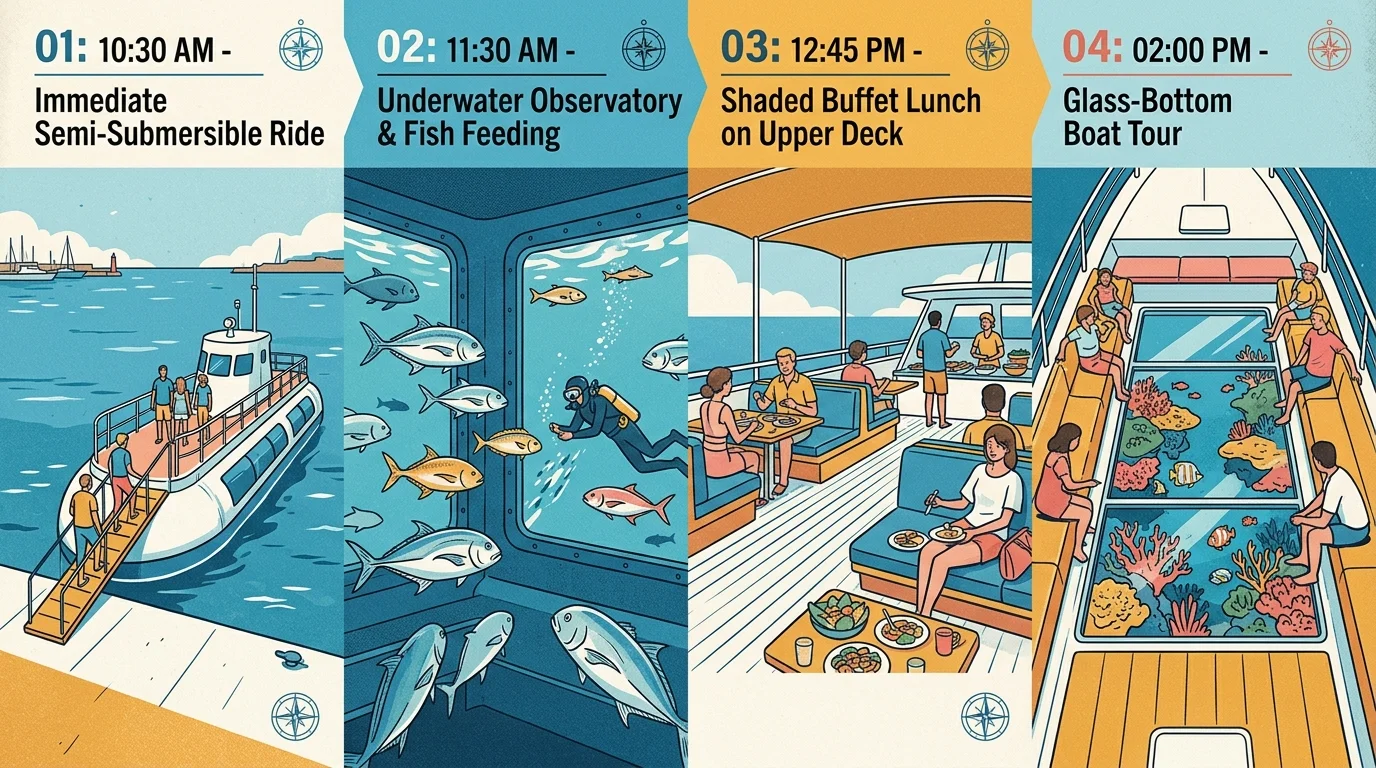
Step-by-Step Pontoon Strategy for Non-Swimmers
Maximizing your pontoon day requires a thoughtful sequence that avoids peak midday crowds at the viewing decks. Follow this proven schedule to enjoy every non-swimming amenity at a relaxed, comfortable pace.
- Check In Early: Arrive at the Cairns Reef Fleet Terminal by 8:00 AM to secure boarding passes and verify any helmet dive medical paperwork.
- Head Down to the Observatory First: Walk down into the underwater observatory within 15 minutes of docking before the main crowd gathers.
- Board the First Semi-Submersible Tour: Catch the initial semi-submersible departure while sunlight strikes the reef walls directly from above.
- Enjoy an Early Buffet Lunch: Eat lunch at 12:00 PM while swimmers are still in the water, avoiding long queues at the hot and cold stations.
- Attend the Marine Biologist Presentation: Sit in shaded comfort on the upper deck to learn about coral reproduction and marine conservation efforts.
- Complete Your Helmet Dive or Glass-Bottom Cruise: Undertake your scheduled Ocean Walker descent or glass-bottom boat tour during the early afternoon lull.
Following a structured routine ensures you experience every vantage point without feeling rushed. You conserve physical energy while indulging your curiosity across the reef’s diverse marine habitats.
Frequently Asked Questions
Do I need any swimming ability to take a semi-submersible tour?
You do not need any swimming experience or physical water comfort to ride a semi-submersible. You simply walk down interior stairs into an air-conditioned cabin and sit comfortably on bench seating while viewing the coral walls through large windows.
Can I wear my prescription eyeglasses during an underwater helmet dive?
You can wear your regular prescription eyeglasses during an Ocean Walker helmet dive without issue. The helmet stays pressurized with air, preventing water from reaching above your shoulders so your face and glasses remain completely dry.
What happens if I fail the medical clearance questionnaire for helmet diving?
If you fail the medical questionnaire or cannot secure physician sign-off, operators issue a refund for the helmet dive portion. You can still enjoy the included semi-submersible submarine, glass-bottom boat, underwater observatory, and buffet lunch without any medical restrictions.
Are outer reef pontoons accessible for travelers with walking canes or manual wheelchairs?
Modern pontoons like Reef Magic accommodate manual wheelchairs and mobility walkers across ramped boarding gangways and flat deck surfaces. However, maritime safety laws generally exclude motorized power wheelchairs due to boarding hoist weight limits.
Disclaimer: This article is for informational and inspirational purposes. Life decisions are deeply personal, and we encourage readers to pursue their dreams while considering their unique circumstances, health, and financial situation.




1 Comment