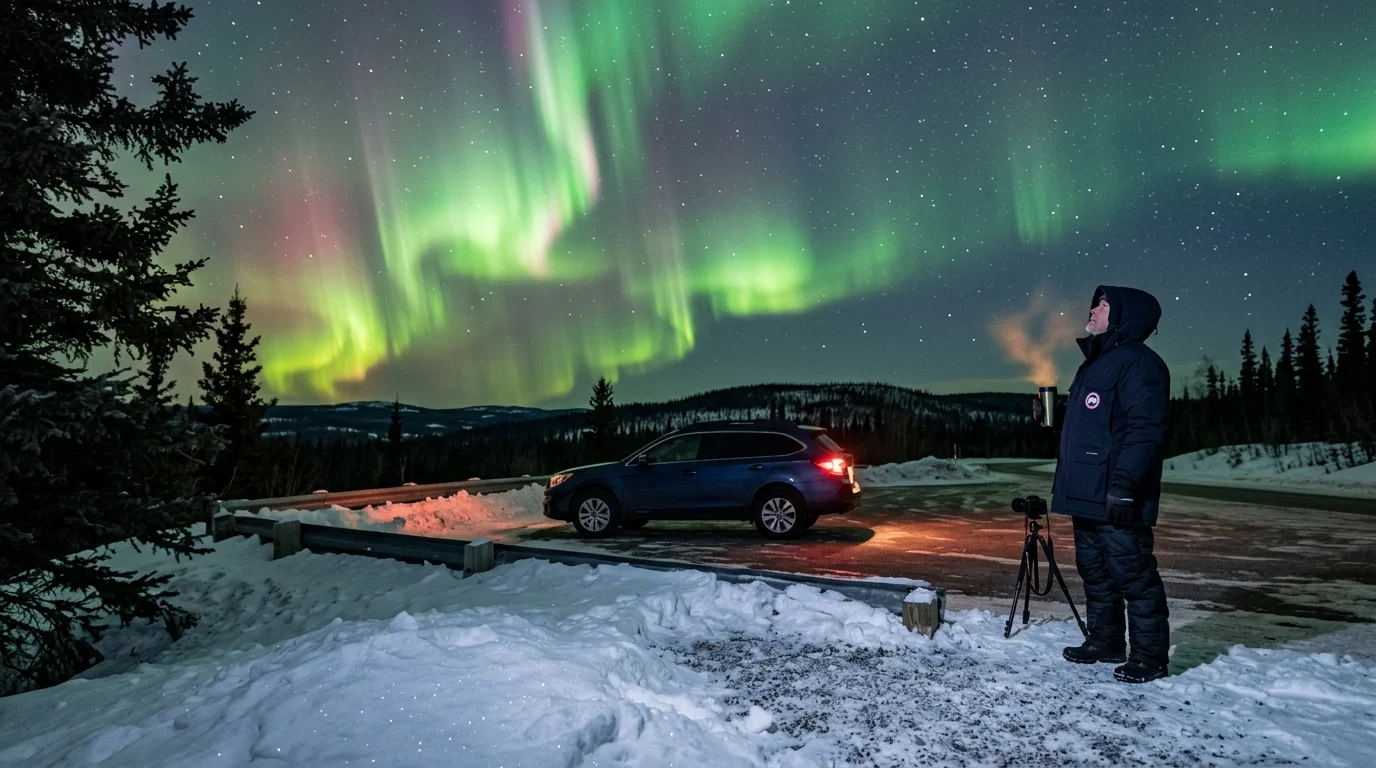
You can witness the northern lights dance across the Arctic sky without spending thousands on commercial tour packages. A solo shoulder-season expedition to Fairbanks in March offers the ideal balance of clear skies, active solar physics, and manageable costs.
Much like executing a well-budgeted Grand Circle road trip, mastering the math ahead of time guarantees an unforgettable journey on a modest budget.
By pairing a sub-$500 flight deal with an independent all-wheel-drive rental car and free geomagnetic data, you can build a complete four-night adventure for under $1,800. You retain total freedom over your schedule while tracking auroral storms from warm, paved pullouts.
This guide delivers the exact hourly forecast tactics, subzero layering blueprints, and smartphone camera settings you need to hunt the aurora safely on your own terms.
The March Equinox Advantage: Why Timing Beats Tour Packages
Commercial tour operators often push expensive midwinter packages when subzero temperatures plummet past -30°F. March delivers a far smarter window for your solo retirement journey.
Timing your travels around shoulder-season weather patterns is just as effective when exploring Utah’s Mighty 5 in October to bypass peak heat and dense crowds.
During March, daytime temperatures in Fairbanks climb to comfortable highs between 24°F and 30°F. Nighttime lows typically hover between -1°F and 5°F, providing crisp winter conditions without the punishing extremes of January.
Cloud cover represents the single greatest threat to any aurora expedition. Statistical weather data reveals that March is the clearest month of the year in Interior Alaska.
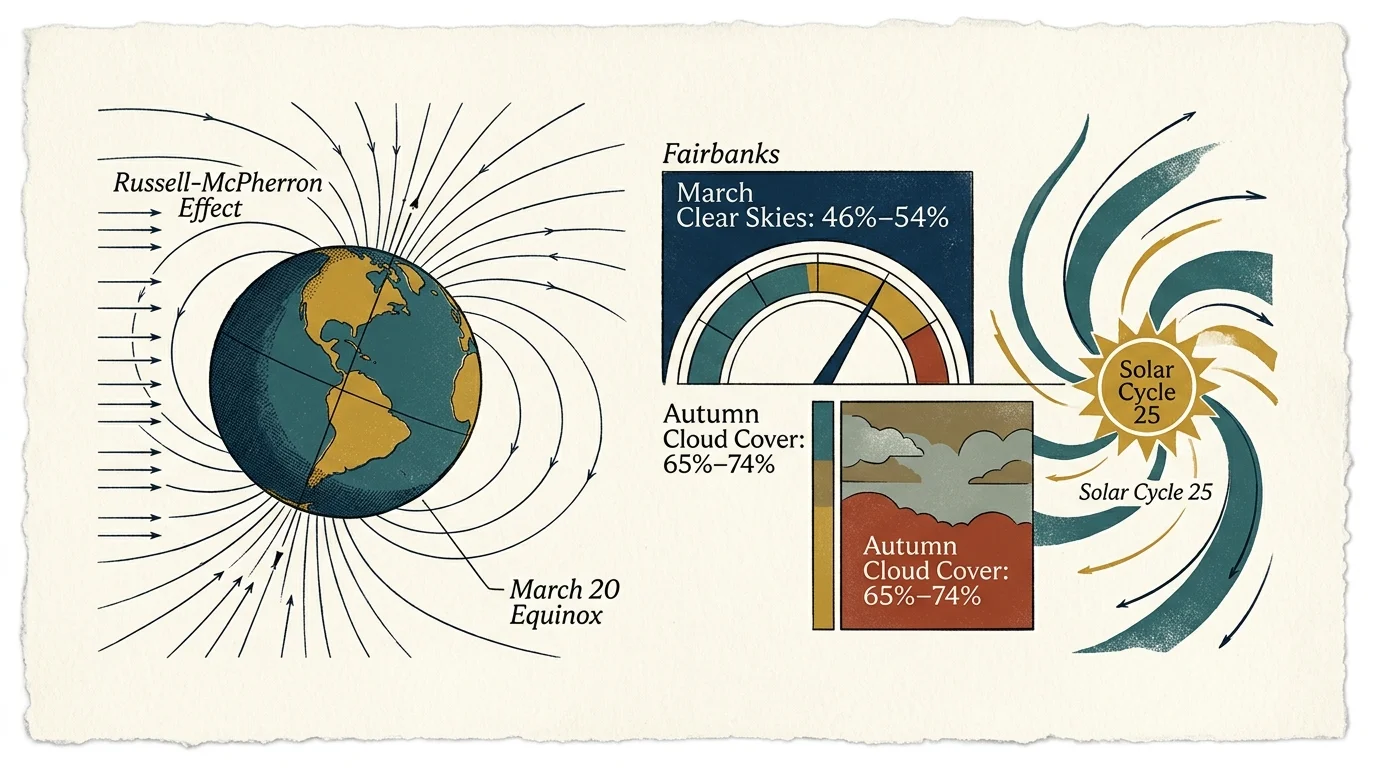
Fairbanks experiences clear or scattered skies roughly 46% to 54% of the time in March. In contrast, late autumn visitors battle cloud cover rates exceeding 65% to 74%.
You also benefit from favorable orbital geometry. The vernal equinox around March 20 triggers the Russell-McPherron effect, where Earth’s magnetic poles align directly with the incoming solar wind.
This geomagnetic alignment roughly doubles your chances of seeing vibrant substorms compared to the solstices. Solar Cycle 25 reached its solar maximum phase in 2024, maintaining elevated sunspot activity and frequent coronal mass ejections through 2026.
Data from the University of Alaska Fairbanks Geophysical Institute confirms that guests who spend three active nights searching the sky in this region enjoy a greater than 90% viewing success rate under clear skies.
The Under-$1,800 Solo Retirement Budget Breakdown
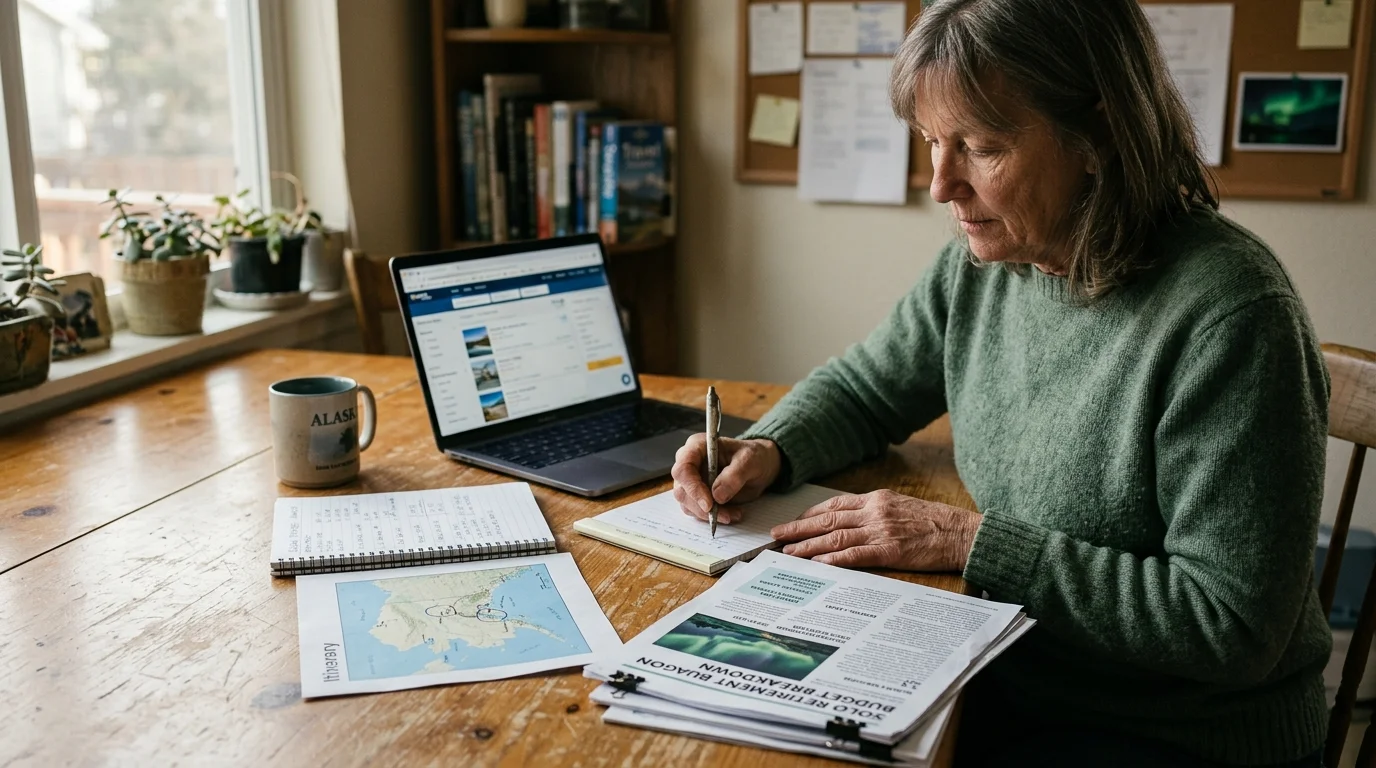
You do not need to pay luxury lodge rates of $600 per night to experience the Arctic sky. Independent planning lets you control every line item while maintaining safety and comfort.
Cultivating these frugal strategies aligns directly with other budget retirement bucket list adventures that prove memorable travel doesn’t require a fortune.
A shoulder-season flight deal serves as the foundation of your itinerary. Major carriers such as Alaska Airlines and Delta offer round-trip economy flights between Seattle and Fairbanks International Airport (FAI) for $380 to $500 in March.
Standard downtown Fairbanks hotels and university-area suites offer off-peak winter rates averaging $110 to $130 per night. Choosing clean, conventional lodging over remote luxury chalets saves you more than $1,500 over a four-night stay.
Here is an exact worked budget for a solo four-night DIY aurora hunting trip from March 18 to March 22:
- Round-Trip Airfare (West Coast hub to FAI): $420
- Fairbanks Lodging (4 nights at Wedgewood Resort or Golden North Motel): $460 ($115 per night)
- AWD Compact SUV Rental (4 days via airport fleet): $260 ($65 per day)
- Vehicle Fuel and Headbolt Extension Cord: $75
- Complete 4-Day Extreme Outerwear Rental: $165
- Groceries and Casual Dining (4 days): $240 ($60 per day)
- Attraction Admissions (Museum of the North and Cultural Center): $35
- Total Expedition Cost: $1,655
This realistic total leaves you nearly $150 beneath your $1,800 financial ceiling. The cushion provides extra peace of mind for unexpected hot beverage stops or airport parking.
Shopping at local Fairbanks grocers like Fred Meyer allows you to stock your hotel room with hearty breakfast items, sandwich fixings, and high-energy trail snacks. You can dine out for leisurely lunches while keeping meal costs predictable.
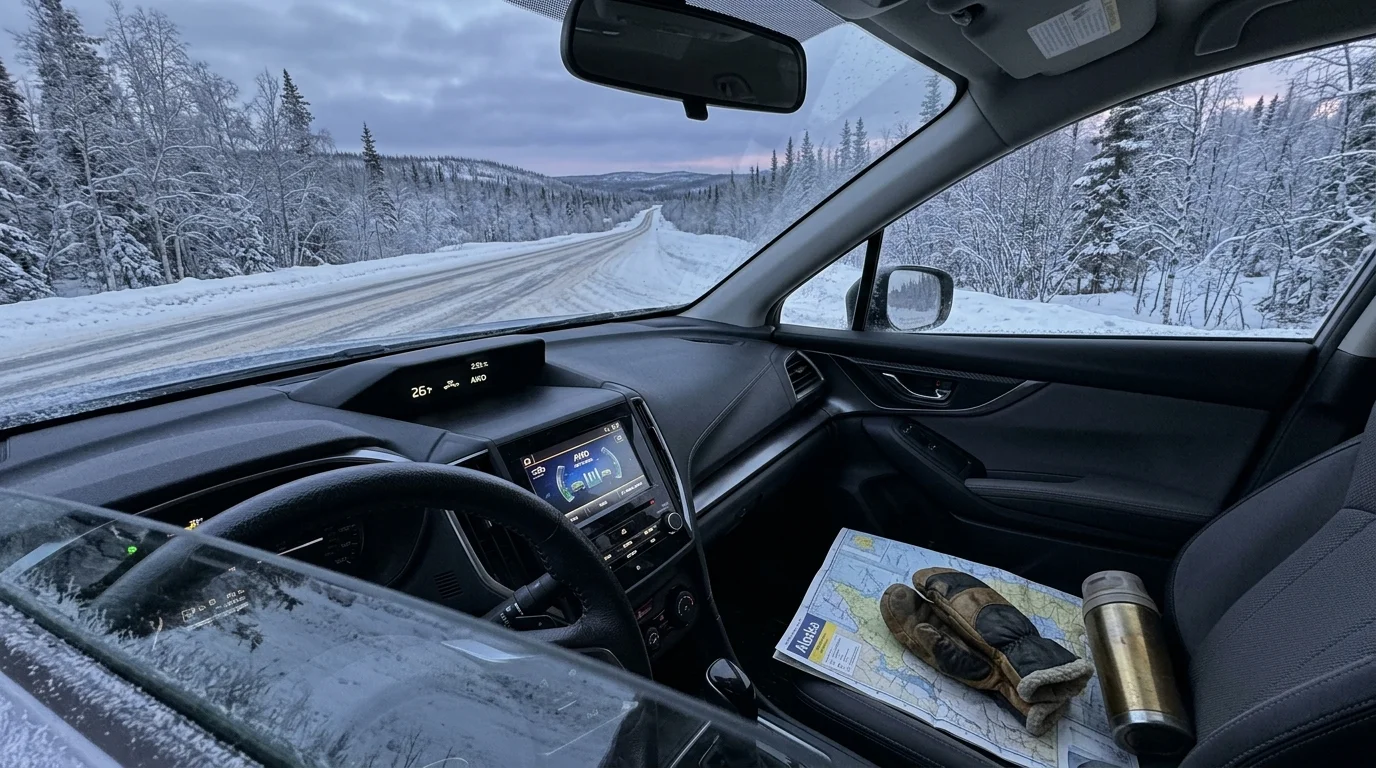
Airport AWD Car Rentals and Winter Road Safety
Your rental car serves as your primary viewing vehicle and personal warming cabin. Booking directly from the airport terminal ensures a seamless transition into subzero driving.
Similarly, retirees seeking peaceful subarctic scenery without the demands of winter driving can explore crossing Canada by VIA Rail in a sleeper berth for a restful northern transit.
For travelers who prefer enjoying sweeping winter landscapes without navigating snowy highways, embarking on an Amtrak Empire Builder route provides a scenic, rail-based alternative.
Reserve an all-wheel-drive (AWD) compact crossover or small SUV rather than an economy front-wheel-drive sedan. Elevated clearance helps you navigate snowy pullouts safely along state-maintained routes.
Standard rental contracts from Avis, Budget, and Enterprise explicitly prohibit driving on unpaved gravel roads such as the Dalton Highway. Fortunately, the finest aurora vantage points around Fairbanks sit along fully paved, state-plowed highways.
Every winter rental vehicle in Interior Alaska features an engine block heater with a power cord tucked into the front grille. When temperatures drop below -10°F, you must plug this cord into hotel electrical outlets known locally as headbolt plugs.
Pack a basic winter safety kit in your vehicle before driving into dark corridors. Keep the fuel tank at least half full at all times to prevent condensation freeze in the fuel lines.
- Inspect the vehicle tires at the rental counter to verify adequate tread depth for packed snow.
- Locate the block heater cord in the front bumper grill and confirm you have an interior cabin ice scraper.
- Store an insulated steel thermos of hot water and emergency thermal blankets in the back seat.
- Keep a compact 10,000 mAh battery jump pack inside the heated passenger cabin rather than the trunk.
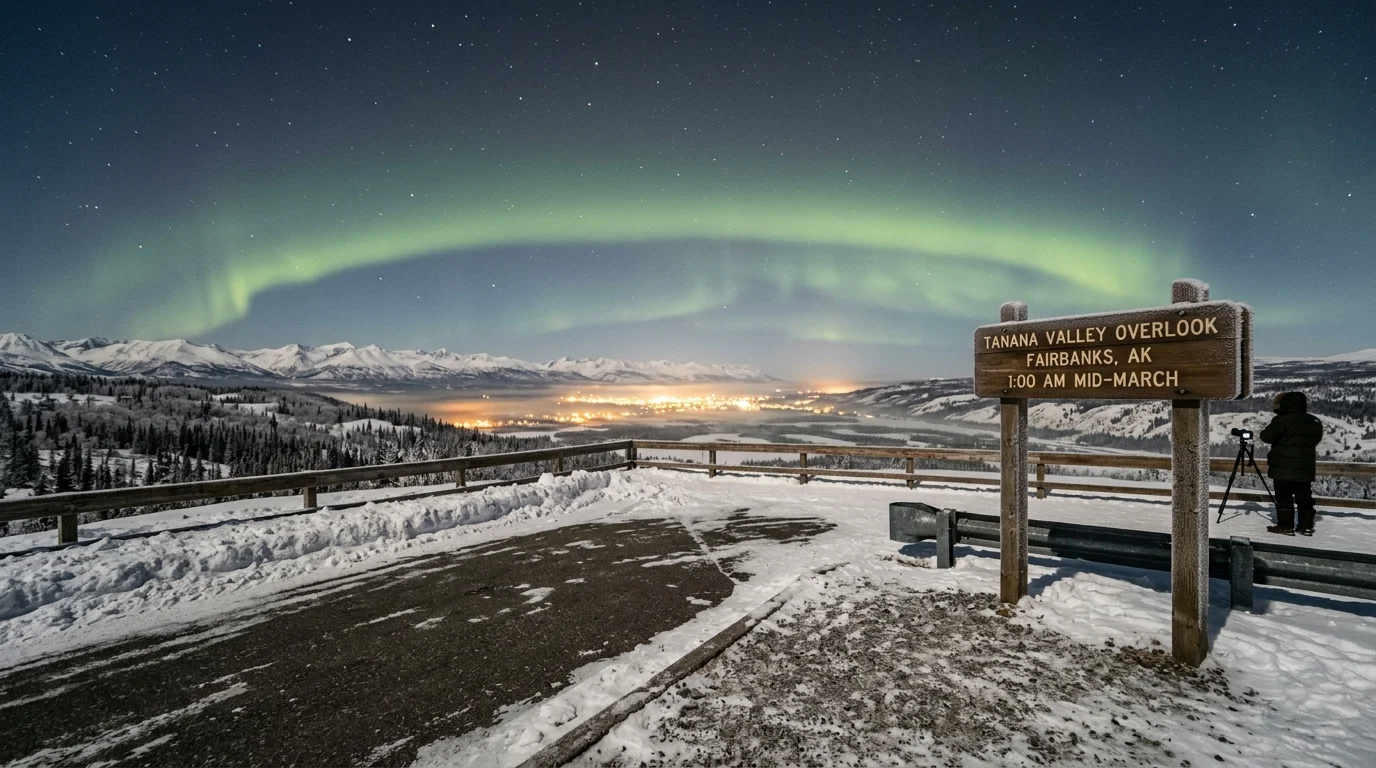
Top Paved DIY Aurora Viewing Sites Around Fairbanks
Commercial tours charge upwards of $200 per night simply to drive you to wide-open parking turnouts. You can navigate to these exact locations independently with zero tour guide fees.
Exploring remote highways under vast skies is also a hallmark of planning the ultimate US road trip across North America.
If you love night sky observation but want to avoid subzero Arctic climates, a Fort Davis dark-sky expedition offers world-class stargazing under milder conditions.
Light pollution from city streetlamps washes out faint auroral curtains. Driving just 20 to 45 minutes beyond the Fairbanks core places you under dark sky conditions.
The table below outlines four proven, state-maintained viewing areas accessible via two-wheel-drive or AWD vehicles on paved surfaces.
| Location Name | Distance from FAI | Paved Access Route | Bortle Dark Sky Class | Site Amenities & Pullouts |
|---|---|---|---|---|
| Chena Lake Recreation Area | 24 Miles | Richardson Hwy to Badger Rd | Class 3 (Rural Sky) | Paved boat launch lot, vault toilets |
| Cleary Summit Viewpoint | 21 Miles | Steese Highway (AK-2) | Class 2 (Dark Site) | Large paved gravel-sand pullout, high horizon |
| Murphy Dome Lower Turnouts | 16 Miles | Murphy Dome Road | Class 2 (Dark Site) | Wide paved shoulders, elevated 360-degree view |
| Chena Hot Springs Road Mile 26 | 29 Miles | Chena Hot Springs Road | Class 2 (Dark Site) | State Department of Transportation pullouts |
Chena Lake Recreation Area in North Pole offers expansive frozen lake horizons with open views facing north. The park remains quiet on weekday evenings, providing a secure setting for solo observers.
Cleary Summit sits along the Steese Highway at an elevation of 2,230 feet. This elevation regularly places you above low-lying valley fog and temperature inversions.
Arrive at your chosen turnout during twilight or early evening to inspect surface ice conditions before complete darkness sets in. Position your vehicle facing away from the road to shield your eyes from passing headlight glare.
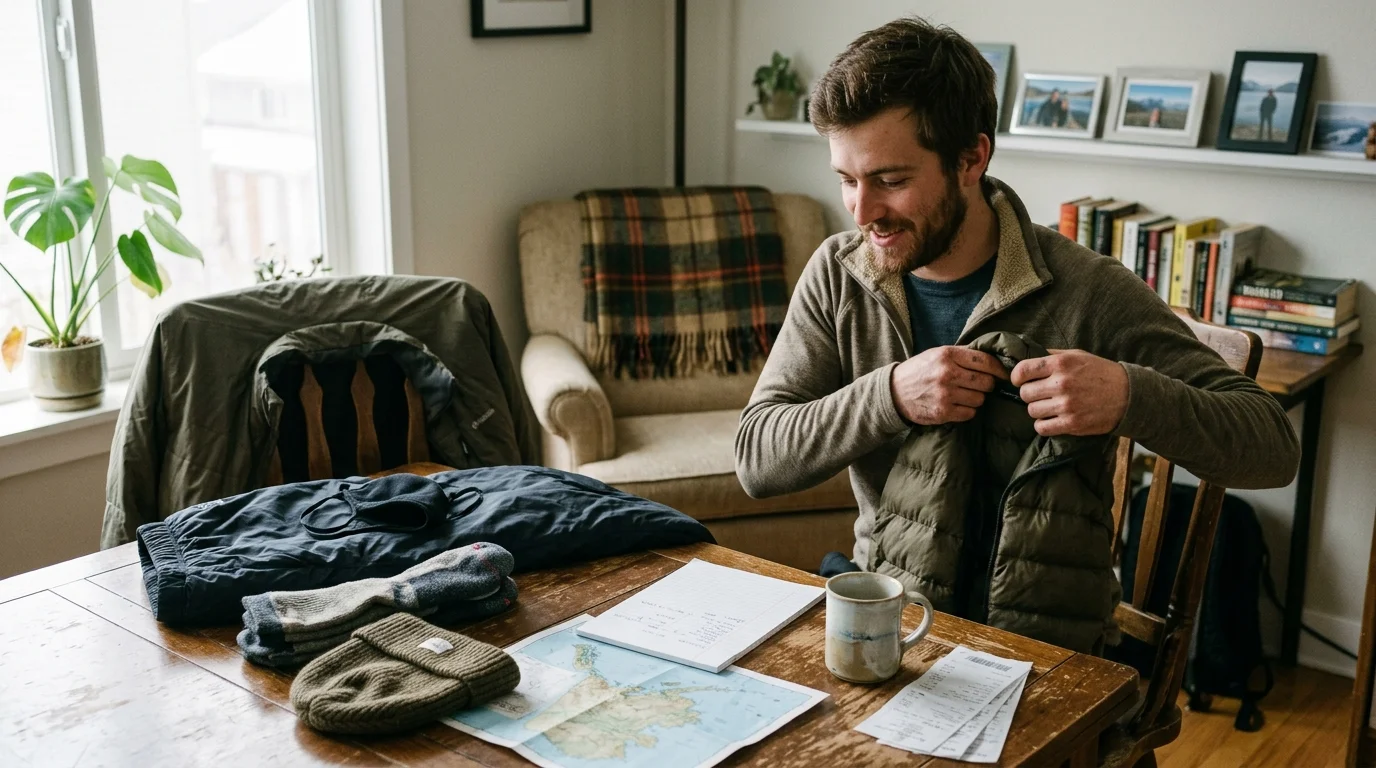
The Subzero Thermal Layering System Under $300
Extreme cold comfort does not require purchasing thousands of dollars in technical mountaineering apparel. Smart travelers combine outerwear rentals with affordable everyday base layers.
Never purchase a -40°F expedition parka for a single holiday. Local Fairbanks gear outfitters like Alaska Outdoor Gear Rental and Alaska Element rent complete extreme-weather packages.
For roughly $160 for four days, these packages supply an insulated down parka, heavy snow bibs, subzero Baffin boots, and windproof outer mittens. This leaves you with $140 from your $300 gear budget to assemble your inner layers.
A three-phase hourly layering system prevents the biggest danger in Arctic photography: perspiration. If you sweat while walking, that moisture freezes once you stand motionless beneath the night sky.
- Phase 1: Moisture-Wicking Base Layer. Wear a 200 to 250 gsm merino wool top and bottom directly against your skin; synthetic polyester fleece serves as an affordable alternative. Avoid cotton entirely.
- Phase 2: Trapped Insulation Mid-Layer. Layer a lightweight packable down jacket or a 200-weight polar fleece pullover over your base layer to trap warm air generated by your torso.
- Phase 3: Rented Outer Armor. Don your rented expedition parka and insulated bibs before stepping out of the vehicle. Secure the hood ruff to block Arctic breezes.
Protect your extremities with dedicated focus. Your hands must operate delicate smartphone screens without exposing bare skin to freezing metal surfaces.
Wear thin merino wool or touchscreen-compatible synthetic glove liners inside your heavy rented mittens. When you step outside your car to adjust camera settings, slip off the outer mitten while keeping the liner glove on.
Place adhesive chemical toe warmers on top of your socks before sliding your feet into rented arctic boots. Maintain a relaxed boot lace tension to ensure healthy blood circulation to your toes.
Real-Time Forecast Tactics: Reading Solar Wind and Bz Data
Successful DIY aurora hunting depends on understanding solar physics rather than relying on luck. Tour companies track the exact same public satellite feeds that you can monitor from your smartphone.
Bookmark NOAA’s Space Weather Prediction Center (SWPC) and the University of Alaska Fairbanks Geophysical Institute Aurora Forecast. These free tools provide real-time updates on auroral oval expansion.
The most vital metric to monitor is the Interplanetary Magnetic Field (IMF) vector, specifically the Bz component measured in nanoteslas (nT). The Bz represents the north-south direction of the sun’s magnetic field.
When the Bz tilts southward (indicated as a negative number, such as -5 nT to -15 nT), it cancels Earth’s northward magnetic defense. This opens a magnetic door that pours energetic solar particles into our upper atmosphere.
Pair Bz readings with solar wind velocity measurements. Normal solar wind speeds sit near 300 to 350 kilometers per second; speeds surging past 450 to 600 kilometers per second indicate rapid, active substorm displays.
- Planetary K-index (Kp): Fairbanks sits under the auroral oval, meaning a modest Kp value of 3 produces bright green ribbons directly overhead.
- Bz Vector Direction: Watch for a sharp drop below 0 nT. A Bz staying between -4 nT and -10 nT for over 45 minutes triggers vibrant auroral curtains.
- Solar Wind Speed: Higher speeds accelerate auroral motion and bring purple or magenta fringes to the bottom of green arcs.
- Alaska Daylight Timing: The most intense displays consistently unfold between 10:00 PM and 3:00 AM, peaking around magnetic midnight (1:30 AM local time).
Check the FAA weather cameras located across Interior Alaska before leaving your lodging. These live webcams reveal local cloud banks and ground fog conditions in real time.
If clouds blanket your southern horizon, drive north along the Steese Highway toward Cleary Summit. If coastal clouds blow in from the west, head east down Chena Hot Springs Road to find clear mountain pockets.
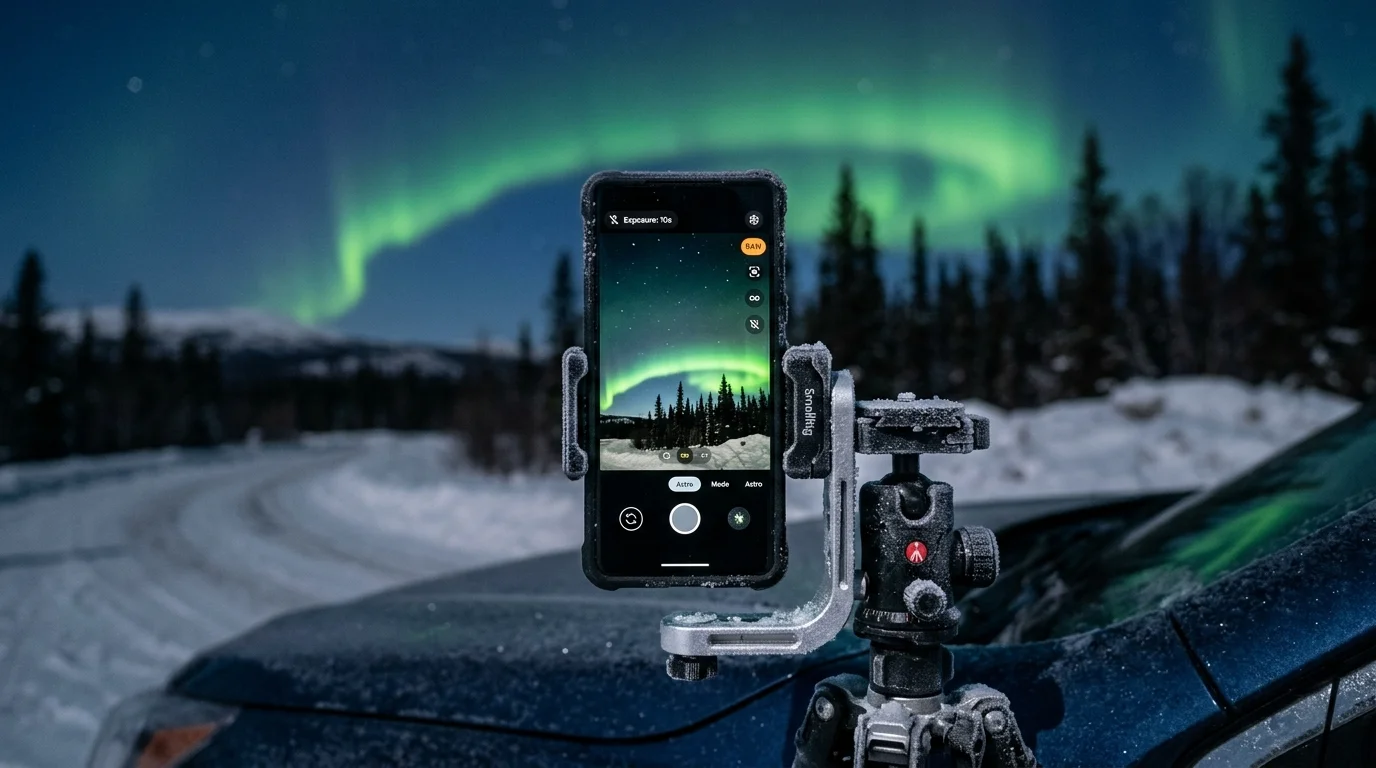
Smartphone Astrophotography: Exact Night Mode Settings
You do not need a complicated digital SLR camera or expensive glass lenses to document the aurora borealis. Modern smartphone computational photography captures vibrant auroral light with stunning clarity.
Smartphones like the iPhone 12 through 16 series, Samsung Galaxy S21 through S24, and Google Pixel 6 through 8 feature powerful Night Mode software. Understanding how to override automatic settings makes all the difference.
Never hold your phone in your hands when photographing night skies. Hand tremors blur fine auroral curtains during long exposures, rendering your images soft and grainy.
Purchase an inexpensive, sturdy travel tripod paired with a spring-loaded universal smartphone clamp. A lightweight Bluetooth remote shutter button allows you to trigger photos without touching the screen.
- Mount your phone onto the tripod and disable your camera’s automatic flash setting.
- Select Night Mode and adjust the manual exposure slider from automatic (typically 3 seconds) to maximum (10 to 30 seconds).
- Tap the screen on a distant light source or horizon star, then slide the focus lock to ensure crisp infinity focus.
- If using Android Pro Mode, set your ISO manually between 800 and 1600, with a shutter speed between 2 and 5 seconds.
- Depress your Bluetooth shutter button while standing still to eliminate vibrations from the snowpack.
Subzero cold causes internal smartphone batteries to drop voltage rapidly, resulting in sudden shutdowns. Keep your phone attached to an external battery bank tucked inside your warm parka pocket.
Adhere an air-activated chemical hand warmer to the back of your smartphone case using an elastic band. This simple trick keeps the battery warm, allowing continuous shooting for hours.
Embracing Solo Winter Travel in Your Next Chapter
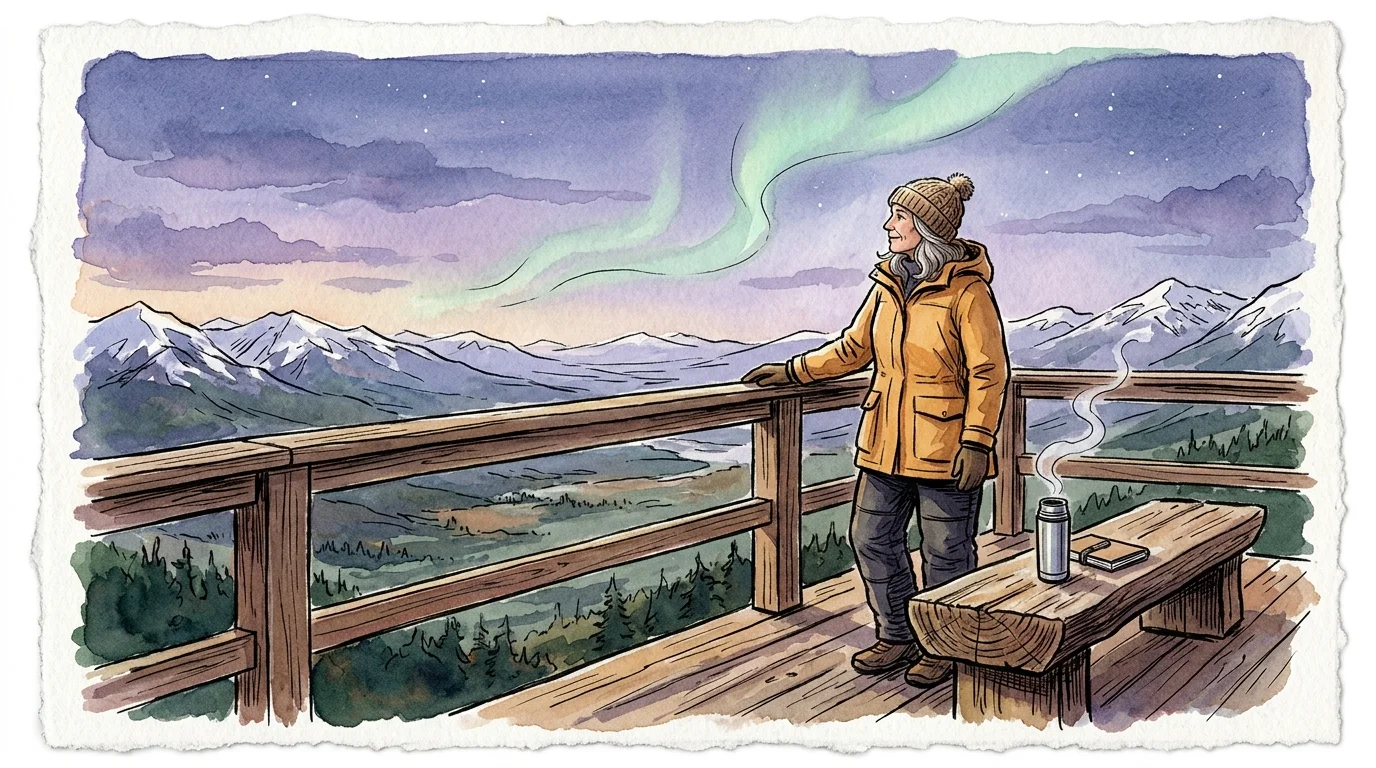
Stepping out beneath a shimmering, dynamic Arctic sky offers an unmatched sense of personal triumph. Solo travel in your retirement chapter is not about isolation; it celebrates your curiosity and self-reliance.
You answer to nobody else’s timetable. If an auroral storm flares at 2:00 AM, you can linger as long as you wish without coordinating with a tour bus group.
Organizations like Road Scholar demonstrate that mature adults thrive when undertaking educational and experiential adventures. Independent journeys allow you to blend that spirit of discovery with your own personal pacing.
Structure your daily schedule around rest and conservation. Sleep late into the morning to recover from nighttime aurora hunts, waking in time for a nourishing noon meal.
Spend gentle afternoon hours touring local cultural institutions. The Morris Thompson Cultural and Visitors Center and the University of Alaska Museum of the North offer deep insights into Alaska’s indigenous heritage.
Advocacy groups like AARP emphasize that engaging in bold, novel experiences helps maintain cognitive vitality and emotional well-being throughout our retirement years.
By preparing thoroughly, respecting winter conditions, and trusting scientific forecast data, you can achieve a world-class adventure entirely within your personal budget.
Frequently Asked Questions
Is March too cold for older adults to view the northern lights safely?
March brings manageable late-winter conditions to Interior Alaska, with daytime highs reaching 24°F to 30°F and nighttime lows hovering between -1°F and 5°F. By using an insulated vehicle as a mobile warming shelter and wearing rated thermal layers, you can view the aurora in complete safety and physical comfort.
Can I drive to aurora viewing locations around Fairbanks without a four-wheel-drive vehicle?
You do not need a heavy 4×4 truck, but you should reserve an all-wheel-drive (AWD) compact SUV or crossover. State maintenance crews plow paved routes like Chena Hot Springs Road and the Steese Highway regularly, making AWD vehicles with good winter tires fully capable.
What time of night offers the best chance to see the aurora in Fairbanks?
The prime viewing window occurs between 10:00 PM and 3:00 AM Alaska Standard Time. Solar wind disturbances interact most efficiently with Interior Alaska’s night sky around magnetic midnight, which occurs near 1:30 AM local time.
How do I prevent my smartphone battery from dying in subzero temperatures?
Subzero temperatures rapidly drain lithium-ion phone batteries. Store your phone inside an interior zippered pocket close to your core body heat, attach a portable power bank, and adhere an adhesive chemical hand warmer to the back of your phone case while shooting.
Disclaimer: This article is for informational and inspirational purposes. Life decisions are deeply personal, and we encourage readers to pursue their dreams while considering their unique circumstances, health, and financial situation.