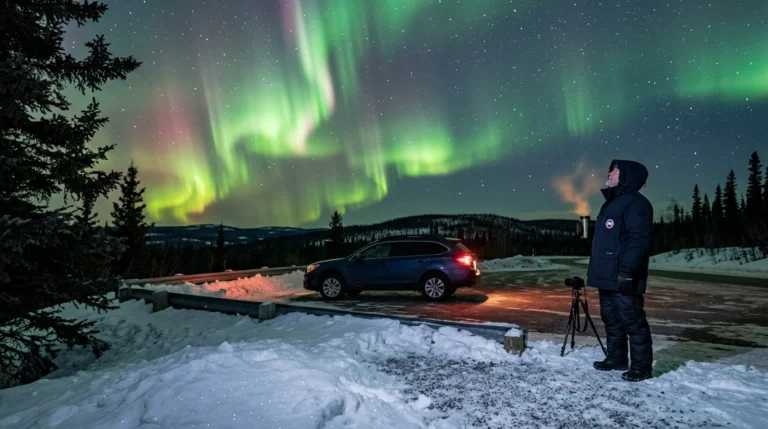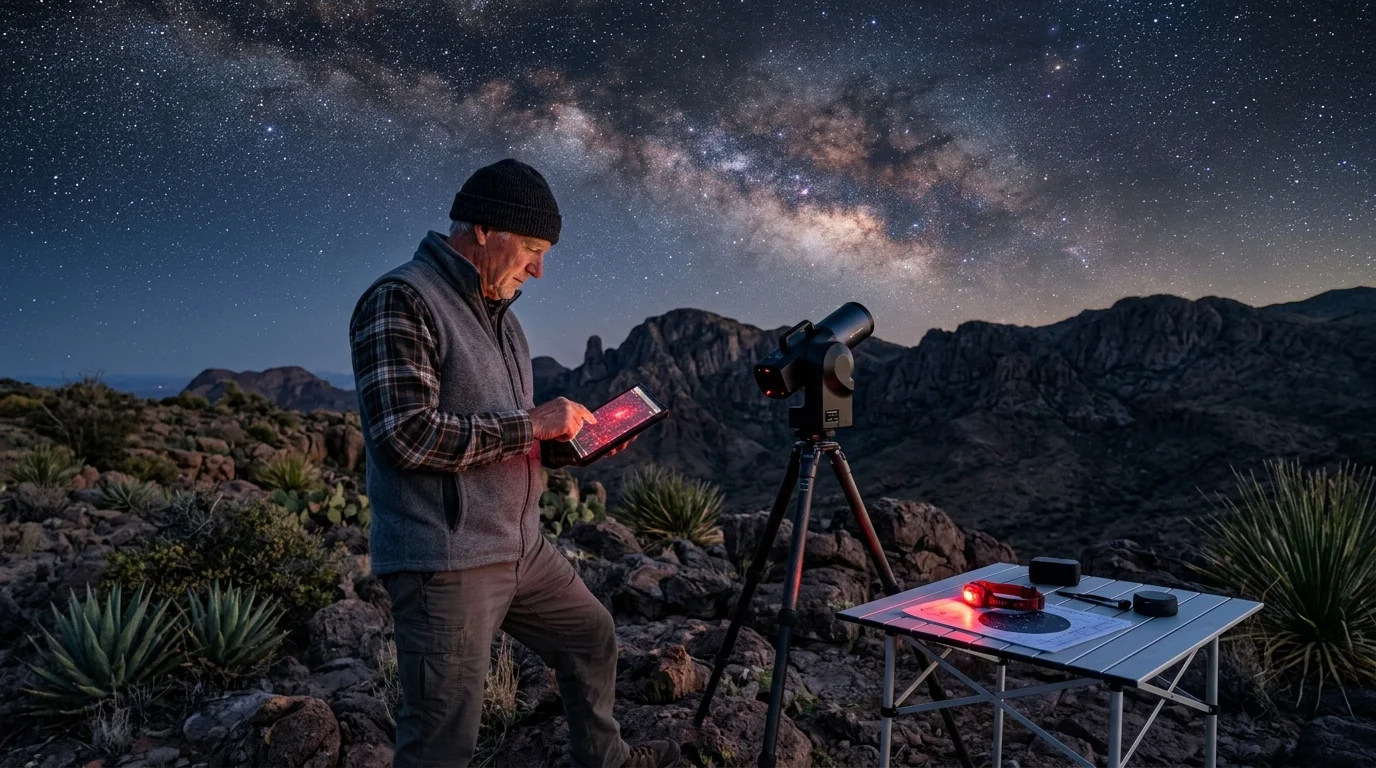
Stargazing in West Texas offers you pristine cosmic views under rare Bortle Class 1 skies. You can execute a complete seven-night solo expedition to Fort Davis on a strict $3,000 gear and lodging budget without hauling back-breaking equipment.
While commercial astro-tours charge thousands for rigid group itineraries, this guide demonstrates how a tailored, lightweight optical setup and strategic public camp bookings maximize every dollar.
You will command your own schedule across the Davis Mountains, discovering how retirement unlocks the ultimate dark-sky adventure.
The Greater Big Bend International Dark Sky Reserve Advantage
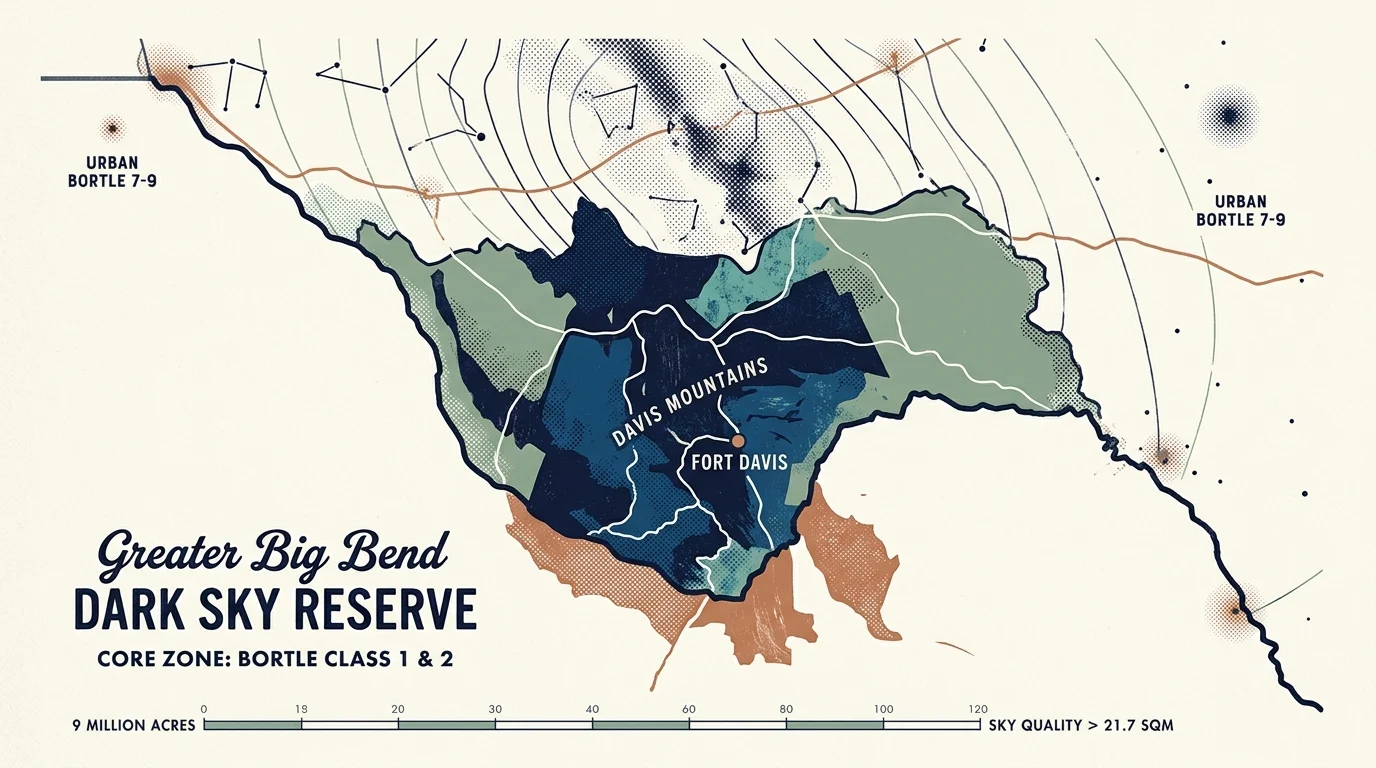
Dark-sky stargazing in Texas reached an unprecedented global benchmark in April 2022. That year, DarkSky International certified the Greater Big Bend International Dark Sky Reserve.
Spanning over 9 million acres across West Texas and northern Mexico, it forms the largest protected dark-sky territory on Earth. Fort Davis and the Davis Mountains sit directly within the reserve’s protected core zone.
Urban backyards routinely register as Bortle Class 7 to 9, where light pollution drowns out all but the brightest planets. In contrast, the Davis Mountains deliver Bortle Class 1 and 2 conditions nightly.
Sky Quality Meter readings in this core basin consistently exceed 21.7 magnitudes per square arcsecond. Under these pristine conditions, the Milky Way casts discernible shadows across the desert floor.
“The cosmos is within us. We are made of star-stuff. We are a way for the cosmos to know itself.” — Carl Sagan
Organizations like Road Scholar demonstrate how immersive, self-directed experiential learning enriches retirement. Stargazing in West Texas offers the ideal venue to cultivate that intellectual curiosity.
Here, you do not merely view the night sky; you reconnect with raw cosmic scales. Pristine high-desert air ensures that faint emission nebulae, globular clusters, and distant galaxies emerge with crystalline clarity.
Public Campgrounds and RV Hookup Analysis Near Fort Davis
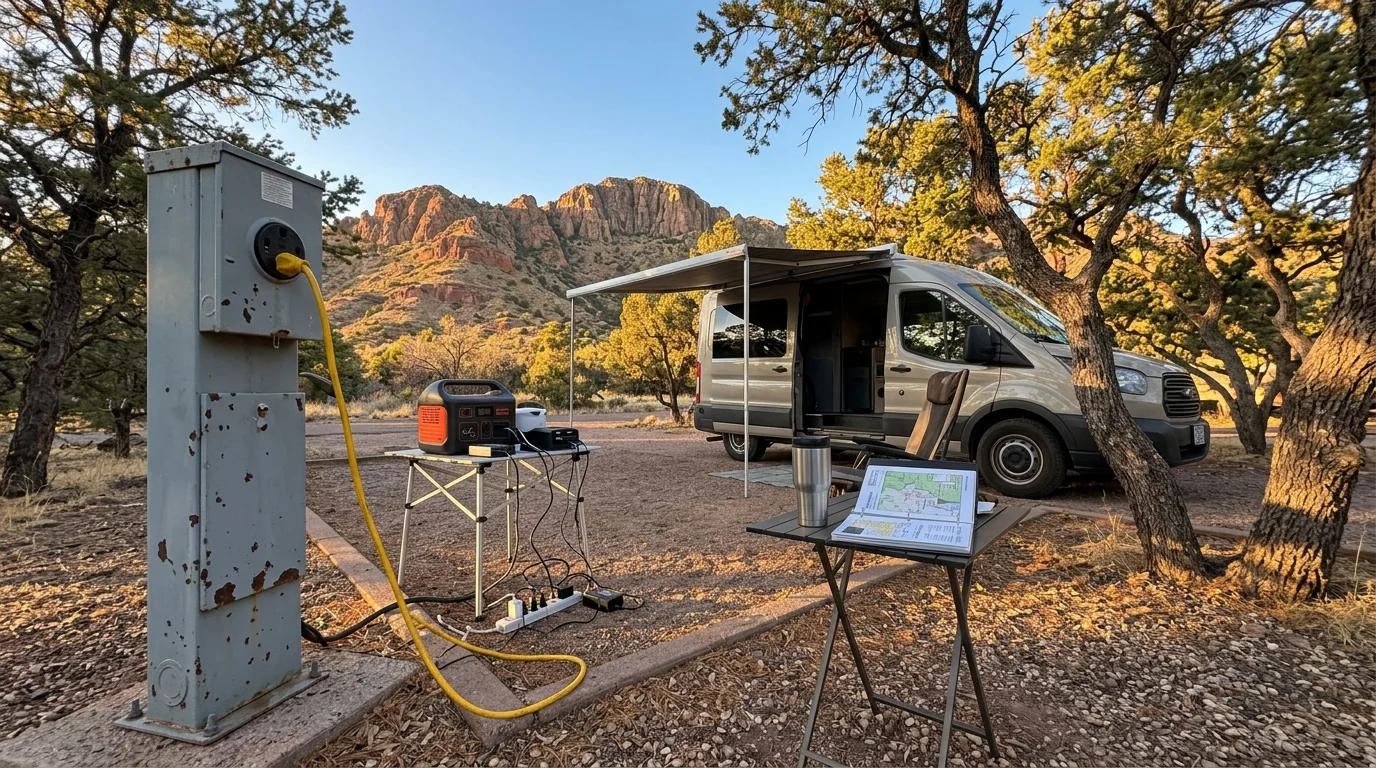
Selecting the right basecamp determines both your physical comfort and viewing quality. Solo amateur astronomers require stable electrical hookups to recharge auxiliary power banks and run heated anti-dew equipment.
Public lands surrounding Fort Davis offer distinct advantages over costly commercial resorts. You will find affordable campsites with utility pedestals positioned right under Bortle Class 1 and 2 skies.
| Campground / Facility | Nightly Hookup Cost | Distance to Observatory | Bortle Rating & SQM | Base Elevation |
|---|---|---|---|---|
| Davis Mountains State Park | $20 to $25 | 12 miles | Bortle 2 (21.75 SQM) | 5,100 feet |
| Balmorhea State Park | $17 to $20 | 35 miles | Bortle 2 (21.68 SQM) | 3,200 feet |
| Indian Lodge (CCC Historic Hotel) | $150 to $190 | 12 miles | Bortle 2 (21.75 SQM) | 5,200 feet |
| Fort Davis Commercial RV Sites | $40 to $55 | 16 miles | Bortle 2 (21.70 SQM) | 4,900 feet |
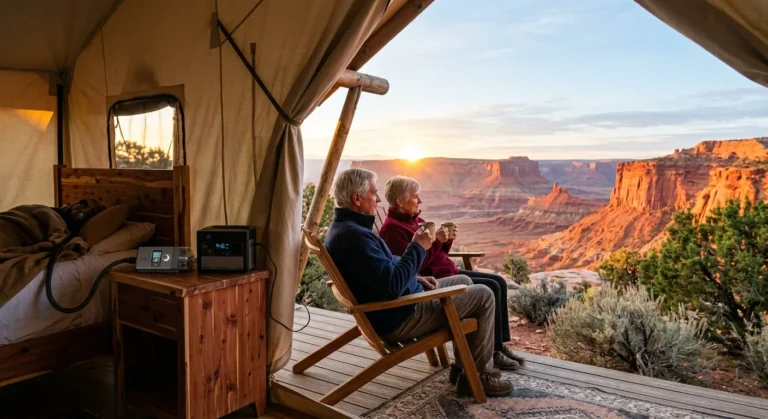
Davis Mountains State Park serves as the premier base for solo observers. Nestled inside Keesey Canyon, the park features water and 30-amp or 50-amp electrical sites that keep your camper powered.
Day visitors must leave the scenic Skyline Drive overlook inside the park by 10:00 PM. However, registered overnight campers can access designated lower viewing pads throughout the entire night.
The daily park entrance fee is $6 per adult. Purchasing the $70 annual Texas State Park Pass immediately waives this fee for your entire seven-night stay.
If you prefer brick-and-mortar lodging without hauling a trailer, consider Indian Lodge. Built in the 1930s by the Civilian Conservation Corps, this 39-room historic adobe hotel sits directly inside the park.
Guests staying at Indian Lodge also avoid the daily state park entrance fee. Its newly renovated rooms provide a comfortable, climate-controlled retreat after long hours of cold desert observing.
Senior-Friendly Optics: 8-Inch Dobsonians Versus Smart Telescopes
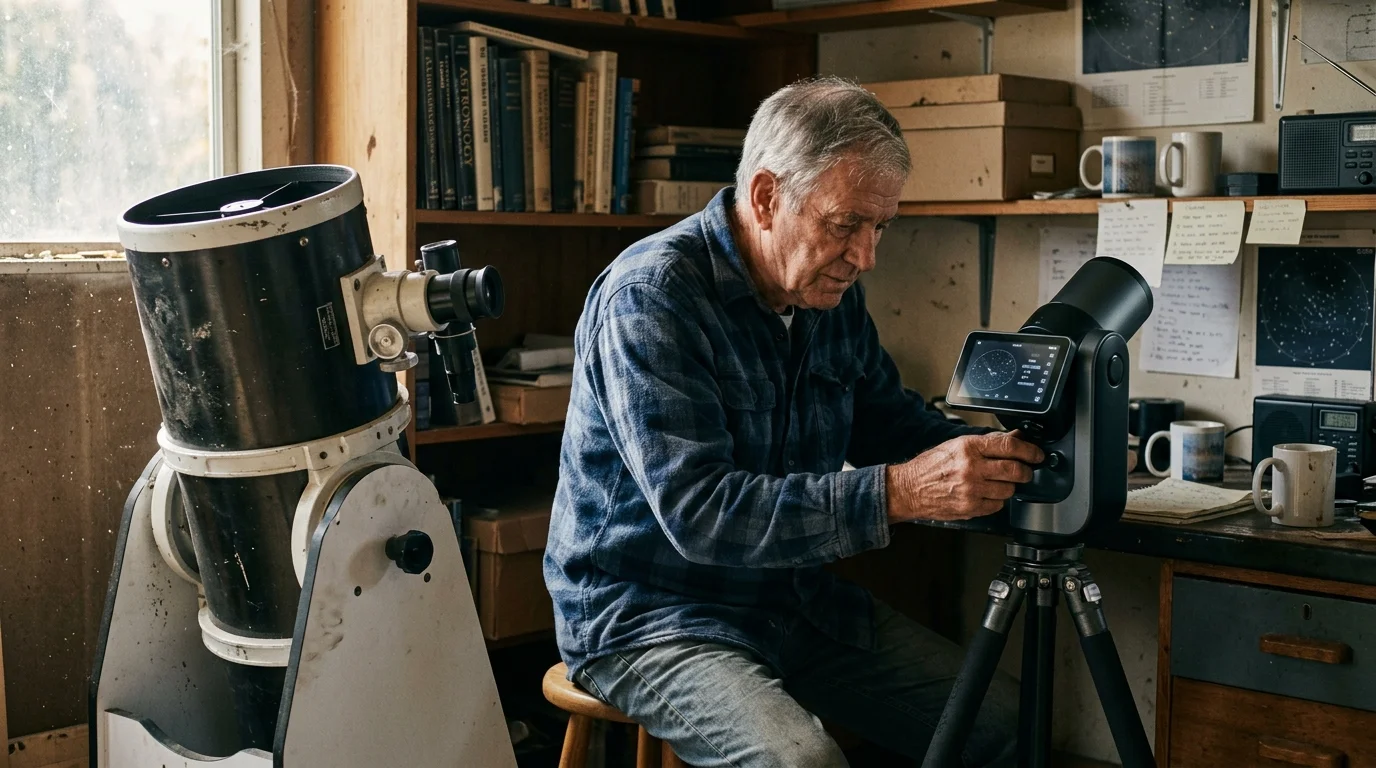
Your optical gear loadout must balance light grasp against physical ergonomics. Hauling heavy equipment in the dark creates unnecessary fatigue and strain for solo travelers.
An 8-inch Dobsonian reflector has long served as the gold standard for amateur astronomy. It provides immense light gathering at an economical price point, but mechanical weight demands careful review.
| Telescope Setup | Total Weight | Setup Time | Aperture & Design | Retail Cost |
|---|---|---|---|---|
| Apertura AD8 Dobsonian | 52.2 lbs | 15 minutes | 203mm Parabolic Reflector | $849 |
| Sky-Watcher Flextube 200P | 45.0 lbs | 12 minutes | 203mm Collapsible Reflector | $785 |
| ZWO Seestar S50 | 5.5 lbs | 3 minutes | 50mm Triplet Apochromat | $499 |
| DwarfLab DWARF 3 | 2.97 lbs | 2 minutes | 35mm Periscope Telephoto | $499 |
A standard 8-inch solid-tube Dobsonian divides into two main components: the optical tube assembly and the wooden ground base. The Apertura AD8 tube weighs 24.5 pounds, while its base weighs 27.7 pounds.
Lifting these separate 25-pound components into a vehicle trunk remains manageable for many active seniors. However, moving them across unpaved campsite gravel at night requires a heavy-duty folding hand truck.
If you prefer an 8-inch manual telescope, consider the Sky-Watcher Flextube 200P. Its collapsible truss mechanism shortens the optical tube length to under 36 inches for simplified vehicle transport.
Modern automated smart telescopes present an agile alternative for portable telescope senior travel. These compact systems integrate robotics, cameras, and automated tracking into a single ultra-light chassis.
The ZWO Seestar S50 weighs just 5.5 pounds including its carbon-fiber tripod. It requires no heavy counterweights, manual polar alignment, or star-hopping star charts.
You control the Seestar through a smartphone or tablet interface while seated inside a heated camp chair. Its integrated sensor stacks images in real time, revealing vibrant nebula color that visual eyepieces cannot show.
The DwarfLab DWARF 3 weighs under 3 pounds and slips effortlessly into a daypack. It offers automated star tracking and field derotation for deep-sky and solar observations.
Regardless of your optical choice, local lighting ordinances strictly enforce night-vision preservation. Pack headlamps and flashlights that emit red wavelengths between 600 and 650 nanometers.
Worked Financial Plan: A Complete 7-Night Budget Under $3,000
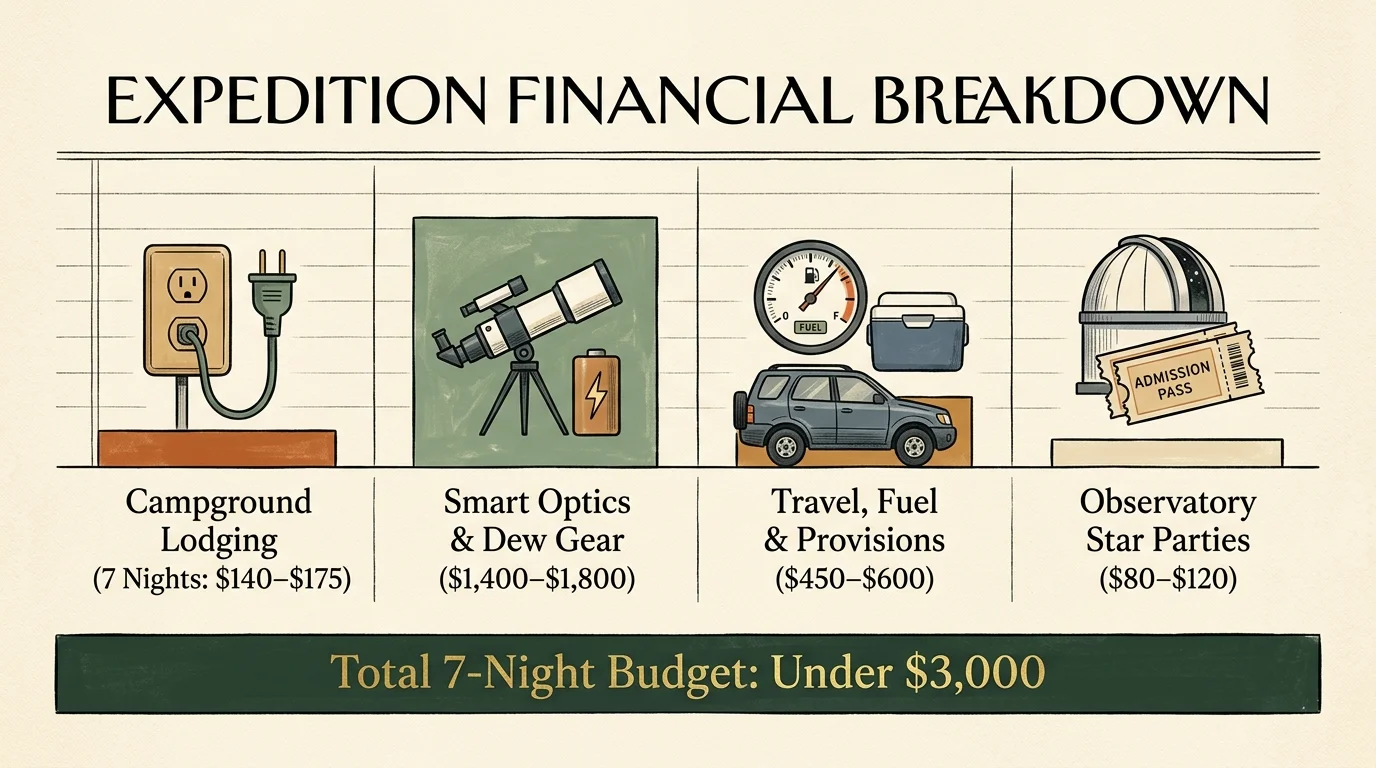
You can execute a world-class astronomy expedition to Fort Davis without exceeding a modest retirement travel allocation. Careful planning keeps equipment, site reservations, fuel, and admissions well below your $3,000 ceiling.
The following worked financial plan demonstrates realistic costs for a 65-year-old solo traveler. This model pairs an ultra-portable smart telescope with visual wide-field binoculars for a balanced observing run.
- Smart Optical Rig: ZWO Seestar S50 All-in-One Smart Telescope — $499
- Wide-Field Visual Optics: Celestron Outland X 10×42 Binoculars — $95
- Campground Lodging: 7 nights at Davis Mountains State Park (electric hookup at $25/night) — $175
- State Park Access: Annual Texas State Park Pass — $70
- Observatory Tickets: McDonald Observatory Senior Star Party ($20) plus 36-Inch Telescope Night ($100) — $120
- Observatory Daytime Tour: Guided Telescope Tour — $10
- Vehicle Fuel: 1,200 miles round-trip driving (estimated at 22 MPG and $3.25/gallon) — $177
- Campsite Provisions & Groceries: 7 days of fresh meals, hydration, and trail rations — $350
- Night Gear & Power: Anker 20,000mAh external battery pack and red headlamps — $95
- Contingency Reserve: Emergency maintenance and roadside buffer — $500
Total expenditure for this entire seven-night solo expedition equals $2,091. This financial structure leaves you with over $900 in unspent capital from your $3,000 baseline budget.
If you prefer an 8-inch visual reflector instead, swap the smart scope for a Sky-Watcher Flextube 200P ($785) and two quality Plössl eyepieces ($150). Your revised total remains just $2,531.
This disciplined allocation confirms that authentic dark-sky stargazing in Texas remains thoroughly accessible. You secure top-tier equipment and prime lodging without incurring commercial travel premiums.
High-Altitude Acclimation and Solo Desert Safety Protocols
Fort Davis rests at approximately 4,900 feet above sea level, while Davis Mountains State Park reaches 5,400 feet. The research domes at McDonald Observatory sit even higher, exceeding 6,790 feet.
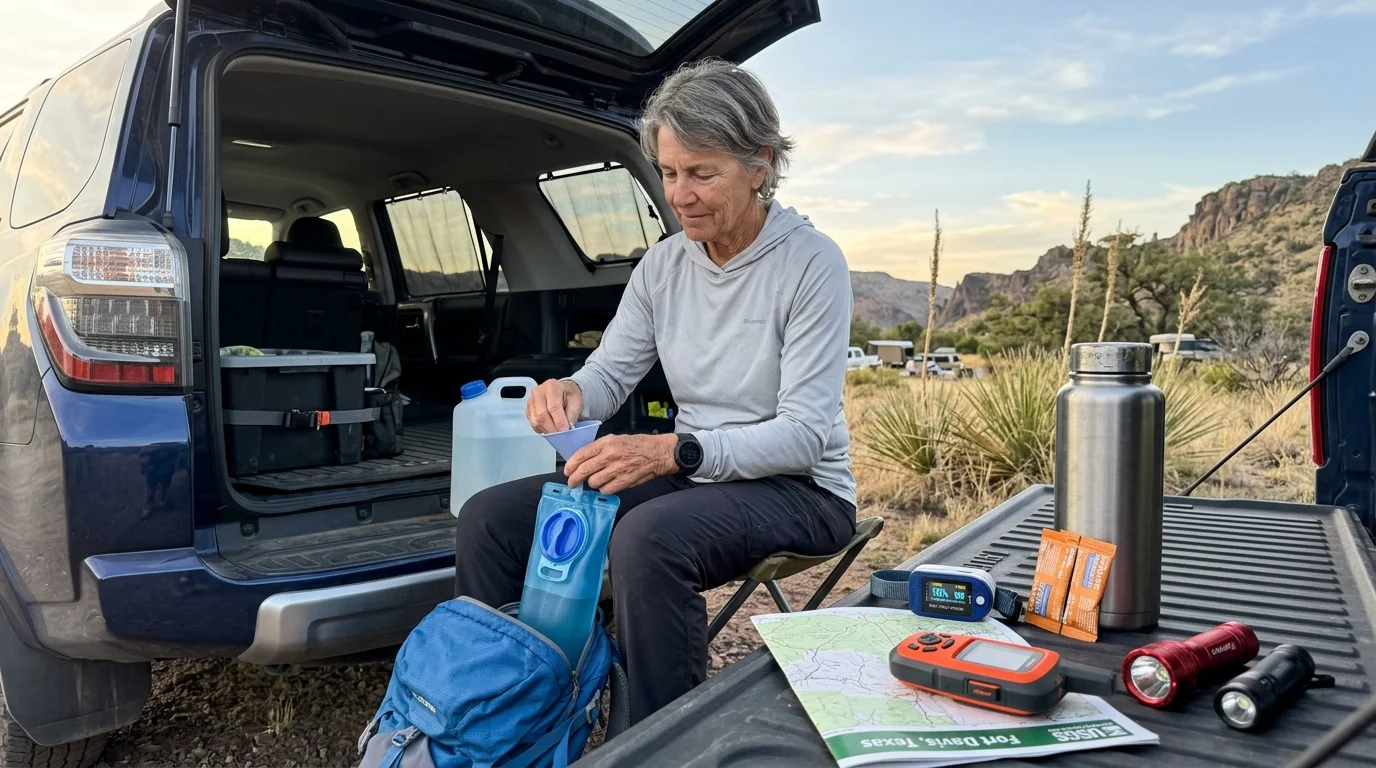
Solo seniors must actively monitor hydration and physical exertion at these mountain elevations. Lower atmospheric pressure and dry air accelerate fluid loss before you notice thirst.
The National Institute on Aging emphasizes proactive hydration and physical moderation for older adults managing strenuous outdoor travel. Drink at least three to four liters of water daily.
High-desert mountain climates also generate rapid temperature drops after dusk. Nighttime temperatures routinely plunge 30°F to 40°F below daytime peaks, even during mild spring and autumn months.
- Pack layered thermal base garments, windproof outerwear, and insulated footwear.
- Keep cellular devices fully charged; download offline topographical maps before arriving.
- Install a secondary 12-volt battery monitor inside your vehicle to prevent dead starter batteries.
- Store high-energy snacks and warm thermos beverages at your observing station.
Medical preparation warrants careful attention when traveling alone in rural West Texas. The nearest comprehensive medical facility is Big Bend Regional Medical Center in Alpine, Texas.
Reaching this hospital requires a 25-mile drive south along State Highway 118, taking approximately 30 minutes. Always carry a printed medical profile and personal prescription reserves inside your vehicle glovebox.
McDonald Observatory: Star Parties and Research Dome Access
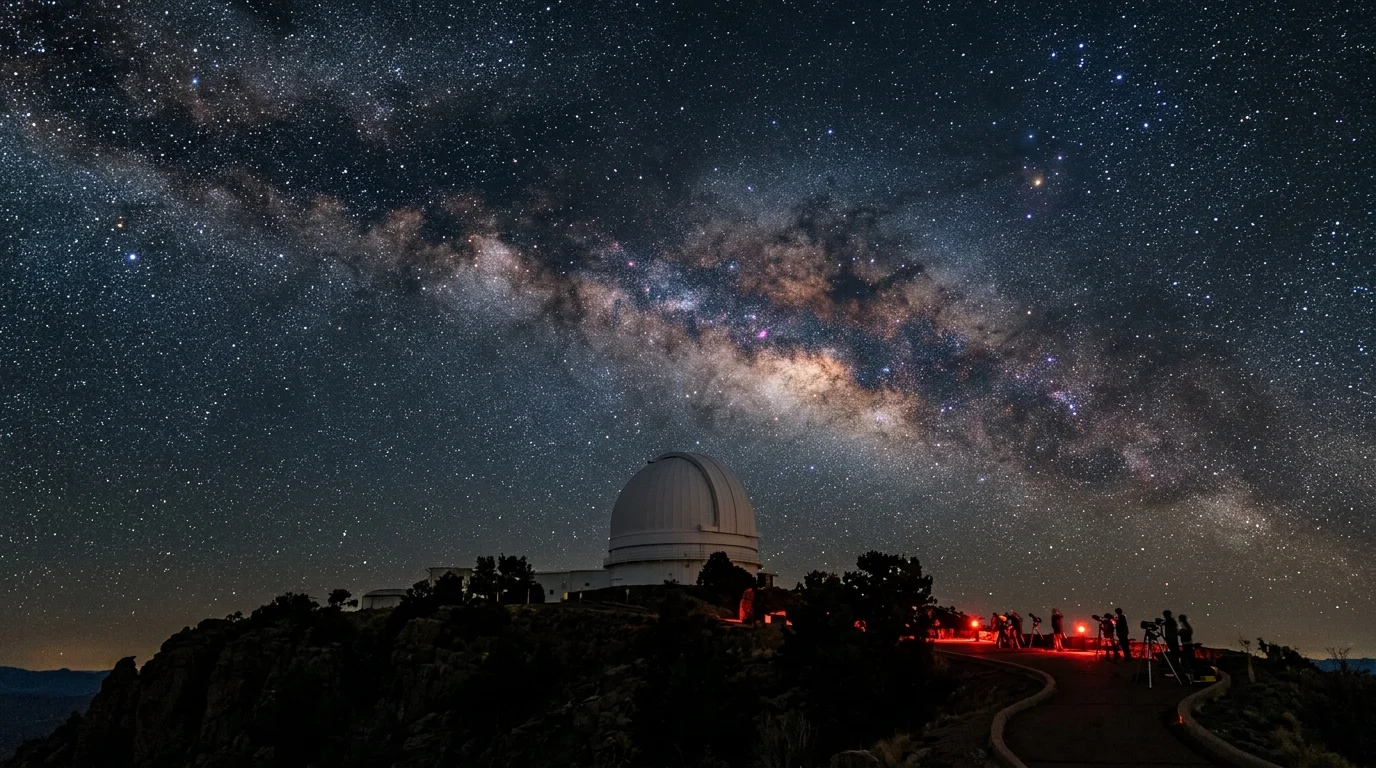
No astronomy expedition to Fort Davis is complete without visiting McDonald Observatory. Located on Mount Locke and Mount Fowlkes, this premier research facility is operated by the University of Texas at Austin.
The observatory hosts world-famous public Star Parties three evenings each week on Tuesday, Friday, and Saturday. These gatherings take place at the Frank N. Bash Visitors Center outdoor amphitheater.
Public star party tickets cost $25 for general adults, but visitors aged 65 and older receive a discounted $20 senior rate. You must book reservations online two to four weeks in advance, as tickets sell out quickly.
During the program, staff astronomers point laser markers across constellations and train research telescopes on cosmic showpieces. You will observe Saturn’s rings, stellar nurseries, and distant galaxies through high-grade optics.
Daytime admission to the visitors center costs just $3 for self-guided exploration. Guided tours of the summit domes run between $5 and $10, granting interior access to giant research reflectors.
You can walk inside the enclosure of the Otto Struve 82-inch telescope and view the massive Harlan J. Smith 107-inch instrument. Nearby on Mount Fowlkes sits the Hobby-Eberly Telescope, featuring a 91-mirror segmented primary reflector.
For an unforgettable splurge, reserve a seat for a 36-inch telescope special viewing night. Priced at $100 per guest, these limited-capacity sessions provide direct visual eyepiece time on deep-sky targets.

A Solo Stargazer’s 7-Night Field Schedule
A structured field schedule balances restful daytime recreation with intensive late-night observing runs. Research from the Stanford Center on Longevity shows that engaging in challenging mental and physical pursuits helps maintain vitality throughout retirement.
Follow this curated seven-day itinerary to systematically explore West Texas skies while safeguarding your physical energy.
- Day 1: Basecamp Setup and Solar Alignment. Arrive at Davis Mountains State Park, position your camper or tent, and level your tripod mounts. Test all low-temperature batteries and inspect red-light flashlights before civil twilight fades.
- Day 2: Elevation Acclimation and Constellation Survey. Spend a relaxed morning resting in camp to adjust to the 5,000-foot altitude. Spend dusk tracing naked-eye constellations and observing the Andromeda Galaxy (M31) using your 10×42 binoculars.
- Day 3: McDonald Observatory Tour and Evening Star Party. Drive up TX-118 for an afternoon guided summit dome tour. Remain on Mount Locke for the official evening Star Party, enjoying guided views through large observatory instruments.
- Day 4: Deep-Sky Automated Imaging. Deploy your portable smart scope on the campsite observing pad. Program image-capture sequences targeting faint emission nebulosity in the Orion or Cygnus complexes while relaxing nearby in camp.
- Day 5: Cultural Excursion and Lunar Photography. Visit the historic frontier post at Fort Davis National Historic Site during the afternoon. At nightfall, capture high-resolution imagery of lunar crater relief and bright planetary targets.
- Day 6: Deep Aperture Visual Observing. Dedicate this evening to hunting faint Messier and Caldwell objects using your 8-inch Dobsonian or high-magnification smart optics. Focus on globular clusters like M13 and interacting galaxies like M51.
- Day 7: Southern Horizon Sweep and Expedition Wrap-Up. Sweep the southern horizon toward the constellation Sagittarius to view dense Milky Way star clouds. Pack sensitive optics securely inside your vehicle before retiring for your morning departure.
Frequently Asked Questions
What makes Fort Davis skies darker than other rural camping locations?
The Davis Mountains sit inside the core zone of the Greater Big Bend International Dark Sky Reserve. Surrounding municipalities enforce strict outdoor lighting ordinances, keeping artificial light pollution near zero under Bortle Class 1 and 2 skies.
Can an active 65-year-old solo traveler handle an 8-inch Dobsonian telescope?
Yes, provided you separate the instrument into its two sub-assemblies during transit. The optical tube and rocker base weigh roughly 25 pounds each, making them manageable to move with a lightweight folding cart.
Are reservations required for the public Star Parties at McDonald Observatory?
Reservations are mandatory because visitor capacities are strictly capped. Tickets for Tuesday, Friday, and Saturday night star parties routinely sell out two to four weeks in advance through the observatory website.
What emergency services exist near Davis Mountains State Park?
The town of Fort Davis provides basic emergency medical response and volunteer fire personnel. Comprehensive medical treatment and emergency hospital care are available at Big Bend Regional Medical Center in Alpine, 25 miles south.
Disclaimer: This article is for informational and inspirational purposes. Life decisions are deeply personal, and we encourage readers to pursue their dreams while considering their unique circumstances, health, and financial situation.