You can trade your clinical career in precision pharmacy for active astrophysical research right from your backyard. Establishing a personal variable-star monitoring station lets you record publishable astronomical measurements throughout your retirement.
While many assume meaningful contributions require multi-million-dollar desert installations, disciplined sensor calibration and standardized photometric filters make your backyard setup scientifically equal to professional institutions. You produce genuine peer-reviewed data from home.
This technical guide details equipment costs, camera cooling calibrations, and submission workflows designed to transform your analytical habits into vital scientific discovery.
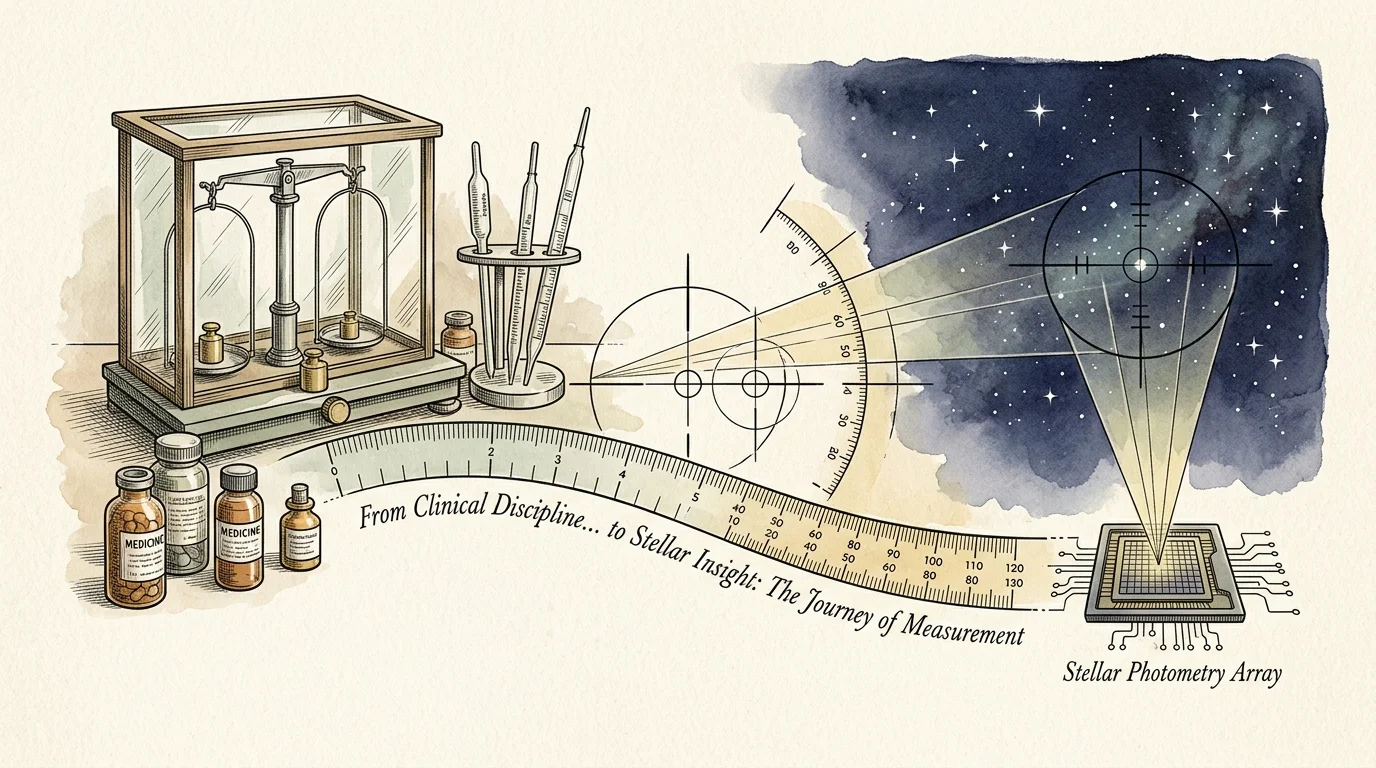
The Second-Act Astronomer: From Clinical Precision to Photometric Science
Decades spent verifying dosages, measuring chemical compounds, and managing quality control provide the exact mindset required for modern stellar photometry. Science does not require youth; it demands patience, consistency, and unrelenting attention to detail.
Channeling a career of analytical discipline into astronomy is an inspiring way of reinventing yourself in retirement through genuine scientific discovery.
Astronomers cannot monitor every pulsating star, cataclysmic nova, or transiting exoplanet alone. Professional research facilities rely on amateur observers to track changes across thousands of active stellar systems.
Entering citizen science astronomy variable stars initiatives provides deep cognitive engagement and authentic scientific purpose. Your observations directly assist astrophysicists modeling stellar evolution and galactic dynamics.
Research published by the Stanford Center on Longevity emphasizes that pursuing rigorous, intellectually challenging endeavors preserves cognitive health and fosters emotional fulfillment during retirement. Measuring distant suns exercises that analytical rigor.
Rather than taking aesthetic photographs of nebulae, you will measure the incoming photon flux of fluctuating stars. Every data point you register helps refine our map of stellar lifecycles.

Equipment Architecture and Real-World Backyard Observatory Costs
Constructing a scientific observation station requires reliable, repeatable mechanics rather than cosmetic perfection. Every component must operate deterministically to eliminate measurement error.
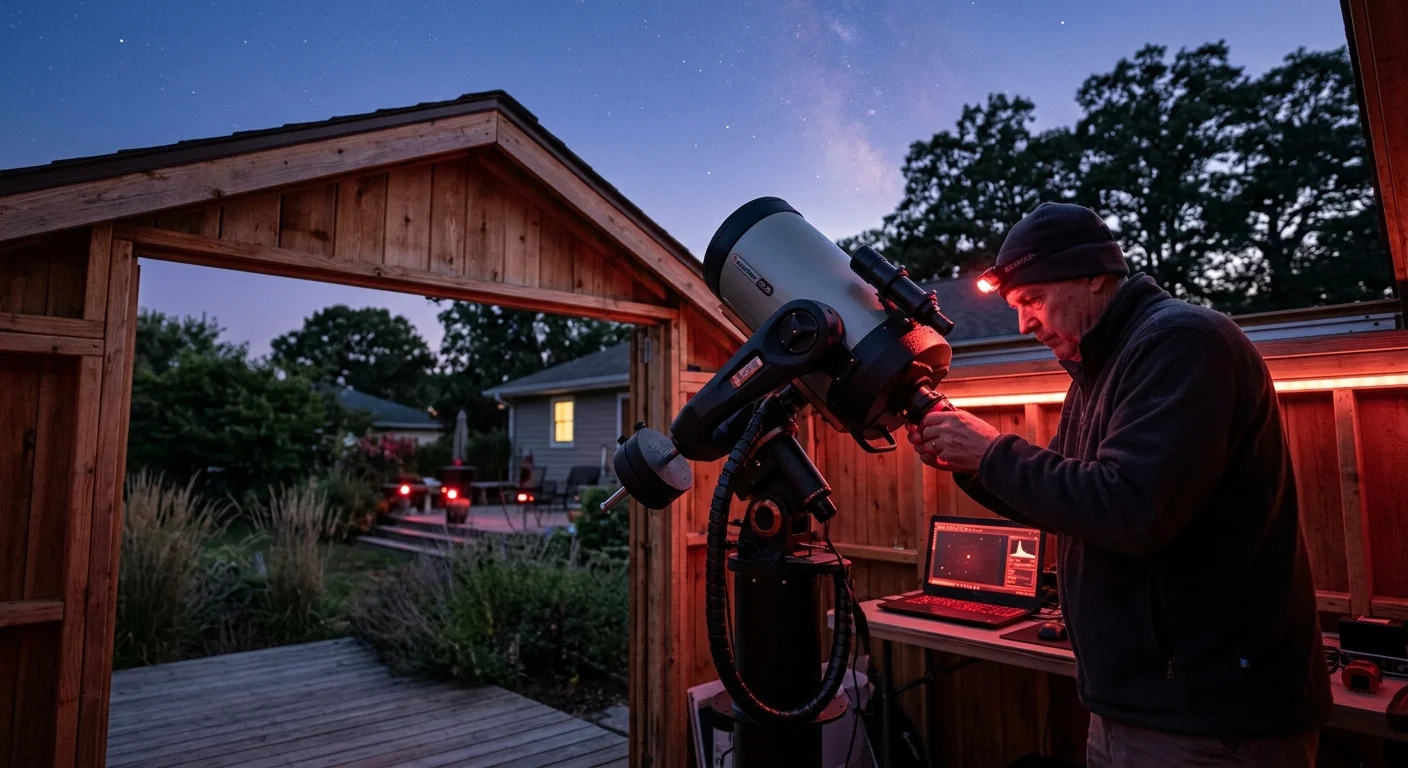
Setting up an aavso telescope setup senior station demands balancing aperture, tracking precision, and physical ergonomics. Automated robotic equipment handles heavy mechanical tracking while you supervise collection from an indoor workstation.
Expect to budget across four distinct hardware categories:
- German Equatorial GoTo Mount ($1,500 – $2,200): A heavy-duty mount like the Sky-Watcher EQ6-R Pro provides periodic error correction and handles scientific payloads up to 44 pounds smoothly.
- Optical Tube Assembly ($1,100 – $1,700): An 8-inch Schmidt-Cassegrain telescope, such as the Celestron EdgeHD 8, delivers a flat focal plane ideal for precise point-spread function analysis.
- Cooled Scientific Monochrome Camera ($1,000 – $2,000): A dedicated sensor like the ZWO ASI2600MM Pro or ASI294MM Pro offers low read noise and controlled cooling down to 35°C below ambient.
- Photometric Filter Wheel and Filters ($850 – $1,450): A motorized filter wheel paired with calibrated Johnson-Cousins/Bessell filters ensures standard wavelength isolation.
In addition to hardware, factor in specialized operational memberships. Registering for an AAVSO observer code and submitting observations are free; optional paid memberships—required for tools like VPhot and AAVSOnet—run $110 annually for regular adults, with discounted $55/year rates available.
Altogether, an instrument package capable of generating publication-grade photometry requires an investment between $4,500 and $7,500. This setup provides scientific capabilities comparable to university-grade installations from three decades ago.
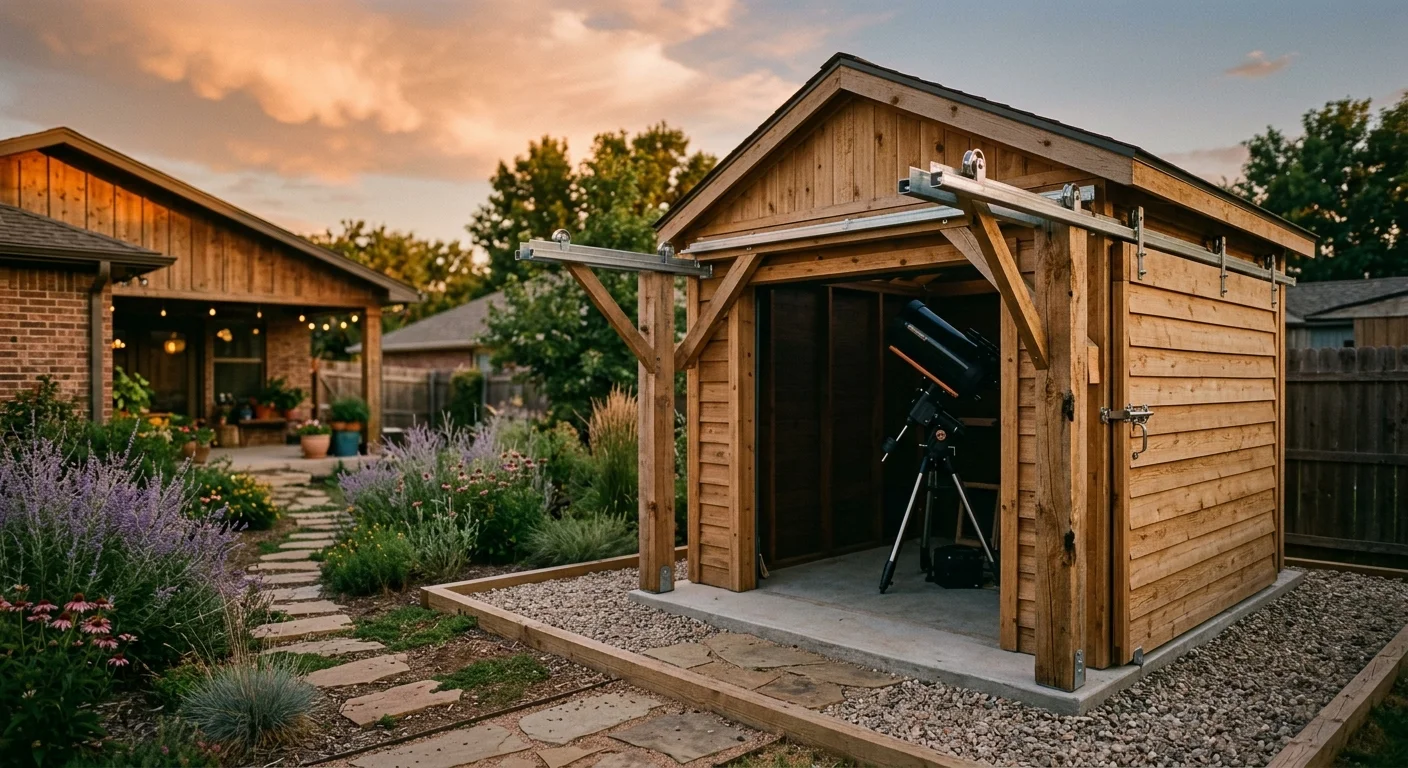
Observatory Housing: Roll-Off Roof Sheds Versus Prefabricated Domes
A permanent backyard observatory for retirees eliminates the physical strain of hauling heavy tripods and counterweights into the yard every clear night. Shelter turns sporadic stargazing into routine, comfortable observation sessions.
Building a dedicated backyard observatory is an inspiring way of rekindling old passions for engineering, carpentry, and science.
Permanent installations anchor your telescope to an isolated concrete pier. This mechanical isolation prevents floor vibrations caused by foot traffic from shaking your optical train during long exposures.
You have two primary architectural options for housing your instrumentation:
- DIY Roll-Off Roof (ROR) Shed: Built with local lumber on an 8×8 or 10×10 foot footprint, costing between $3,000 and $7,000 in raw materials and track hardware.
- Prefabricated Fiberglass Dome: Systems like the NexDome 2.2-meter observatory cost approximately $3,895 for the complete dome and wall kit, offering wind protection and rapid assembly.
Roll-off sheds offer generous interior space for computers, reference manuals, and maintenance tables. Domes shield your telescope from lateral wind gusts, maintaining steady tracking during blustery nights.
Most municipal zoning ordinances permit detached accessory structures under 100 to 120 square feet without demanding structural building permits. Always verify your local setback requirements and homeowner association rules before pouring concrete foundations.
Motorizing the roof assembly with automated gate openers lets you monitor and run automated observation sequences safely from your living room.
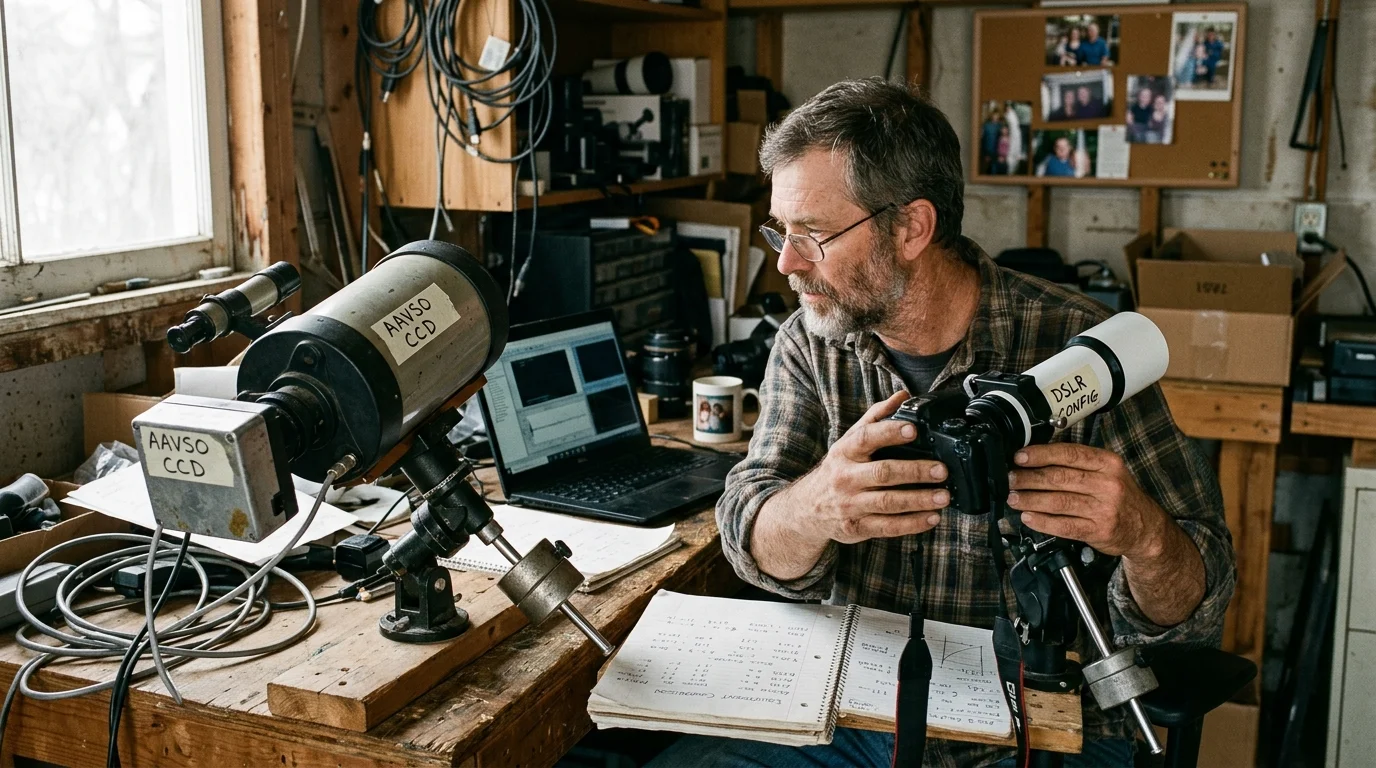
Telescope and Camera Configuration: A Head-to-Head Comparison
Choosing matching hardware components prevents optical vignetting and ensures appropriate pixel scale resolution. Photometry requires an ideal spatial sampling between 1.0 and 2.5 arcseconds per pixel.
Oversampling wastes sensor area, while undersampling blends nearby stars together, introducing severe measurement errors into your readings. Select configurations optimized for light throughput and reliable tracking.
| System Configuration | Optical Payload Weight | Pixel Resolution Scale | Sensor Thermal Delta | Estimated Hardware Cost |
|---|---|---|---|---|
| Celestron EdgeHD 8 + ASI2600MM Pro | 14.0 lbs | 0.39 arcsec/px (native) / 0.56 (f/7 reducer) | -35°C below ambient | $3,900 |
| Sky-Watcher Quattro 200P + ASI294MM Pro | 17.5 lbs | 1.19 arcsec/px (Bin2) / 0.60 arcsec/px (Bin1) | -35°C below ambient | $2,350 |
| William Optics Zenithstar 81 + ASI533MM Pro | 7.8 lbs | 1.49 arcsec/px | -35°C below ambient | $2,100 |
The 8-inch Schmidt-Cassegrain pairing with a focal reducer provides the versatile aperture needed to target faint stars down to 16th magnitude. It captures compact star fields without introducing edge aberrations.
Refractors offer stable thermal equilibrium and wide fields of view, making them well-suited for bright variable stars. However, their smaller apertures limit your reach on faint deep-sky targets.
Suburban Light Pollution Management and Photometric Filter Selection
Suburban light pollution often discourages aspiring observers, but photometric science thrives even under illuminated skies. Unlike astrophotography, photometry measures relative point-source brightness rather than faint, extended nebular structures.
For retirees who want to experience extreme dark-sky phenomena beyond standard stellar monitoring, an affordable trip to view the northern lights can serve as an unforgettable seasonal expedition.
While taking a dark-sky stargazing expedition offers unmatched celestial views, suburban observers can still achieve publication-grade accuracy right from home.
Differential photometry resolves suburban interference by comparing the target star directly against known reference stars in the identical image frame. Light pollution dims both stars uniformly, allowing software to subtract ambient sky glow seamlessly.
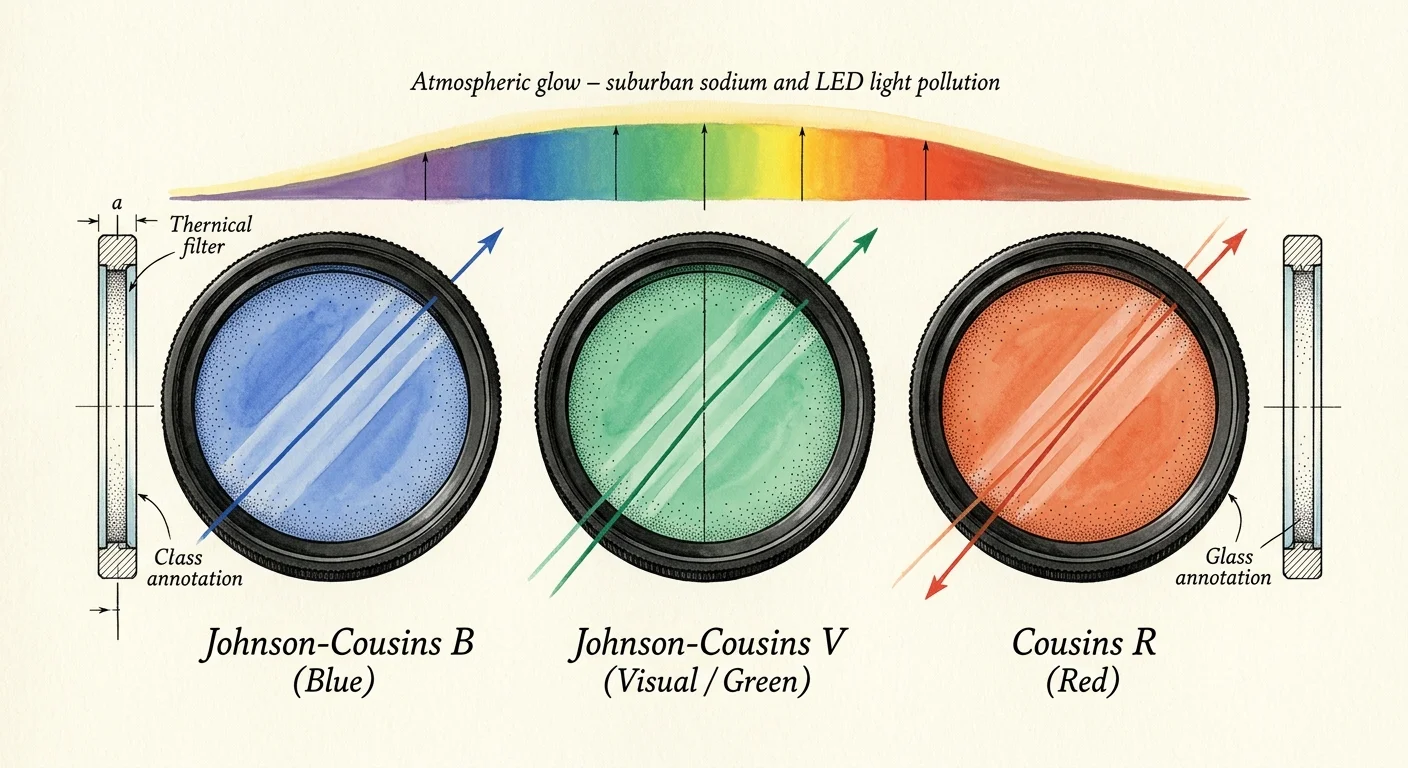
Never rely on generic RGB color filters for scientific submissions. Variable star databases require standardized photometric glass with specific transmission bandpasses:
- Johnson-Cousins V (Visual) Filter: Centered at 550 nanometers with an 85-nanometer bandwidth, this filter serves as the foundational standard for historical magnitude comparisons ($150 – $250).
- Johnson-Cousins B (Blue) Filter: Centered near 440 nanometers, pairing this with the V filter produces standard color index values ($B – V$) to calculate stellar temperatures ($150 – $250).
- Cousins R (Red) and I (Infrared) Filters: Essential for penetrating interstellar dust and studying cool red giants, Mira variables, and flare stars ($300 – $500 paired).
Beginners should start exclusively with the standard Johnson V filter. Mastering one bandpass simplifies image calibration before you introduce complex multi-filter color transformation coefficients.
High optical quality filters from manufacturers like Chroma or Baader maintain precise spectral cutoffs. Reliable filters ensure that your suburban data matches observations recorded by mountaintop observatories.
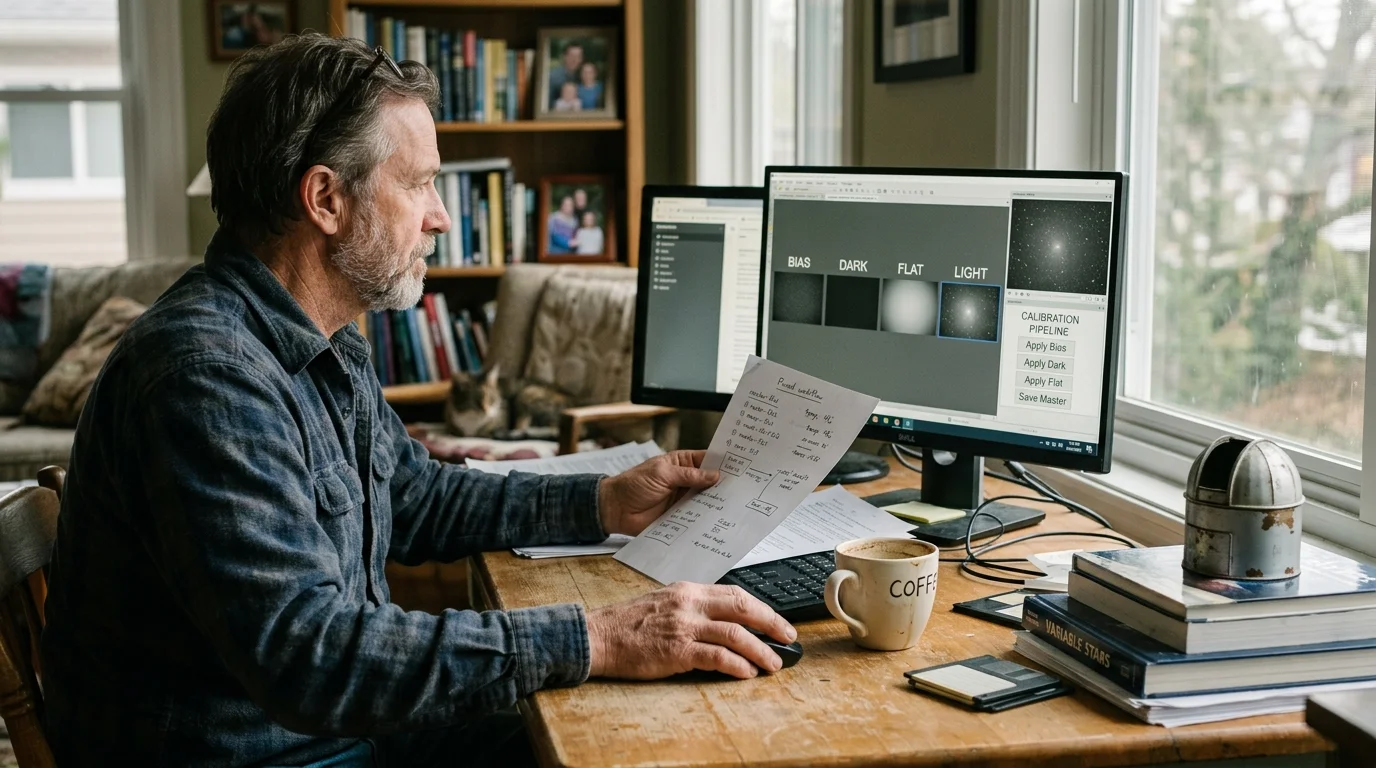
The CCD and CMOS Calibration Pipeline: Darks, Flats, and Bias Frames
Raw astronomical images contain electronic noise, sensor defects, and optical artifacts that corrupt scientific calculations. Pharmacists understand that an uncalibrated analytical scale produces invalid data; imaging sensors function under the identical physical principle.
To produce research-grade photometry, you must mathematically calibrate raw light frames using a systematic calibration framework. Each calibration step removes a specific source of instrumental error.
- Master Bias Frames: Capture readout noise and pixel-to-pixel electrical offsets by averaging 30 to 50 exposures taken at your camera’s fastest shutter speed (e.g., 1/10,000 second) with the telescope cap securely in place.
- Master Dark Frames: Measure thermal sensor noise by recording 20 or more exposures matching your light frames in duration and cooling temperature, taken in absolute darkness.
- Master Flat-Field Frames: Correct for optical vignetting and dust particles on the optical glass by imaging an evenly illuminated twilight sky or an electroluminescent panel.
- Master Flat-Dark Frames: Characterize thermal buildup during flat-field exposures by matching their short exposure duration at your standardized operating temperature.
Regulate your camera cooling systematically. Locking your sensor to -10°C or -15°C stabilizes thermal electron generation, enabling reliable dark frame subtraction across entire observing seasons.
Automation platforms like N.I.N.A. (Nighttime Imaging ‘N’ Astronomy) handle this acquisition sequence automatically. Automation frees you from tedious late-night computer operations while building a reliable calibration library.
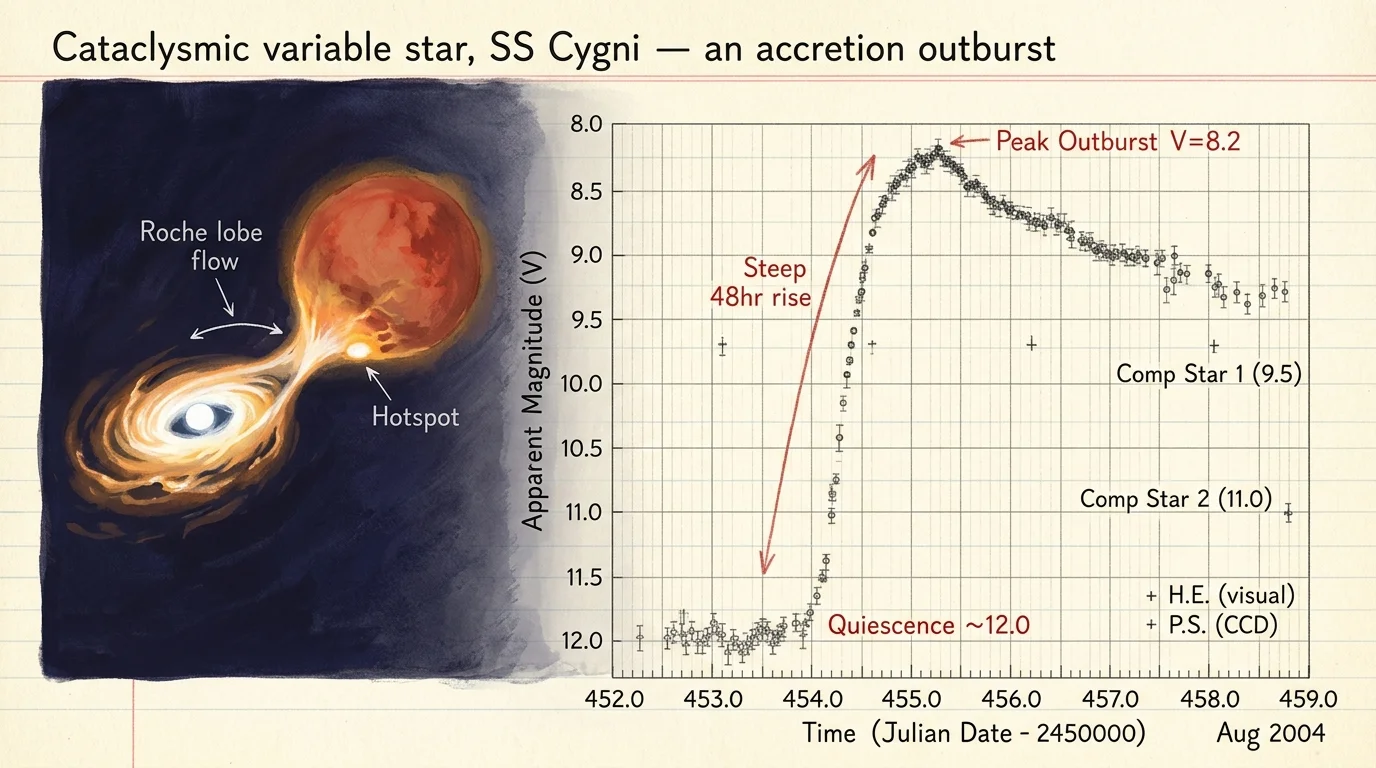
Worked Scientific Example: Measuring SS Cygni in Outburst
Consider a practical observation scenario tracking SS Cygni, a famous dwarf nova composed of a white dwarf stripping matter from an orange dwarf companion. The system undergoes unpredictable, violent outbursts every 7 to 8 weeks.
For this observation, configure an 8-inch SCT at f/7 (1422 mm focal length) paired with a cooled CMOS camera held at -10°C through a Johnson V filter. Point your telescope toward Cygnus and record a calibrated 30-second exposure.
Using photometric reduction software like AstroImageJ or VPhot, place digital measuring apertures over your target, comparison, and check stars. The software integrates all photon counts within the inner aperture and subtracts the background sky noise measured in the outer annulus.
Your calibrated analysis generates the following background-subtracted analog-to-digital unit (ADU) flux values:
- Target Star (SS Cygni) Net Flux ($F_{target}$): 125,400 counts
- Comparison Star 105 (Standard V = 10.51) Net Flux ($F_{comp}$): 82,100 counts
- Check Star 112 (Standard V = 11.23) Net Flux ($F_{check}$): 42,300 counts
Compute the target star’s instrumental magnitude using standard differential photometry. Apply the Pogson magnitude equation relative to the calibrated comparison star:
Magnitude difference: $\Delta m = -2.5 \times \log_{10}(F_{target} / F_{comp})$.
Substituting your flux measurements: $\Delta m = -2.5 \times \log_{10}(125,400 / 82,100) = -2.5 \times \log_{10}(1.5274) = -2.5 \times 0.18395 = -0.46$.
Derive the true visual magnitude: $V_{target} = V_{comp} + \Delta m = 10.51 + (-0.46) = 10.05$.
Verify your instrumentation’s stability using the check star: $\Delta m_{check} = -2.5 \times \log_{10}(42,300 / 82,100) = +0.72$. Adding this to 10.51 yields 11.23, matching its catalog value perfectly.
SS Cygni has brightened to magnitude 10.05, confirming an active accretion disk outburst. Your calibrated observation captured dynamic astrophysical behavior from your backyard.
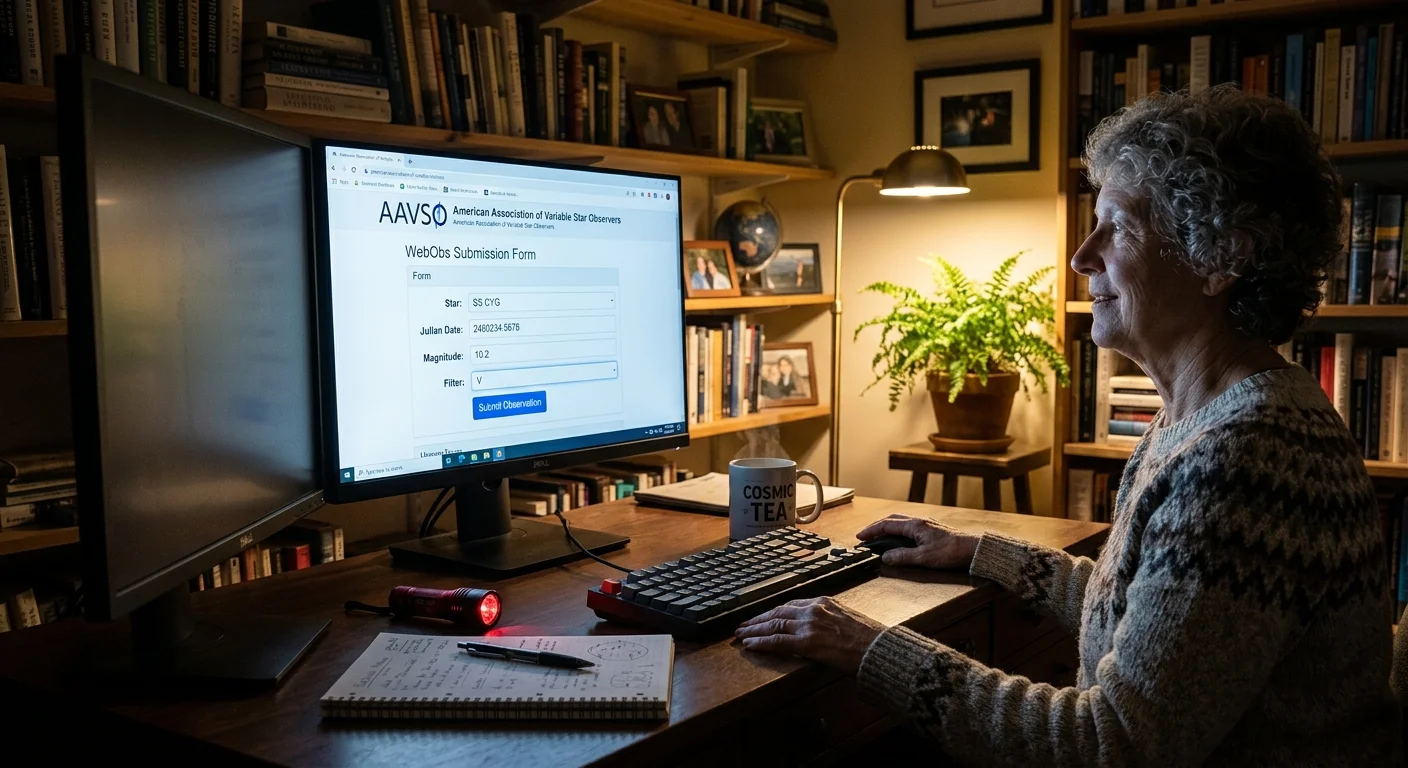
Submitting Data to the AAVSO International Database
Raw calculations hold little value if they remain isolated on your personal computer drive. The final step of the scientific workflow is uploading your calibrated measurements to the AAVSO International Database (AID).
Founded in 1911, the AID stores over 70 million variable star observations spanning more than 37,000 distinct stars. Professional astronomers use this unified repository to plan Hubble, James Webb, and Chandra space telescope missions.
Follow this systematic procedure to format and submit your nocturnal observations:
- Register for your unique personal Observer Code (Obscode) through the official AAVSO website at no cost.
- Format your photometric reduction results into the standardized AAVSO extended format using tools like AstroImageJ, VPhot, or spreadsheet exports.
- Verify that your submission file contains precise observation timestamps converted to geocentric Julian Date (JD) or Heliocentric Julian Date (HJD).
- Log into WebObs on the AAVSO portal and upload your formatted observation text file.
- Inspect the automated validation report to ensure zero syntax discrepancies, star identification mismatches, or impossible magnitude deviations.
Organizations like Osher Lifelong Learning illustrate how seniors excel when coupling technical retirement projects with structured intellectual networks. The global amateur astronomy network offers the same collaborative scientific community.
Once accepted, your measurements become permanently indexed in the global scientific record. Future generations of astrophysicists will use your data to study changing stellar dynamics across centuries.
Frequently Asked Questions
Can I perform scientifically valid photometry using a standard color DSLR or one-shot-color CMOS camera?
While you can extract green-channel data from a color sensor to approximate visual magnitudes, standard submissions prefer monochrome cameras paired with calibrated photometric filters. Color camera Bayer matrix dyes overlap spectral regions, introducing chromatic measurement errors.
How much technical maintenance does an automated backyard observatory require each month?
Routine maintenance takes roughly one to two hours per month. You will inspect drive belts, balance mechanical counterweights, clean external optical glass, and refresh dark frame libraries as seasonal temperatures shift.
Do I need an advanced astrophysics degree or professional programming skills to run this setup?
No formal degree is required. Modern automated software suites handle telescope coordination and plate solving, allowing anyone with disciplined attention to detail and patience to produce high-value scientific data.
What should I do if local streetlights or neighborhood security lighting shine directly into my yard?
Direct glare can be shielded using simple physical dew shields, light shrouds, or observatory dome walls. Because differential photometry subtracts background sky brightness mathematically, ambient suburban glow will not invalidate your measurements.
Disclaimer: This article is for informational and inspirational purposes. Life decisions are deeply personal, and we encourage readers to pursue their dreams while considering their unique circumstances, health, and financial situation.