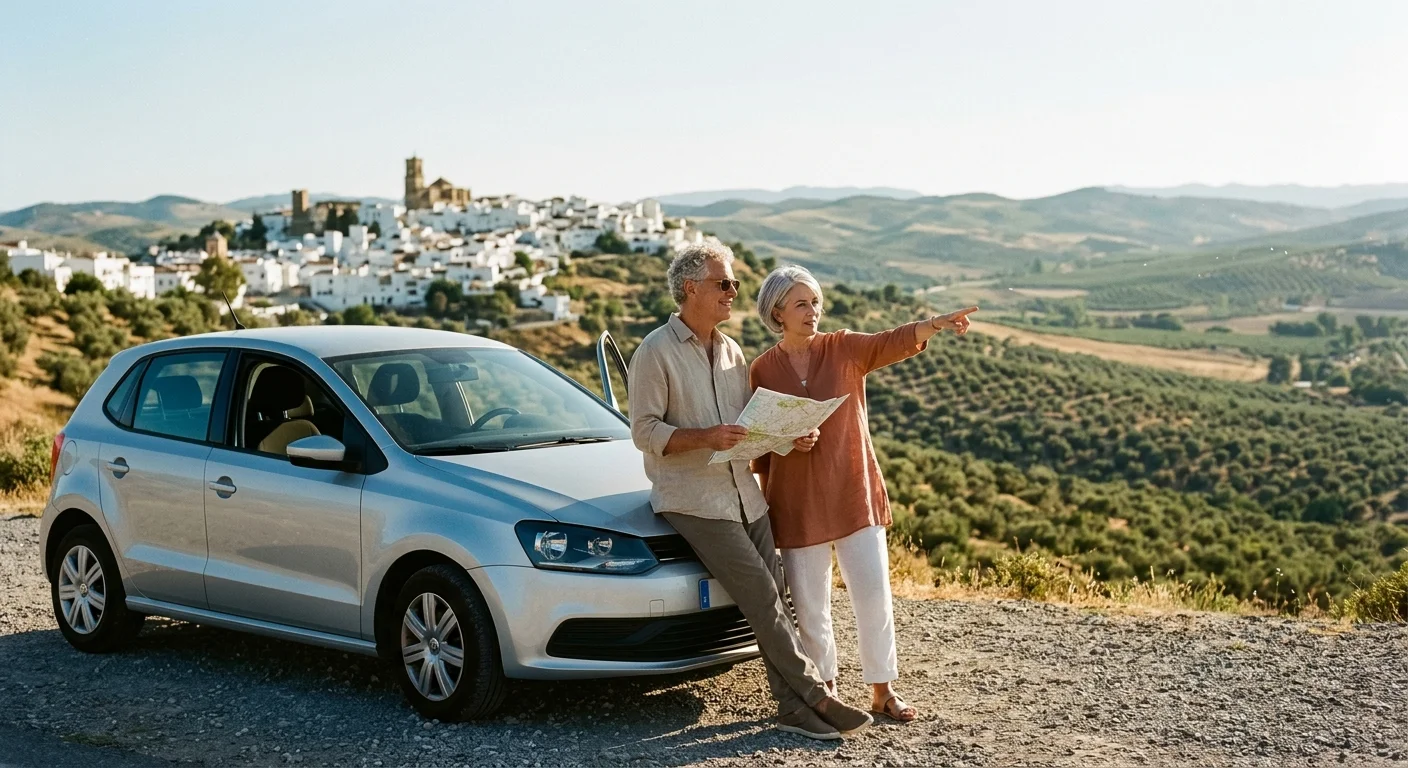
You can navigate the sun-drenched highways of southern Spain with absolute confidence without memorizing hundreds of complex subjunctive conjugations. Mastering a focused 200-word functional verb matrix paired with daily dialect audio drills prepares you to handle any Andalusian road-trip interaction in ninety days.
Whether you are embarking on a quick scenic drive or planning an extended stay like European house-sitting, learning the regional dialect transforms how you experience southern Spain.
Unlike generic language courses that teach formal Castilian grammar rules, this targeted framework trains your ear to decode real Andalusian speech patterns. At 67, your life experience provides the discipline needed to build conversational Spanish over 60 and unlock authentic travel adventures.

Decoding Southern Spanish Phonetics and Senior Cognitive Reserve
Most commercial language programs teach textbook standard Castilian, which relies on crisp consonants and distinct syllable endings. Once you step into a village in Cádiz or Granada, that formal Spanish evaporates into rapid melodic cadences.
Much like navigating trails when walking the Portuguese Camino on a budget, mastering local nuances on the Iberian Peninsula boosts self-reliance and peace of mind.
Andalusian speakers routinely drop syllable-final and word-final consonants, turning familiar vocabulary into compact bursts of sound. Syllable-final /s/ softens into an aspirated breath, transforming los amigos into loh amigo’ or lo’ amigo’.
Locals also omit intervocalic /d/ sounds in everyday speech. A word like cansado becomes cansao, and todo turns into to’.
Failing to train for these phonetic shifts creates unnecessary confusion at highway toll booths and fuel stations. Learning these specific dialect shifts provides the foundation of practical Spanish for senior travelers.
Acquiring this regional listening acuity delivers profound neurological benefits for older adults. Engaging in adult second-language learning stimulates prefrontal cortex networks and strengthens neuroplasticity.
Clinical studies led by Dr. Ellen Bialystok demonstrate that bilingual practice delays the onset of dementia symptoms by 4 to 5.1 years. Regular auditory processing exercises create resilient neural pathways that protect your long-term cognitive health.
According to research highlighted by the National Institute on Aging, challenging your brain with novel cognitive tasks actively supports healthy brain function as you age. Your road-trip preparations double as an invigorating workout for your working memory.
“It is never too late to be what you might have been.” — George Eliot
Approaching dialect training with intention transforms an intimidating road trip into a celebration of lifelong learning. You do not need childlike fluency; you simply need auditory recognition to engage your surroundings.
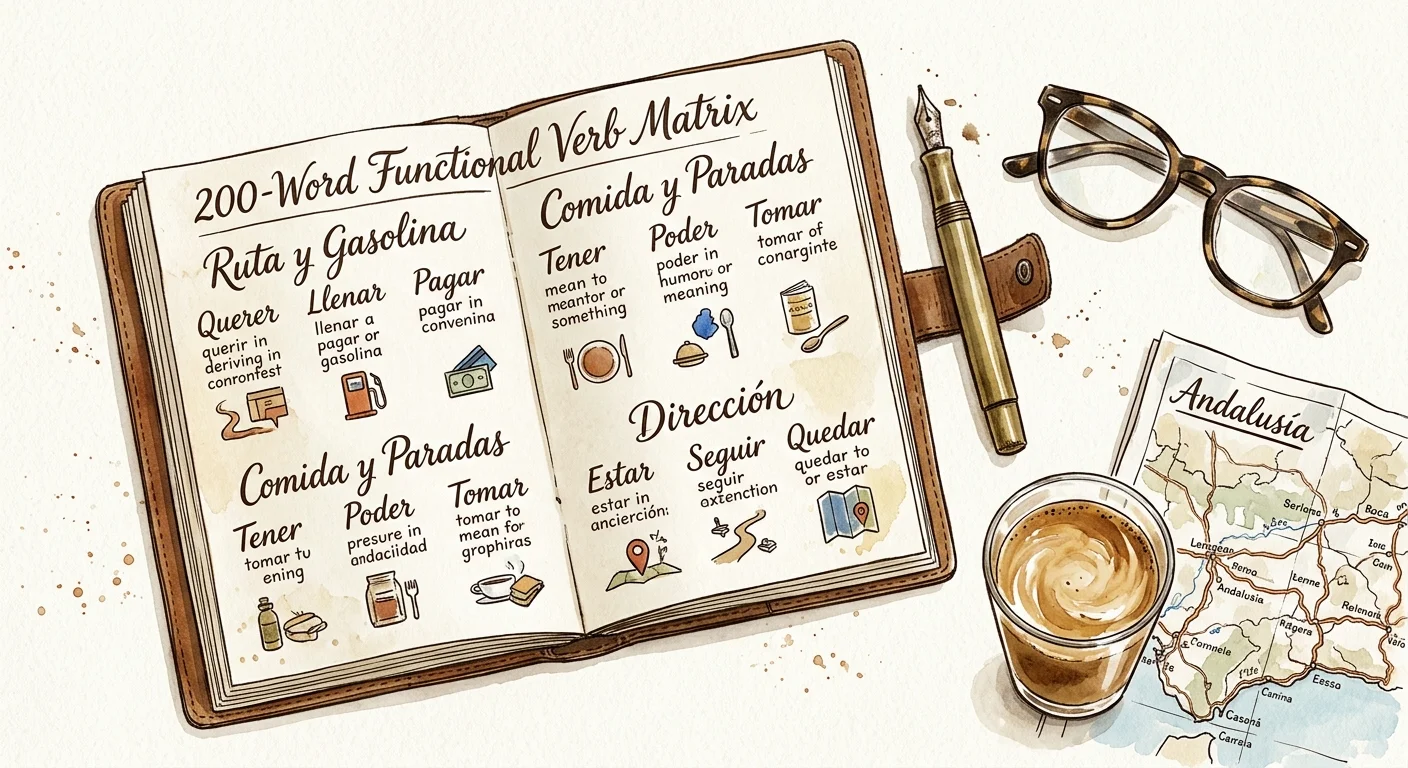
The 200-Word Functional Matrix: Prioritizing Survival Verbs Over Grammar
Standard language curricula burden learners with dozens of verb tenses, including complex subjunctive forms you will never use at an Andalusian service plaza. Independent driving demands immediate, practical utility rather than poetic syntax.
Aligning your travel goals with curated retirement bucket list themes can keep language acquisition exciting and purposeful.
Approaching language acquisition as mastering a new skill allows you to prioritize practical conversational utility over exhaustive grammatical perfection.
The 200-word functional matrix operates on the Pareto principle, focusing on high-frequency verbs that control 80 percent of real-world travel interactions. By pairing present-tense root verbs with auxiliary modals, you bypass hundreds of conjugate variations.
Mastering modal verbs such as querer (to want), poder (to be able), and necesitar (to need) allows you to express nearly any request. Combine the modal with an infinitive to produce effortless, polite demands.
Focus your first thirty days of study on these essential functional navigation verbs:
- Aparcar (to park): ¿Puedo aparcar el coche aquí hasta las ocho? (Can I park the car here until eight?)
- Girar (to turn): Necesito girar a la izquierda en la siguiente rotonda. (I need to turn left at the next roundabout.)
- Seguir (to continue): ¿Debo seguir recto hacia la autovía? (Should I continue straight toward the highway?)
- Perderse (to get lost): Estoy perdido; busco la carretera hacia Arcos. (I am lost; I am looking for the road to Arcos.)
- Cruzar (to cross): ¿Por dónde puedo cruzar el puente viejo? (Where can I cross the old bridge?)
When dining or shopping in white-hill villages, transactional verbs keep exchanges polite, quick, and stress-free. Southern hospitality welcomes genuine effort, especially when you communicate clearly.
- Cobrar (to charge/bill): ¿Me cobra, por favor? (Can you bill me, please?)
- Costar (to cost): ¿Cuánto cuesta el menú del día? (How much does the daily menu cost?)
- Poner (to serve/put): ¿Me pone una copa de vino tinto y una tapa? (Will you serve me a glass of red wine and a tapa?)
- Llevar (to take/carry): ¿Lleva jamón este plato? (Does this dish contain ham?)
- Pagar (to pay): Quiero pagar con tarjeta de crédito si es posible. (I want to pay with a credit card if possible.)
Your matrix must also account for southern Spain’s colorful regional slang. Understanding these local expressions helps you follow bar banter and village chats.
- Quillo / Quilla: Short for chiquillo, used universally across Seville and Cádiz like “mate” or “friend.”
- Miarma: Literally meaning “my soul” (mi alma), heard constantly across Seville markets as an affectionate address.
- Noniná: A famous triple-negative contraction (no ni ná) meaning “without a doubt” or “obviously.”
Automobile maintenance vocabulary prevents small mechanical surprises from ruining your scenic itinerary. Familiarize yourself with basic terms before picking up your rental keys.
- Echar (to put in/fill): Por favor, ponga cincuenta euros de gasóleo. (Please put fifty euros of diesel.)
- Funcionar (to work): El aire acondicionado no funciona bien. (The air conditioning is not working properly.)
- Llenar (to fill): ¿Puede llenar el depósito por completo? (Can you fill the fuel tank completely?)
- Revisar (to check): Necesito revisar la presión de los neumáticos. (I need to check the tire pressure.)
- Averiarse (to break down): El motor se ha averiado cerca de la salida doce. (The engine has broken down near exit twelve.)
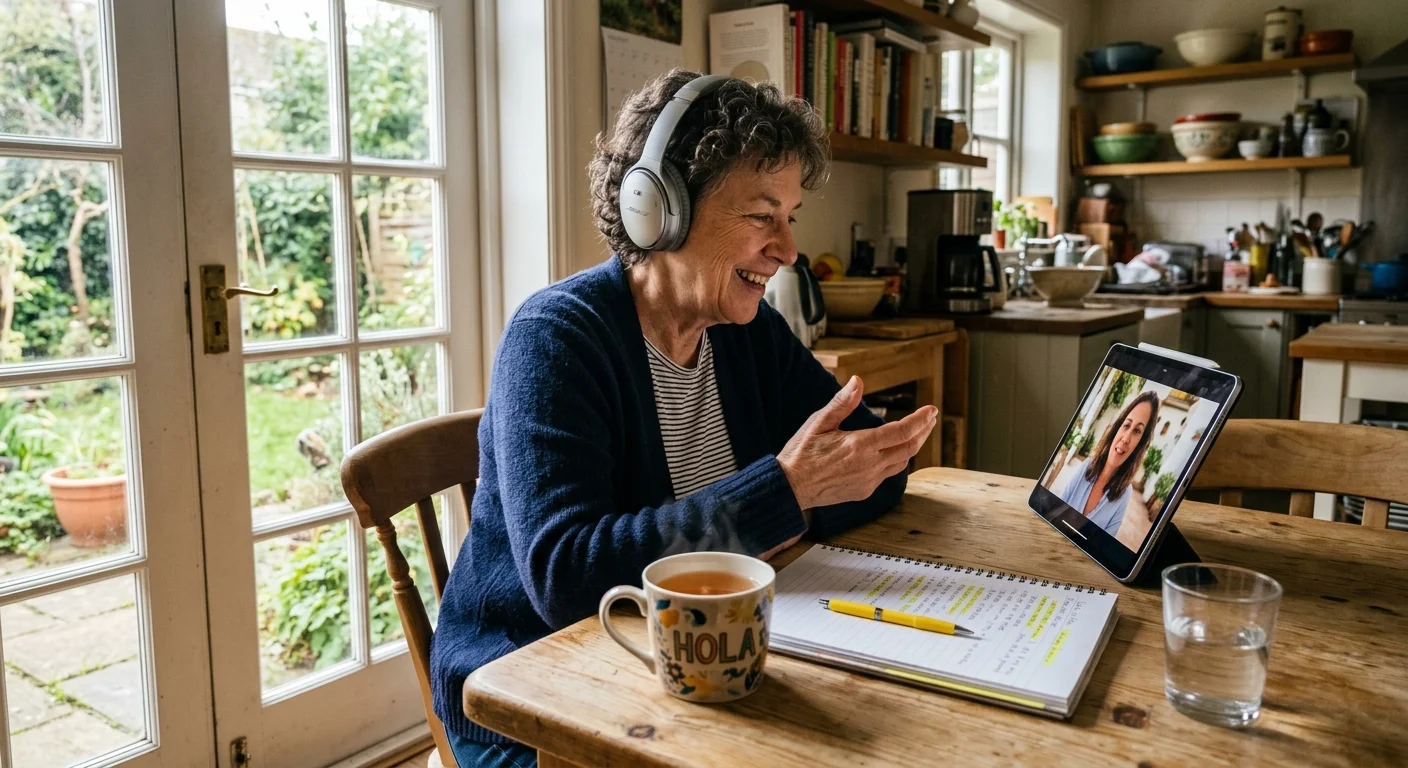
Comprehensible Input Apps Versus 1-on-1 iTalki Tutors
Senior independent travelers often struggle to choose between self-paced mobile apps and live human tutoring. Evaluating your options requires looking directly at cost, acoustic authenticity, and conversational speed.
Leveraging online classrooms and apps is a fantastic way to sharpen your digital skills in retirement while mastering a new language.
Comprehensible input apps, such as Dreaming Spanish, rely on extensive video immersion without explicit grammar memorization. These tools expose your ear to natural syntax, but they rarely reflect southern Andalusian accents.
Private online tutoring through platforms like iTalki allows you to filter specifically for native instructors from Seville, Málaga, or Granada. A tailored tutor designs drills directly around road navigation and local café culture.
| Learning Platform | Dialect Customization | Cost per Hour | Active Output Latency | Road-Trip Relevance Score |
|---|---|---|---|---|
| Dreaming Spanish (Premium) | Low (Predominantly Standard Peninsular / Latin American) | $12.00 / month flat subscription | Delayed (Passive listening for first 100+ hours) | 6 / 10 |
| LingQ Peninsular Audio | Low (Standardized European Castilian texts) | $13.00 / month flat subscription | Minimal (Focuses on reading and vocabulary tracking) | 5 / 10 |
| iTalki Native Andalusian Tutor | Absolute (Filter specifically for Cádiz, Seville, or Granada) | $14.00 – $22.00 / hour | Immediate (Live real-time vocal feedback from Day 1) | 10 / 10 |
A hybrid training approach yields the fastest results for an independent road trip. Use comprehensible input video materials for low-stress passive listening while resting at home.
Schedule two 45-minute iTalki sessions per week with a native Andalusian instructor. Instruct your tutor to roleplay parking emergencies, hotel check-ins, and fuel purchases while speaking at natural southern speed.
This combined approach keeps learning Spanish fast for Spain trip preparation realistic and affordable. You eliminate academic perfectionism while establishing real vocal muscle memory.
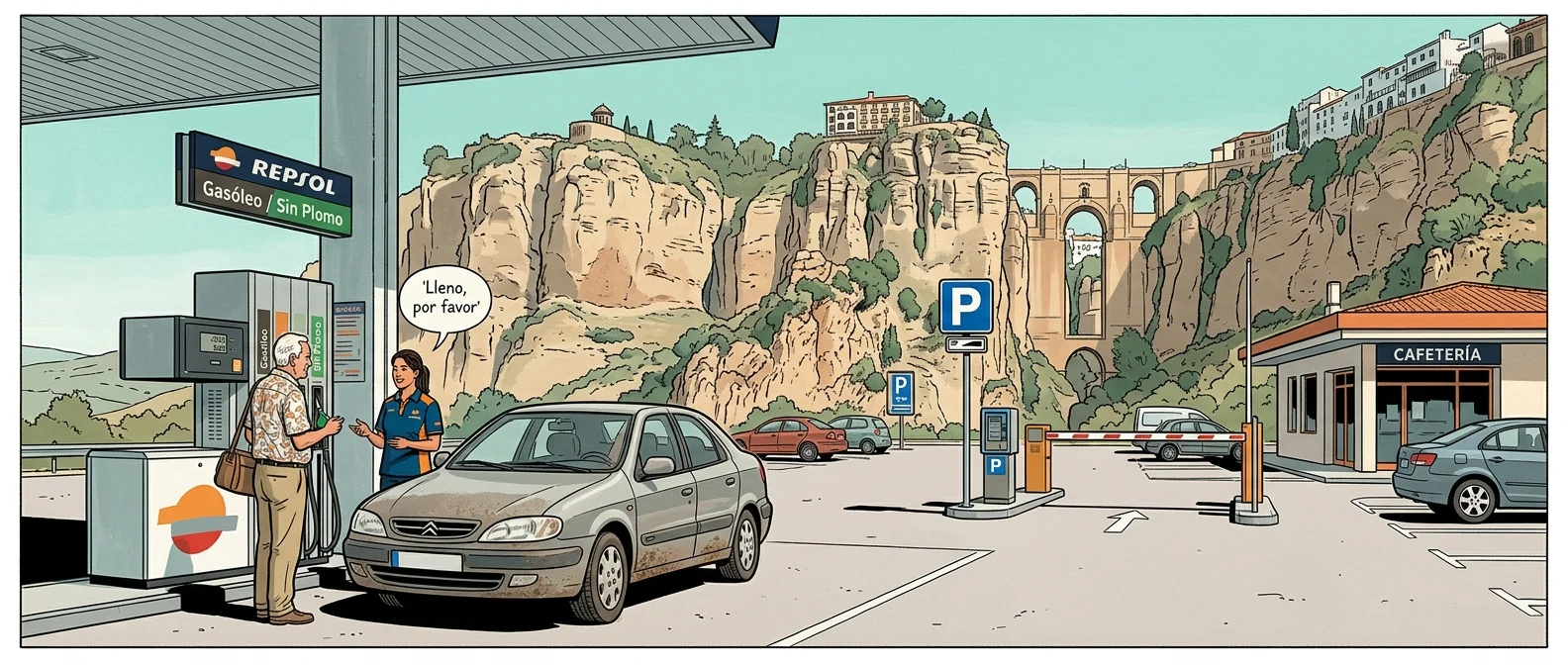
Worked Road-Trip Scenario: Fueling and Parking in Ronda
Consider this concrete scenario on the morning of October 14. You navigate your rental compact car toward the historic town of Ronda, winding along the scenic A-374 highway.
Navigating local services abroad can seem intimidating, but stepping outside your comfort zone turns routine travel chores into rewarding cultural interactions.
At 10:15 AM, your low-fuel indicator flashes on the dashboard. You pull into a Repsol service station outside the city center to purchase fuel.
The pump attendant approaches your driver-side window. Rather than standard textbook Spanish, you hear real Andalusian phonetics.
The attendant asks: “¡Hola, quillo! ¿Qué le ponemo’ al coche?” (Hello! What are we putting in the car?)
You reply using your matrix verbs: “Buenos días. Por favor, ponga cuarenta litros de gasóleo normal.” (Good morning. Please put forty liters of regular diesel.)
The fuel price displays €1.68 per liter. Your total bill for forty liters reaches exactly €67.20.
You offer your credit card and ask: “¿Puedo pagar con tarjeta aquí?” (Can I pay with a card right here?)
The attendant nods, processing the portable reader: “Po’ claro, miarma. Pasa la tarjeta por aquí.” (Of course. Tap your card right here.)
Twenty minutes later, you arrive at the underground Parking Plaza del Socorro in central Ronda. The automated entry barrier presents a flashing yellow warning light.
The parking attendant steps out of the booth, speaking with dropped consonants: “El párkin’ ‘tá casi lleno, caballero. Solo queda sitio al fondo a la ‘hquierda.” (The parking lot is almost full, sir. Space remains only at the back to the left.)
Because you practiced consonant drop drills, you decode the directions immediately. You confirm: “Entendido. Giro a la izquierda al fondo. ¿Cuánto cuesta la hora?” (Understood. I turn left at the back. How much per hour?)
The attendant answers: “Son dos euro’ con cuarenta céntimo’ la hora.” (€2.40 per hour). You park safely, pay the machine three hours later, and explore the dramatic Tajo gorge without anxiety.
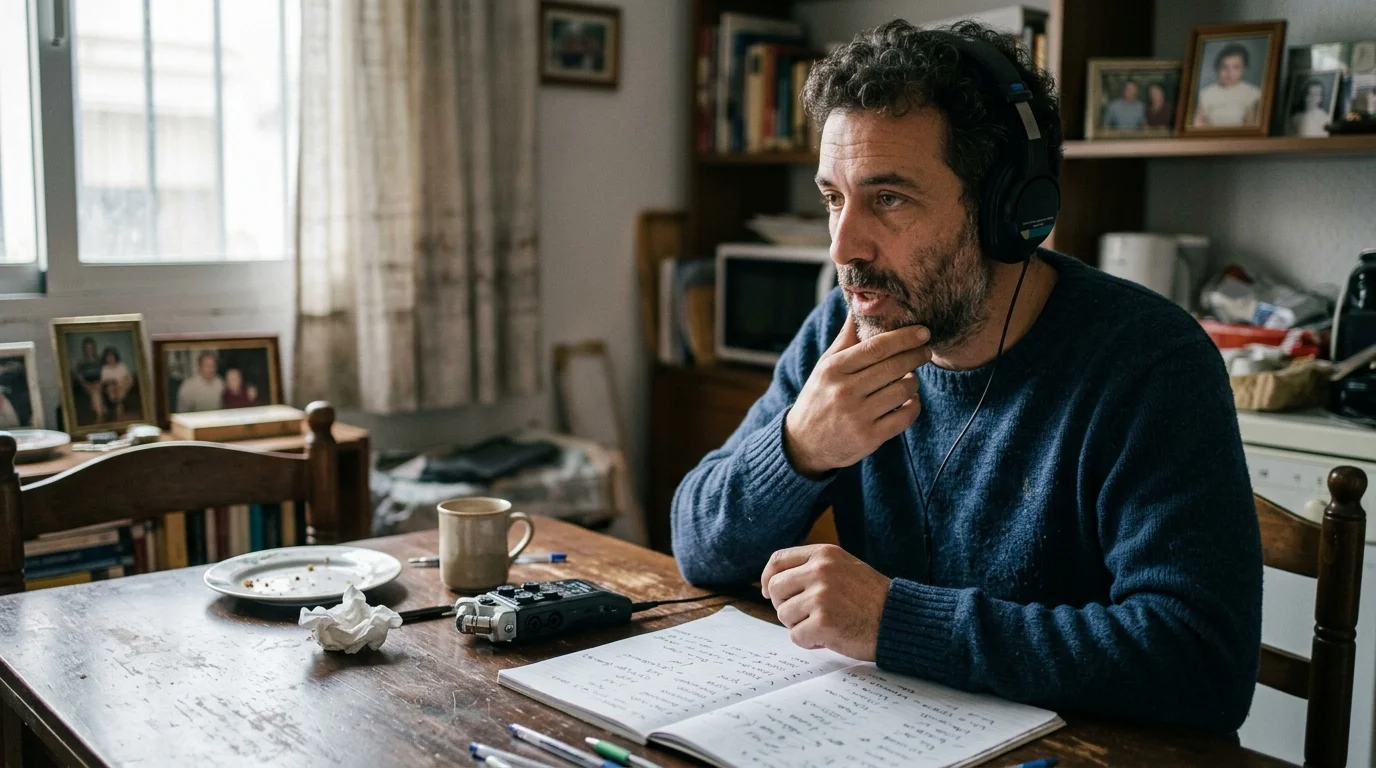
The High-Repetition Audio Drill Protocol for Rapid Processing
High-repetition audio drills build auditory processing speed far better than quiet reading. Spaced acoustic repetition stimulates prefrontal auditory networks, training your brain to parse rapid speech without translating back into English.
Dedicate twenty-five uninterrupted minutes each morning to this focused listening regimen. Use a pair of noise-canceling headphones to capture subtle phonetic aspirations.
Follow this exact four-step daily audio drill sequence:
- Controlled Speed Auditory Mapping (5 Minutes): Play a recorded Andalusian travel dialogue at 0.85x speed using VLC Media Player or Audacity. Focus entirely on identifying dropped final consonants and omitted /d/ sounds without reading text.
- Shadowed Vocal Repetition (10 Minutes): Increase playback speed to normal 1.0x velocity. Speak each phrase aloud a fraction of a second behind the native speaker, mimicking rhythm, pitch, and elisions.
- Acoustic Overdrive Conditioning (5 Minutes): Accelerate the same audio tracks to 1.15x playback speed. Forcing your brain to parse high-velocity input makes regular Andalusian conversation feel manageable on the road.
- Freeform Vocal Retrieval (5 Minutes): Switch off all audio equipment. Set a timer and describe your upcoming driving day aloud in Spanish, utilizing at least six verbs from your matrix.
Consistent daily acoustic training prevents conversational freezing when you meet locals. Muscle memory takes over, allowing you to respond smoothly during real interactions.
Record your voice journaling sessions once a week on your smartphone. Comparing week one to week twelve offers clear proof of your growing speech fluidity.
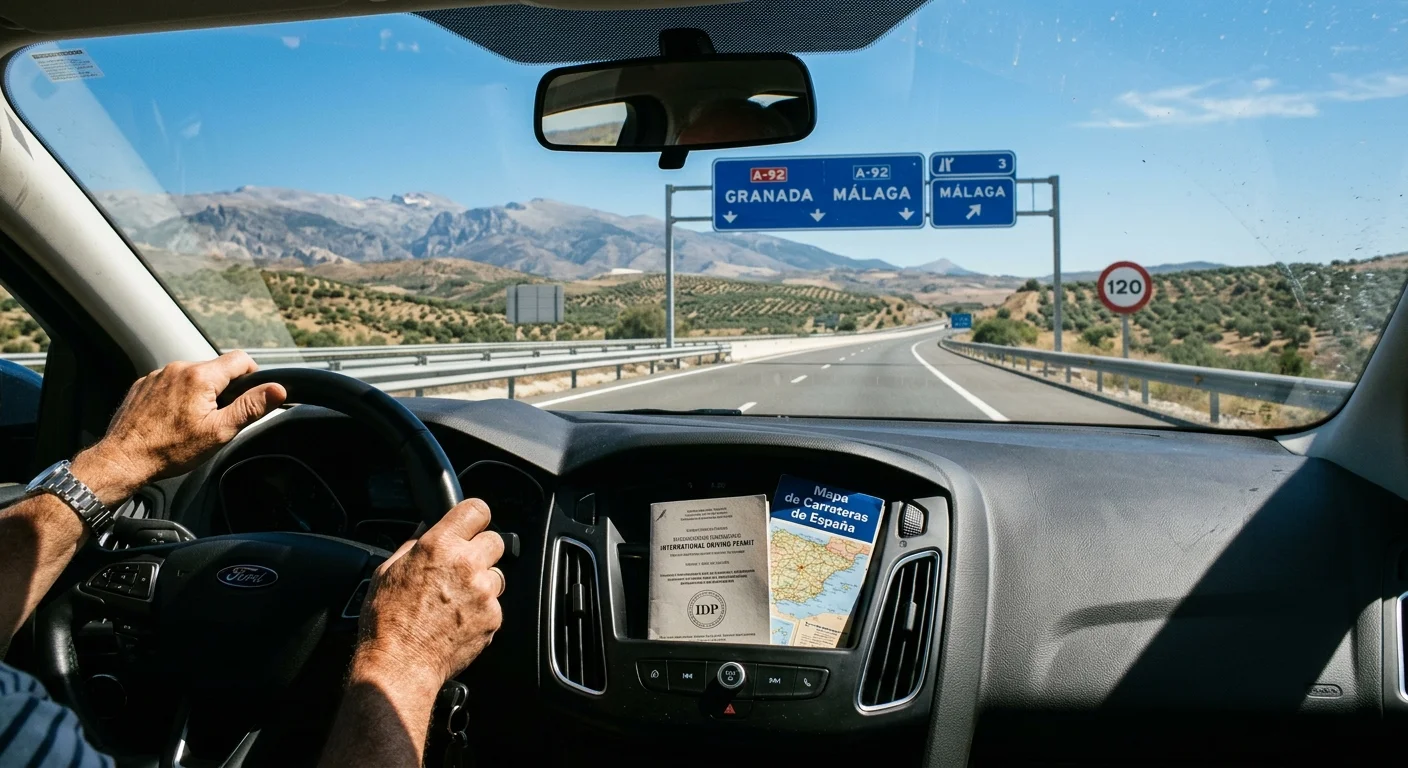
Navigating Spanish Travel Logistics: Visa Rules and Driving Realities
Executing an independent driving trip across southern Spain requires understanding current European entry protocols. Americans can explore Spain without a visa for up to 90 days within any rolling 180-day window under Schengen Area rules.
This 90-day allowance accommodates a comprehensive language study period and a long road adventure. Keep strict count of your travel dates to avoid overstaying your Schengen allowance.
Travelers must also comply with the European Travel Information and Authorisation System (ETIAS) registration before boarding flights. The online filing fee is €20 for adult travelers.
However, travelers aged 70 and older receive an age-based waiver, making the ETIAS application completely free. At 67, you pay the standard €20 registration fee, which grants authorization valid for three consecutive years.
Many active older adults fall in love with southern Spain and choose to extend their stay through retirement. If you decide to reside in Andalusia longer than 90 days, you must secure a Non-Lucrative Visa (NLV).
The Spanish government bases financial qualification for the NLV on the IPREM economic indicator, currently set at €600 per month. A primary applicant must prove passive income or verified retirement assets equal to 400 percent of the IPREM.
This threshold requires demonstrating guaranteed monthly income of €2,400 (€28,800 annually). Adding a spouse requires an additional €600 per month (€7,200 annually) in verifiable income.
While specialized group travel organizations like Road Scholar offer excellent structured tours, independent driving unlocks secluded regions often missed by bus itineraries. You can stop at olive oil mills in Jaén or coastal fish shacks in Barbate whenever you please.
Equip yourself with an International Driving Permit (IDP) alongside your valid state driver’s license before departing the United States. Secure an automated electronic toll device (Telepeaje / Bip&Drive) from your car rental desk to breeze through highway plazas.
Frequently Asked Questions
Can I really become conversational in Spanish at age 67 in just 90 days?
Yes, because targeted functional conversational fluency focuses on practical communication rather than total grammatical mastery. By memorizing 200 high-frequency verbs and training your ear with audio drills, you can handle road travel effortlessly.
Why focus specifically on Andalusian Spanish instead of standard Castilian?
Andalusian Spanish features dropped consonants and distinct regional contractions that sound completely different from standard textbook recordings. Training your ear to decode these local phonetic shifts prevents confusion during road trips in southern Spain.
Do I need to learn complex subjunctive verb forms for a three-week road trip?
No, you do not need the subjunctive mood for basic independent travel. Combining modal verbs like necesitar, querer, and poder with infinitive verbs communicates your needs politely and effectively.
What are the entry and visa rules for senior American travelers in Spain?
U.S. citizens can travel visa-free in Spain for up to 90 days within any 180-day window under Schengen regulations. Travelers must register with ETIAS; the €20 application fee applies until age 70, when the fee is waived.
Disclaimer: This article is for informational and inspirational purposes. Life decisions are deeply personal, and we encourage readers to pursue their dreams while considering their unique circumstances, health, and financial situation.