
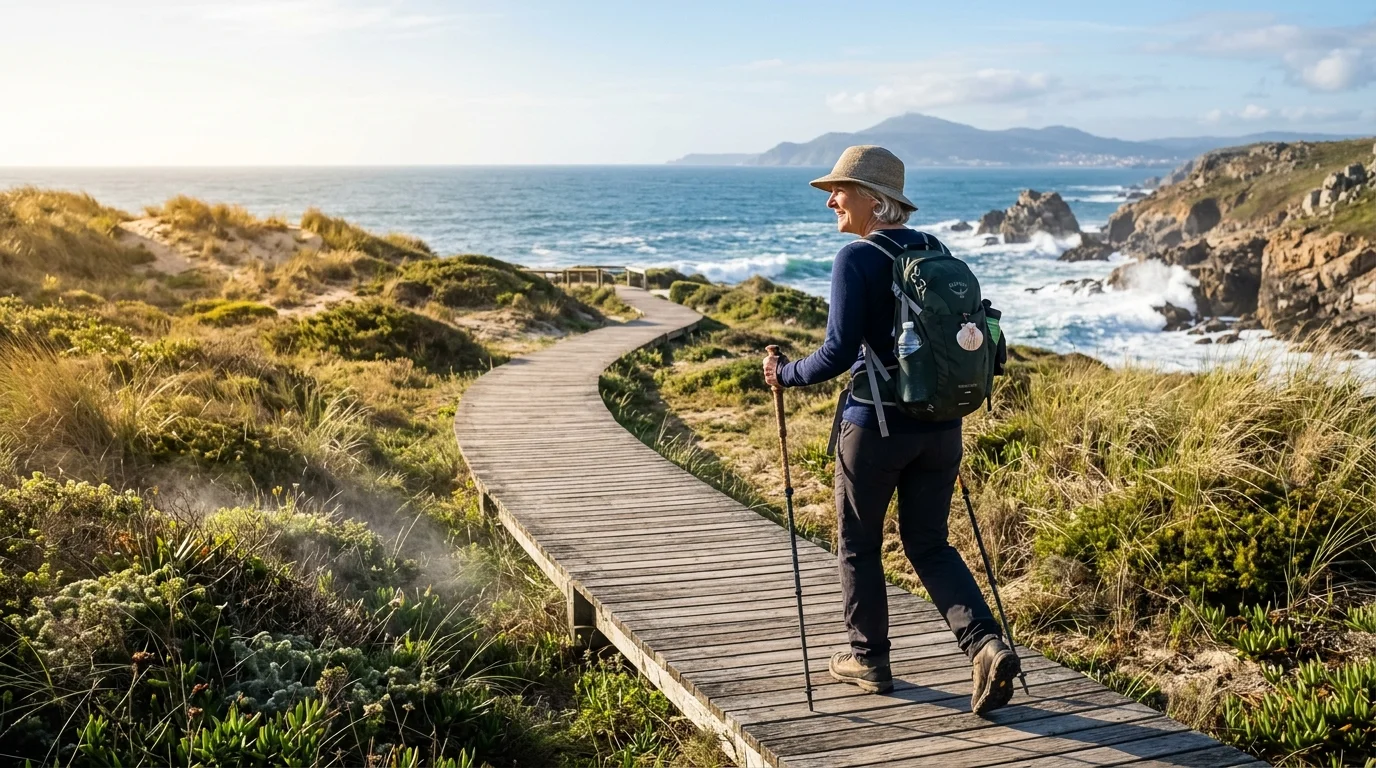
You can walk the ancient shores of the Portuguese Camino without exhausting your savings or your joints. A solo retirement adventure along the Atlantic coast remains completely achievable on a modest monthly income of $2,200 when you keep your daily spending under $75.
Proving that walking holidays offer some of the most rewarding budget retirement bucket list adventures, this route combines rich culture with modest daily costs.
Standard guidebooks push aggressive fifteen-mile days carrying heavy packs, but your path requires a gentler strategy. Capping daily walks at nine miles and booking scheduled luggage transport lets you protect your physical stamina while securing budget-friendly private hostel beds every afternoon.
This practical guide shows solo women over sixty how to turn a dream pilgrimage into an affordable reality through disciplined planning, smart lodging, and seamless pack transfers.
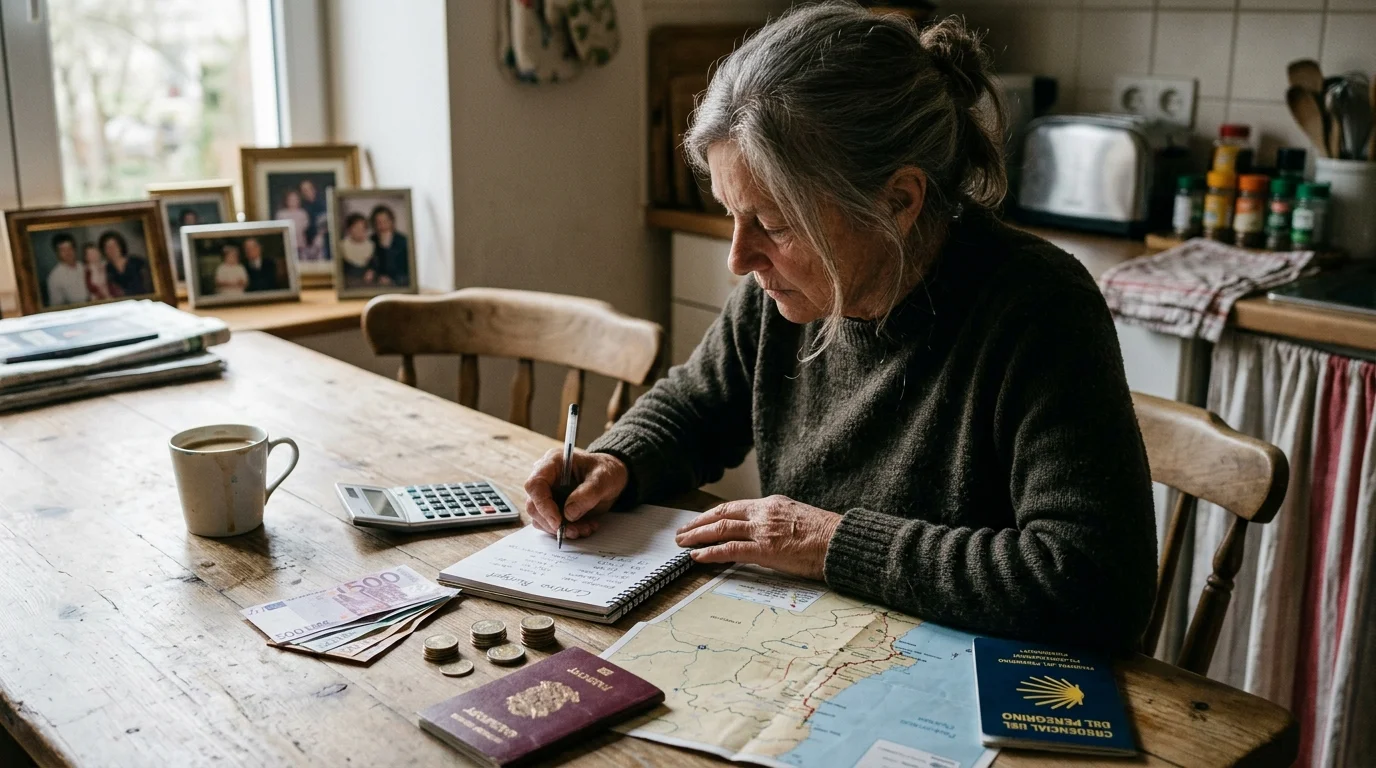
The $2,200 Monthly Budget: Funding Your Solo Camino
A fixed retirement income should fuel your wanderlust rather than restrict it. When your total monthly revenue sits at $2,200 from Social Security or a modest pension, you receive roughly $73.33 every single day.
If you are considering sharing the country with family members later, check out our budget blueprint for exploring Portugal across multiple generations.
Daily life in the United States often drains that money on utility bills, groceries, and car insurance. Moving your daily routine to northern Portugal and Galicia shifts those same dollars directly into cultural immersion and ocean views.
Managing your pilgrimage under a strict $75 daily ceiling creates financial safety without depriving you of comfort. Your money buys fresh local food, a clean bed, and reliable door-to-door transit for your heavy gear.
The overall camino de santiago cost over 60 stays remarkably low because walking serves as your daily entertainment. You do not purchase expensive museum passes, theater tickets, or car rentals while on the path.
To walk for three weeks without financial stress, establish clear allocations for every single euro:
- Reserved private albergue dorm bed: €20.00 to €22.00 ($21.60 to $23.75) per night
- Stage luggage transfer fee: €7.00 to €8.00 ($7.55 to $8.65) per morning
- Pilgrim dinner menu (two courses, bread, wine): €12.00 to €14.00 ($13.00 to $15.10)
- Bakery breakfast and espresso: €3.50 to €4.50 ($3.80 to $4.85)
- Trailside snacks, fresh fruit, and mineral water: €4.00 to €5.00 ($4.30 to $5.40)
- Daily emergency contingency reserve: €15.00 ($16.20) for occasional private rooms
Following this precise framework keeps your routine daily baseline near €50, or roughly $54. This leaves you an extra $21 daily buffer to absorb currency fluctuations or spontaneous cafe stops.
Lodging Realities: Private Albergues vs. Municipal Hostels
Selecting the right roof over your head dictates whether your budget succeeds or fails. Many first-time walkers assume municipal hostels provide the best option simply because their beds cost only €10 to €15 per night.
Living out of a small pack also mirrors the benefits of embracing minimalism in retirement, proving how few possessions you truly need to thrive.
If you want to linger in Europe before or after your walk without draining your savings, zero-rent European house-sitting provides an excellent strategy to keep accommodation costs near zero.
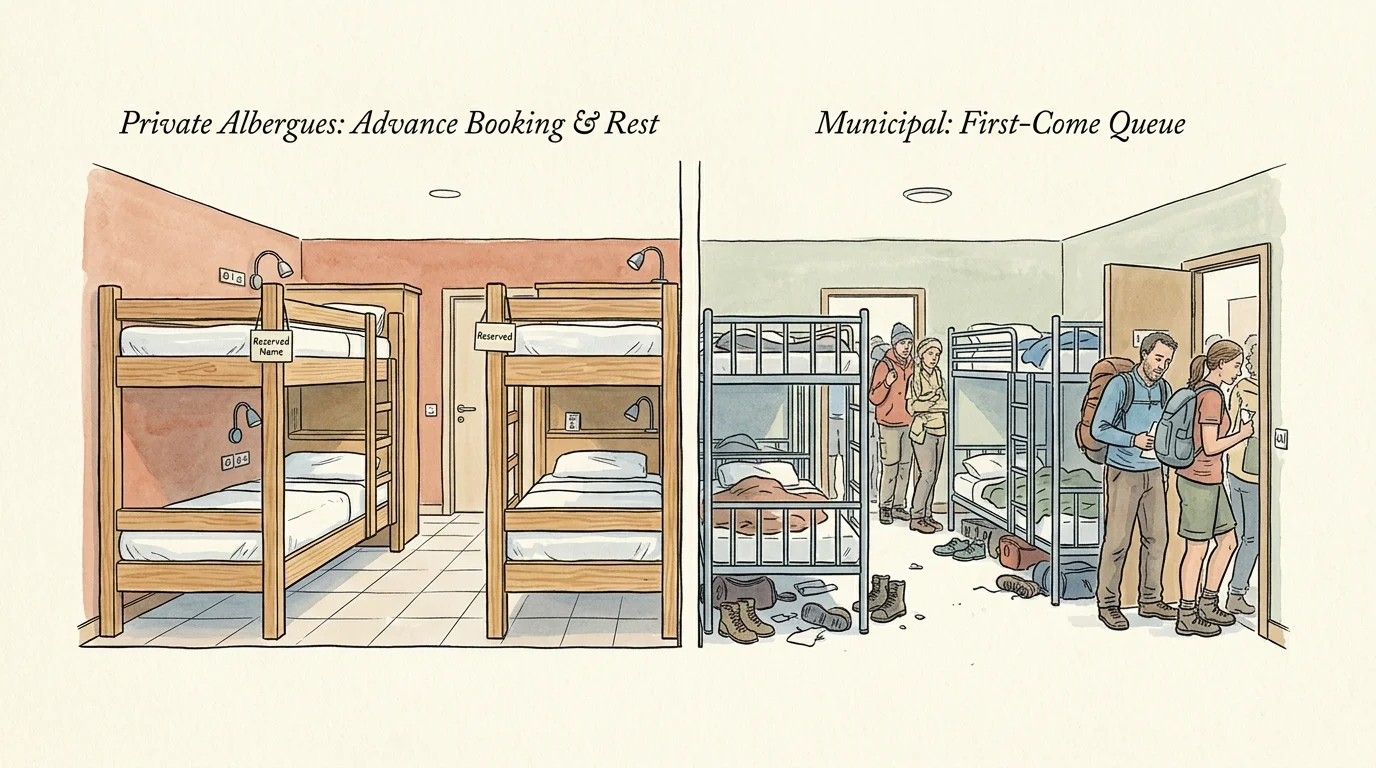
Municipal albergues in Portugal and public hostels operated by the Xunta in Spain refuse advance reservations. They award beds strictly on a first-come, first-served basis to walkers who arrive on foot.
Crucially, municipal hostels do not accept bags dropped off by commercial transport companies. Backpack delivery requires a staffed reception desk willing to accept liability for luggage left in public entryways.
Private albergues solve this problem entirely by charging between €15 and €25 per night. They permit advance booking via WhatsApp or online reservation portals weeks before your flight departs.
These private hostels welcome luggage courier services every single afternoon. You can walk unburdened, knowing your belongings wait safely behind the reception desk when you arrive.
Private hostels also feature smaller dormitories, often housing four to eight beds instead of sixty bunks. You experience far less middle-of-the-night noise, ensuring restful sleep that speeds your physical recovery.
When you need total privacy, rural pensións and small family-run hostals offer single rooms for €35 to €55. Balancing two nights in a private albergue with one night in a private room easily fits your $75 cap.
Comparing Luggage Transfer Services: Pilbeo, Tuitrans, and Correos
Carrying a fifteen-pound rucksack strains aging shoulder joints, spine discs, and knee cartilage. Forwarding your main duffel bag transforms your pilgrimage from an endurance trial into an energizing coastal stroll.
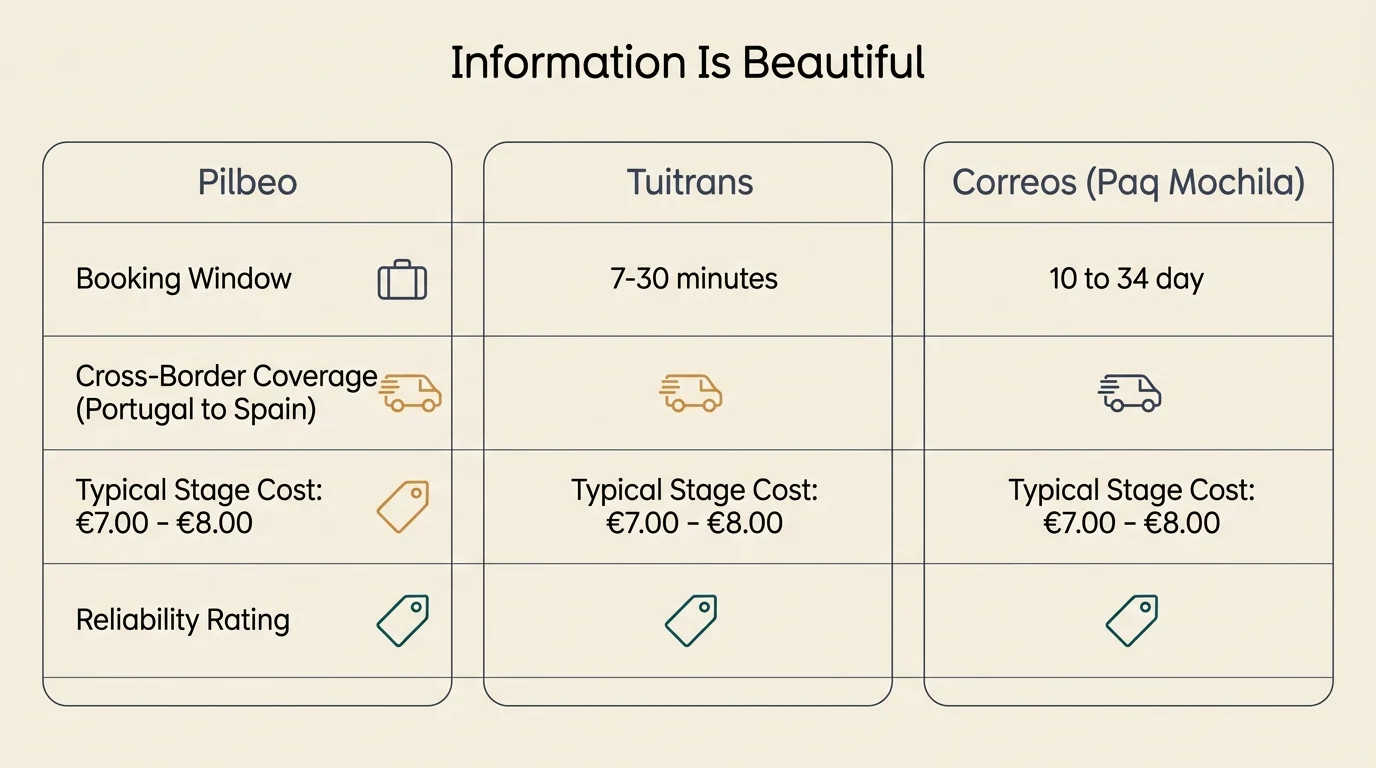
Three established operators manage backpack transfers along the Portuguese Coastal route. Each service charges between €6 and €8 per stage, delivering bags directly between registered accommodations.
| Service Operator | Cost Per Stage | Weight Limit | Daily Morning Cutoff | Typical Delivery Time | Route Coverage |
|---|---|---|---|---|---|
| Pilbeo | €7.00 – €8.00 | 20 kg (44 lbs) | 8:00 AM | 2:00 PM – 3:00 PM | Porto through Santiago |
| Tuitrans | €7.50 – €8.50 | 18 kg (40 lbs) | 8:30 AM | 2:30 PM | Porto / Valença to Santiago |
| Correos (Paq Mochila) | €6.50 – €7.50 | 15 kg (33 lbs) | 8:00 AM | 2:30 PM | Galician border to Santiago |
Pilbeo offers an intuitive smartphone application that tracks your bag using scannable luggage tags. You receive notifications the moment your bag leaves one desk and arrives at your destination.
Tuitrans specializes in cross-border logistics between northern Portugal and Galicia. Their dispatchers communicate effectively through WhatsApp, making last-minute itinerary adjustments straightforward if you need a rest day.
Spain’s national postal service, Correos, runs its renowned Paq Mochila service across the Galician stages. Their staff knows every remote hamlet and village guesthouse between A Guarda and Santiago.
To use these services smoothly, stick to three non-negotiable operational rules every morning:
- Attach a laminated luggage tag displaying your full name, telephone number, and credential registration code.
- Place your labeled bag in the hotel or hostel lobby beside the designated transport sign by 8:00 AM.
- Confirm your destination accommodation address with the courier company by 8:00 PM the previous evening.
Investing roughly $8 each day in bag transfers represents less than eleven percent of your daily allowance. That modest sum preserves your physical vitality, leaving you fresh to savor local culture every evening.
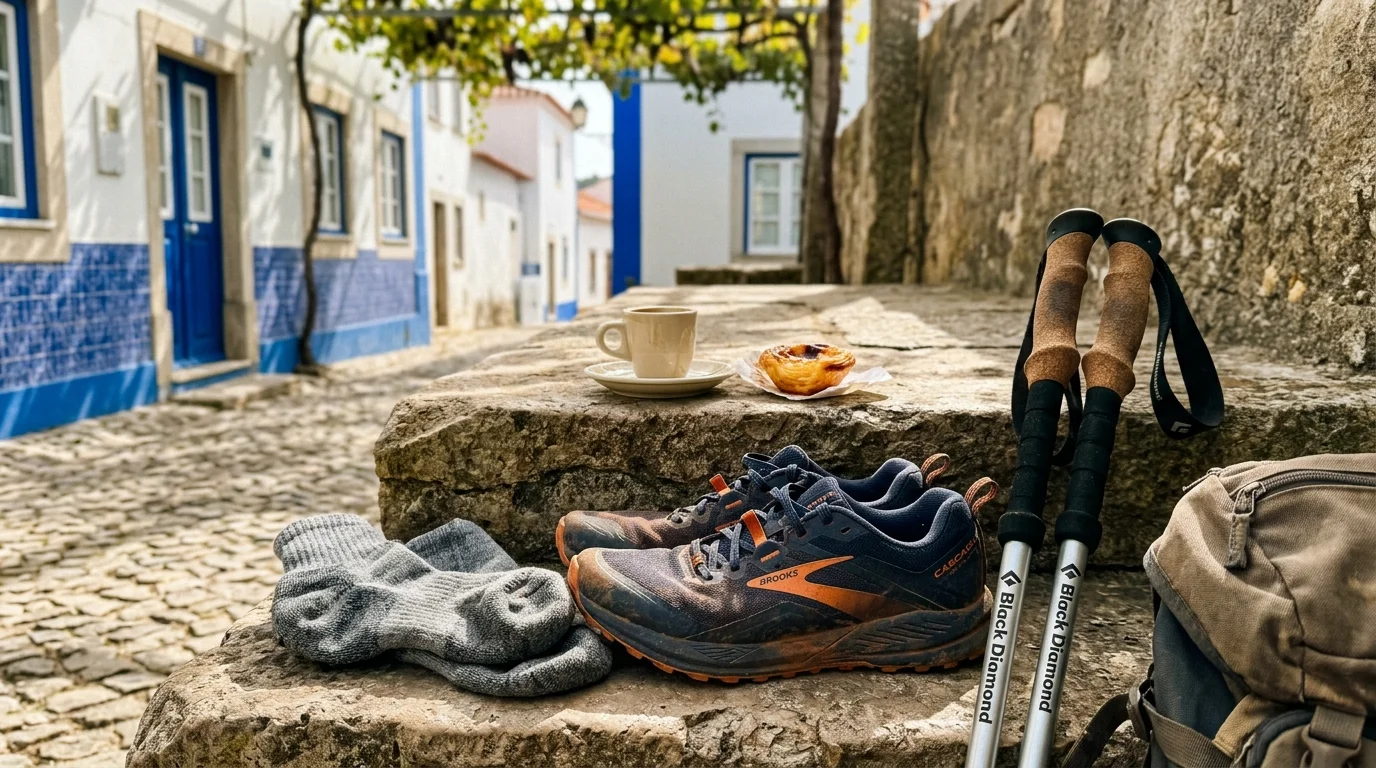
The 9-Mile Pacing Advantage for Solo Walkers Over 60
Most traditional guidebooks break the Portuguese Camino into stages spanning twelve to eighteen miles. That intense pacing forces older walkers to rush through villages and risks overuse injuries.
Taking a balanced, unhurried pace on long trails directly aligns with holistic retirement wellness by protecting both your joints and peace of mind.
Similar gentle pacing strategies also work on the French Way, where walking Sarria to Santiago after joint replacement relies on manageable eight-mile stages and pre-arranged pack transfers.
When walking the portuguese coastal camino senior adventurers discover that capping daily distance at nine miles changes everything. Nine miles requires roughly three to four hours of gentle morning movement at a relaxed pace.
Scientific guidance from the National Institute on Aging emphasizes the importance of pacing, recovery, and regular aerobic activity for older adults maintaining physical stamina. Taking frequent walking breaks preserves musculoskeletal health and prevents chronic inflammation.
Data from the Pilgrim’s Reception Office in Santiago de Compostela proves that walkers over sixty represent roughly twenty percent of all arrivals. You walk alongside thousands of vibrant, like-minded peers who embrace mindful pacing.
Ending your walk before 1:00 PM delivers critical advantages for the solo budget traveler:
- You arrive before the afternoon heat peaks along exposed coastal boardwalks.
- You secure your reserved bed and unpack without fighting crowds at check-in counters.
- You sit down for the traditional midday menu before kitchens close at 3:00 PM.
- You enjoy four full hours of afternoon rest, journaling, or sightseeing along historic village harbors.
A manageable schedule eliminates performance anxiety. If your foot feels tender or you discover a charming cafe overlooking the ocean, you have plenty of time to linger.
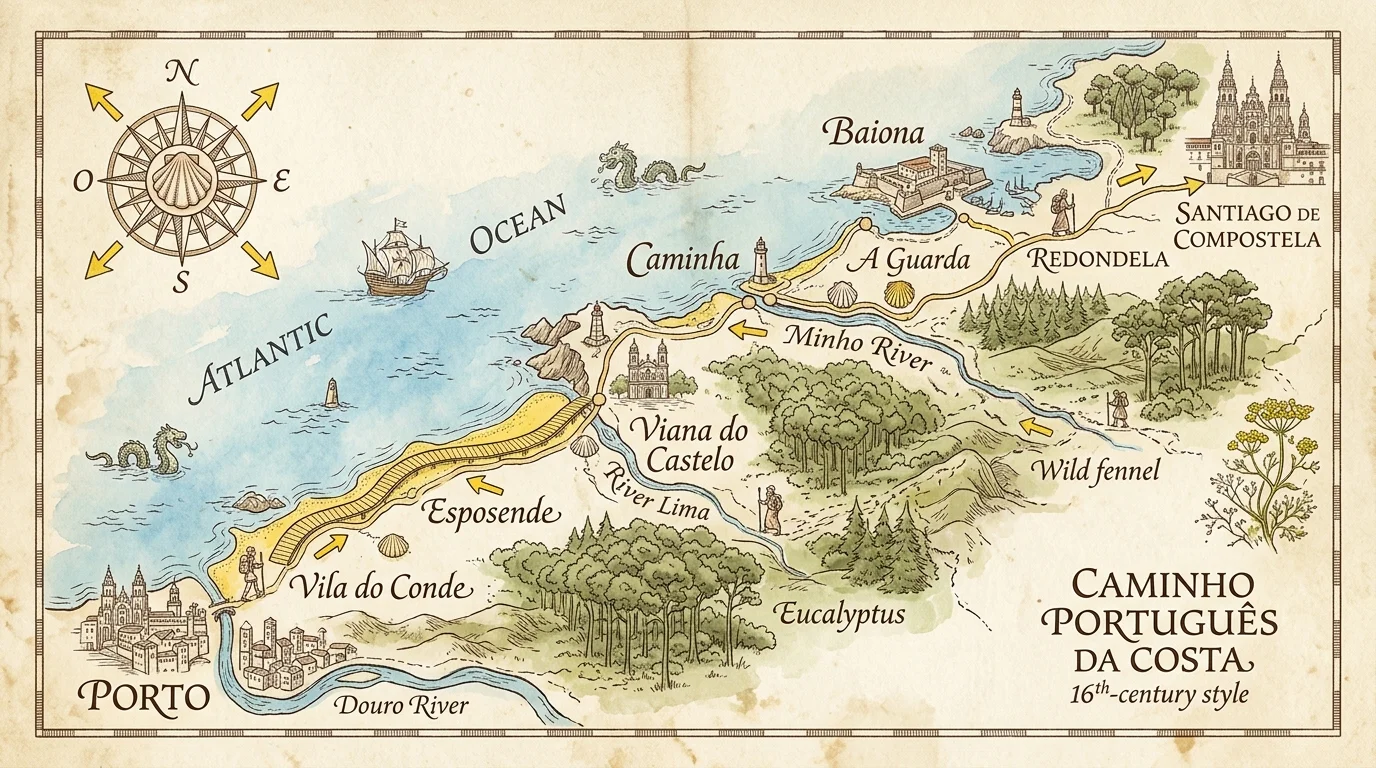
Stage-by-Stage Coastal Itinerary Under 9 Miles Daily
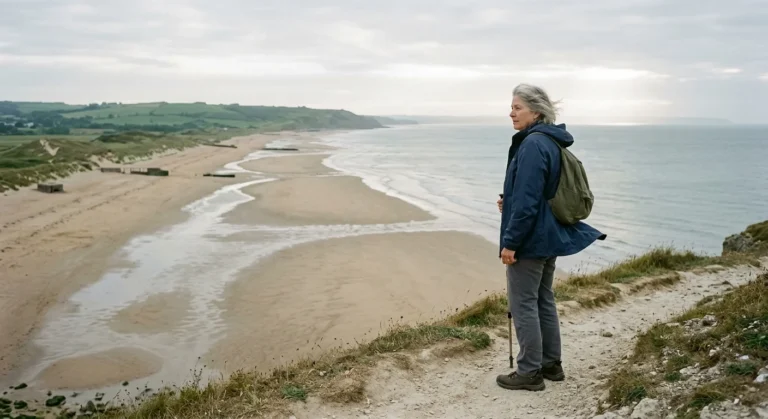
This customized budget solo camino itinerary splits the coastal route into bite-sized segments under nine miles. You follow the flat ocean boardwalks north from Porto before crossing into Spain’s lush Galician hills.
Thoughtful route selection is a fundamental tenet of strategic retirement travel planning that ensures you finish every journey feeling invigorated.
Begin your pilgrimage at the Cathedral of Porto (Sé do Porto) to purchase your official credential for €3. Take the historic metro tram out to Matosinhos to bypass industrial suburbs and start right beside the sea.
- Matosinhos to Labruge (8.5 miles / 13.7 km): Walk along wide wooden boardwalks over coastal sand dunes. Sleep at a cozy private hostel in Labruge just steps from the quiet fishing beach.
- Labruge to Vila do Conde (8.2 miles / 13.2 km): Trace the coastline past historic windmills and small coves. Vila do Conde offers splendid medieval architecture and riverside cafes.
- Vila do Conde to Agucadoura (7.8 miles / 12.5 km): Stroll through the seaside promenade of Póvoa de Varzim into market-garden country. Quiet private rooms here cost well under your budget limit.
- Agucadoura to Esposende (8.9 miles / 14.3 km): Cross the pristine coastal nature reserve of the Cávado River estuary. Esposende features wide pedestrian plazas and affordable seafood bistros.
- Esposende to Castelo do Neiva (8.1 miles / 13.0 km): Transition briefly through peaceful eucalyptus woods before returning to rocky shoreline paths. Enjoy dinner at a traditional family taverna.
- Castelo do Neiva to Viana do Castelo (8.7 miles / 14.0 km): Cross the Eiffel-designed iron bridge over the Lima River into an iconic cultural city. Rest in a comfortable private hostel near the historic center.
- Viana do Castelo to Carreco (6.8 miles / 11.0 km): Take an easy, short stage following coastal lanes north. Carreço provides quiet solitude and dramatic views of ocean waves crashing on granite cliffs.
- Carreco to Vila Praia de Ancora (8.4 miles / 13.5 km): Walk between coastal mountain slopes and sandy Atlantic bays. Ancora offers bustling bakeries and an exceptionally friendly pilgrim hostel community.
- Vila Praia de Ancora to Caminha (5.6 miles / 9.0 km): Stroll an easy morning stage into Portugal’s northern border town on the Minho River. Savor fresh pastries in Caminha’s historic main square.
- Caminha to A Guarda (5.2 miles / 8.4 km): Board the passenger ferry across the international river boundary into Spain. Check into a coastal hostel in A Guarda and explore the ancient Celtic ruins at Santa Trega.
- A Guarda to Oia (8.9 miles / 14.3 km): Hike along dramatic Galician cliffs facing the open ocean. The 12th-century Royal Monastery of Santa María de Oia sits right on the water’s edge.
- Oia to Baiona (8.8 miles / 14.2 km): Round the coastal headland to enter the historic port where Columbus’s ship returned. Baiona provides vibrant tapas bars and protected harbor walking paths.
Completing these twelve stages covers roughly ninety-nine miles without a single day exceeding nine miles. From Baiona, continue through Vigo and Redondela to complete your final required 100 kilometers into Santiago.
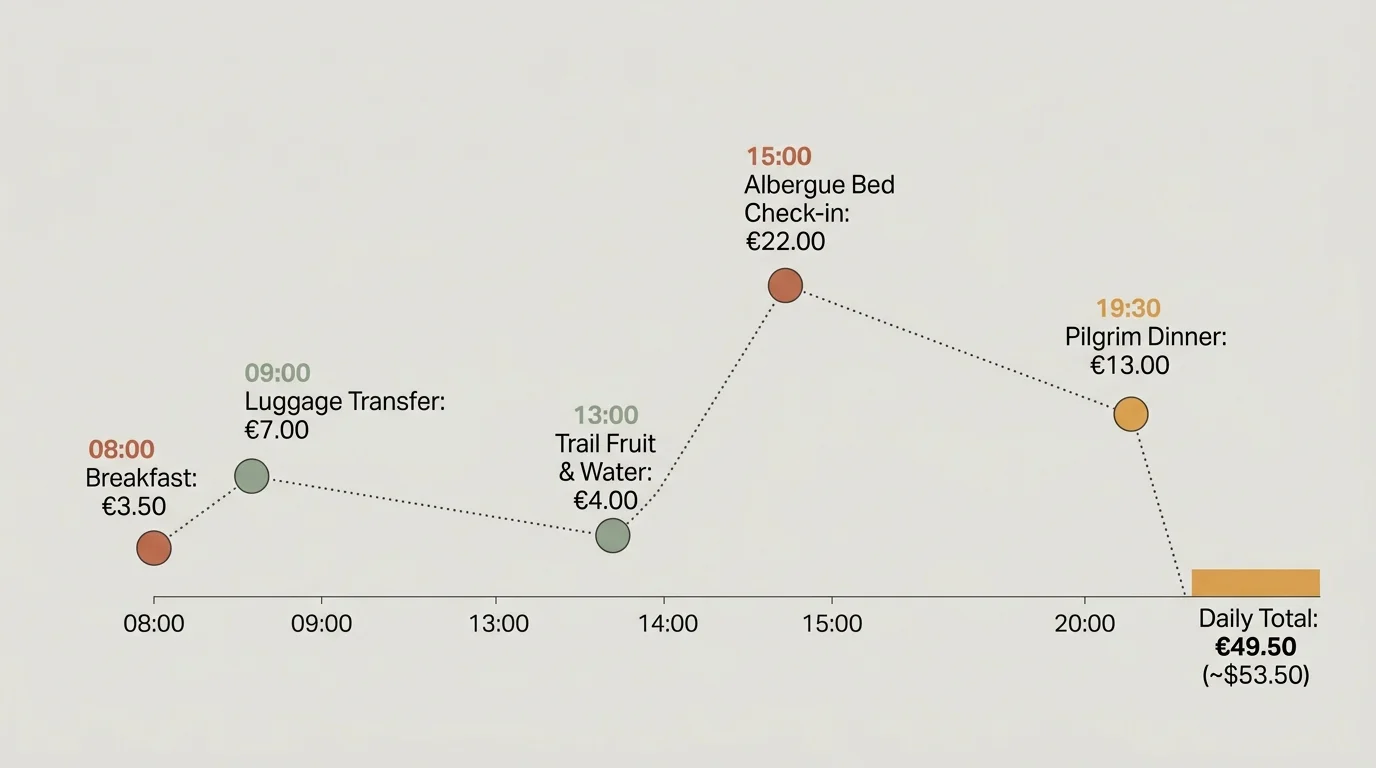
Worked Daily Spending Example: A Complete 24-Hour Budget
To see how the numbers function in practice, review this concrete financial log from a typical day walking between Esposende and Castelo do Neiva. Every expense reflects actual trail pricing converted at typical euro rates.
7:30 AM – Morning Departure: You leave your hostel in Esposende after breakfast at a corner pastelaria. You order a hot café com leite and a toasted butter roll for €3.20 ($3.45).
7:55 AM – Luggage Transfer: You drop your tagged twenty-pound duffel bag in the hostel lobby. Pilbeo charges your credit card €7.00 ($7.55) to transport it ahead to your next hostel.
10:30 AM – Trailside Refueling: Halfway through your eight-mile walk, you stop at a village market for a bottle of mineral water, an apple, and a slice of local cheese, spending €3.80 ($4.10).
1:15 PM – Arrival and Check-In: You arrive at your reserved private albergue in Castelo do Neiva. You pay €20.00 ($21.60) for a comfortable bunk bed in a four-person women-only dorm room.
2:00 PM – Midday Meal: You join two fellow walkers at a neighborhood tasca for the daily pilgrim menu. You receive vegetable soup, grilled sea bass with potatoes, a glass of vinho verde, and espresso for €12.50 ($13.50).
6:30 PM – Evening Grocery Snack: Having eaten your main hot meal at lunch, you purchase yogurt and fresh grapes at a local grocery shop for €3.50 ($3.78) to eat on the hostel garden terrace.
Total Daily Spend: €50.00 ($53.98 USD).
This completed daily scenario stays more than $21 below your $75 budget limit. That daily surplus accumulates across your journey, giving you the funds to book private guesthouse rooms whenever you desire extra solitude.
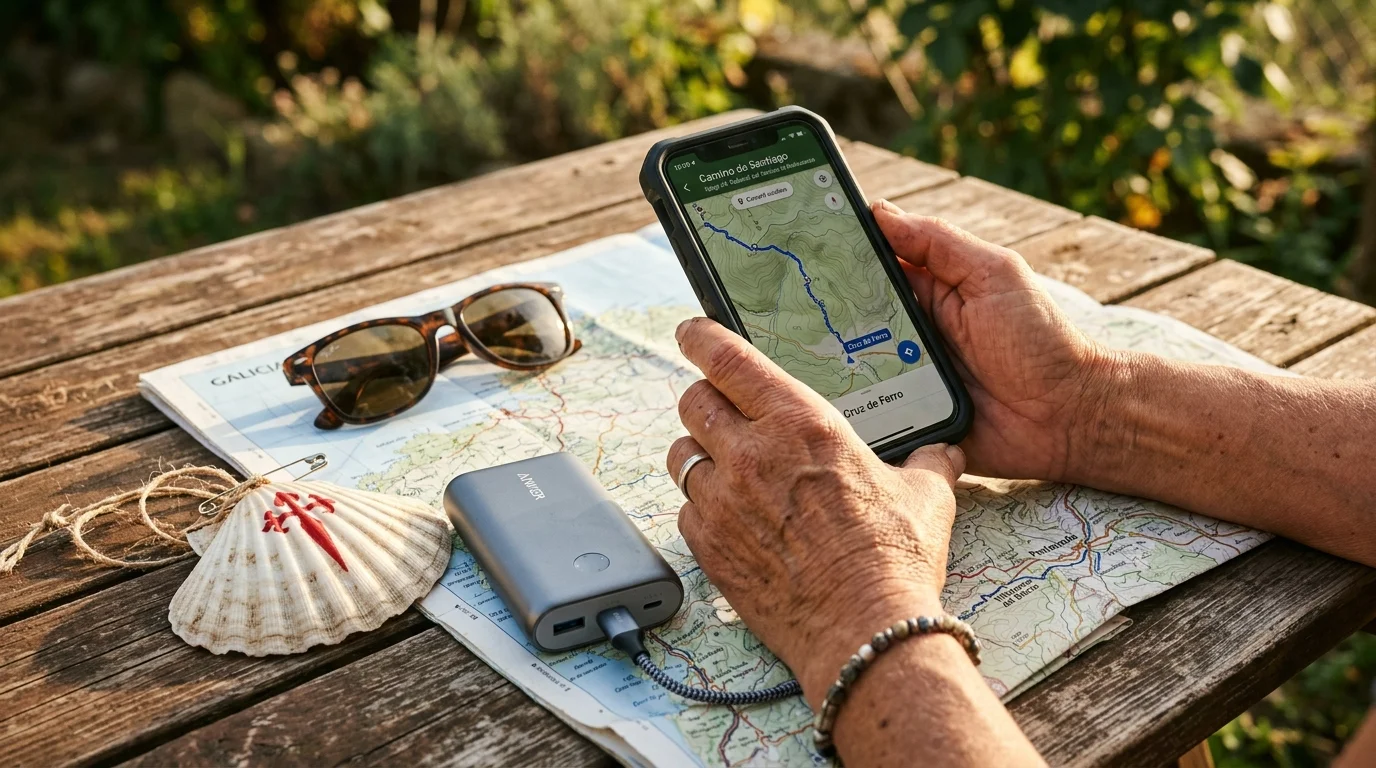
Solo Female Safety, Navigation, and Gear Strategy
Safety worries often prevent independent older women from pursuing solo international adventures. Yet the Portuguese Camino ranks among the safest walking corridors on the European continent.
Violent crime along the trail remains virtually nonexistent. Towns rely on pilgrim tourism, and local residents look out for walkers with genuine warmth and protective hospitality.
According to educational travel research from Road Scholar, older women traveling independently discover profound confidence when supported by clear infrastructure and friendly peer communities. The Camino offers that exact communal safety net.
You can walk entirely alone during the morning while remaining surrounded by a loose, protective family of pilgrims. You share paths, cross boardwalks together, and reunite at identical hostels each afternoon.
Mastering your gear distribution simplifies daily walking and keeps your daypack light:
- Main Transport Duffel (18–22 lbs): Extra clothing changes, sleep sheet, toiletry bottles, spare footwear, European plug adapters, and evening warm layers forwarded by courier.
- Trail Daypack (16–20 liters, under 6 lbs total): Passport, credential, smartphone, small first-aid kit with blister bandages, lightweight rain shell, water flask, and sun hat.
Keep your daily smartphone navigation simple by downloading offline trail maps through apps like Wise Pilgrim or Buen Camino. Yellow arrows painted on stone walls, trees, and sidewalks guide your direction every few hundred yards.
Always carry an unlocked phone equipped with an inexpensive local SIM card or eSIM plan. This ensures you can message luggage transfer drivers or hostel hosts via WhatsApp at any hour of the day.
Frequently Asked Questions
Can I walk the Camino solo if I do not speak Portuguese or Spanish?
Yes, you can navigate the entire route comfortably without speaking fluent foreign languages. Hospitaleros and shop owners along the trail interact with international pilgrims daily and use translation apps readily.
Do I need to carry cash, or do hostels accept credit cards?
You should carry €40 to €60 in physical euro cash at all times for small village bakeries and municipal stamps. While private hostels take cards, rural cafes and small markets often require cash for purchases under €10.
What happens if bad weather hits or my joints hurt during a stage?
You can hail local taxis easily from almost any village along the coastal route by asking a cafe worker or using your phone. A short five-mile taxi ride between stages generally costs €8 to €12, protecting your health without breaking your budget.
How do I qualify for the Compostela certificate in Santiago?
You must walk at least the final 100 kilometers into Santiago de Compostela and collect two official ink stamps per day in your credential. The coastal route from Baiona or Vigo easily fulfills this distance requirement.
Disclaimer: This article is for informational and inspirational purposes. Life decisions are deeply personal, and we encourage readers to pursue their dreams while considering their unique circumstances, health, and financial situation.



1 Comment