
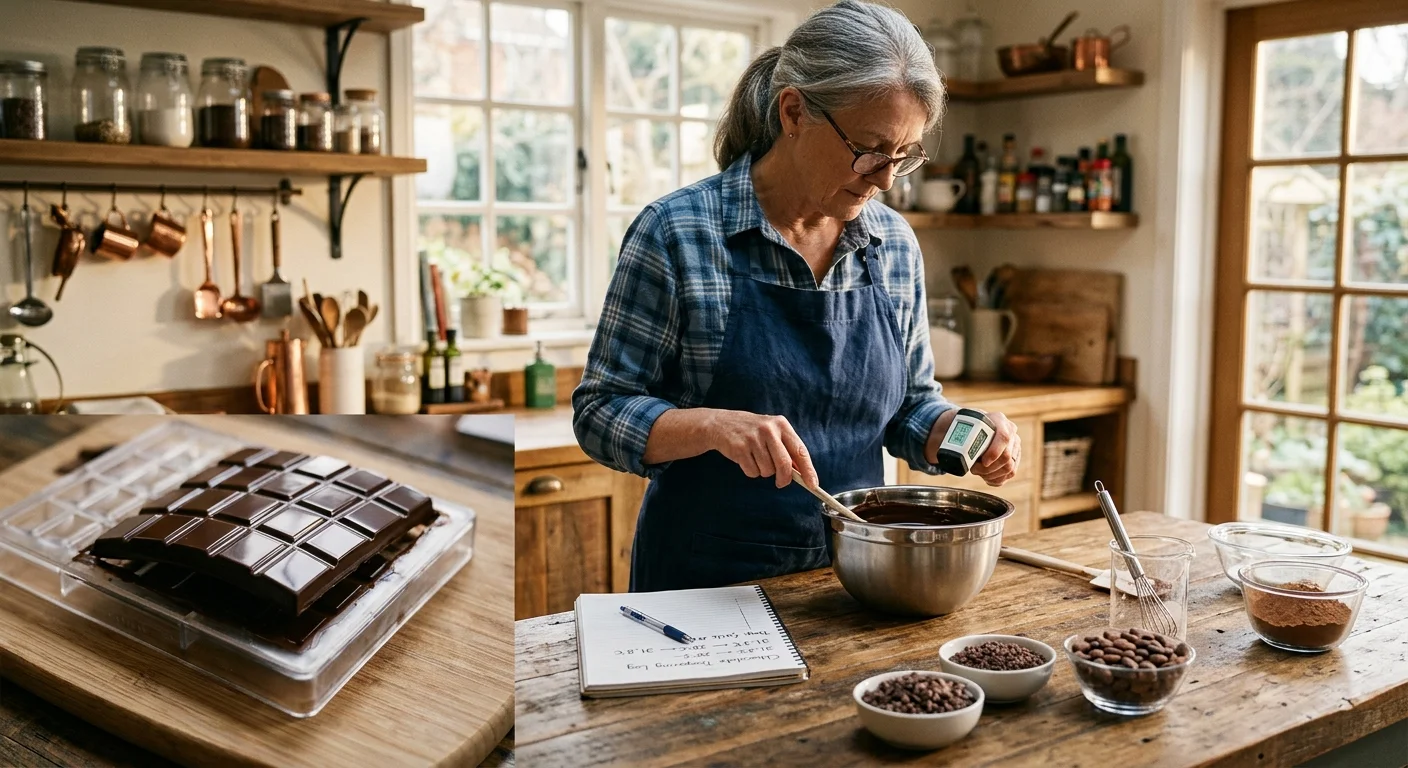
You spent decades teaching thermodynamics, chemical equilibrium, and reaction kinetics to curious students. Your retirement allows you to apply that exact scientific rigor to roasting, cracking, and refining single-origin cacao beans.
Rather than settling for passive leisure, you can launch a lucrative cottage food micro business directly from an inspected home kitchen counter.
Bean-to-bar confectionery depends strictly on polymorphic phase transitions. This scientific edge allows analytical retirees to out-produce casual hobbyists and generate reliable weekly market income.
The Chemistry Advantage: Cocoa Butter Polymorphism
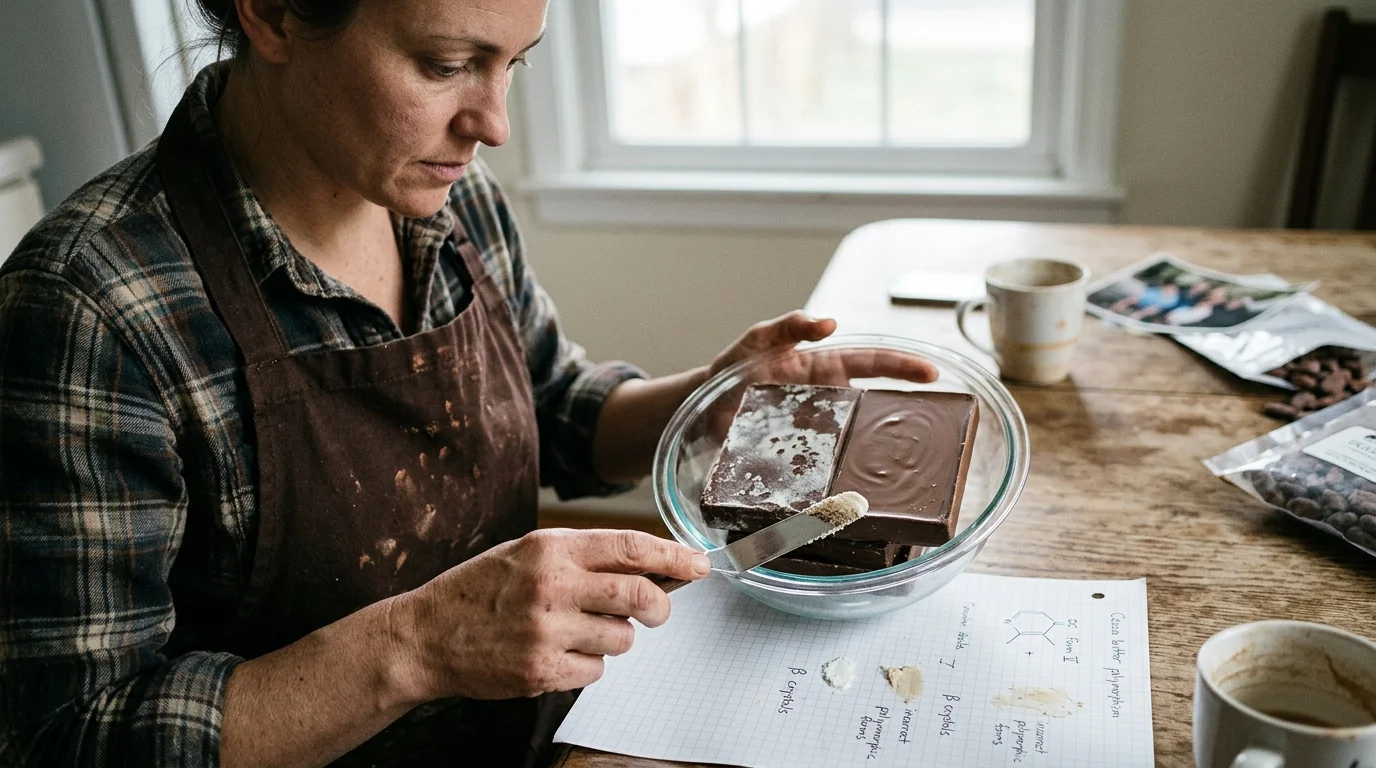
Your classroom laboratory background provides an immediate operational advantage over typical culinary hobbyists. Natural cocoa butter is a complex triacylglycerol matrix that solidifies into six distinct crystal structures, termed Forms I through VI.
Mastering these thermodynamic transformations is a prime example of undertaking culinary adventures to expand your cooking repertoire into high-end artisan craft.
Amateur candy makers view chocolate tempering as an unpredictable culinary art. In contrast, a trained science educator recognizes it as controlled fractional crystallization driven by thermodynamic stability.
Form V, known scientifically as the beta-2 polymorph, represents the gold standard for luxury confections. It exhibits a precise melting point between 32°C and 34°C (89.6°F to 93.2°F).
Form V crystals deliver the audible structural snap, mirror-like surface gloss, and stable shelf life consumers demand. They also melt cleanly at average human body temperature.
- Form I: Solidifies at 17°C (62.6°F); extremely soft, unstable, and melts instantly to the touch.
- Form II: Solidifies at 21°C (69.8°F); soft, highly crumbly, and prone to rapid phase collapse.
- Form III: Solidifies at 26°C (78.8°F); dull finish with a weak, waxy structural break.
- Form IV: Solidifies at 28°C (82.4°F); soft texture that blooms quickly at room temperature.
- Form V: Solidifies at 32°C–34°C (89.6°F–93.2°F); optimal beta-prime crystal matrix with brilliant gloss and clean snap.
- Form VI: Forms slowly over months via solid-state transition from Form V; causes powdery, white fat bloom and grittiness.
When you control time and temperature curves during tempering, you systematically melt out Forms I through IV. You intentionally leave pure Form V seed nuclei behind to guide total batch crystallization.
Your understanding of exothermic cooling curves prevents unstable crystal formation. This chemical mastery virtually eliminates batch failure, saving valuable raw cacao and packaging materials.
“It is never too late to be what you might have been.” — George Eliot
Navigating Cottage Food Law and Water Activity Safety
Launching a second act food business does not require leasing expensive commercial real estate. You can initiate legal retail production straight from an inspected home kitchen under state cottage food regulations.
Much like retirees who transform suburban plots into micro-farms, home chocolatiers can produce exceptional commercial yields from a standard residential footprint.
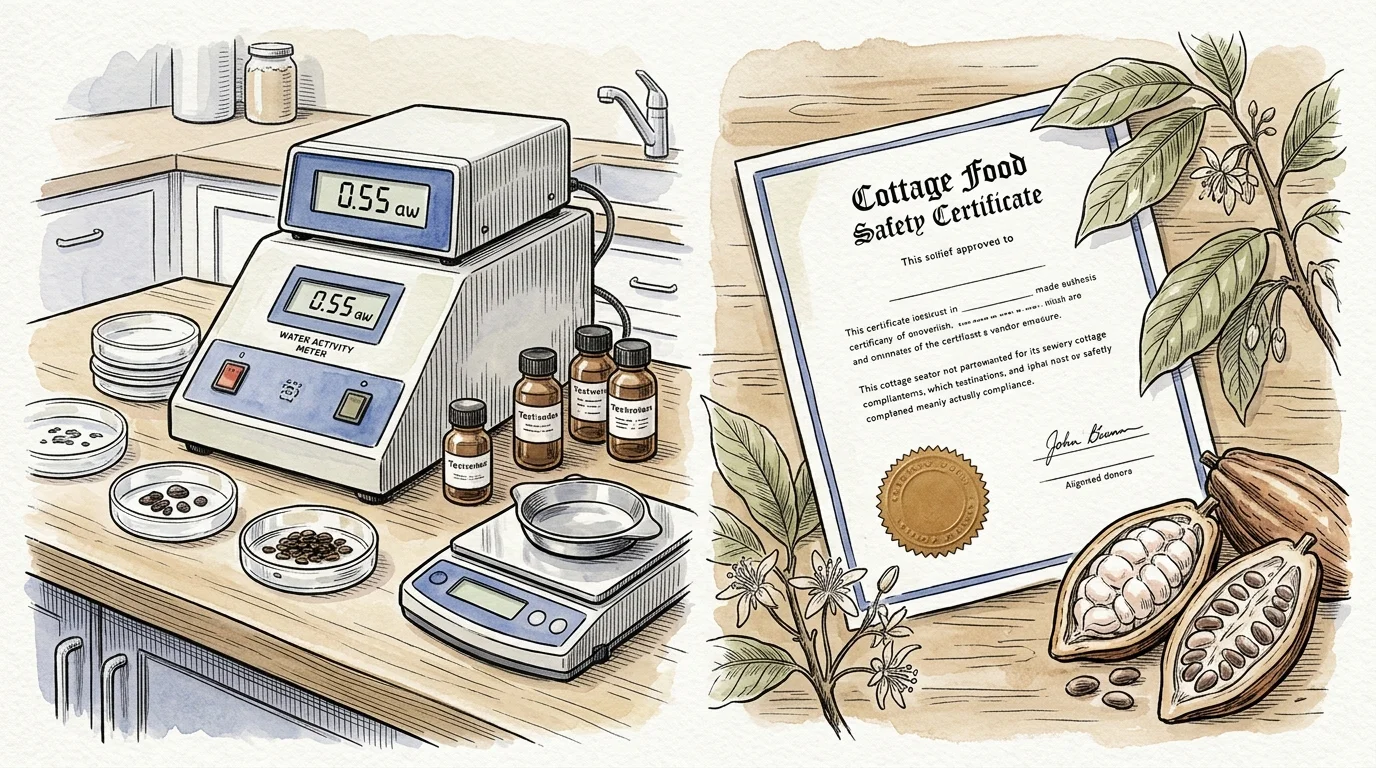
Solid dark chocolate bars represent one of the safest foods to produce at home. Their biological stability stems directly from an exceptionally low water activity measurement.
Water activity, designated scientifically as a_w, measures unbound water molecules available for microbial proliferation. Pathogenic bacteria like Salmonella and Clostridium require a minimum water activity level of 0.85 a_w to reproduce.
Properly formulated dark chocolate bars register an internal water activity between 0.30 and 0.50 a_w. Because chocolate contains almost no free moisture, federal regulators classify it as a non-potentially hazardous, shelf-stable food.
Allowable gross sales caps under cottage food laws vary substantially across different state jurisdictions. Understanding your state cap ensures your business model remains fully compliant as revenue expands.
- Florida: Permits home-based operations up to $250,000 in gross annual confectionery sales.
- Texas: Authorizes up to $150,000 annually under home processor exemptions with direct-to-consumer sales.
- Wyoming, Utah, and Alabama: Impose zero revenue caps on cottage food producers selling non-hazardous baked goods and confections.
- New York State: A rare exception whose Home Processor Exemption prohibits dipped or molded chocolate products without commercial facilities.
Your finished chocolate bar labels must carry specific statutory disclosures. These include product identity, net weight in imperial and metric units, an ingredient declaration, and your home facility address.
State inspectors also mandate strict allergen declarations for potential cross-contamination with milk, tree nuts, peanuts, and soy. Maintaining dedicated, sanitized production equipment eliminates regulatory compliance risks.
Countertop Infrastructure: Outfitting a $2,200 Roasting and Milling Lab
Industrial chocolate manufacturers operate multi-million-dollar ball mills and roll refiners. However, tabletop stone refiners now allow micro-batch artisans to achieve identical micron sizes on a standard kitchen counter.
Much like leveraging specialized professional expertise in retirement, translating academic laboratory knowledge into confectionery equipment yields exceptional commercial efficiency.
Equipping a dedicated home workspace mirrors the thoughtful planning seen when restoring antique books in a home workshop, where specialized tools ensure museum-grade craftwork.
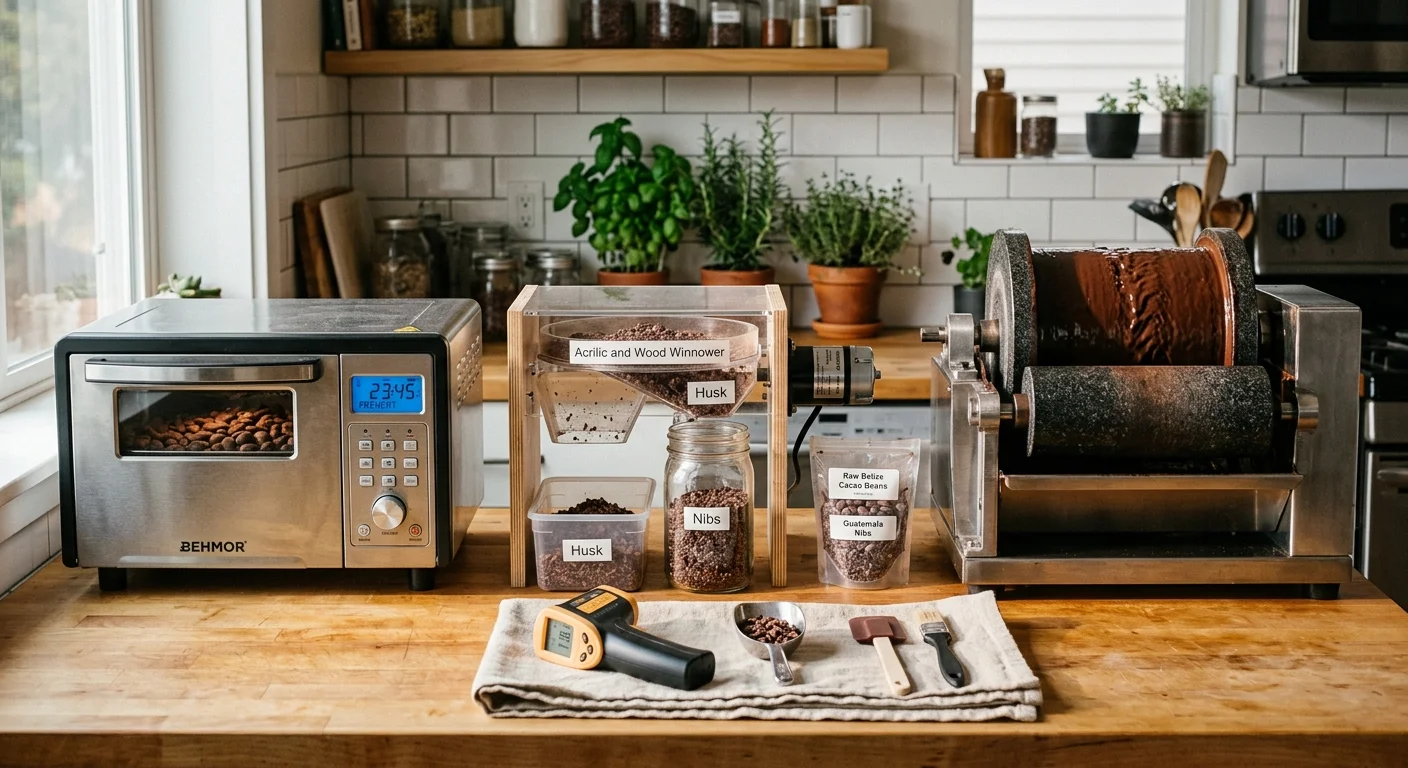
Building your home processing lab requires targeted capital allocation across five essential pieces of equipment. An intentional $2,200 investment provides a complete commercial-grade setup capable of processing 20 pounds of chocolate weekly.
- Tabletop Stone Melanger ($360): A Premier Chocolate Refiner (8–10 lb capacity) with granite stones running continuous 48-hour cycles to grind cacao nibs and sugar.
- Convection Roasting Oven ($400): A Breville Smart Oven Air Fryer Pro featuring precise dual-fan air circulation and 1°F digital temperature adjustments.
- DIY Countertop Winnower ($120): A modified shop-vacuum separation system with clear acrylic hopper tubes to separate roasted shells from cracked nibs using aerodynamic density.
- Countertop Tempering Machine ($850): A ChocoVision Revolation 2 unit that automatically executes heating, cooling, and seed crystallization curves for 1.5-pound batches.
- Molds and Finishing Gear ($470): Commercial polycarbonate 50-gram bar molds, an infrared digital surface thermometer, a 0.01-gram scale, and an impulse heat sealer.
The stone melanger performs two biochemical operations simultaneously: refining and conching. Natural granite stones crush cacao solids against a granite baseplate under adjustable spring tension.
Human sensory receptors on the tongue can detect individual food particles larger than 25 to 30 microns. Unrefined cocoa liquor feels sandy, gritty, and unpleasant in the mouth.
Running a tabletop stone refiner for 48 to 72 hours crushes sugar crystals and cocoa particles down to 15–18 microns. This sub-20-micron particle size creates a silk-smooth mouthfeel and optimal viscosity.
Simultaneously, the frictional heat generated by the spinning stones drives off unwanted volatile acetic acids. This gentle conching process softens harsh bitterness while highlighting delicate fruity or floral terroir notes.
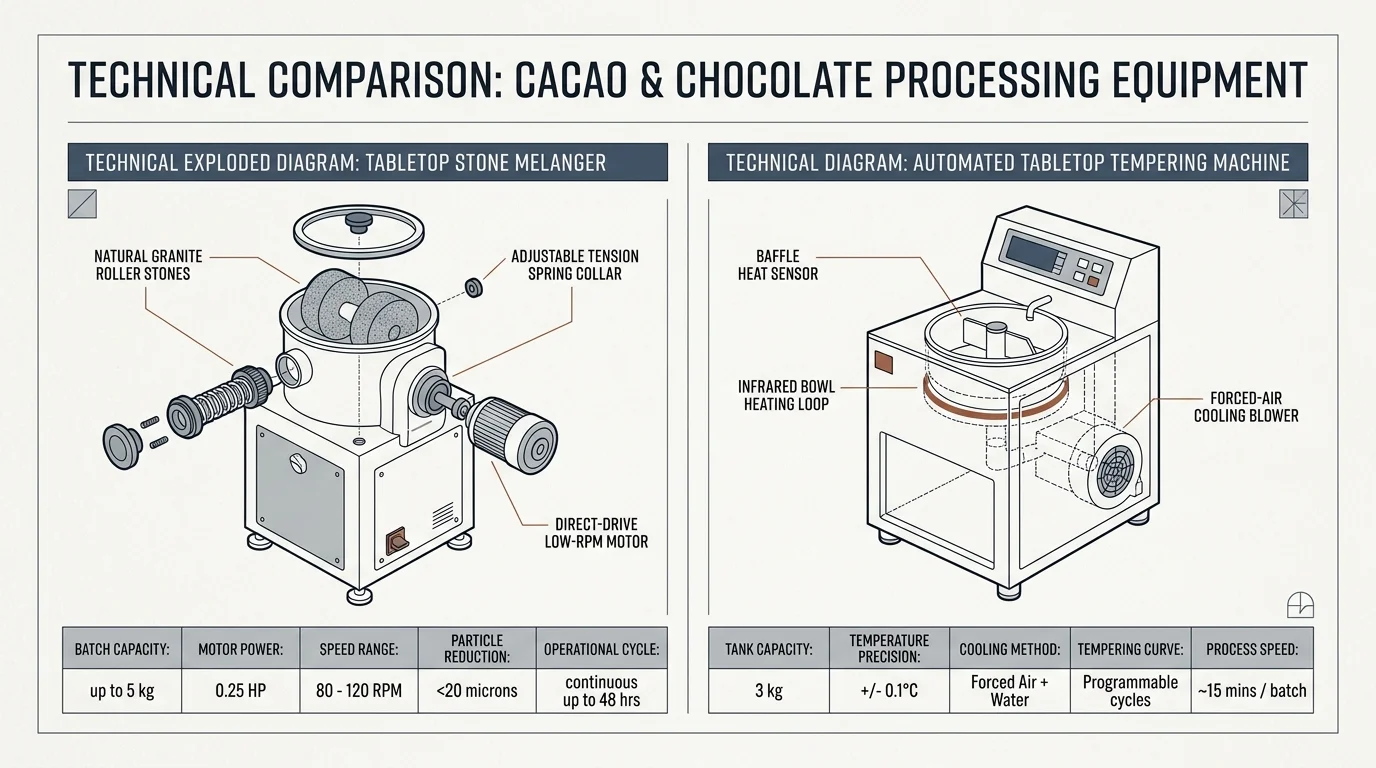
Equipment Selection: Tabletop Melangers and Tempering Units Compared
Selecting the right production machines prevents expensive operational bottlenecks. Tabletop equipment must tolerate continuous multi-day duty cycles without thermal motor breakdown.
Reinvesting early market revenues to upgrade machinery follows the proven principles of building a successful small business in retirement without taking on debt.
The following table outlines measurable technical specifications and current retail costs for entry-level and intermediate micro-batch chocolate machinery.
| Equipment Model | Machine Classification | Batch Capacity | Power and Duty Cycle | Approximate Retail Cost |
|---|---|---|---|---|
| Premier Chocolate Refiner | Tabletop Stone Melanger | 8–10 lbs (3.6–4.5 kg) | 200 Watts; 72-hour continuous runtime | $360 |
| Santha 11 Stone Grinder | Tabletop Stone Melanger | 11 lbs (5.0 kg) | 180 Watts; 48-hour continuous runtime | $550 |
| ChocoVision Revolation 2 | Automated Countertop Temperer | 1.5 lbs (0.68 kg) | 350 Watts; intermittent batch tempering | $850 |
| ChocoVision Revolation Delta | Commercial Benchtop Temperer | 10 lbs (4.54 kg) | 750 Watts; continuous daily thermal cycling | $2,700 |
Beginning with a Premier 8-pound refiner and a ChocoVision Revolation 2 keeps startup overhead minimal. This baseline setup supports production of up to 100 chocolate bars every three days.
When weekly demand approaches 250 bars, adding a second stone refiner doubles refining capacity without requiring commercial electrical rewiring. Standard 120-volt residential kitchen circuits readily handle this power load.
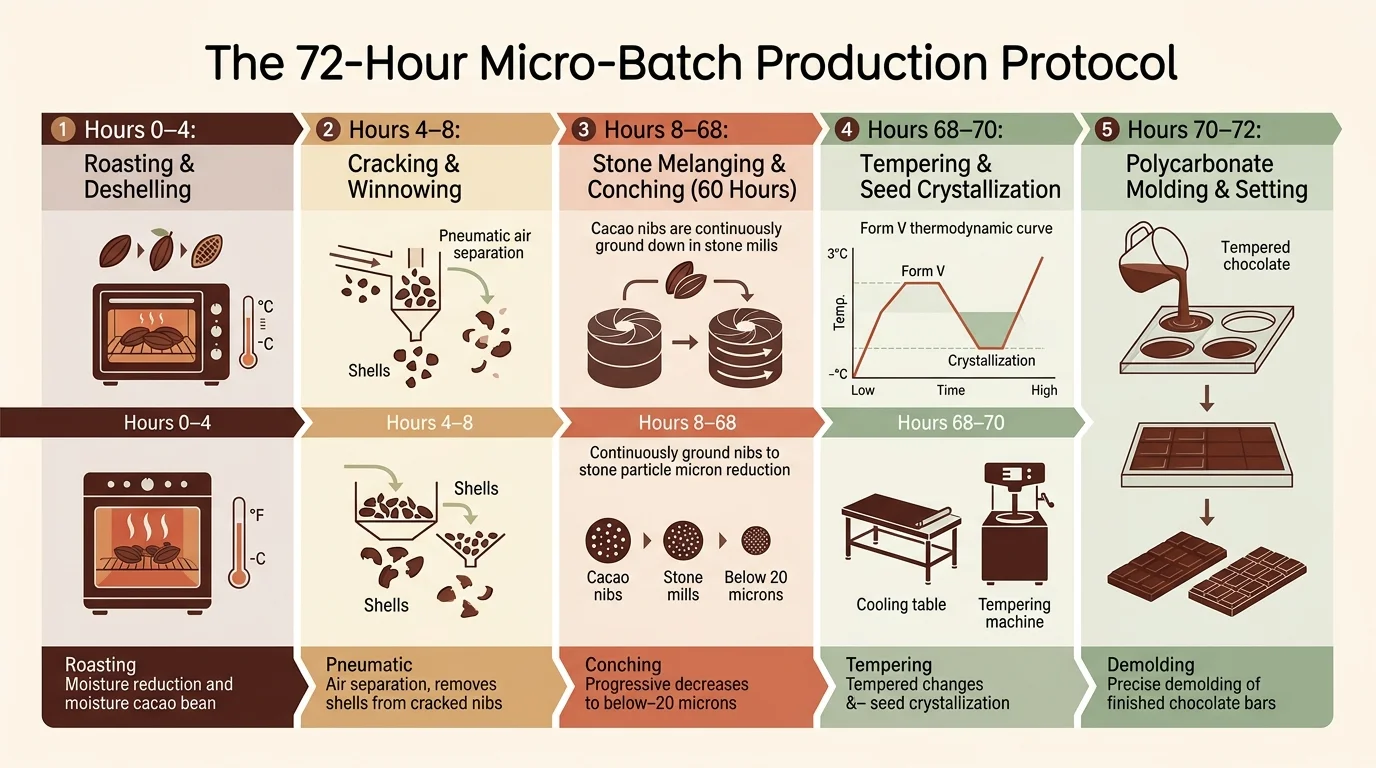
The 72-Hour Micro-Batch Production Protocol
Transforming raw agricultural seeds into tempered confections requires an uncompromising process schedule. Each processing stage introduces chemical changes that dictate the aroma and mouthfeel of the finished chocolate.
Developing a structured production rhythm offers an exceptional blueprint for crafting fulfilling retirement projects that combine creative passion with concrete tangible results.
Mastering these multi-day technical workflows reflects the joy of lifelong learning that transforms technical curiosity into culinary excellence.
- Manual Bean Sorting: Hand-inspect raw fermented beans to discard debris, flat beans, and broken shells before thermal processing.
- Convection Roasting: Roast sorted beans at 130°C (266°F) for 24 minutes to induce Maillard reactions while loosening external husks.
- Mechanical Cracking: Pass roasted beans through an adjustable hand-crank grain mill set to fracture husks without pulverizing nibs.
- Density Winnowing: Drop cracked beans through your vacuum-powered baffle column, pulling lightweight papery husks away from heavy cocoa nibs.
- Milling and Refining: Pre-warm the stone melanger drum with a heat gun, feed in cacao nibs slowly, and let liquefy into pure cocoa liquor.
- Sugar Incorporation: Introduce organic cane sugar at hour 12 of milling, allowing continuous shearing to reduce particle size below 18 microns.
- Continuous Conching: Allow the refiner to run unlidded for an additional 36 hours at 50°C (122°F) to volatilize harsh volatile acids.
- Controlled Tempering: Transfer melted chocolate into the automated tempering unit, heating to 45°C, cooling to 27°C, and reheating to 31.5°C.
- Molding and Solidification: Pipe tempered chocolate into polycarbonate molds, vibrate to release micro-bubbles, and cool at 15°C (59°F) for 30 minutes.
Temperature control during roasting demands total focus. Roasting too hot burns delicate bean volatiles, while roasting too cool leaves raw, astringent tannins in the finished bar.
Always inspect the cooled bars immediately upon release from their molds. A properly tempered bar releases easily from polycarbonate with a loud click and displays a glossy, streak-free surface.
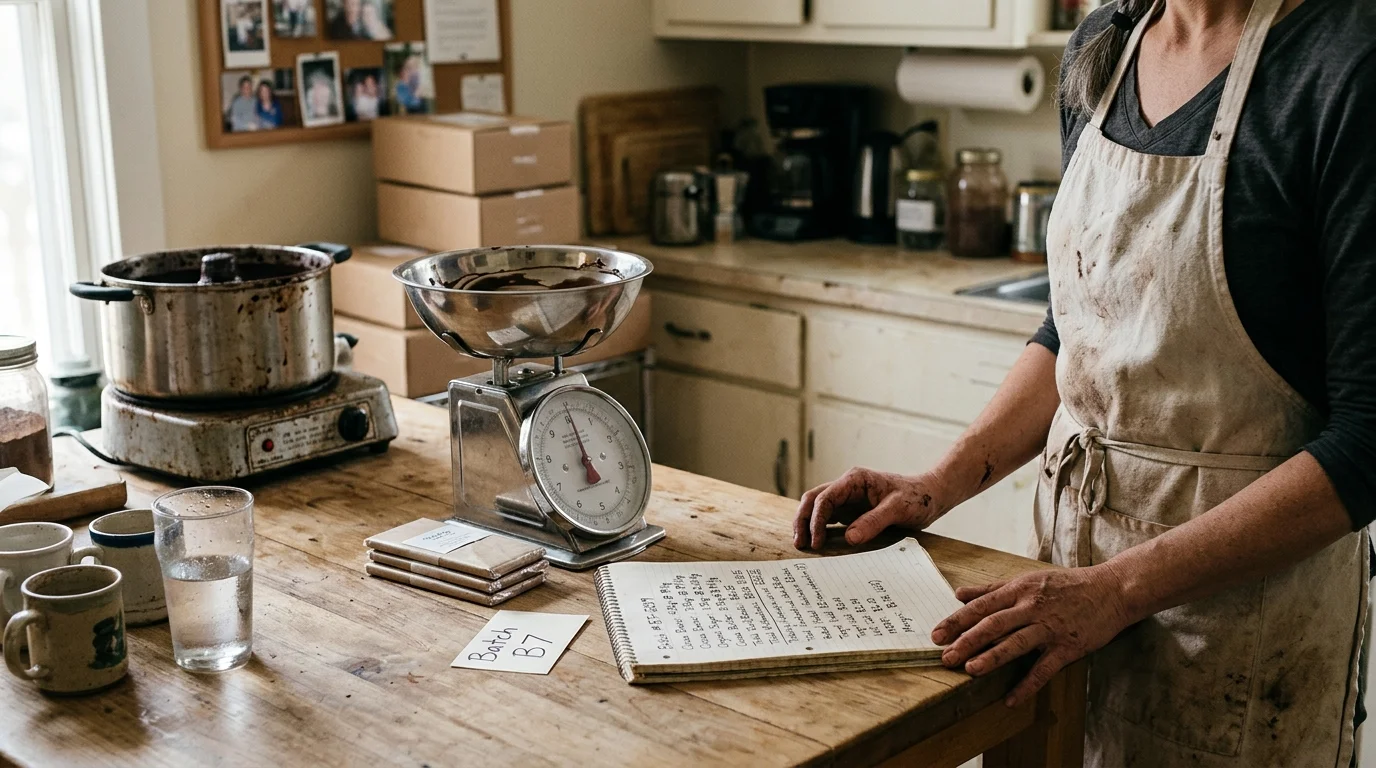
Worked Production Scenario: Batch Yields and Cost Accounting
To establish a viable business, you must ground your scientific passion in exact unit economics. Calculating ingredient recovery yields and packaging costs reveals exceptional margins on small-batch artisan chocolate.
Consider a fully worked micro-batch scenario utilizing 5.00 kilograms of raw single-origin cacao beans from the Sambirano Valley in Madagascar.
Raw specialty-grade Madagascar beans cost $9.00 per kilogram when purchased in 25-kilogram sacks. Your initial raw bean expense is exactly $45.00 for the batch.
Roasting and winnowing naturally shed moisture and husk mass, yielding an 80% nib recovery rate. Roasting 5.00 kilograms of raw beans leaves precisely 4.00 kilograms of clean cacao nibs.
You decide to formulate a 70% Single-Origin Dark Chocolate bar containing 70% cacao solids and 30% organic cane sugar. Calculating required sugar: 4.00 kilograms divided by 0.70 multiplied by 0.30 equals 1.71 kilograms of sugar.
Organic cane sugar costs $2.48 per kilogram, adding $4.25 to ingredient costs. Combining the nibs and sugar yields 5.71 kilograms (5,710 grams) of finished chocolate liquor.
Molding standard 50-gram artisan chocolate bars produces exactly 114 finished bars per batch, allowing for minor bowl loss. Packaging each bar in metallic food-grade foil and a custom printed cardstock box costs $0.65 per unit.
Utility consumption for 48 hours of melanger operation, oven roasting, and tempering machine cycles adds $3.80 in residential electrical expense. Total direct costs reach $127.15 per batch.
Dividing total batch costs ($127.15) by finished output (114 bars) establishes a unit manufacturing cost of exactly $1.12 per 50-gram bar. Specialty chocolate bars of this quality retail at local farmers markets for $8.50 each.
Selling out a 114-bar micro-batch generates $969.00 in gross revenue. Subtracting direct production costs leaves $841.85 in gross profit, representing an outstanding 86.9% gross profit margin.
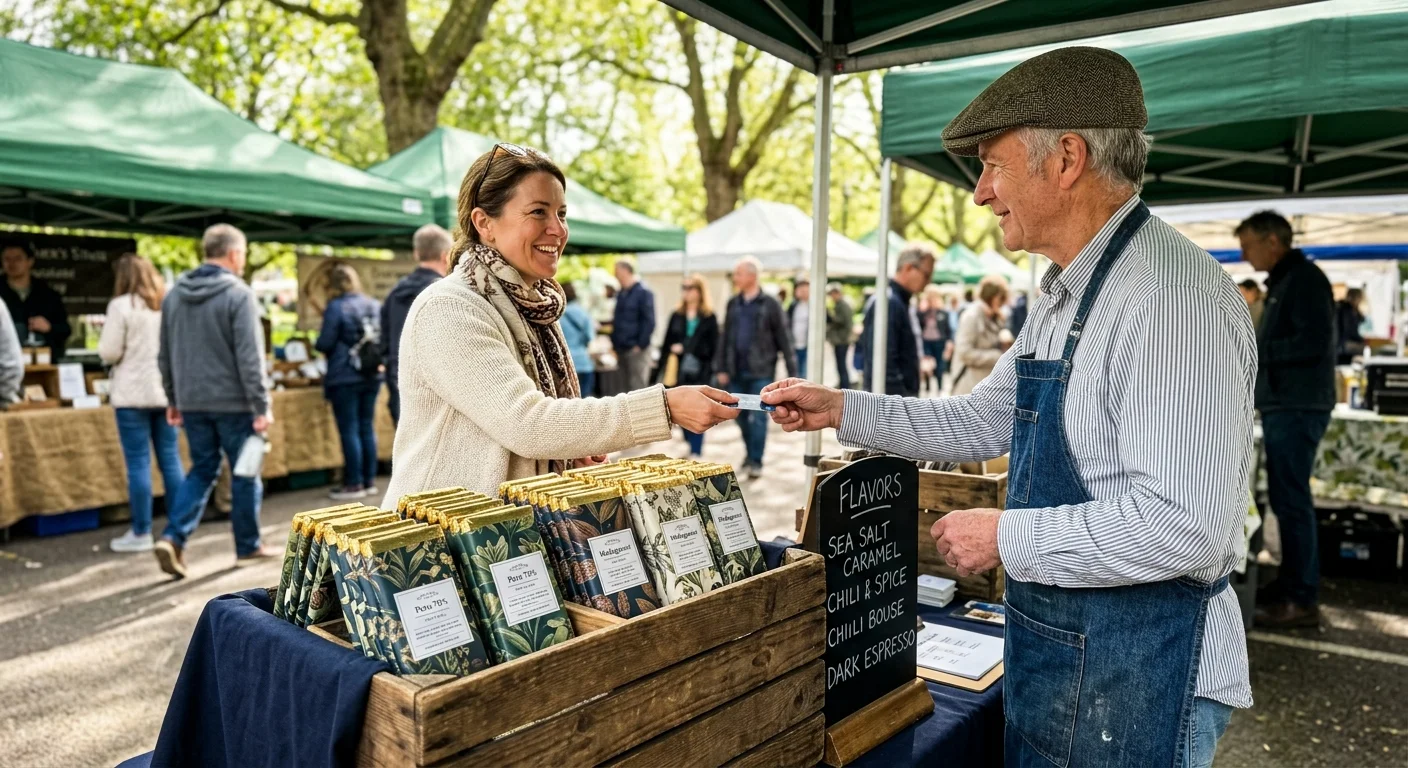
Weekly Farmers Market Turnover and Revenue Velocity
Securing a booth at a bustling weekend farmers market provides direct access to affluent customers who value craft foods. Micro-batch chocolatiers find that face-to-face consumer education accelerates inventory turnover.
Educating market shoppers on bean origins and flavor chemistry also allows former academics to continue inspiring others through teaching after retirement.
Operating two tabletop melangers on alternating schedules allows you to process two batches weekly. This production rhythm supplies 228 finished 50-gram bars for a Saturday morning sales session.
Organizing your market table inventory into clear tasting categories drives multi-bar purchases. Consumers rarely buy single bars when presented with clear origin and flavor contrasts.
- Single-Origin Madagascar 70% Dark: 114 bars featuring bright citrus, raspberry, and red fruit notes.
- Peruvian 60% Dark with Flaked Sea Salt: 60 bars presenting caramel and honey notes balanced by crunchy mineral salt.
- Ecuadorian 85% Intense Dark: 54 bars offering earthy, floral, and toasted walnut complexity for dark chocolate purists.
Conducting systematic sensory tastings at your booth creates high-converting foot traffic. Slice bars into tiny 1-gram sample cubes displayed on clean acrylic pedestals under protective glass domes.
While customers taste, explain how roasting profiles and crystal physics shape the chocolate’s melt and flavor. This brief educational demonstration transforms curious passersby into enthusiastic buyers.
Conservative market turnover models project an 80% weekly sell-through rate across a 5-hour market morning. Selling 182 bars at $8.50 each produces $1,547.00 in gross retail sales.
Deducting a $45.00 market stall fee and $203.84 in direct manufacturing costs leaves $1,298.16 in net weekly cash flow. Repeating this weekend routine four times per month generates over $5,100.00 in net income.
Unsold inventory remains entirely stable at room temperature due to its low water activity. You simply roll unsold stock into the subsequent weekend inventory without product loss.

Building Your Second Act with Purpose and Scale
Transitioning from a career in education to small business ownership represents an energizing second chapter. Mature adults bring patience, discipline, and problem-solving skills that younger founders often lack.
Operating a home-based artisan brand brings profound emotional rewards and purpose in a second career, connecting you directly with an appreciative local community.
According to the Ewing Marion Kauffman Foundation, adults aged 55 to 64 account for roughly 25% of all new entrepreneurs across the United States. Older founders possess the emotional grounding and focus essential for artisanal craftsmanship.
Organizations like Encore.org champion adults who repurpose their decades of professional experience into meaningful community-centered ventures. A cottage confectionery provides creative autonomy while generating dependable supplementary retirement cash flow.
Before launching retail sales, access free guidance from experienced business executives through SCORE Mentoring. A volunteer mentor can review your local business entity registration, general liability insurance policies, and sales tax compliance.
As your market presence solidifies, high-margin expansion paths open naturally beyond the weekend booth. Local specialty wineries frequently commission custom dark chocolate bars to pair with cabernet sauvignon and syrah.
Corporate gifting during the fourth quarter offers another lucrative, predictable channel. Local accounting firms, banks, and medical practices enthusiastically order custom-boxed, bean-to-bar chocolate sets for valuable clients.
Running a micro-batch confection lab keeps your mind engaged in applied science while producing tangible, delicious results. Your retirement becomes an inspiring masterclass in living boldly, passionately, and deliberately.
Frequently Asked Questions
Do I need a commercial kitchen license to sell bean-to-bar chocolate?
In most states, solid chocolate bars can be legally manufactured inside a standard home kitchen under state cottage food exemptions. Because chocolate has a water activity well below 0.85 a_w, it poses minimal bacterial risk and avoids commercial zoning mandates.
Why does chocolate bloom, and how does chemistry prevent it?
Chocolate bloom occurs when cocoa butter transitions into unstable polymorphs, causing white fat crystals to migrate to the surface. Tempering your chocolate correctly into Form V crystals and storing bars below 20°C (68°F) permanently prevents this phase separation.
How many hours a week does running a home chocolate business require?
A two-batch weekly schedule requires approximately 12 to 15 hours of hands-on labor, excluding passive stone melanger running time. You will spend roughly 4 hours sorting, roasting, and winnowing, 4 hours tempering and packaging, and 5 hours staffing a weekend market.
What is the shelf life of micro-batch dark chocolate bars?
Properly tempered dark chocolate bars containing only cacao nibs and cane sugar maintain peak sensory quality for 18 to 24 months. Store finished bars wrapped tightly in aluminum foil in a cool, dry pantry away from direct sunlight and humidity.
Disclaimer: This article is for informational and inspirational purposes. Life decisions are deeply personal, and we encourage readers to pursue their dreams while considering their unique circumstances, health, and financial situation.





1 Comment