
You can transform decades of executive messaging, active listening, and crisis negotiation into a deeply meaningful encore consultancy. Your corporate communications background gives you an unmatched advantage in bedside presence, family mediation, and end-of-life advocacy.
Most new practitioners struggle with unpredictable hourly gigs and unclear boundaries. By leveraging your strategic communication skills, you can establish an authoritative, contract-packaged death doula practice that secures steady $1,200 to $3,000 family engagements while maintaining rigorous professional guardrails.
This blueprint breaks down credential pathways, specialized risk coverage, and package architecture so you can launch your practice with absolute clarity.
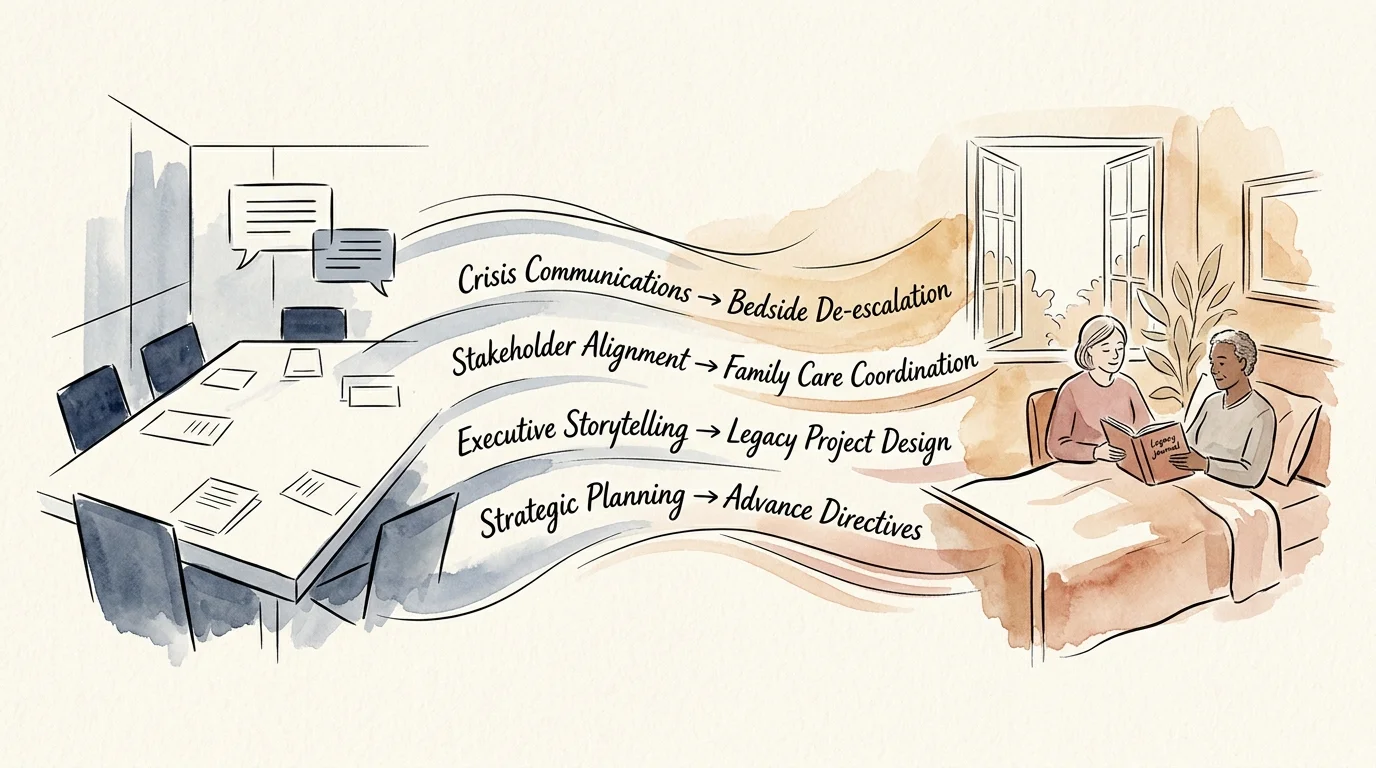
Translating Corporate Communications to End-of-Life Advocacy
Retirement gives you the freedom to redirect your professional talents toward work with profound human impact. As a former corporate communications director, you already command the exact skills families desperately need during acute life transitions.
You have spent years de-escalating tense executive meetings, clarifying complex information, and guiding stakeholders through institutional crises. Those exact capabilities translate seamlessly to helping grieving families navigate terminal diagnoses, palliative choices, and emotional exhaustion.
Research published by Psychology Today on purposeful living shows that channeling accumulated executive wisdom into social advocacy accelerates cognitive vitality. Your encore career is not a withdrawal from responsibility; it is the ultimate application of your professional craft.
Consider how your corporate toolkit directly maps to private client advocacy:
- Crisis Communications to Bedside De-escalation: You transform panic into grounded presence when family tensions flare over care decisions.
- Stakeholder Alignment to Family Care Coordination: You facilitate consensus among estranged siblings, palliative doctors, and hospice nurses.
- Executive Storytelling to Legacy Project Design: You guide dying individuals to articulate their values, record oral histories, and author meaningful ethical wills.
- Strategic Planning to Advance Directive Facilitation: You turn overwhelming medical paperwork into coherent, values-based end-of-life roadmaps.
Recognizing these parallels allows you to position your consultancy not as casual companion care, but as high-level navigational support. You bring executive poise to sacred spaces.
This distinct professional identity also shapes how you select credentials, negotiate contracts, and establish pricing structures that reflect your genuine market value.
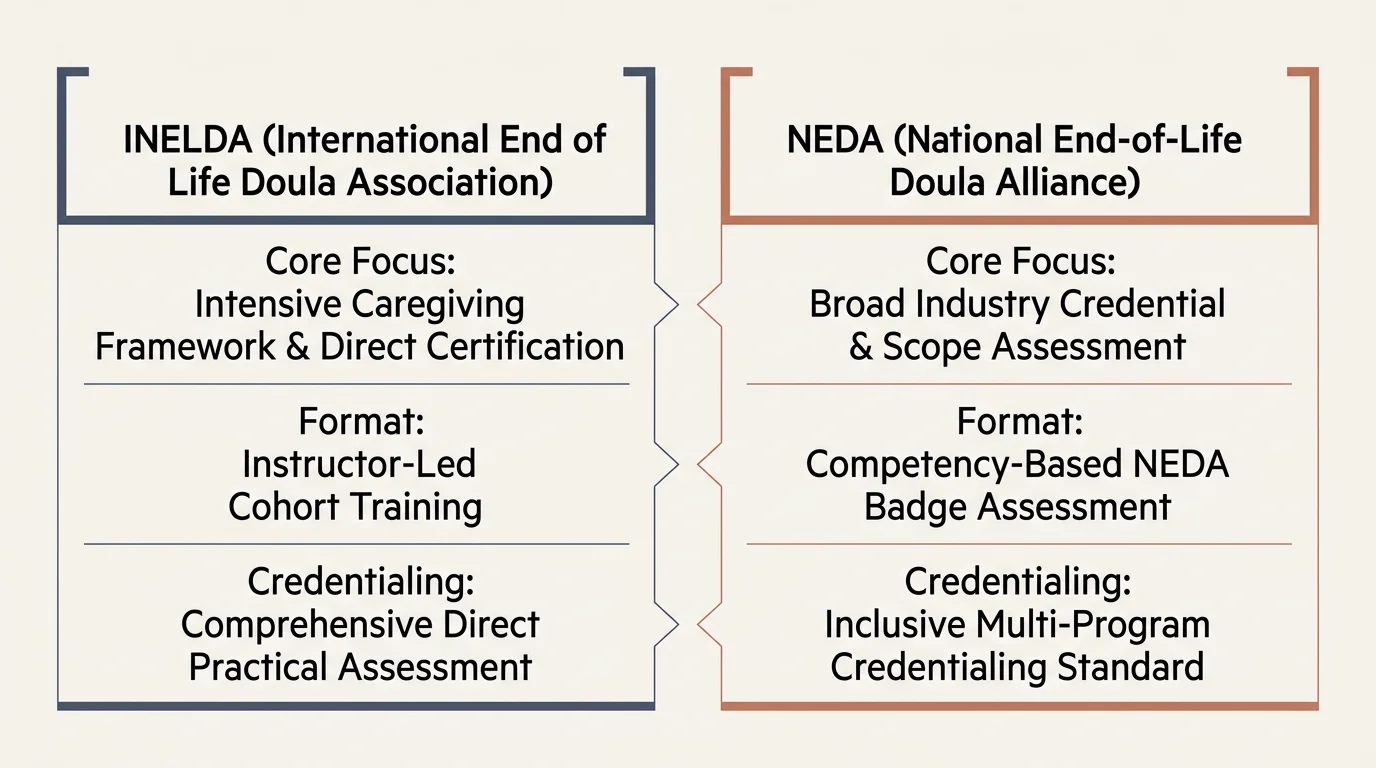
Credential Pathways: INELDA vs NEDA Certification Analyzed
Before marketing your services, you must navigate professional credentialing with absolute discernment. As of 2026, the end-of-life doula profession remains unregulated by federal agencies and state licensing boards.
Pursuing structured credentialing is an effective way of developing new skills for a second career while gaining the confidence needed to serve private clients.
No mandatory government license exists, meaning anyone can technically claim the title. However, affluent clients and clinical hospice teams demand rigorous, verifiable educational standards before opening their doors.
The two most recognized credentialing entities in the United States are the International End of Life Doula Association (INELDA) and the National End-of-Life Doula Alliance (NEDA). Choosing between them depends on your preferred learning model and timeline.
INELDA operates as a direct education provider and formal credentialing body. Their foundational training costs $995 for an online cohort, spanning 24 live educator-led hours alongside 13 to 16 prep hours.
If you prefer classroom environments, INELDA offers an in-person workshop format for $1,195. Once you complete foundational training, you can apply for their formal, cohort-based certification pathway.
This separate 1-year certification program costs $595 and requires rigorous field documentation. You must log at least 30 hours of doula experience, including 20 direct client-service hours, alongside two professional references and a comprehensive CV.
NEDA uses an entirely different, highly flexible organizational architecture. Rather than delivering its own core curriculum, NEDA serves as an umbrella alliance that evaluates external educational rigor.
You join NEDA by paying a modest $50 annual membership fee. From there, you earn the widely respected NEDA Proficiency Badge by passing an online assessment for $115.
To qualify for the NEDA exam, you must complete approved foundational training from any recognized independent academy. You also sign a binding pledge upholding NEDA’s Scope of Practice and Code of Ethics.
For corporate retirees seeking prestige, combining both paths often yields the strongest market position. Completing INELDA’s foundational course and passing NEDA’s credentialing exam establishes immediate institutional credibility.

Direct Comparison: Costs, Hours, and Scope
Evaluating your training pathway requires an objective look at capital requirements, time investments, and operational scope. The table below details how the primary credential routes compare for an aspiring practice founder.
| Evaluation Attribute | INELDA Certification Track | NEDA Proficiency Pathway | Dual Combined Route |
|---|---|---|---|
| Primary Function | End-to-end curriculum provider and certifying body | Alliance micro-credential and assessment standard | Comprehensive education with national alliance validation |
| Upfront Training Cost | $995 (online) or $1,195 (in-person) | Varies by academy ($600 to $1,200 external) | $995 (INELDA online foundational course) |
| Credentialing & Exam Fees | $595 (cohort certification program) | $115 assessment fee + $50 annual membership | $165 ($115 NEDA exam + $50 membership) |
| Direct Client Practicum | 30 logged hours (minimum 20 direct hours) | Self-attested via ethics pledge & exam | 30 logged hours under INELDA criteria |
| Governance Model | Proprietary association standards | Open-source cross-organizational standards | Multi-stakeholder industry compliance |
| Typical Completion Time | 12 to 14 months from intake | 2 to 4 months (dependent on core training) | 6 to 12 months for full portfolio |
Your choice directly impacts your launch velocity and operational positioning. If you want a structured, academic cohort with formal faculty review, INELDA’s $595 certification program delivers rigorous mentorship.
If you prefer an efficient launch, you can finish INELDA foundational training, pass the $115 NEDA exam, and market immediately while earning practicum hours. That hybrid strategy gets your practice running in less than 90 days.

End-of-Life Doula Business Setup and Liability Insurance
Setting up your consultancy requires treating the practice as a legitimate corporate entity from day one. Failing to build robust operational firewalls leaves your personal retirement assets exposed to unnecessary risk.
Start by registering a formal legal structure, such as a Single-Member Limited Liability Company (LLC), through your state government. Secure a dedicated Federal Employer Identification Number (EIN) from the IRS to keep personal and business taxes strictly partitioned.
Never run client fees through your personal checking account. Establish a commercial bank account and implement a cloud-based client relationship platform to organize documents, intake logs, and client contracts securely.
You can consult volunteer business advisors through SCORE Mentoring for small business guidance to review your corporate operating agreements and refine local administrative filings at no cost.
Securing specialized business insurance is your next mandatory safeguard. Standard homeowner or umbrella liability policies categorically exclude claims stemming from commercial, non-medical end-of-life care.
You must purchase dedicated Professional Liability (Errors and Omissions) insurance designed specifically for non-medical doulas. Reputable carriers like CM&F Group, CPH Insurance, and Alternative Balance write specialized policies for end-of-life practitioners.
A standard professional liability policy with $1,000,000 per occurrence and $3,000,000 aggregate coverage costs between $200 and $450 per year. This coverage defends you against allegations of negligence, breach of confidentiality, or emotional distress.
Always add Commercial General Liability (CGL) coverage to protect against slip-and-fall incidents or physical property damage in client homes. Bundling general and professional liability raises your total annual insurance investment to approximately $350 to $500.
Execute this five-step sequence to complete your operational foundation:
- Form Your Business Entity: File Articles of Organization for an LLC and obtain your EIN to insulate your personal nest egg.
- Open Commercial Financial Accounts: Set up a separate commercial checking account and integrate an electronic billing platform that supports debit and credit cards.
- Secure Specialized Coverage: Purchase an E&O and General Liability policy through carriers like CM&F Group or CPH Insurance ($350 to $500 annual total).
- Draft Protective Client Agreements: Work with an attorney to create a non-medical service agreement that explicitly delineates your role from licensed medical personnel.
- Implement Secure Digital Systems: Deploy HIPAA-compliant, encrypted cloud storage for care plans, family contact trees, and advance directive forms.
These operational safeguards give you the peace of mind to focus entirely on client care. Clear liability boundaries also reassure clinical hospice workers that you respect medical boundaries.
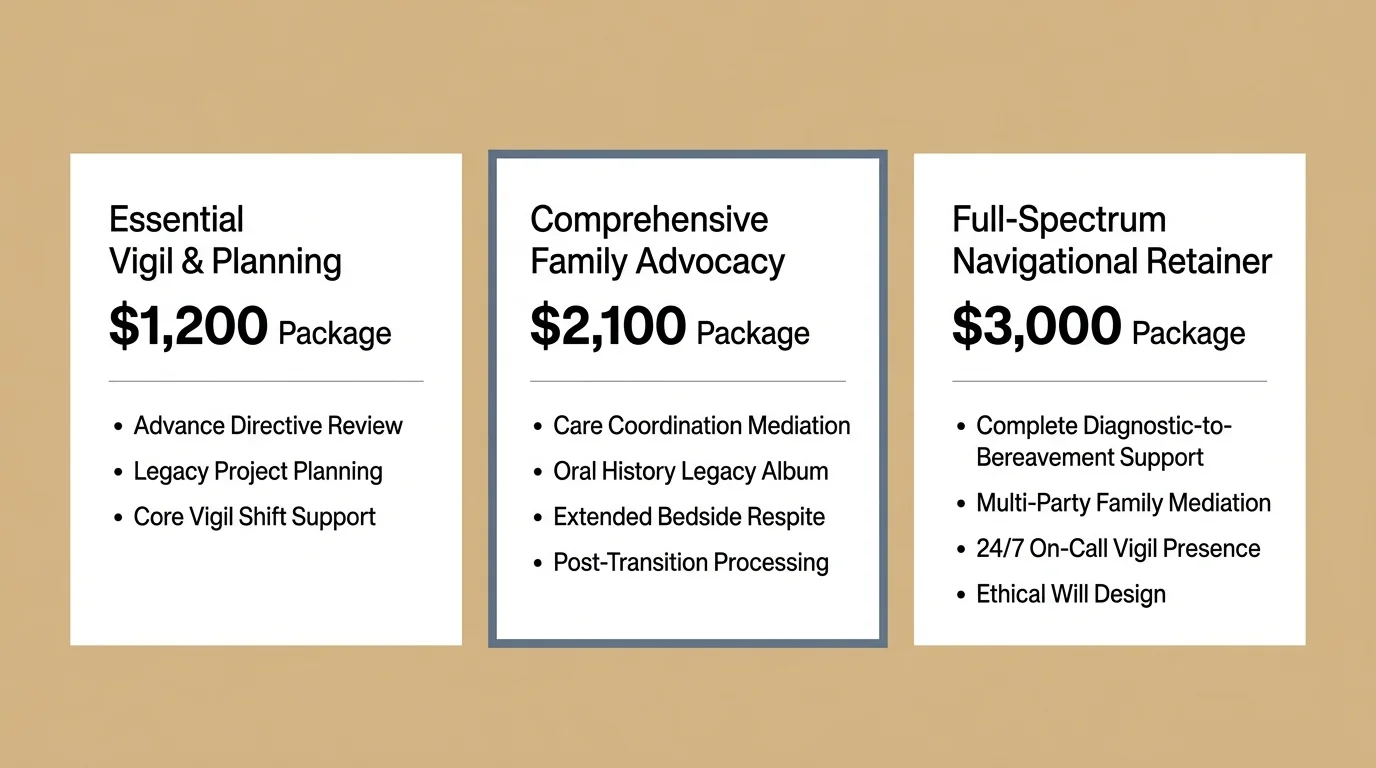
Structuring High-Value Packages: $1,200 to $3,000 Contracts
Many new doulas fall into the trap of charging low hourly fees between $50 and $125. Bidding by the hour devalues your presence, invites awkward clock-watching, and creates an unstable, exhausting revenue model.
Families navigating active dying do not want the cognitive burden of tracking hourly invoices. They want predictable, empathetic support from a professional who guides them through the final weeks with calm authority.
Package contracts solve this friction by packaging your time, expertise, and emotional support into transparent flat fees. In the current market, comprehensive end-of-life companion packages average between $1,500 and $2,000, with high-touch offerings commanding $3,000 or more.
You can segment your consultancy into three distinct contract packages to serve families at varying stages of need:
- Advance Planning & Legacy Architecture ($450 to $750): Includes 4 to 6 hours of values clarification, healthcare proxy documentation, funeral wishes, and one completed life-review legacy project.
- Active Transition & Respite Package ($1,200 to $1,800): Combines 12 hours of dedicated family respite, care coordination with hospice teams, bedside comforting techniques, and early vigil planning.
- Comprehensive Bedside Vigil & Transition Retainer ($2,200 to $3,200): Delivers ongoing family alignment meetings, 24/7 on-call availability during the final active week, up to 24 hours of bedside vigil presence, and post-death bereavement debriefing.
To demonstrate high value, break down every component within your engagement agreement. Specify precisely how many hours, check-ins, and materials your comprehensive flat fee covers.
For example, a $2,500 Comprehensive Transition Contract should include clear, concrete deliverables:
- Phase 1: Foundation (6 Hours): In-depth discovery sessions, care goal documentation, advance directive audits, and custom legacy project planning.
- Phase 2: Ongoing Respite & Guidance (8 Hours): Two weekly four-hour shifts providing compassionate relief for primary spousal caregivers.
- Phase 3: Continuous Vigil Window (Up to 16 Hours): Dedicated bedside vigil shifts during active dying, utilizing sensory soothing, repositioning assistance, and family support.
- Phase 4: Post-Mortem Integration (4 Hours): Immediate body-honoring ceremonies, funeral home departure facilitation, and a structured family closure session two weeks later.
If a family requires additional bedside shifts beyond the package terms, bill those hours under an overtime rate. Industry-standard overnight rates sit between $70 and $90 per hour, or $250 to $400 for a dedicated eight-hour shift.

A Complete Financial Scenario: The 90-Day Practice Launch
To understand the business economics, walk through this realistic 90-day launch model. This scenario follows an independent practitioner operating an LLC with low overhead while serving two concurrent clients.
Your initial startup capital covers training, credentialing, administrative filings, and insurance. The initial capital outlay remains modest compared to nearly any other professional consultancy.
- LLC Registration & State Filings: $150 (state filing fee average).
- INELDA Online Training Course: $995.
- NEDA Annual Membership & Badge Exam: $165 ($50 membership + $115 exam).
- Annual Liability Insurance (CM&F Group): $425 (combined professional and general liability).
- Website, Professional Email & Collateral: $300.
- Total Launch Investment: $2,035.
Once certified and operational, evaluate your monthly revenue against your baseline carrying costs. In Month 3, assume your local networking yields two comprehensive package clients and one legacy planning client.
Your monthly revenue calculation produces the following concrete results:
- 2 Comprehensive Transition Packages (@ $2,400 each): $4,800.
- 1 Advance Planning & Legacy Package (@ $550): $550.
- Gross Monthly Cash Flow: $5,350.
Now, subtract your ongoing monthly operational expenses:
- Software, EHR & Secure Cloud Storage: $60.
- Liability Insurance Allocation (1/12th of annual): $35.
- Marketing, Driving Mileage & Client Comfort Items: $220.
- Total Monthly Overhead: $315.
- Net Monthly Pre-Tax Profit: $5,035 ($5,350 gross minus $315 overhead).
Look closely at the time required to earn this $5,035 net profit. Serving two comprehensive clients involves roughly 56 total direct service hours over the month.
The legacy project requires approximately 6 direct client hours, while practice marketing and administration takes 10 hours. Your total monthly commitment equals 72 working hours, or roughly 18 hours per week.
Dividing your $5,035 net profit by 72 hours yields an effective hourly return of $69.93. You earn executive-level compensation while maintaining full control over your calendar and energy.
More importantly, you dedicate those 18 weekly hours to deep, transformational service. You run an agile, highly sustainable retirement business that enriches your community without risking burnout.

Cultivating Ethical Alliances: Hospice Networking and Referral Systems
Securing paying clients does not require aggressive sales pitches or digital advertising campaigns. The most sustainable client acquisition pipeline flows from trusted relationships with local hospice teams, elder law attorneys, and palliative care coordinators.
However, you must approach hospice organizations with careful diplomacy. Many clinical hospice nurses and social workers have encountered poorly trained doulas who overstepped medical boundaries or interfered with clinical care.
Your background in corporate communications gives you the poise to overcome that skepticism immediately. You understand how to present yourself as a cooperative ally who enhances, rather than disrupts, the clinical team’s care plan.
Review the encore career and intergenerational impact resources curated by CoGenerate (formerly Encore.org) on social impact leadership to see how retirees successfully position themselves within community healthcare ecosystems. Positioning your practice as an allied support service opens doors across the medical landscape.
Follow this four-step outreach protocol to establish formal referral networks with regional hospice agencies:
- Audit Local Hospice Capacity: Research nonprofit and private hospice agencies within a 25-mile radius, identifying their volunteer coordinators and lead social workers.
- Schedule Informational Discovery Meetings: Reach out to request a 15-minute introductory coffee, framing your practice as non-medical, supplemental family support.
- Present a Clear Scope of Practice: Provide a clean one-page overview outlining your NEDA or INELDA ethics compliance, non-clinical boundaries, and professional liability coverage.
- Offer Educational Value First: Host complimentary 30-minute seminars on legacy project facilitation or advance directive completion for their family caregiver support groups.
When presenting your practice to hospice social workers, emphasize what you do not do. Reassure them that you never administer medications, interpret medical test results, or alter clinical treatment directives.
Explain that your work handles the time-intensive emotional holding that clinical staff rarely have time to deliver. You sit at the bedside for four straight hours so an exhausted spouse can shower and sleep.
Once clinical social workers realize you lighten their emotional burden while respecting their clinical authority, they will eagerly share your contact details. That professional trust transforms local medical professionals into your strongest advocates.
Frequently Asked Questions
Is an end-of-life doula required to hold a state or federal license?
No official state or federal license exists for death doulas in the United States as of 2026. Certification remains entirely voluntary, allowing independent practitioners to practice without a medical or governmental credential.
Does Medicare or private health insurance reimburse death doula services?
Neither Medicare, Medicaid, nor commercial healthcare insurers reimburse doula fees because death doulas provide non-medical care. Services are normally private-pay; FSA or HSA reimbursement is generally excluded under IRS Publication 502 unless a physician signs a Letter of Medical Necessity (LMN) for a specific diagnosed condition and the plan administrator approves the claim.
How much does specialized liability insurance cost for a death doula?
Professional liability insurance offering $1,000,000/$3,000,000 limits typically costs between $200 and $450 annually. Combining professional liability with commercial general liability generally raises the annual premium to $350 to $500.
Should you choose INELDA or NEDA to establish market credibility?
INELDA provides direct, cohort-based curriculum training with structured practicum evaluations. NEDA serves as a credential assessment alliance that validates core competencies from any training background via an affordable proficiency exam.
Disclaimer: This article is for informational and inspirational purposes. Life decisions are deeply personal, and we encourage readers to pursue their dreams while considering their unique circumstances, health, and financial situation.