
A newly retired university librarian leaving a salaried catalog desk brings rare skill in provenance, paleography, and unindexed manuscripts to private genealogy clients. Yet starting with casual favors or hobbyist wages quickly turns that work into unpaid labor.
Sustainable profitability depends on strict engagement letters, verbatim protective clauses, upfront retainers, and Association of Professional Genealogists (APG) standards rather than research brilliance alone. Every preventable income loss traces back to a missing rule, rate threshold, or contract clause.
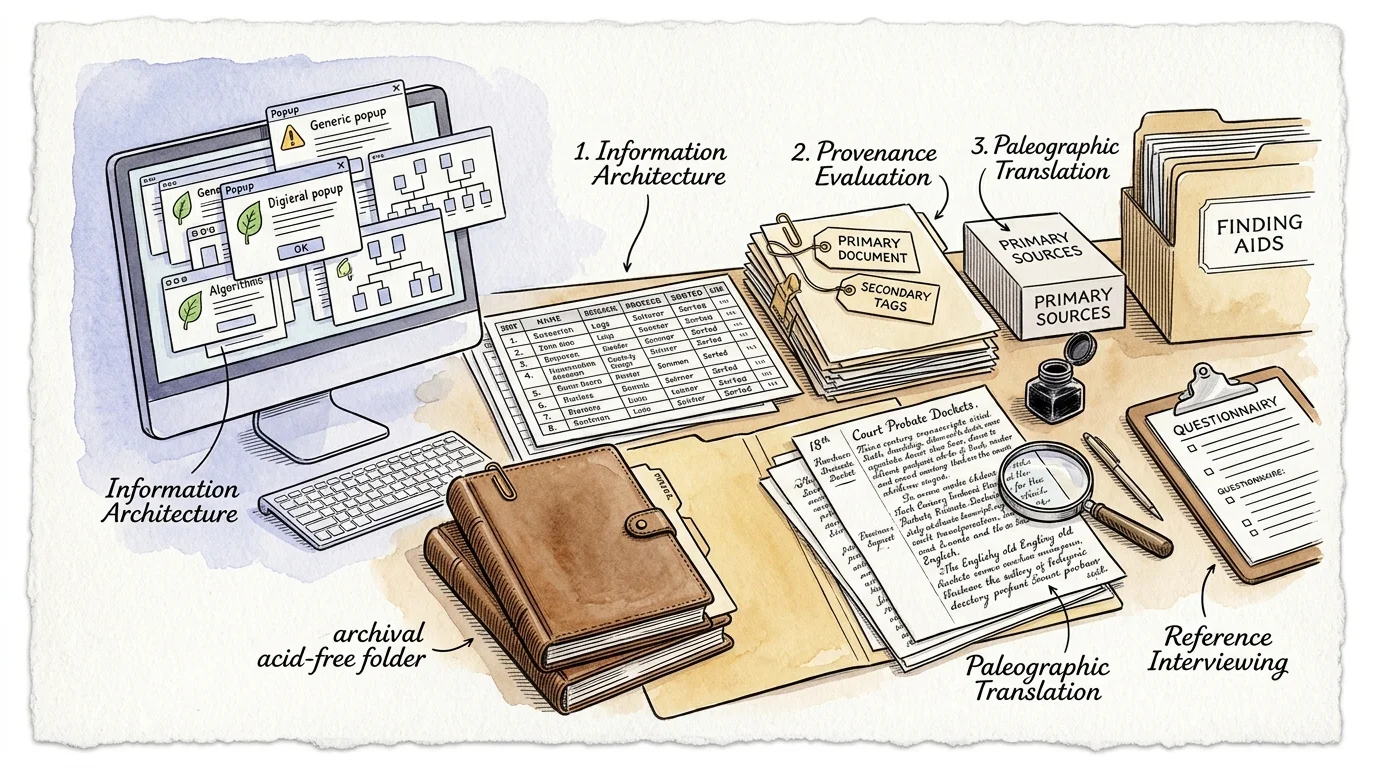
Starting With Handshake Favors Violates 2024 Ethics Rules
The failure mode: Reviewing a prospective client’s pedigree chart before signing paperwork creates hours of unpaid preliminary work and violates modern ethics standards.
The cause: Salaried reference service builds a reflex to answer questions immediately, and beginners reinforce that habit with free speculative checks of tax duplicates or probate inventories.

The APG, founded in 1979 with 2,000 members across 40 countries, implemented a revised Code of Ethics on July 1, 2024, after April 18, 2024 approval. Standard 4 mandates written fee and scope agreements, while membership requires 12 annual continuing education hours.
The fix: Apply entrepreneurial practices highlighted by Encore.org and refuse unbilled reviews. Require a signed engagement letter before opening any finding aid or reference interview.
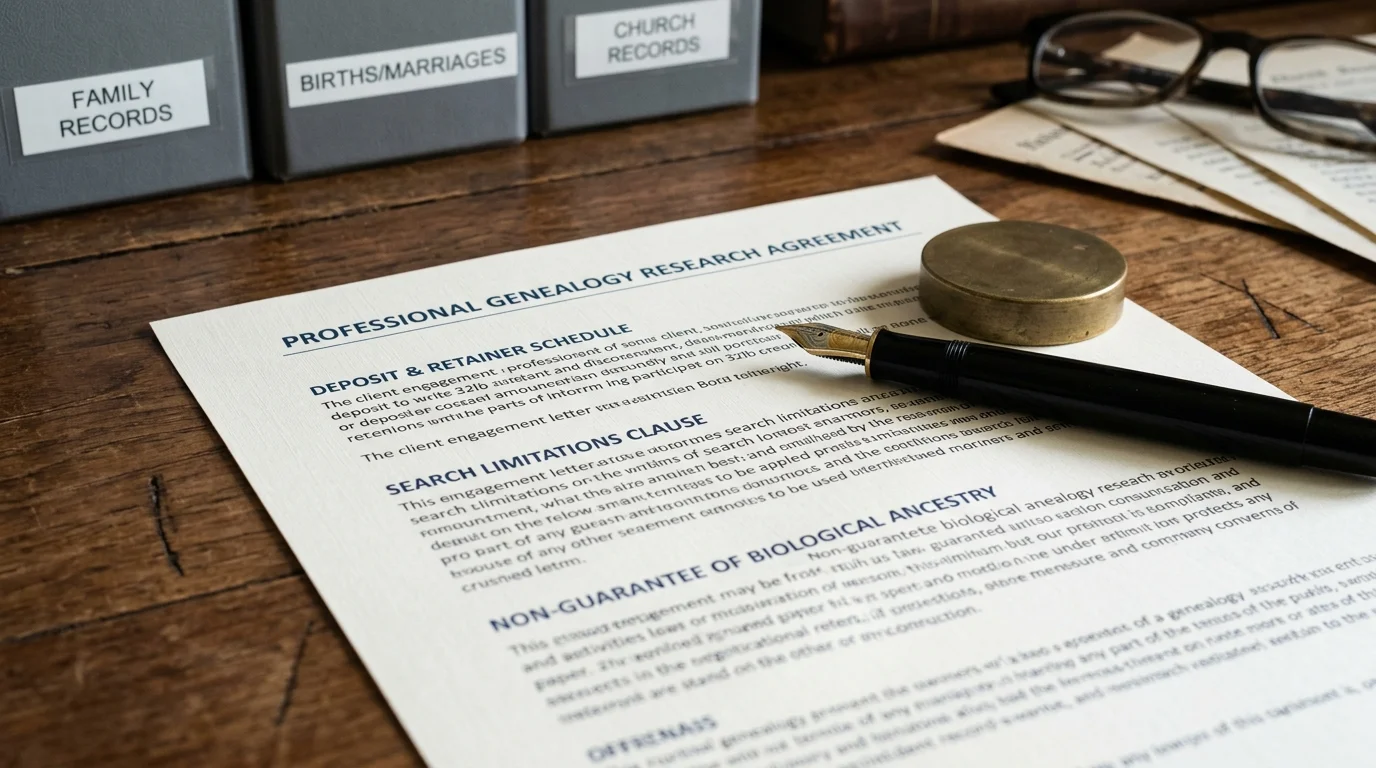
Relying on Vague Bullet Points Instead of Verbatim Contract Clauses
The failure mode: Clients demand refunds after negative searches or dispute archive copy charges when loose intake notes fail to govern the engagement.
The cause: Summarizing contract topics as brief bullet points leaves clients expecting guaranteed positive discoveries rather than billable analysis of chancery dockets and court records.
The fix: Specify a target like identifying an ancestor born in 1845, authorized hours, deliverable formats, and cancellation terms, using SCORE Mentoring to refine bookkeeping and templates. Insert this verbatim non-guarantee clause before collecting a signature:
“Client engages Researcher for professional research time, paleographic transcription, and evidence analysis, not guaranteed positive discoveries. Negative searches in unindexed or incomplete records require full billable labor and remain payable in full from the authorized retainer.”
Follow that section immediately with verbatim expense reimbursement terms so repository fees never erode your hourly pay:
“Client agrees to reimburse direct project expenses separate from hourly fees, including certified civil certificates, archive entrance passes, photocopies, reader prints, and IRS-rate business mileage. Researcher will deduct verified receipts from a dedicated expense deposit and refund any unused balance.”

Quoting Entry-Level Hobbyist Rates for Master-Level Archival Skill
The failure mode: Charging entry-level hourly wages or billing single unbundled hours cuts your retirement income and attracts price-focused clients.
The cause: Retired librarians often anchor to $30 to $40 entry-level rates instead of the $50 to $120 general freelance range or $150 to $200 forensic rates.
Meanwhile, commercial firms like AncestryProGenealogists price custom research packages individually, with standard genealogy projects starting as low as $3,800 USD (and genetic unknown-parentage packages starting at $4,900+ USD).
The fix: Set baseline rates at $45 to $75 per hour for 18th- and 19th-century manuscript work, sold in prepaid retainer blocks, and add $10 hourly once you hold a four-week waiting list:
- Targeted Record Retrieval: $45.00 hourly in 5 to 8 hour blocks at local municipal archives for digital scans and citations.
- Single-Line Problem Solving: $60.00 hourly in 15 to 20 hour blocks at county and state archives for an analytical GPS report.
- Comprehensive Lineage Search: $75.00 hourly in 25 to 40 hour blocks across state, federal, and specialty repositories for a bound narrative and pedigree.

Commingling Research Retainers With Out-of-Pocket Archive Expenses
The failure mode: Fronting courthouse copy fees or skipping fifteen-minute time logs shrinks your net pay and creates end-of-project billing friction.
The cause: Collecting only an hourly retainer forces you to absorb mid-project reader printer and probate copy costs or chase reimbursements after delivery.
The fix: Collect a separate expense deposit upfront, as in a 20-hour case investigating Samuel Vance, who died in Washington County, Pennsylvania, in 1876. At $65 hourly, the client pays $1,450 upfront, combining a $1,300 retainer and $150 expense deposit:
- Preliminary analysis and plan of client notes, census records, and finding aids (3.0 hours).
- Onsite courthouse research in estate packets, deed indices, and orphan court dockets (10.5 hours).
- Evidence synthesis resolving conflicting census dates in a correlation matrix (2.5 hours).
- Report writing, will transcriptions, and document call sheets (4.0 hours).
With 20.0 hours billed in fifteen-minute increments, expenses total $78.50 for $36.00 certified probate copies, $24.00 reader prints, and $18.50 tolls. Issuing a $71.50 refund check from the deposit builds trust and often leads to a second 20-hour retainer.
Sending Unstructured Research Notes Instead of GPS-Compliant Reports
The failure mode: Delivering raw scans or public online tree links obscures negative search value and risks exposing private family records.
The cause: Relying on informal reference emails or cloud trees that auto-sync publicly leaves clients without clear proof or privacy safeguards.
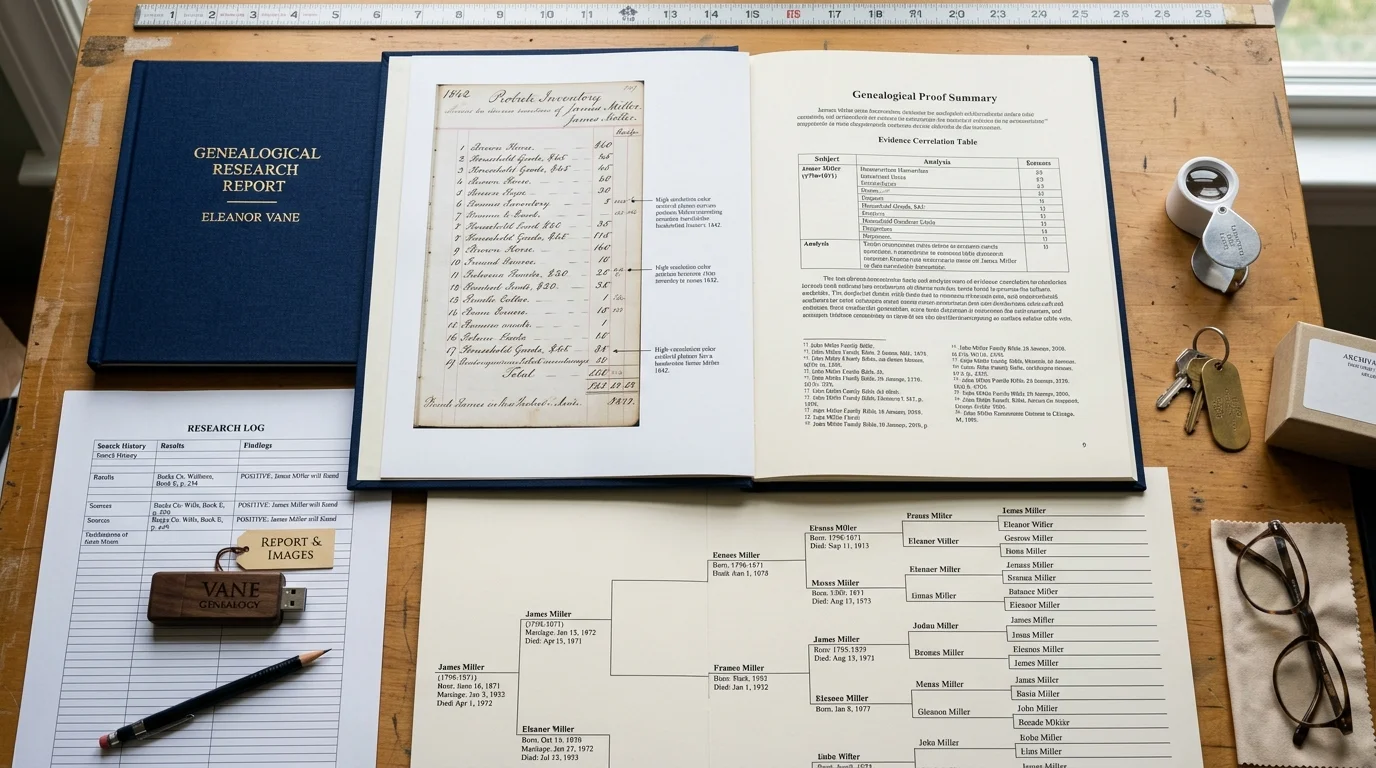
The fix: Follow the Board for Certification of Genealogists’ Genealogical Proof Standard (GPS) and Elizabeth Shown Mills’s Evidence Explained citations. Deliver a hyperlinked, bookmarked archival PDF containing six structured sections:
- Cover sheet with project title, client name, credentials, date, and contract number.
- Executive summary answering the research question directly.
- Background and scope restating authorized questions.
- Evidence analysis with high-resolution snippets, paleographic transcriptions, and negative findings.
- Research log listing every index, manuscript, and repository call number.
- Next-phase recommendations for subsequent retainers.
Maintain client privacy inside desktop software like RootsMagic 10 or Family Tree Maker 2024 rather than public sites, and track citations and billing in Microsoft Excel.
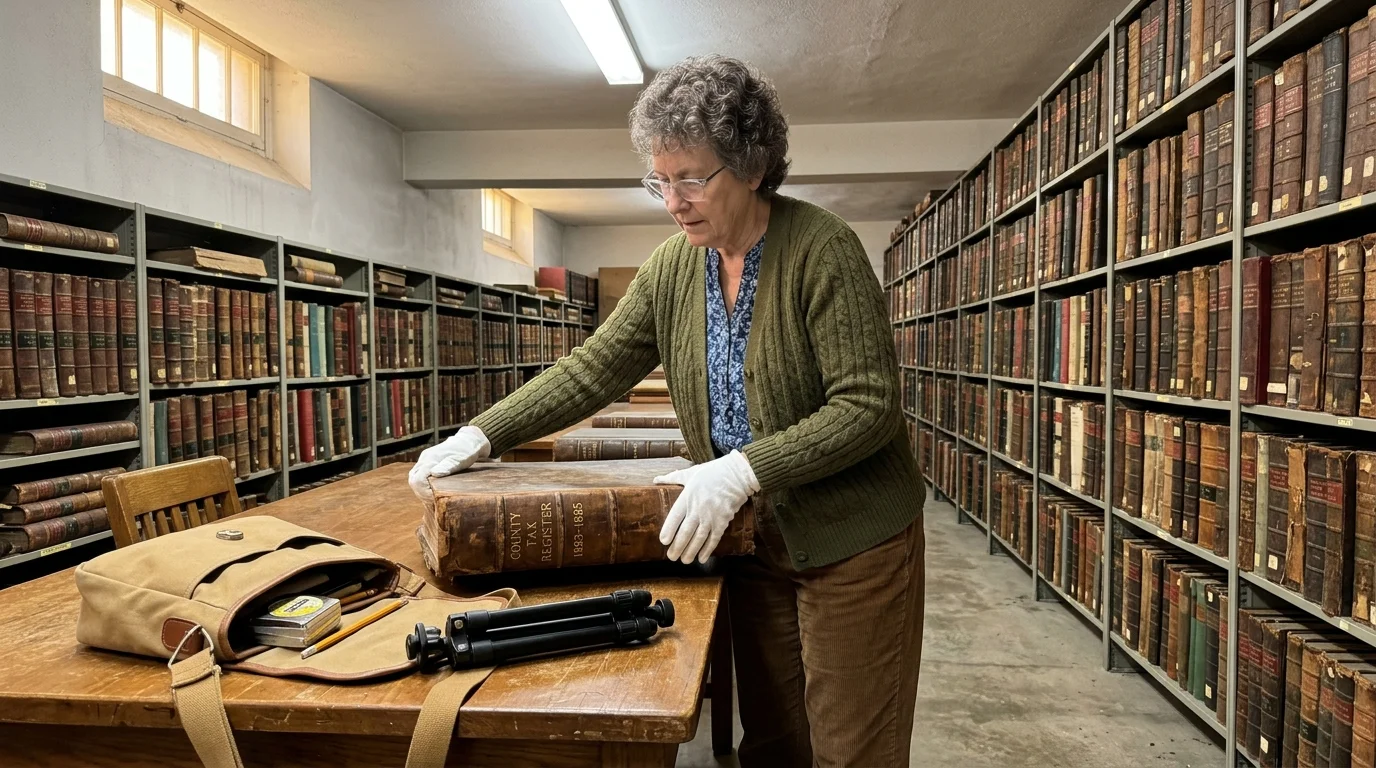
Absorbing Courthouse Travel Time and Arriving Unprepared at Archives
The failure mode: Driving unpaid hours to distant courthouses or hitting surprise camera bans and pull limits wastes your billable day.
The cause: Treating regional visits as personal day trips and assuming county clerks share university library rules lowers real hourly pay.
The fix: Bill out-of-area transit at your full rate or an agreed 50 to 60 percent travel rate plus standard IRS business mileage. Offer $30 to $45 flat fees for exact-citation lookups.
Always confirm archive hours, digital camera policies, and record retrieval limits before traveling. Build working relationships with local historical society, university library, and county clerk staff to keep onsite research efficient.
Overbooking Weekly Hours or Stalling Below Credentialed Fee Tiers
The failure mode: Overloading your calendar recreates a stressful full-time grind, while avoiding formal credentials locks you out of top fee brackets.
The cause: Because no state or federal regulatory body requires a genealogy license, new practitioners either overcommit early or delay peer review indefinitely.
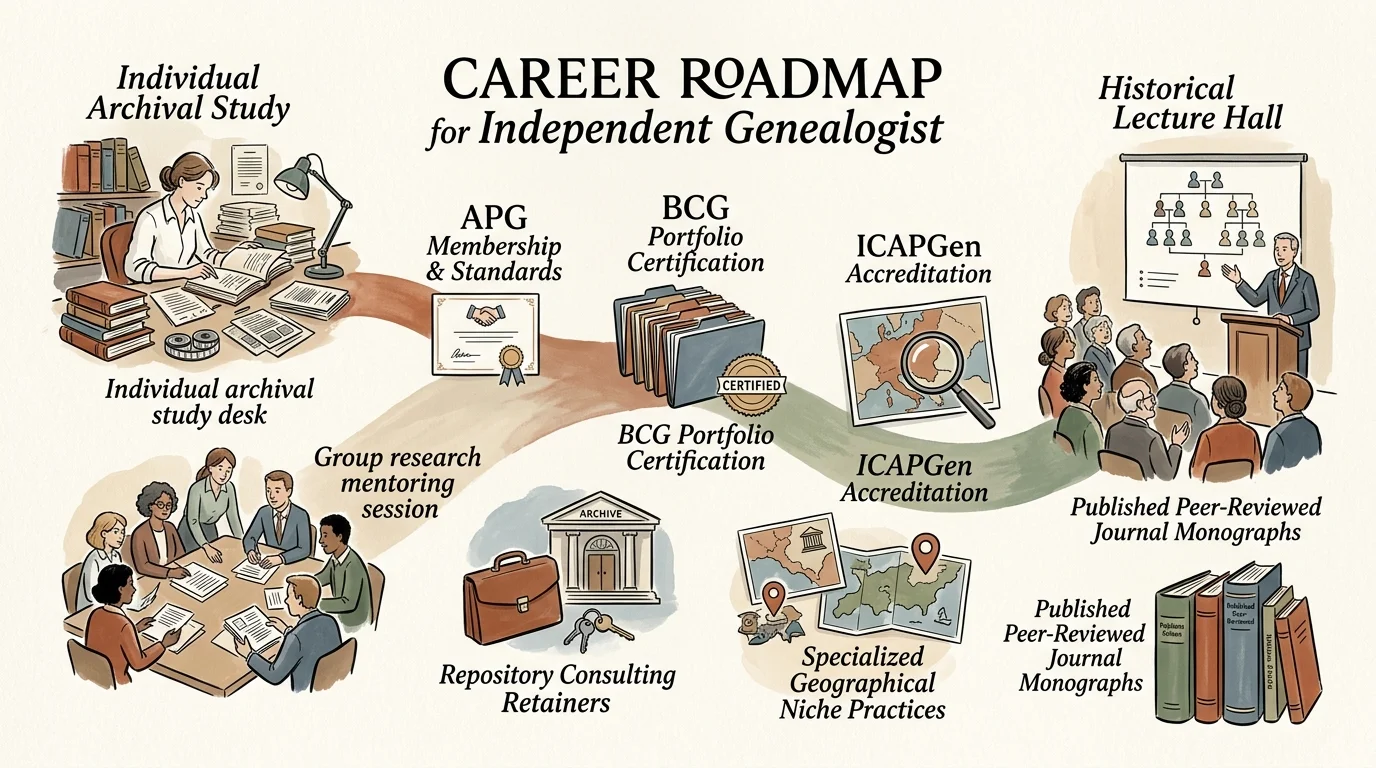
The fix: Sustain 10 to 20 billable research hours weekly, or roughly two client cases per month, to preserve retirement flexibility. Once established, earn peer-reviewed credentials to justify rates exceeding $85 to $110 per hour.
The Board for Certification of Genealogists awards the Certified Genealogist (CG®) credential via portfolio review, requiring an $80 preliminary application fee and a $400 total portfolio submission fee ($200 each for Parts 1 and 2, plus $80 annual maintenance).
Alternatively, the International Commission for the Accreditation of Professional Genealogists awards the Accredited Genealogist (AG®) credential through a four-generation project and proctored testing. Maintenance costs $80 annually plus $20 per additional tested region.
Disclaimer: This article is for informational and inspirational purposes. Life decisions are deeply personal, and we encourage readers to pursue their dreams while considering their unique circumstances, health, and financial situation.