

Your decades of administrative leadership hold premium value for boutique law firms across the country. By specializing in estate administration workflows, you can bypass entry-level freelancing and immediately command $35 to $55 per hour.
Most virtual assistant guides steer retirees toward low-paying data entry gigs; this guide proves that mastering probate-specific platforms turns your corporate organizational skills into an indispensable, high-margin legal asset.
You will discover how to launch a resilient probate virtual assistant business that delivers intellectual stimulation, complete calendar control, and reliable recurring revenue.
The $124 Trillion Wealth Transfer: Why Solo Attorneys Need You
The legal market is undergoing a historic transformation driven by demographics. Solo practitioners and boutique law firms are facing unprecedented caseloads in estate administration.
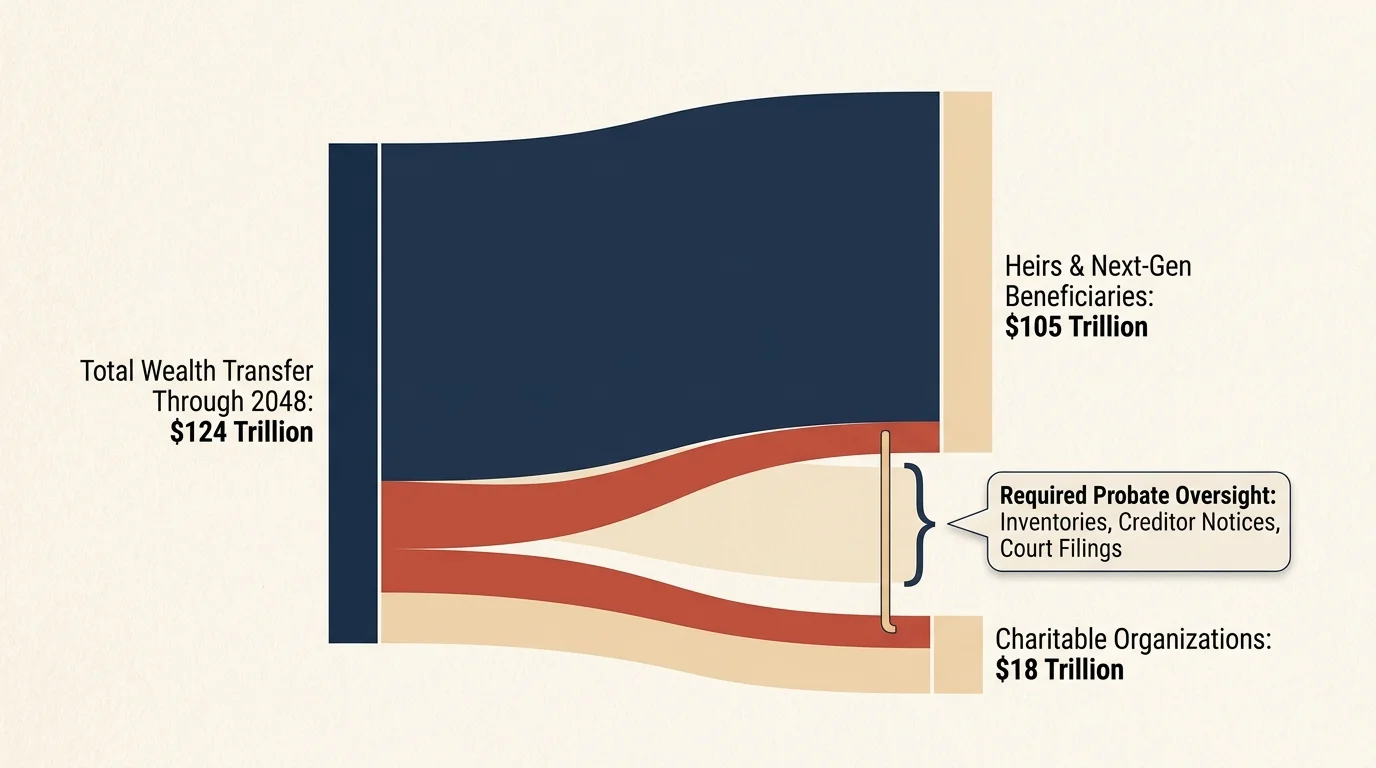
According to comprehensive wealth research from Cerulli Associates, an estimated $124 trillion in assets will transfer between generations through 2048. Heirs will receive roughly $105 trillion, while charitable organizations will receive $18 trillion.
Every dollar that moves through formal estate distribution requires structured legal oversight. County probate courts mandate inventories, creditor notifications, appraisals, and formal fiduciary accountings.
Solo attorneys simply cannot keep up with this crushing administrative volume alone. Hiring full-time, in-house staff brings steep overhead costs, expensive office leases, and heavy benefit packages that small firms avoid.
This dynamic creates extraordinary demand for independent, remote legal support professionals. Your operational maturity provides the poise and diligence that attorneys urgently need to keep client matters moving forward.
A transition into this specialized field allows you to capitalize on your executive background. Organizations like Encore.org highlight how experienced professionals convert lifelong workplace skills into purposeful, high-impact encore careers.
Launching a legal VA second career after 60 lets you bypass corporate politics completely. You choose your legal partners, establish your working schedule, and run an autonomous advisory practice from your home.
Hourly Rate Benchmarks and Monthly Retainer Structures
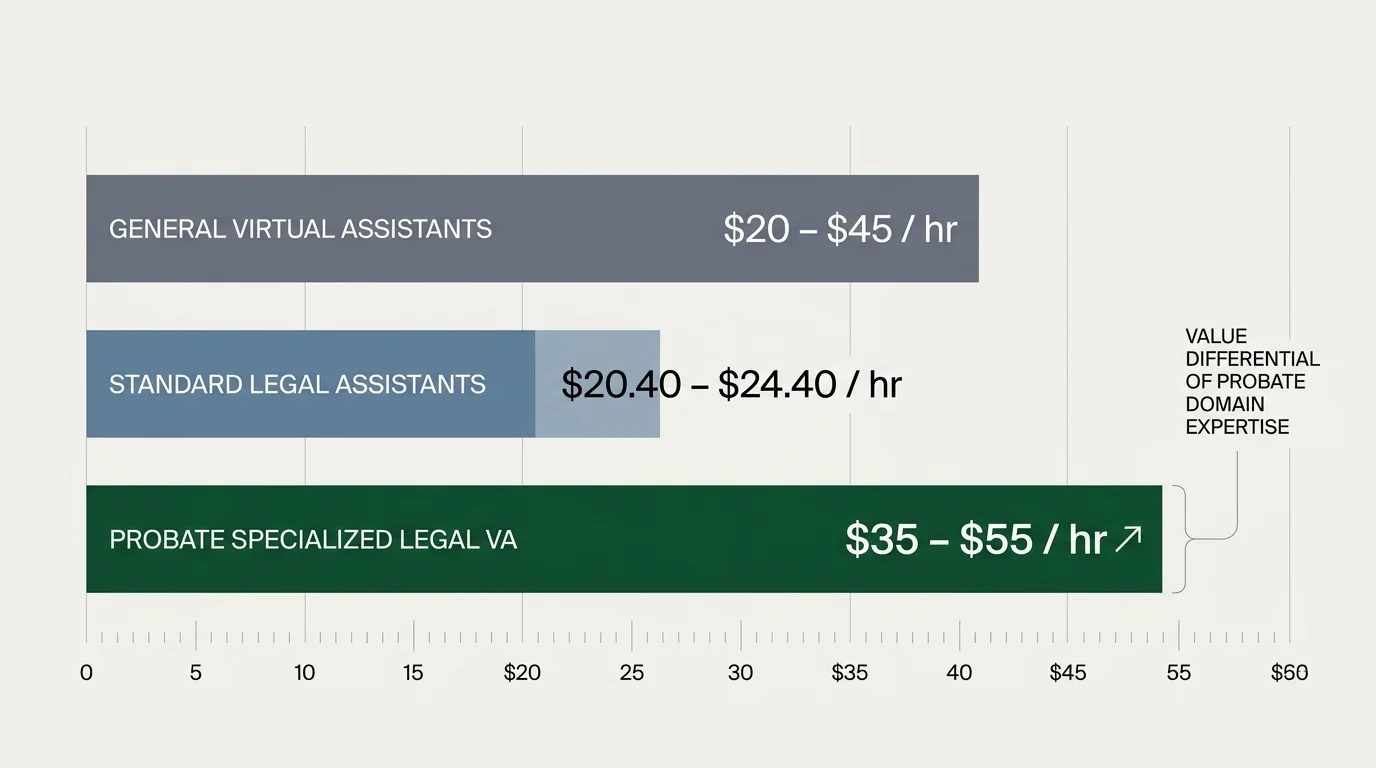
Generalist virtual assistants often struggle to compete against international labor pools offering rock-bottom pricing. Data shows standard remote legal assistants earn average baseline rates between $20.40 and $24.40 per hour.
Beyond administrative retainers, some legal assistants also run a part-time mobile loan signing route to notarize mortgages and estate deeds during flexible morning hours.
General administrative freelancers on broad platforms usually peak between $20 and $45 per hour. However, specialized probate support commands significantly higher compensation in the domestic legal marketplace.
Specialized probate virtual assistants and freelance estate paralegals regularly bill between $35 and $75 per hour. Your familiarity with fiduciary documentation, financial spreadsheets, and formal court deadlines justifies these premium rates.
To establish predictable monthly income, you should transition private clients away from hourly billing and into structured retainer agreements. Monthly retainers stabilize your earnings while guaranteeing dedicated service hours for your attorney clients.
- Starter Probate Retainer: $1,050 per month for 30 hours of support ($35 per hour equivalent), ideal for solo attorneys handling two to three active probate files.
- Standard Estate Workflow Retainer: $1,800 per month for 40 hours of support ($45 per hour equivalent), designed for busy boutique practices requiring routine weekly filings.
- Premium Fiduciary Retainer: $2,750 per month for 50 hours of support ($55 per hour equivalent), tailored for high-volume estate litigation and complex multi-asset trust accountings.
Attorneys understand this commercial proposition because your specialized assistance functions as an immediate profit center. While probate courts disallow billing clerical or administrative tasks to an estate, law firms routinely bill substantive legal work performed by a qualified paralegal under attorney supervision—such as drafting probate filings or preparing asset inventories—at $125 to $175 per hour.
A firm may pay you $45 per hour for that qualified paralegal support. You receive reliable compensation, the firm expands its gross margins, and the estate moves smoothly toward final settlement.

Essential Software Certifications: Clio, Estateably, and Court Portals
You do not need a law degree to win high-paying attorney clients; you need platform fluency. Gaining verifiable credentials in leading legal applications proves your immediate capability to prospective law firms.
Begin your professional upskilling with Clio Academy, the educational arm of the legal industry’s dominant cloud practice management platform. Clio provides two prestigious credentials that establish your operational authority.
- Complete the training modules for the Clio Certified Administrator badge, covering core database management, secure billing, and calendar coordination.
- Once working with a firm subscribed to Clio Work, earn the Clio Work Certified Expert credential to prove mastery over task automation, matter management workflows, and document template generation.
The Clio Certified Administrator training course and certification exam are completely free to anyone on demand, while the Clio Work Certified Expert credential is restricted to active Clio Work customers. Displaying these digital badges on your website and proposals instantly reassures attorneys that you require zero software hand-holding.
Next, master specialized estate administration software like Estateably. Estateably is a purpose-built cloud application designed specifically for probate administration and fiduciary trust accounting.
The platform maintains active integrations with Clio and houses an extensive library of automated court forms spanning more than 3,000 legal jurisdictions. The system operates on a flexible per-file pricing model, starting at approximately $129 per probate matter.
Law firms pass this software fee directly to the client as an authorized estate expense. You can attend Estateably’s free onboarding webinars to learn their automated asset inventory and distribution modules thoroughly.
Finally, develop working knowledge of court e-filing portals. Most county probate registries utilize platforms such as Odyssey File & Serve, PeachCourt, Florida Courts E-Filing Portal, or New York State Courts Electronic Filing (NYSCEF).

Specialized Probate Software: Feature and Cost Comparison
Understanding the exact software landscape helps you recommend the right workflow solutions to solo practitioners. The table below details key specifications for leading legal estate platforms.
| Platform Name | Primary Legal Function | Certification Availability | Platform Direct Cost | Core Workflow Capabilities |
|---|---|---|---|---|
| Clio Manage | General Practice Management | Free Certified Administrator Badge | $89 – $149 per user per month | Time tracking, matter intake, automated calendaring, client communication portal |
| Estateably | Probate & Trust Administration | Free Product Onboarding Webinars | $129 base fee per probate matter | 3,000+ jurisdiction forms, automated inventory, formal fiduciary accounting tables |
| WealthDocx (WealthCounsel) | Estate Planning Drafting | Paid Member Training Programs | $400 – $650 per month subscription | Document assembly, statutory compliance updates, complex trust structure drafting |
| Smokeball | Productivity & Document Automation | Smokeball Academy Certification | $149 – $219 per user per month | Automated activity recording, court form libraries, local word processor integration |
Familiarity with these distinct architectures allows you to advise solo attorneys on streamlining their administrative bottlenecks. Mastering these platforms turns you into an indispensable technical partner for growing firms.
Drafting Bulletproof Engagement Contracts and Legal Guardrails
Operating a probate virtual assistant business requires rigorous compliance with professional legal standards. You must define strict operational guardrails to protect your business and preserve the attorney’s professional license.
Non-attorney assistants must operate strictly under the direct supervision of a licensed attorney pursuant to American Bar Association (ABA) Model Rules 5.3 and 5.5. These rules prohibit non-lawyers from engaging in the Unauthorized Practice of Law (UPL).
Your service contracts must state explicitly that you provide administrative and document-preparation support exclusively. You cannot give legal advice, represent parties before a judge, or set legal fees for clients.
Integrate clear ethical clauses within every service agreement you present to a law firm:
- Supervisory Oversight Clause: Explicitly states that the contracting attorney reviews and approves all correspondence, probate forms, and court submissions before formal filing.
- Confidentiality and Privilege Protocol: Upholds ABA Model Rule 1.6 by requiring bank-grade file encryption, strict data isolation, and adherence to attorney-client privilege rules.
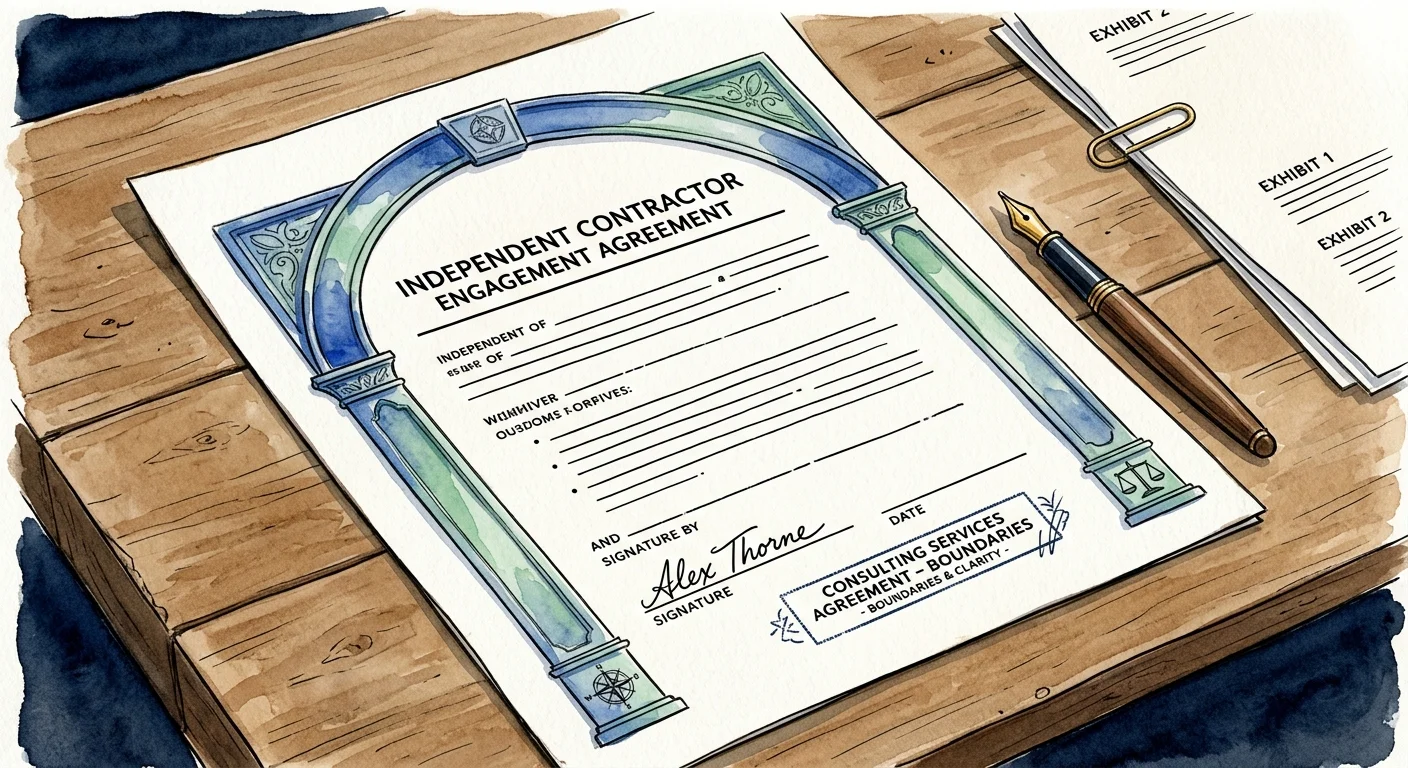
- Independent Contractor Status: Clarifies that you operate as a 1099 independent contractor responsible for your own taxes, business insurance, and equipment.
- Invoicing and Late Fees: Establishes clear payment parameters, requiring retainer payments in advance on the first business day of every calendar month.
When launching your corporate structure, consult non-profit counseling organizations like SCORE Mentoring for free expert guidance. Volunteer business mentors can help you review commercial insurance needs and set up an efficient independent contractor framework.
Have every attorney client sign your engagement agreement before you touch a single client file. Require an IRS Form W-9 at client onboarding, and anticipate receiving an annual Form 1099-NEC for payments exceeding $600.

A Worked Retainer Model: Real Numbers for a Part-Time Practice
Let us examine an authentic financial scenario showing how a probate VA practice generates sustainable income. In this example, you work a relaxed 16 hours per week supporting three boutique legal practices.
Client A is a solo practitioner who retains you for 20 hours each month at $45 per hour to manage inventory filings and initial petitions. You bill Client A exactly $900 on the first day of each month.
Client B runs an active estate planning boutique and needs 30 hours of monthly support at $45 per hour to handle estate accountings and creditor claims. Client B pays a predictable $1,350 monthly retainer.
Client C is an estate litigator who contracts 15 hours per month at a premium rate of $50 per hour for document review and deposition summaries. Client C contributes $750 each month.
Across these three clients, your monthly gross revenue reaches precisely $3,000 for 65 total hours of scheduled work. That represents an average commitment of only 15 to 16 hours of focused work each week.
Your ongoing monthly business operating expenses remain exceptionally lean, maximizing your net income:
- Google Workspace with enhanced data encryption and professional domain email: $18.00 per month.
- Professional liability and errors and omissions insurance (E&O): $48.50 per month.
- Dedicated high-speed secure internet allocation: $55.00 per month.
- Cloud backup storage and password manager licensing: $14.00 per month.
- Estateably and Clio software access costs: $0.00 (paid directly by the contracting law firms).
Your total monthly operating costs equal exactly $135.50. Subtracting your operating expenses from your $3,000 gross retainer revenue leaves you with $2,864.50 in monthly net pre-tax profit.
This worked financial model demonstrates that you do not need forty-hour workweeks to earn substantial income. You can maintain intellectual vitality and financial independence while leaving ample time for travel, family, and personal passions.
Step-by-Step Roadmap to Launching Your Second Career
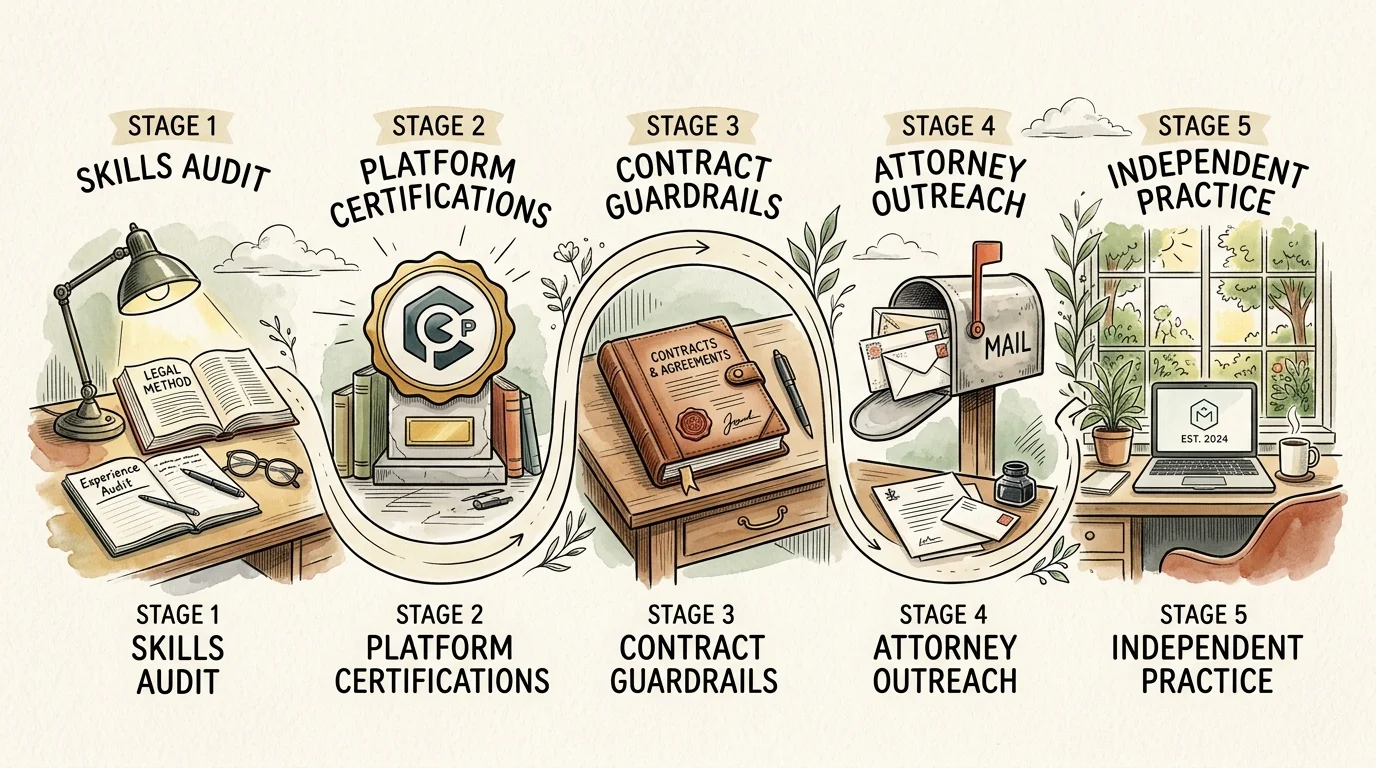
Transitioning into legal support requires methodical execution. Follow this structured roadmap to launch your remote probate virtual assistant business safely and efficiently.
- Audit Your Technical Assets: Establish a dedicated home workstation with a modern dual-monitor configuration, a webcam for client consultations, and full-disk device encryption.
- Attain Industry Software Badges: Register with Clio Academy, complete the necessary coursework, and secure your Clio Certified Administrator credential within two weeks.
- Prepare Legal Templates: Finalize your standard independent contractor engagement contract, client intake questionnaire, non-disclosure agreement, and IRS Form W-9.
- Identify Target Law Firms: Build an outreach list of 30 solo and boutique probate practitioners located across your state bar jurisdiction using public bar directories.
- Pitch Administrative Relief: Contact these attorneys directly with tailored proposals highlighting how you eliminate administrative backlogs, manage court deadlines, and bill at fair remote legal support rates.
- Onboard Your First Retainer: Secure your first monthly retainer agreement, set up a shared digital workspace, and schedule weekly fifteen-minute status checks to maintain accountability.
Each completed probate matter expands your reputation among local bar associations. Word-of-mouth recommendations among solo attorneys will quickly fill your available monthly client hours.
Frequently Asked Questions
Do I need a paralegal certificate or a formal law degree to work as a probate virtual assistant?
No formal legal degree or paralegal certificate is legally required to provide remote administrative support. Licensed attorneys supervise your work and retain final legal responsibility for all filings and documents.
Attorneys value corporate organizational competence, clear communication, and software proficiency far more than legal theory. Your executive background gives you the precise documentation skills probate courts demand.
How do solo attorneys justify paying remote legal support rates between $35 and $55 per hour?
While clerical and administrative work is non-billable overhead, attorneys frequently bill substantive legal tasks performed by a qualified paralegal under attorney supervision directly to the probate estate at approved paralegal rates between $100 and $175 per hour. Your support acts as a direct profit center rather than overhead.
By delegating time-consuming document preparation to you, the attorney frees up valuable billing hours to consult with new clients and litigate cases. This partnership significantly increases the law firm’s total annual revenue.
What hardware and data security tools do law firms expect an independent legal VA to maintain?
Firms require a dedicated computer with full-disk encryption, dual-factor authentication, a business-grade virtual private network, and secure cloud storage. A separate, password-protected user profile isolates confidential client files.
You should never perform legal client work on public Wi-Fi networks without an active, encrypted VPN connection. Maintaining rigorous data hygiene protects client confidentiality and ensures full compliance with ABA Model Rule 1.6.
How do I handle probate court rules if my attorney client operates in a different county or state?
Every county probate court publishes its local rules, filing fee schedules, and required probate forms online. You can quickly master local filing nuances by downloading county clerk checklists and reviewing sample dockets.
Most court filing portals provide clear electronic guidelines and automated validation checks that prevent submission errors. Additionally, court clerks are remarkably helpful when answering procedural questions regarding local filing conventions.
Disclaimer: This article is for informational and inspirational purposes. Life decisions are deeply personal, and we encourage readers to pursue their dreams while considering their unique circumstances, health, and financial situation.






2 Comments