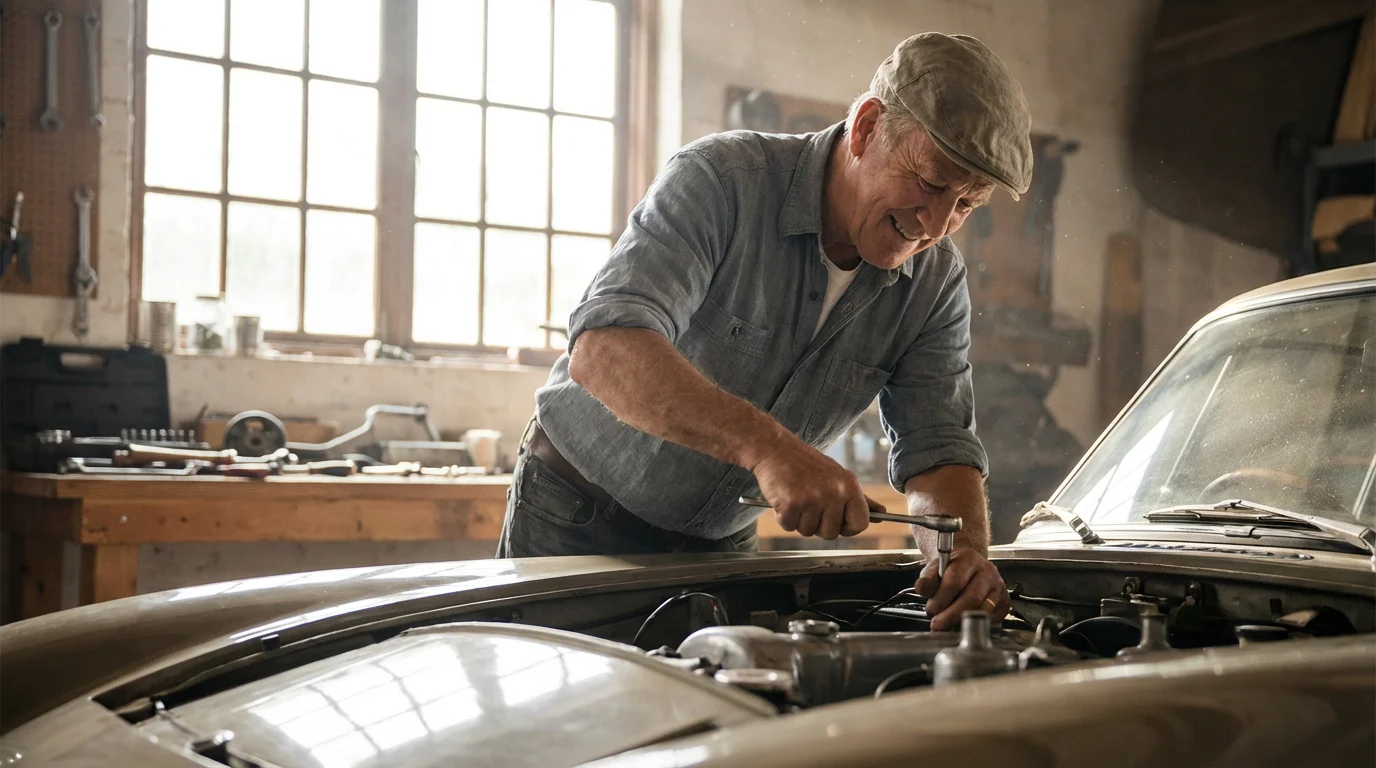
Conventional restoration advice tells a solo retiree over 60 to strip a classic car to bare metal and rebuild everything once. Inside a single-car home garage, that frame-off approach backfires into multi-year bay lockout, stalled momentum, and physical burnout.
As of November 2026, keeping a $15,000 to $35,000 rolling restoration moving requires rebuilding one isolated subsystem at a time on a running car. Avoiding these predictable failure modes protects your single bay, joints, lungs, and budget before wrenching begins.
Frame-Off Teardowns That Lock Up a Single Garage Bay
The failure mode: Tearing a classic down to a bare frame or buying a disassembled basket case turns your only garage bay into dead storage for five years or longer.
The cause: Total teardowns scatter thousands of fasteners into boxes, expose bare steel to humidity, and stall whenever enthusiasm dips or injuries strike. Disassembled basket cases also lack discontinued brackets and interior clips that cost more than complete drivers.
The fix: Start with a complete, running, and stopping car and execute a rolling restoration one isolated subsystem at a time. Complete one discrete job over a weekend, bleed the system, test-drive the car, and keep it registered for club cruises.
Upgrade your single bay first with brighter overhead lighting and dedicated 20-amp circuits so breakers stay on and work stays visible. Those electrical and layout upgrades follow our home improvement projects guide.
Garage-Fit Miscalculations and Hidden Structural Rust
The failure mode: Buying a vehicle that barely fits your single-car bay or conceals structural rust forces costly metal fabrication or strands the car outside.
The cause: Bolt-on parts such as alternators, water pumps, and brake calipers come off in an afternoon, while rusted unibodies and cabs require specialized welding. Sinking $30,000 into heavy metalwork quickly exceeds what a finished driver-grade example sells for.
The fix: Measure garage length and door height first, benchmark values with the Hagerty Price Guide valuation methodology, and pick a popular starter model with full aftermarket sheetmetal, simple electrical harnesses, and wide vendor catalogs:
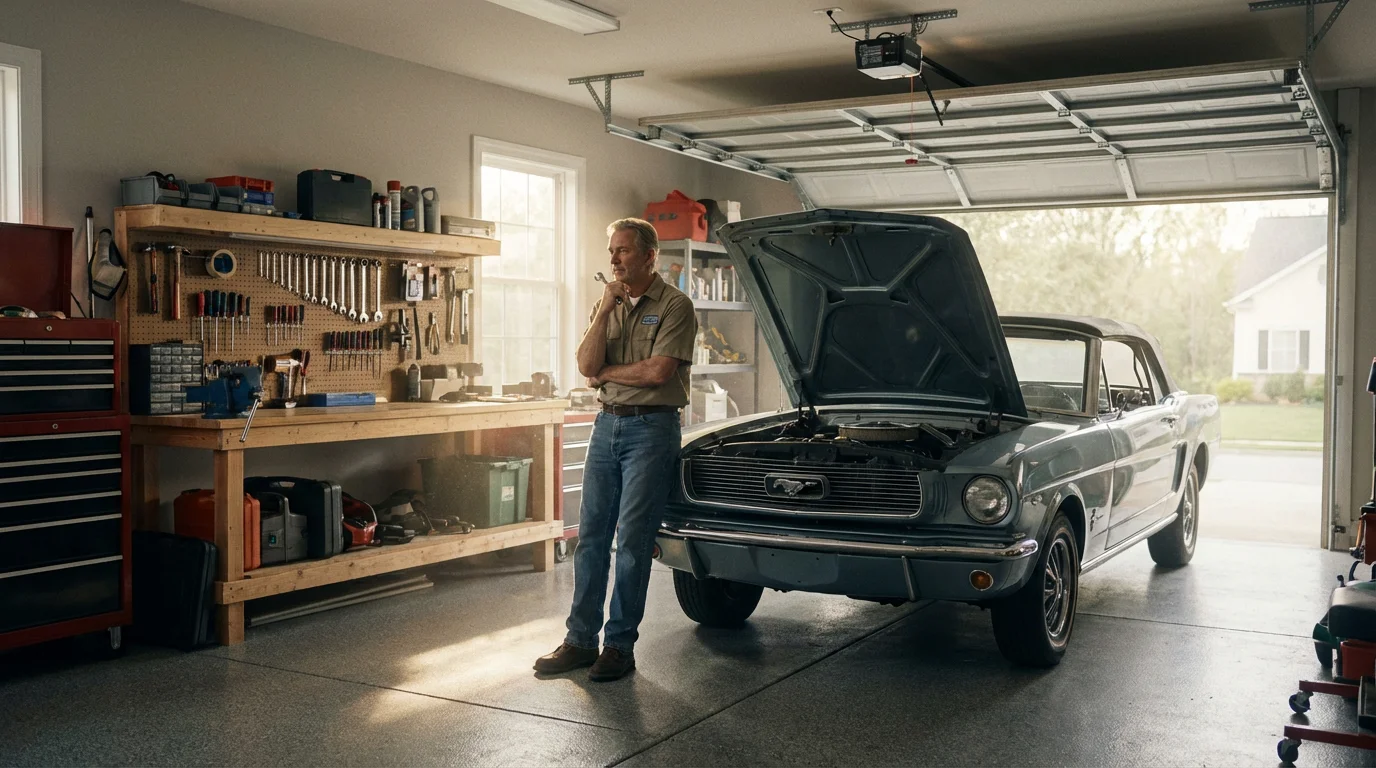
- 1964.5–1968 Ford Mustang: Fits standard single-car bays with an inline-6 or small-block V8 and mechanical ignition, though cowl vents, front torque boxes, floorpans, and rear quarter panels trap rust; strong reproduction catalogs and resale cushion Condition 3–4 budgets.
- Pre-1974 Volkswagen Beetle: Leaves ample bench space on a short bolt-on backbone pan with an air-cooled flat-4 removable with basic hand tools and minimal wiring; check heater channels, floorpan halves, battery tray, and spare-tire well, and watch paint-to-value ratios on later years.
- 1967–1972 Chevrolet C10: Offers a roomy engine bay around an inline-6 or V8 and straightforward leaf/coil suspension, so verify garage length and door height first; check cab corners, lower door skins, rocker panels, and front cab floor supports, knowing every bed panel is reproduced.
- 1962–1980 MGB Roadster: Maneuvers easily in tight garages with a four-cylinder overhead-valve engine, though twin SU carburetors require tuning patience; inspect three-layer rocker sills, doglegs behind doors, and the battery box, backed by nearly full new body shells.
- 1989–1997 Mazda Miata (NA): Pairs light doors and hood with a fuel-injected DOHC 4-cylinder adding OBD diagnostics alongside easy bolt-on access; check rear rocker panels ahead of rear wheels and front frame-rail corrosion, as lower entry costs leave room for paint.
Crawl underneath with a flashlight and magnet before making an offer to check frame rails, floorpans, and lower door seams. Then pay a classic-car mechanic to inspect frame rails, torque boxes, compression, and leaks on a two-post lift before closing.
Salvage Titles, Missing Trim, and HOA Driveway Penalties
The failure mode: Skipping title, trim, and neighborhood checks leaves you with an unregistrable car, ongoing HOA fines, and steep bills for missing small hardware.
The cause: Private sellers sometimes omit salvage, flood, or junk histories, while many HOAs and city codes fine visible non-running cars, trailers, or outdoor wrenching. Missing stainless trim, window regulators, dash bezels, and seat frames also inflate budgets rapidly.
The fix: Confirm the chassis VIN matches the title and check the DOJ National Motor Vehicle Title Information System before paying a deposit. NMVTIS reports uncover salvage, flood, and junk brands before money changes hands.
Review HOA covenants and city ordinances ahead of delivery so work stays strictly inside your single garage bay. Also verify that trim pieces, dash bezels, window regulators, and seat frames are installed before finalizing the purchase.
Solo Heavy Lifting and Marathon Sessions That Trigger Injuries
The failure mode: Working four-hour stretches on cold concrete or hoisting heavy drivetrain parts alone causes knee wear, back stiffness, wrist tendonitis, or crush injuries.
The cause: The National Institute of Arthritis and Musculoskeletal and Skin Diseases notes that reducing repetitive joint stress helps manage osteoarthritis wear. Low creepers, solo cast-iron lifts, and high grip force linked by NIOSH to tendonitis overload bodies over 60.
The fix: Confirm safe postures with your doctor or physical therapist, and work in 60-to-90-minute blocks with bright lighting and magnifying glasses. Recruit a second adult or hire a shop before pulling any cast-iron engine block or transmission.
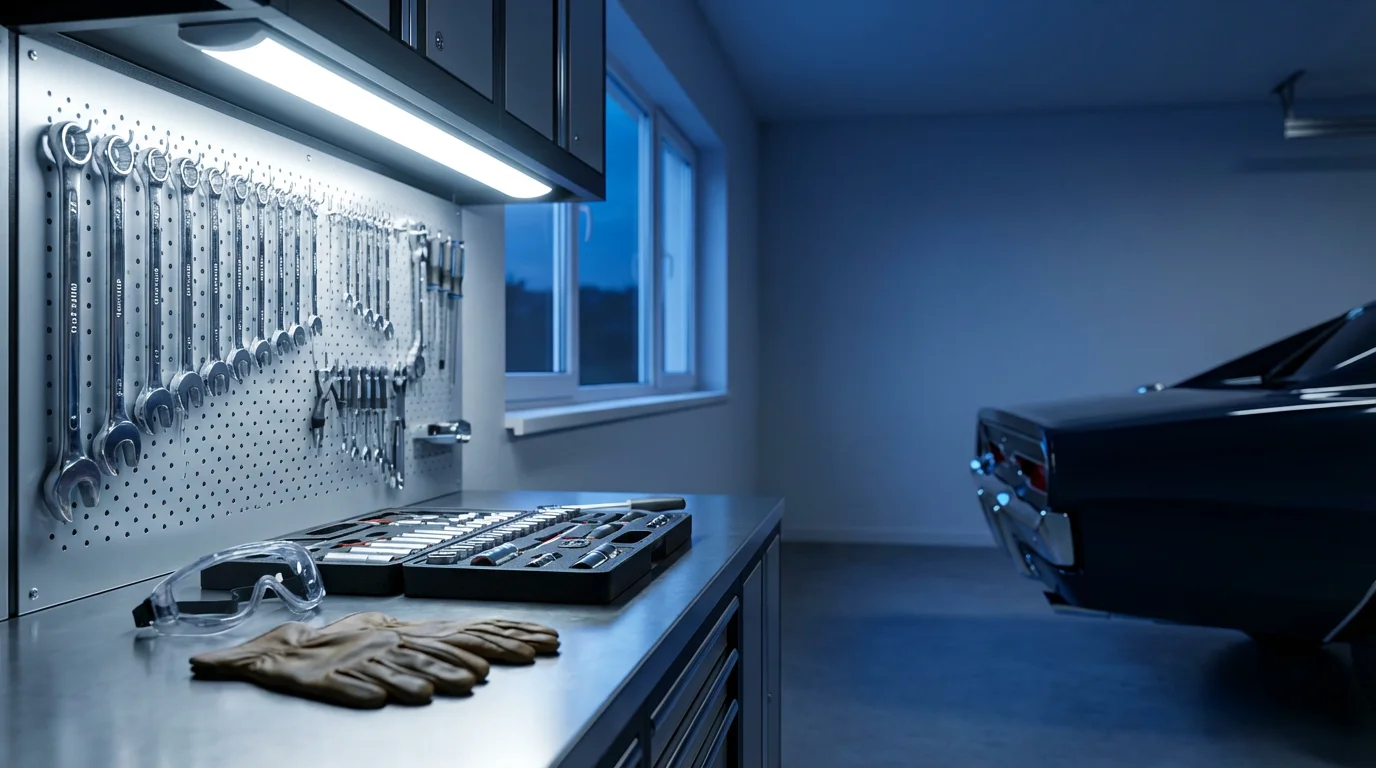
Replace low creepers with a rolling shop stool, anti-fatigue mats, cordless impact wrenches, ratcheting wrenches, and cushioned grips. Combining ergonomic tools with steady workbench habits reinforces the fundamentals in our home repair and DIY skills guide.
Before buying a portable mid-rise lift such as QuickJack, check curb weight limits, tire spread, lifting-point spread, and ground clearance against your car. Follow Automotive Lift Institute lifting safety guidance by choosing third-party certified lifts.
Always place lift pads on factory lifting points and lower weight onto mechanical safety locks. Never crawl beneath a vehicle supported solely by a hydraulic floor jack without rated jack stands on level concrete.
Home Spray Painting, Brake Dust, and Attached-Garage Fumes
The failure mode: Spraying modern urethane paint, blowing old brake dust, or idling an engine inside an attached garage exposes your household to lung damage, fire, and carbon monoxide.
The cause: Two-part (2K) urethane paints emit odorless isocyanates that bypass standard filter cartridges and cause fatal asthma attacks per NIOSH. Older brake shoes and clutches also shed OSHA-flagged asbestos, while CPSC warns indoor idling spreads carbon monoxide quickly.
The fix: Never spray 2K urethane paints in a home garage without a NIOSH-approved supplied-air respirator. Handle sanding and trim removal yourself, then pay a commercial body shop with a filtered booth to spray 2K primer and clearcoat.
Never blow brake dust with compressed air; rinse assemblies with wet brake cleaner over a drip pan while wearing a rated respirator. Never idle a classic engine inside an attached garage, even with the door open.
Store gasoline in cans with CPSC-required flame mitigation devices well away from water heaters and pilot lights. Take leftover paints, thinners, brake fluids, and batteries to EPA-listed municipal Household Hazardous Waste drop-offs, matching our garage small-engine repair guide.
Front-Loaded Spending, Generic Manuals, and Resale Illusions
The failure mode: Overspending early on cosmetics, relying on generic manuals, or expecting a profit leaves safety systems unfinished and drains retirement savings.
The cause: Generic aftermarket manuals skip model-year mid-cycle changes, leading to wrong parts and fastener errors. Meanwhile, hobby builds rarely recover parts and outsourced paint bills, unlike a profitable wooden boat restoration workshop.
The fix: Split a sample $25,000 rolling-restoration budget before buying: $12,000 for a running driver, $4,500 for brakes, tires, cooling, and steering, $2,000 for interior kits, $5,000 for outsourced bodywork and paint, and $1,500 for manuals, fluids, and surprises.
Those allocations exclude workshop tools and vary by region, so cap total spending below finished market value from day one. Order your exact-year factory shop manual and full-color wiring schematic for torque specs and diagnostic sequences before disconnecting any wire.
Join model-specific registries to source rare trim and avoid ill-fitting parts, along with the Antique Automobile Club of America (AACA). AACA membership connects you with over 350 local groups, national tours, and its 3-million-item automotive research library.