
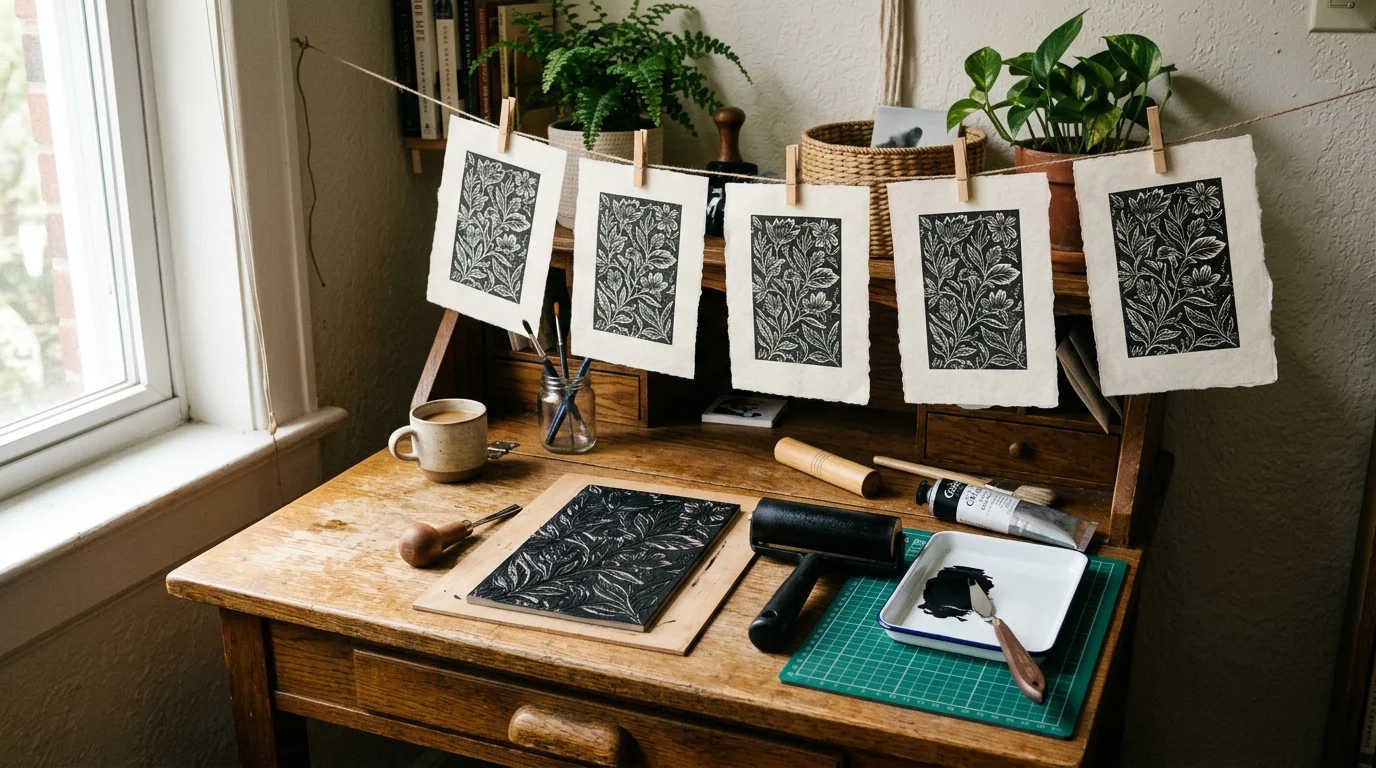
You can launch a fully functional relief printmaking studio on a 24-inch apartment writing desk without purchasing a heavy iron press or inhaling mineral spirits. This setup proves you do not need dedicated commercial ventilation or thousands of dollars to create archival, gallery-quality relief prints in retirement.
While standard printmaking guides mandate separate workshop spaces and hazardous petrochemical cleanups, modern water-washable oil formulations and handheld pressure tools fit comfortably onto your existing desk. You can assemble an odorless, professional studio for an initial investment under $250.
Odor-Free Ink Chemistry: Eliminating Apartment Solvents
Traditional relief printmaking relied on heavy oil inks that required turpentine or odorless mineral spirits for nightly washup. In an enclosed apartment living room or dining nook, these volatile organic compounds circulate through residential ventilation systems and pose significant health risks.
Modern chemistry eliminates this hazard through water-washable oil formulations and water-based emulsions. These formulations comply with ASTM D-4236 standards, codified under the federal Labeling of Hazardous Art Materials Act.
When selecting supplies, look for the Art and Creative Materials Institute Approved Product seal. This certification verifies that a medical toxicologist evaluated the formulation and found no acute or chronic health hazards.
Water-washable oil inks, such as Cranfield Caligo Safe Wash, use modified linseed oil binders that emulsify rapidly with standard liquid dish soap and tap water. You receive the long working time, rich pigment density, and velvety finish of fine oil ink without chemical vapors.
True water-soluble inks dry rapidly via water evaporation rather than oil oxidation. They clean up instantly with plain water, making them ideal for quick printing sessions where you must clear your desk before dinner.
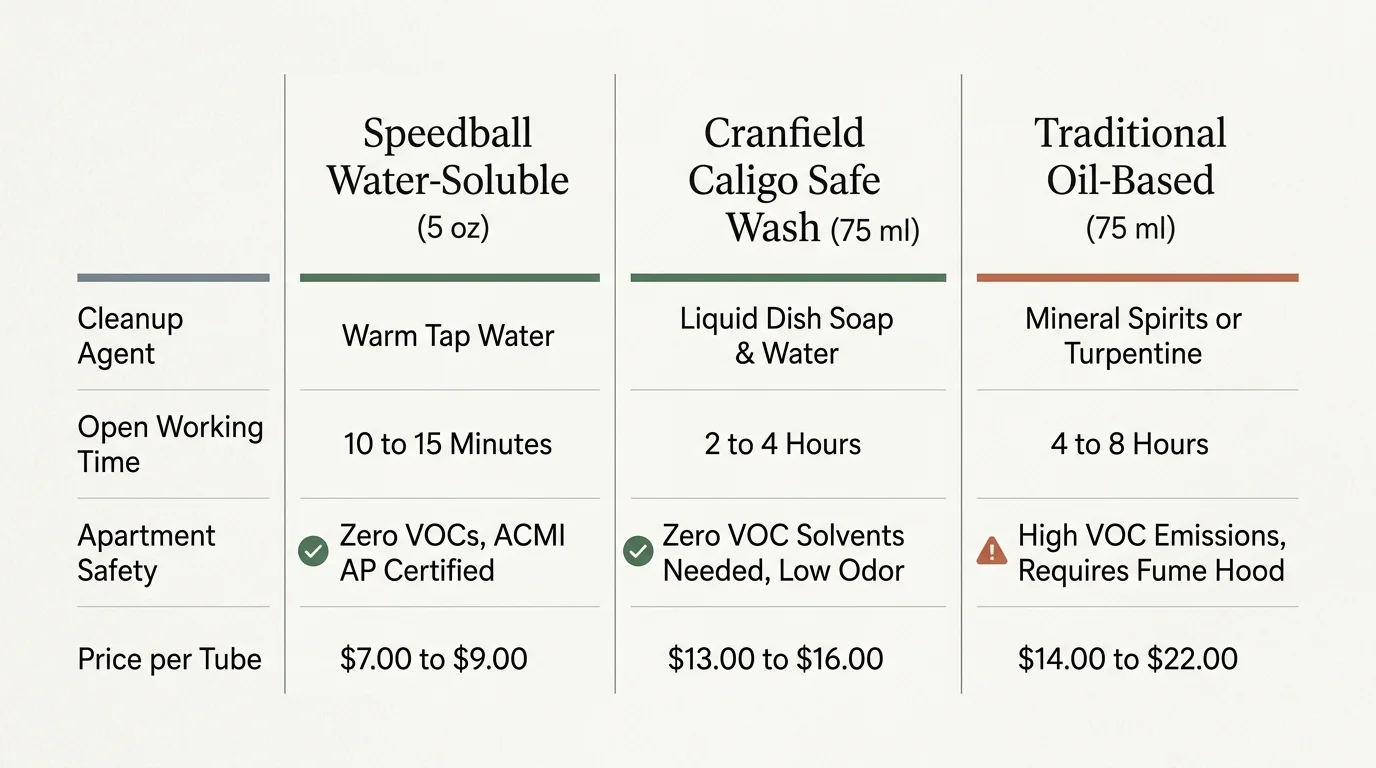
Relief Ink Comparison: Safe Formulations for Small Spaces
Selecting the correct ink determines your drying times, paper compatibility, and apartment cleanup routine. The matrix below contrasts the three primary relief printmaking ink categories across practical domestic metrics.
| Ink Formulation | Cleanup Agent | Open Working Time | Apartment Safety & VOC Level | Average Price per Tube |
|---|---|---|---|---|
| Speedball Water-Soluble Relief Ink (5 oz) | Warm Tap Water | 10 to 15 Minutes | Zero VOCs; ACMI AP Certified Non-Toxic; Odorless | $7.00 to $9.00 |
| Cranfield Caligo Safe Wash Oil Ink (75 ml) | Liquid Dish Soap & Water | 2 to 4 Hours | Zero VOC Solvents Needed; Low Odor Vegetable Base | $13.00 to $16.00 |
| Traditional Oil-Based Relief Ink (75 ml) | Mineral Spirits or Turpentine | 4 to 8 Hours | High VOC Emissions; Requires Dedicated Mechanical Fume Extraction | $14.00 to $22.00 |
Water-soluble inks work exceptionally well for daily sketchbook studies, experimental proofs, and fast-paced printing sessions. Their brief open time means you must roll and print efficiently before the ink film dries on your slab.
Water-washable oil inks provide the ideal solution for exhibition-grade editions on damp or dry archival papers. They remain workable on the rolling slab for hours while cleaning away safely at your standard kitchen sink.
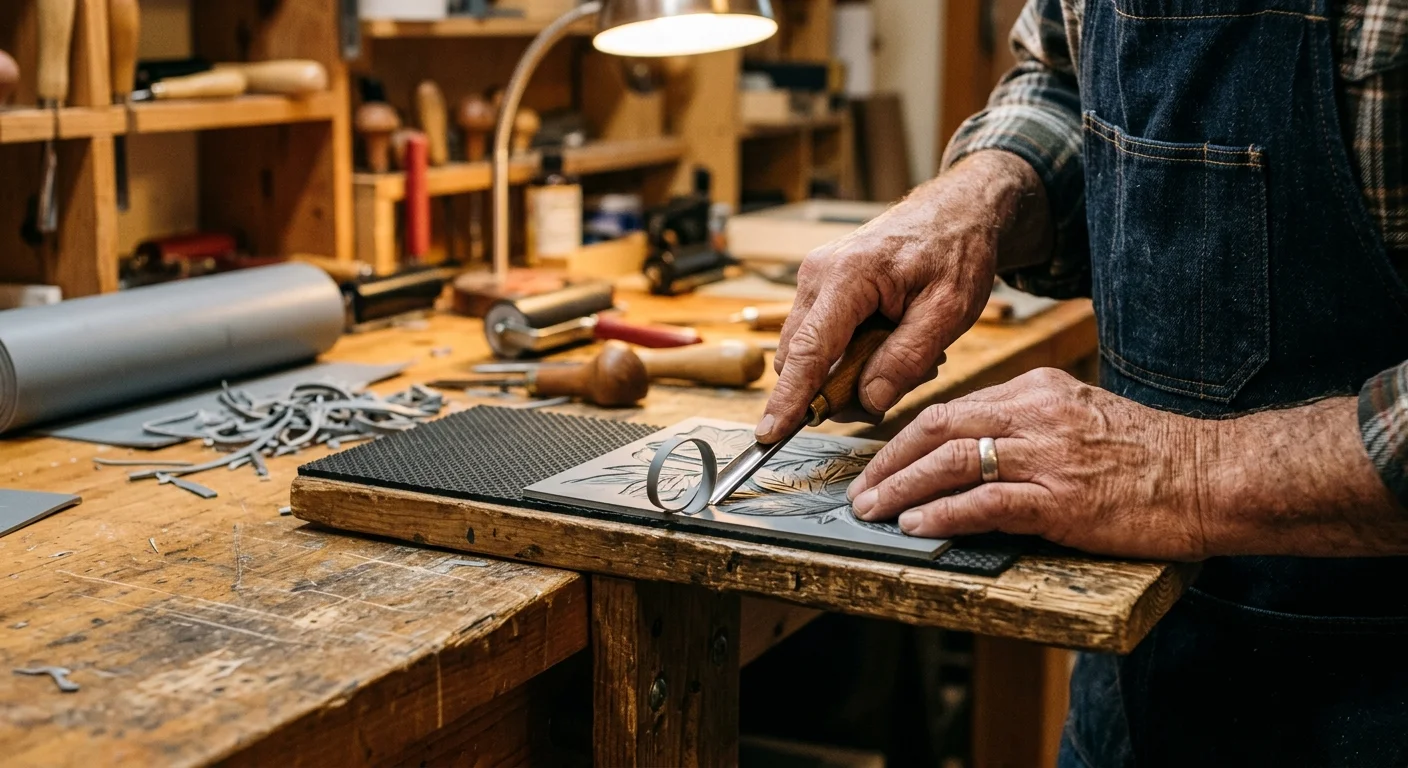
Ergonomic Carving Systems: Joint-Friendly Relief Cutting
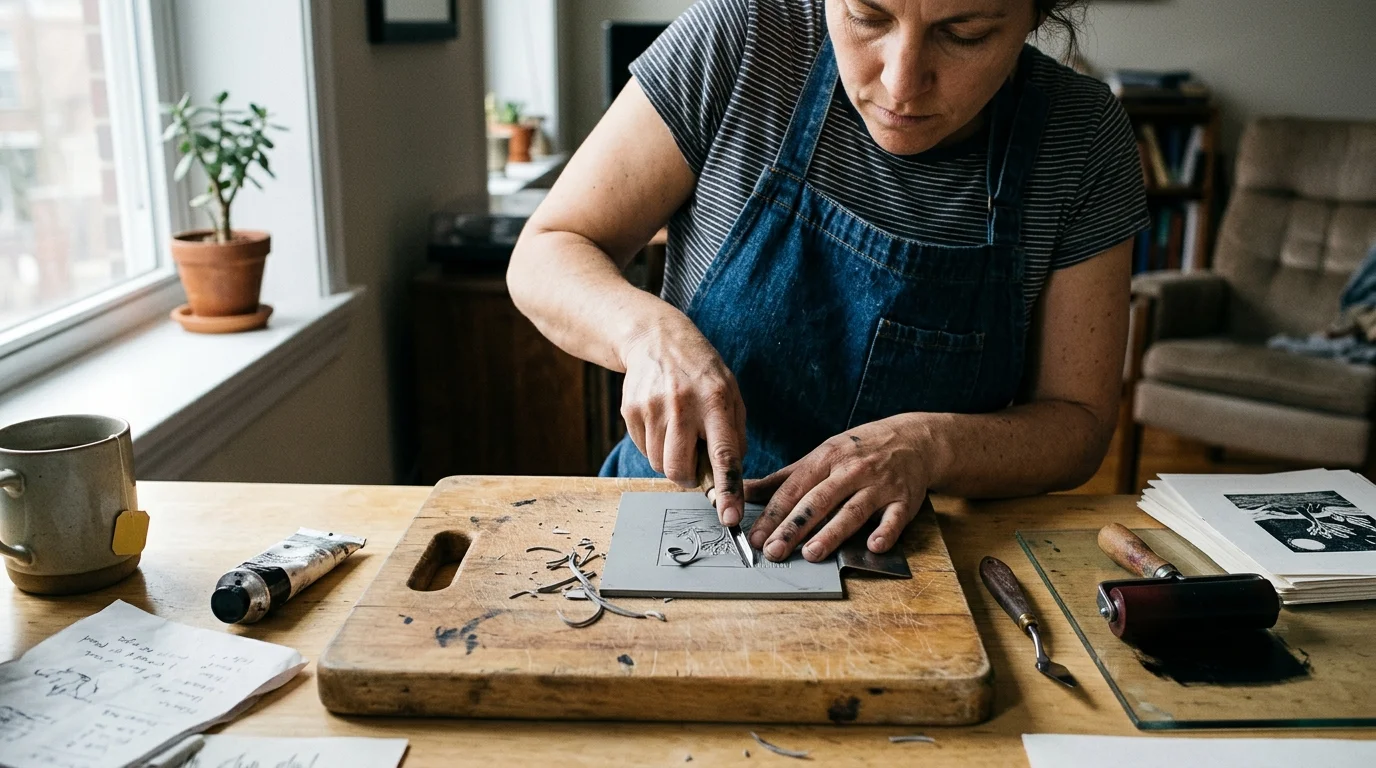
Traditional unmounted battleship linoleum requires significant downward pressure and hand strength to carve cleanly. For retirees managing mild hand fatigue or arthritis, pushing rigid cutters through cold linseed-cork linoleum causes unnecessary strain.
Soft-carve vinyl blocks transform linocut printmaking for seniors by offering silky, low-resistance carving properties. Substrates like Speedball Speedy-Carve or Blick Soft-Kut slice smoothly without crumbling, requiring roughly one-third the physical force of traditional burlap-backed linoleum.
Your cutting tools also dictate physical comfort during extended carving sessions. Standard student cutters feature rigid plastic handles that force your fingers into a cramped pinch grip across repetitive cutting strokes.
Ergonomic palm-grip carving gouges seat their rounded wooden handles against the heel of your palm. This distributes pressure evenly across your arm and wrist, letting your larger forearm muscles guide the cut rather than straining delicate finger joints.
- Always cut in directions pointing away from your non-dominant holding hand.
- Secure your block against a rigid bench stop to eliminate slipping on polished tabletops.
- Warm traditional linoleum with a standard heating pad on low heat for five minutes if you prefer its crisp cutting edge.
- Maintain shallow cutting angles between fifteen and twenty degrees to prevent blade skip and gouging accidents.
- Hone your tool edges on a leather strop coated with polishing compound every thirty minutes of active carving.
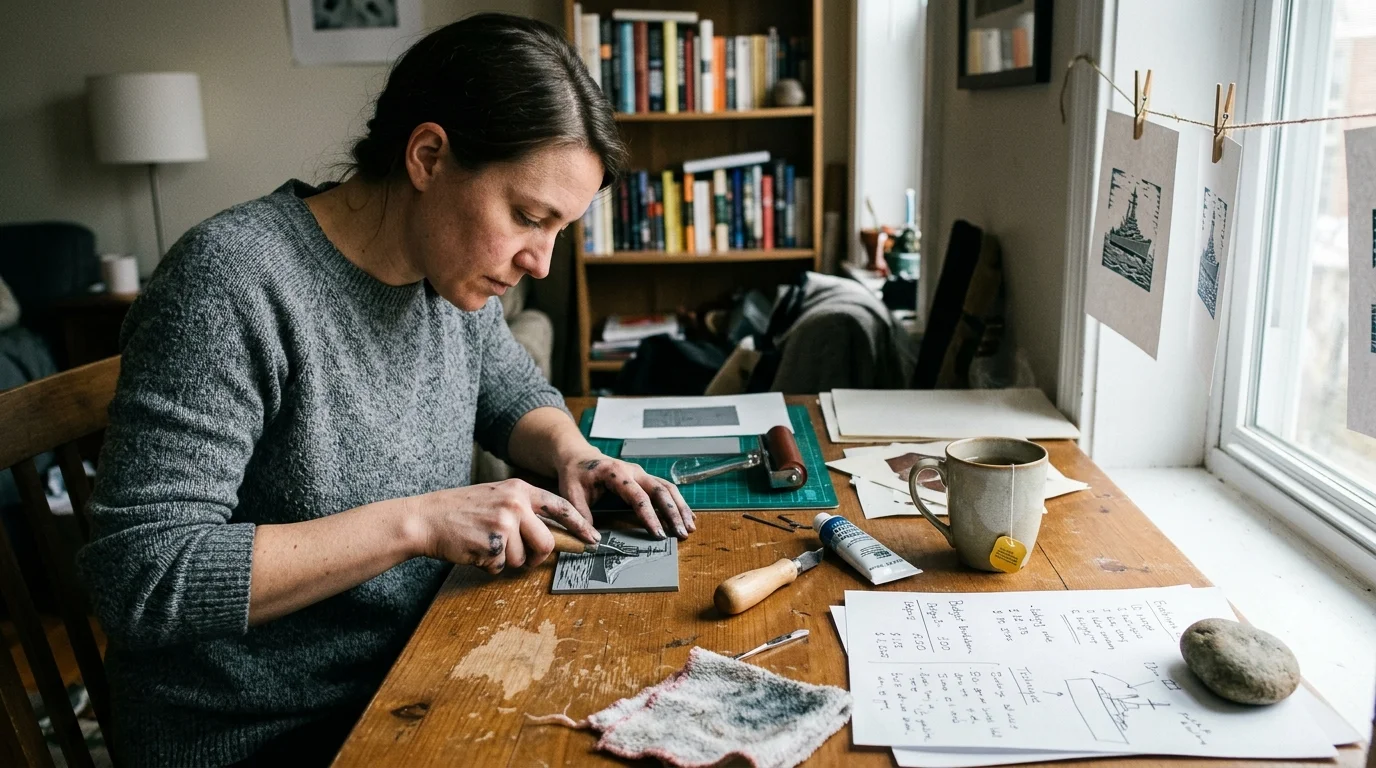
The Complete Under-$250 Studio Budget Breakdown
Equipping an apartment printmaking setup does not require commercial machinery. You can acquire a complete, professional-grade relief print bench for well under your $250 threshold.
The itemized budget below reflects real retail pricing for high-performance, non-toxic printmaking equipment. This leaves a comfortable financial reserve for specialty printmaking papers and supplemental ink colors.
- Dual-Use Powder-Coated Steel Bench Hook and Inking Plate (7″ × 9″): $16.00
- Flexcut Palm Carving Tool Starter Set (4-piece ergonomic set): $48.00
- Speedball 4-Inch Soft Rubber Brayer (40-durometer roller): $12.50
- Cranfield Caligo Safe Wash Relief Ink (75 ml tube, Carbon Black): $14.50
- Speedball Speedy-Carve Printing Blocks (Three 4″ × 6″ blocks at $6.50 each): $19.50
- Yasutomo Hosho Printmaking Paper (Pad of 100 sheets, 9″ × 12″): $18.00
- Traditional 4-Inch Bamboo Baren Hand Press: $9.50
- Aluminum Non-Slip Cork-Backed Ruler and 2B Graphite Transfer Pencil: $6.00
- Dawn Ultra Liquid Dish Soap and Cellulose Cleaning Sponge: $4.50
This comprehensive inventory totals $148.50, leaving you with an exact surplus of $101.50 under your $250 studio ceiling. You can allocate this surplus toward 100-percent cotton archival paper or an additional tube of process red ink.
By relying on a hand baren instead of a tabletop roller press, you save between $300 and $1,200 immediately. You also keep your studio footprint completely portable and featherlight.
The 24-Inch Layout: Zoning Your Compact Print Bench
Spatial discipline keeps compact apartment printmaking enjoyable, organized, and spotless. A standard 24-inch by 36-inch desk provides generous room if you segment the surface into dedicated zones.
Cross-contamination represents the primary frustration in domestic printmaking. Establishing strict boundaries between sticky ink slabs and clean printing paper keeps your margins pristine.
- Position your dry paper stack and clean baren on the far left side of your desk.
- Place your steel bench hook directly in the center foreground, hooked securely over the desk lip.
- Set your ink tube, palette knife, and brayer stand immediately behind the bench hook in the central background.
- Reserve the far right edge of your desk for carved block storage and pencil registration guides.
- Suspend a multi-tier pants hanger with coated clips from an adjacent closet door frame to dry wet prints vertically.
The powder-coated steel bench hook serves two simultaneous studio functions within this compact footprint. Its front downward lip anchors against your desk edge to catch the block during carving.
Turned sideways, that same flat steel surface acts as your smooth ink-rolling slab. This dual functionality eliminates the need for a separate plate glass slab on your desk.
Step-by-Step Worked Example: Printing a 4×6 Archival Edition
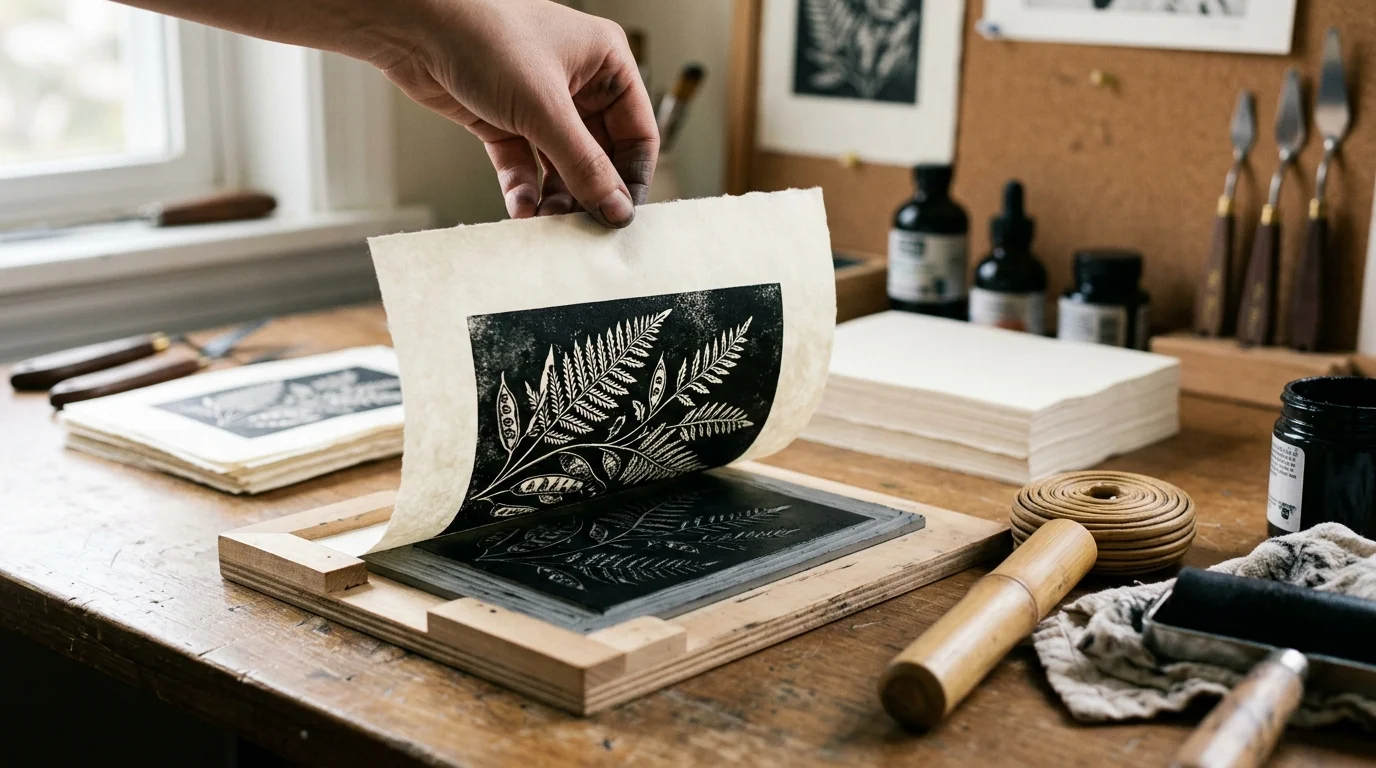
This worked scenario guides you through pulling a uniform, five-print edition of a 4-inch by 6-inch botanical linocut. Following these exact specifications guarantees sharp impressions and zero mess across your furniture.
- Draw your 4-inch by 6-inch composition on tracing paper with a soft 2B pencil, flip the sheet face-down onto the soft vinyl block, and burnish the reverse with a metal spoon for 60 seconds to transfer graphite lines.
- Place the block against your steel bench hook and carve away non-image negative areas using your Flexcut palm gouges over approximately 75 minutes of relaxed cutting.
- Squeeze a dime-sized ribbon (approximately 1.5 grams) of Caligo Safe Wash Carbon Black ink across the top of your steel inking plate.
- Draw the 4-inch soft brayer forward through the ink ribbon and roll it out across the plate in smooth, alternating directions for 12 passes until the ink produces a fine, velvety orange-peel texture and a subtle hissing whisper.
- Roll the charged brayer over your carved block using light downward pressure, performing three vertical passes and three horizontal passes to deposit a smooth, uniform ink film over two minutes.
- Lay a 7-inch by 9-inch sheet of Yasutomo Hosho paper gently onto the inked block, centering the sheet using pencil corner marks drawn on your paper backing sheet.
- Rub your handheld bamboo baren across the back of the paper in tight, overlapping circular patterns for 90 seconds, maintaining firm, even downward palm pressure.
- Gently peel the paper from one corner to reveal your finished high-contrast relief print, then clip it to your vertical door-frame drying rack.
- Apply three drops of standard Dawn liquid dish soap directly to the inked bench hook and block, lather with a damp cellulose sponge for 60 seconds, and wipe clean with warm tap water in under five minutes.
Carrying out water based block printing at home this way guarantees repeatable artistic results. Your entire printing session takes less than two hours, and your desk returns to pristine condition immediately after washing.
Prints produced using water-washable oil inks dry via natural oxidation over forty-eight to seventy-two hours in average apartment humidity. The resulting prints exhibit archival lightfastness and deep pigment saturation.
Creative Longevity: The Health Science of Block Printing
Engaging in hands-on printmaking delivers documented physiological and psychological dividends. Carving and printing demand physical mindfulness, engaging hand-eye coordination, and focused spatial planning.
In the landmark Creative Aging Study directed by Dr. Gene Cohen at George Washington University, older adults who participated in weekly visual art programs demonstrated measurable health improvements. Over a two-year evaluation, participants in active arts groups reported an average of 1.5 fewer doctor visits per year and lower prescription drug usage than non-participating control groups.
Relief block printing challenges your brain through lateral thinking and reversed image composition. Because every block prints as a mirror image, your spatial reasoning adapts continuously as you translate sketches into positive and negative carved planes.
“Creativity takes courage.” — Henri Matisse
The National Institute on Aging highlights how learning novel, cognitively challenging artistic skills helps sustain cognitive vitality and emotional resilience throughout later life chapters. The immersive focus required to guide a palm gouge along a delicate line naturally induces a state of restorative creative flow.
Retirement provides the unhurried schedule needed to cultivate this tactile mastery. You can expand your artistic network and refine printmaking methods by enrolling in hands-on community workshops through the Osher Lifelong Learning institute network.
Frequently Asked Questions
Can water-washable oil inks wash out of clothing and table linens?
Water-washable oil inks wash out of fabrics if treated immediately with warm water and liquid dish soap before the binder begins drying. Once the oil binder oxidizes and fully cures into fabric fibers, it becomes permanent and resists laundering.
Does soft-carve vinyl hold up for large print runs compared to traditional linoleum?
High-density soft vinyl printing blocks easily withstand print runs of one hundred impressions or more when printed with a hand baren. Because hand burnishing applies gentle vertical pressure rather than crushing mechanical press force, vinyl block edges remain crisp.
How long do prints made with Cranfield Caligo Safe Wash take to cure completely in an apartment?
Under typical residential indoor conditions of 70 degrees Fahrenheit and 40 percent humidity, Caligo Safe Wash prints feel dry to the touch in three to five days. Full chemical cure takes approximately two weeks before prints can be mounted in frames.
Can I print relief blocks on ordinary computer copy paper?
Standard copy paper possesses short wood-pulp fibers that tear or buckle when peeled from sticky ink films. Lightweight Japanese relief papers like Hosho or Mulberry absorb ink smoothly, release cleanly without tearing, and cost under twenty cents per sheet.
Disclaimer: This article is for informational and inspirational purposes. Life decisions are deeply personal, and we encourage readers to pursue their dreams while considering their unique circumstances, health, and financial situation.

2 Comments