
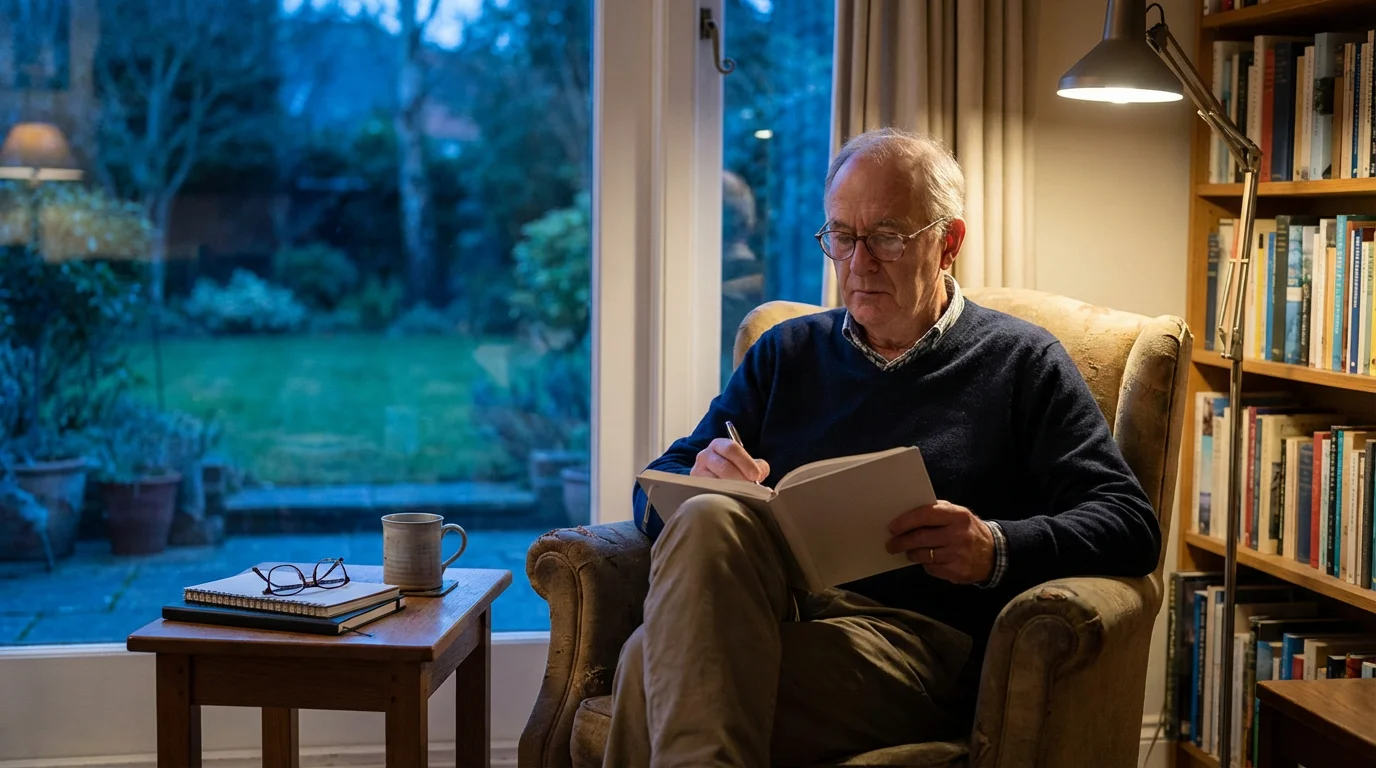
A newly retired corporate manager sitting down to write personal memories often produces a bloodless executive summary instead of a living story. Decades of drafting quarterly reviews, performance appraisals, and bulleted project plans train you to compress entire eras into flat milestones.
Broad prompts trigger blank-page paralysis because they invite that exact resume reflex. Fixing it takes strict constraints: a single 20-minute physical moment, a 15-to-60-minute timer, and an absolute ban on emotion words.
Summarizing Ten Years of Work Instead of Staging Twenty Minutes
Retirees from corporate roles routinely try to capture ten years of work or marriage in one sitting. That timing trap produces a dry institutional overview full of promotions, reorganizations, and job titles rather than a living scene.
The cause is an unconstrained scope that treats memory like an annual report. Without a strict clock boundary, your analytical reflexes default to career totals and broad timelines.
Apply the Guided Autobiography method developed over three decades by Dr. James E. Birren. It limits each draft to roughly two pages on one theme, shrinking ten years into one 20-minute moment.
Set a timer for 45 to 60 minutes and aim for a 500-word draft anchored by clock markers and physical beats. Notice the contrast when “a first office job” shrinks to one Tuesday morning in 1978:
- Corporate habit: Summarizing years of duties across busy departments as a formative career phase.
- Narrative constraint: Building a 500-word scene around three concrete beats: loading carbon paper at 8:30 a.m., delivering typed memos at 10:00, and hearing the noon whistle outside.
Two clock markers and three physical actions give the page structure before you write the opening line. Completed 500-word scenes can later fit into a longer book using our guide to writing your memoir for future generations.
Labeling Emotions Instead of Recording Physical Evidence
Former executives and team leads often write that they felt proud, anxious, or overwhelmed during a turning point. Direct emotional labels flatten a draft into a self-evaluation and keep the reader outside the experience.
The cause is professional conditioning that rewards quick bottom-line verdicts over slow observation. Management prose states conclusions fast, while narrative prose builds tension from physical evidence.
The fix is enforcing an absolute ban on abstract emotion words in every first draft. Rely on vivid descriptions and sensory details so exact verbs and bodily sensations carry the weight instead.
- Corporate habit: Writing that a mistake during an annual review felt stressful and threatened department credibility.
- Narrative constraint: Tracing the physical sensation in your stomach while fixing a mistake that cost an hour of rework before closing.
You can practice replacing emotional labels with concrete imagery in shorter adult poetry drafts. Try these sensory prompts for 30 to 45 minutes without naming a single feeling:
- Write a scene set in your childhood kitchen during dinner prep without naming a single emotion word.
- Describe a mistake at work that cost an hour of rework, focusing strictly on your hands and stomach before closing.
- Capture an unwritten agreement among coworkers on handling a difficult customer, patient, or client without raising your voice.

Skipping Obsolete Workplace Tools as Too Mundane to Matter
Corporate retirees frequently overlook everyday tools, commutes, and office machines when drafting career memories. Assuming readers only care about leadership milestones strips your pages of the physical world that shaped your days.
The cause is familiarity, which makes vanished workflows feel unremarkable to the person who ran them. Younger relatives have never touched a mimeograph, paper ledger, or manual drafting table.
The fix is running a 15-minute micro-memoir sprint capped at 250 words around one shift, tool, or receipt. Like StoryCorps interview questions on early work, these prompts trace exact mechanical steps rather than resume titles.
- Corporate habit: Reporting that a department modernized documentation systems or improved staff routines.
- Narrative constraint: Describing one obsolete machine, one break-room smell, or one specific paycheck in 250 words.
Pick one workplace object below and finish the scene in 15 minutes before your inner editor adds job descriptions:
- The first paycheck you cashed, where you stood to endorse it, and the exact item or bill it paid for.
- A workplace machine you mastered, from a mimeograph to a teletype or drafting table, that no longer exists on desks.
- Your morning commute in a specific year, including the car radio station, bus route number, or price of coffee.
- The dress code or uniform you wore in your twenties, down to uncomfortable shoes, pocket protectors, or safety gear.
- The smell, lighting, and background noise of the break room or lunch counter where you spent 30 minutes daily.
- Cleaning out a locker, toolbox, or metal desk drawer on the final Friday of a job held over five years.
- The week your workplace switched from paper ledgers or index cards to its first desktop computer or barcode scanner.
Staring at a Blank Page Without an Object or Household Room
Scheduling a 60-minute writing block without a concrete anchor often ends in staring at a blinking cursor or writing textbook history summaries. Broad prompts about family closeness or national events push your mind straight back into high-level generalities.
The cause is treating memory like abstract research instead of physical archeology. Without a specific room, worn heirloom, or household schedule, you default to broad summaries of what an era meant.
The fix is limiting a family legacy draft to one room or keepsake in 30 to 45 minutes, or a decades snapshot to household routine. Verify old addresses first with our guide to researching your family history.

- Corporate habit: Summarizing a decade’s economic conditions or describing grandparents as hardworking and organized.
- Narrative constraint: Restricting the scene to one kitchen drawer by touch and sound, or what sat on your counter during a historic broadcast.
Anchor your next 30-to-60-minute session in one physical object or domestic routine from these prompts:
- The contents of a grandparent’s kitchen junk drawer, sewing tin, or garage workbench, described strictly by touch and sound.
- A piece of furniture with a nick, burn mark, or wobble whose origin nobody in the house remembered the same way.
- A household appliance requiring muscle, such as a wringer washer, reel mower, or hand-crank freezer, and who ran it.
- A road trip before GPS or cell phones where misreading a paper highway atlas changed where everyone ate or slept.
- Returning to a childhood street decades later and listing five specific things that shrank, vanished, or changed smell.
- Where you stood, what you held, and who spoke first during a major national news broadcast before 1990.
- A rationing rule, gas line, blackout drill, or storm warning that altered your household schedule for a full week.
- The evening your family watched a historic live television broadcast, including rabbit-ear adjustments and who sat on the floor.
- A price you once paid in coins or single bills, such as movie tickets or gasoline, and what earned that cash.
Auditing Yourself in Monologue Instead of Testing Fiction Dialogue
Retirees who force themselves through strict factual memoir often grow stiff and overly cautious about getting every detail verified. Treating personal writing like a compliance audit makes every speaker sound like the same measured narrator.
The cause is mistaking autobiographical accuracy for dramatic life on the page. When you never step outside your own perspective, spoken dialogue flattens into polite summaries of what people discussed.
The fix is dedicating a 60-minute session to short fiction restricted to two characters and spoken dialogue. Longer scenes can grow using our guide to writing retirement novels and fiction.
- Corporate habit: Writing that two former colleagues met unexpectedly and exchanged updates on past projects.
- Narrative constraint: Letting two characters reveal twenty years of history strictly through spoken lines beside a clinic vending machine.
Keep the real textures of objects and places, then let unfamiliar voices carry one of these two-character scenes:
- Two retirees clearing a friend’s storage unit find a locked tackle box; write only their dialogue while deciding whether to open it.
- During a condo power outage, two neighbors who avoided each other for three years share one flashlight and a manual can opener.
- An estate-sale shopper finds a 1968 dry-cleaning ticket stitched inside a wool coat and tracks down the retired tailor.
- Two adult siblings meet at a diner to split family photo albums, each secretly determined to keep one framed portrait.
- A gardener spots a neighbor digging near the fence at 5:30 a.m. and brings out two coffee mugs instead of complaining.
- A retired librarian pulls a 40-year-overdue book from the drop box with an old handwritten grocery list inside.
- Two former coworkers meet by chance in a clinic waiting room after twenty years and talk only about the vending machine.





4 Comments
Comments are closed.